From Surf Wiki (app.surf) — the open knowledge base
Guildhall
Building used for meetings of guild members

Building used for meetings of guild members
A guildhall, also known as a guild hall or guild house, is a historical building originally used for tax collecting by municipalities or merchants in Europe, with many surviving today in Great Britain and the Low Countries. These buildings commonly become town halls and in some cases museums while retaining their original names.
As town hall in the United Kingdom
In the United Kingdom, a guildhall is usually a town hall: in the vast majority of cases, the guildhalls have never served as the meeting place of any specific guild. A suggested etymology is from the Anglo Saxon "gild, or "payment"; the guildhall being where citizens came to pay their rates. The London Guildhall was established around 1120. For the Scottish municipal equivalent see tolbooth.
List of guildhalls in the United Kingdom
- Andover Guildhall
- Barnstaple Guildhall
- Bath Guildhall
- Beverley Guildhall
- Bewdley Guildhall
- Blakeney Guildhall
- Bodmin Guildhall
- Boston Guildhall
- Bradninch Guildhall
- Brecon Guildhall
- Bristol Guildhall
- Bury St Edmunds Guildhall
- Cambridge Guildhall
- Canterbury Guildhall
- Cardigan Guildhall
- Carmarthen Guildhall
- Chard Guildhall
- Chester Guildhall
- Chichester Guildhall
- Conwy Guildhall
- Derby Guildhall
- Devonport Guildhall
- Dunfermline Guildhall
- Derry Guildhall
- Exeter Guildhall
- Faversham Guildhall
- Gloucester Guildhall
- Grantham Guildhall
- Guildford Guildhall
- Harwich Guildhall
- Helston Guildhall
- High Wycombe Guildhall
- Hull Guildhall
- King's Lynn Guildhall
- Guildhall of St George, Kings Lynn
- Kingston upon Thames Guildhall
- Lavenham Guildhall
- Leicester Guildhall
- Lichfield Guildhall
- Lincoln Guildhall
- Liskeard Guildhall
- Llantrisant Guildhall
- London Guildhall
- Looe Guildhall
- Lostwithiel Guildhall
- Lydd Guildhall
- Lyme Regis Guildhall
- Middlesex Guildhall
- Much Wenlock Guildhall
- Newcastle-under-Lyme Guildhall
- Newcastle upon Tyne Guildhall
- Merchant Adventurers' Hall, York
- Newport Guildhall, Isle of Wight
- Newport Guildhall, Shropshire
- Northampton Guildhall
- Norwich Guildhall
- Oswestry Guildhall
- Peterborough Guildhall
- Plymouth Guildhall
- Plympton Guildhall
- Poole Guildhall
- Portsmouth Guildhall
- Preston Guildhall
- Rochester Guildhall
- Salisbury Guildhall
- Saltash Guildhall
- Sandwich Guildhall
- Southampton Guildhall
- South Molton Guildhall
- St Ives Guildhall
- St Mary's Guildhall, Coventry
- Stratford-upon-Avon Guildhall
- Swansea Guildhall
- Thaxted Guildhall
- Thetford Guildhall
- Totnes Guildhall
- Weymouth Guildhall
- Winchester Guildhall
- Windsor Guildhall
- Worcester Guildhall
- Wrexham Guildhall
- York Guildhall
File:Windsorguildhall.jpg|Windsor Guildhall in Windsor, Berkshire also served as market, town hall and courtroom File:London Guildhall.jpg|Guildhall, London, in the City of London, is the seat of the Corporation of London, the governing body of the city. File:Northampton Guildhall.jpg|Guildhall, Northampton File:Guildhall, Chester.jpg|Guildhall, Chester
As meeting houses for guilds
.jpg)

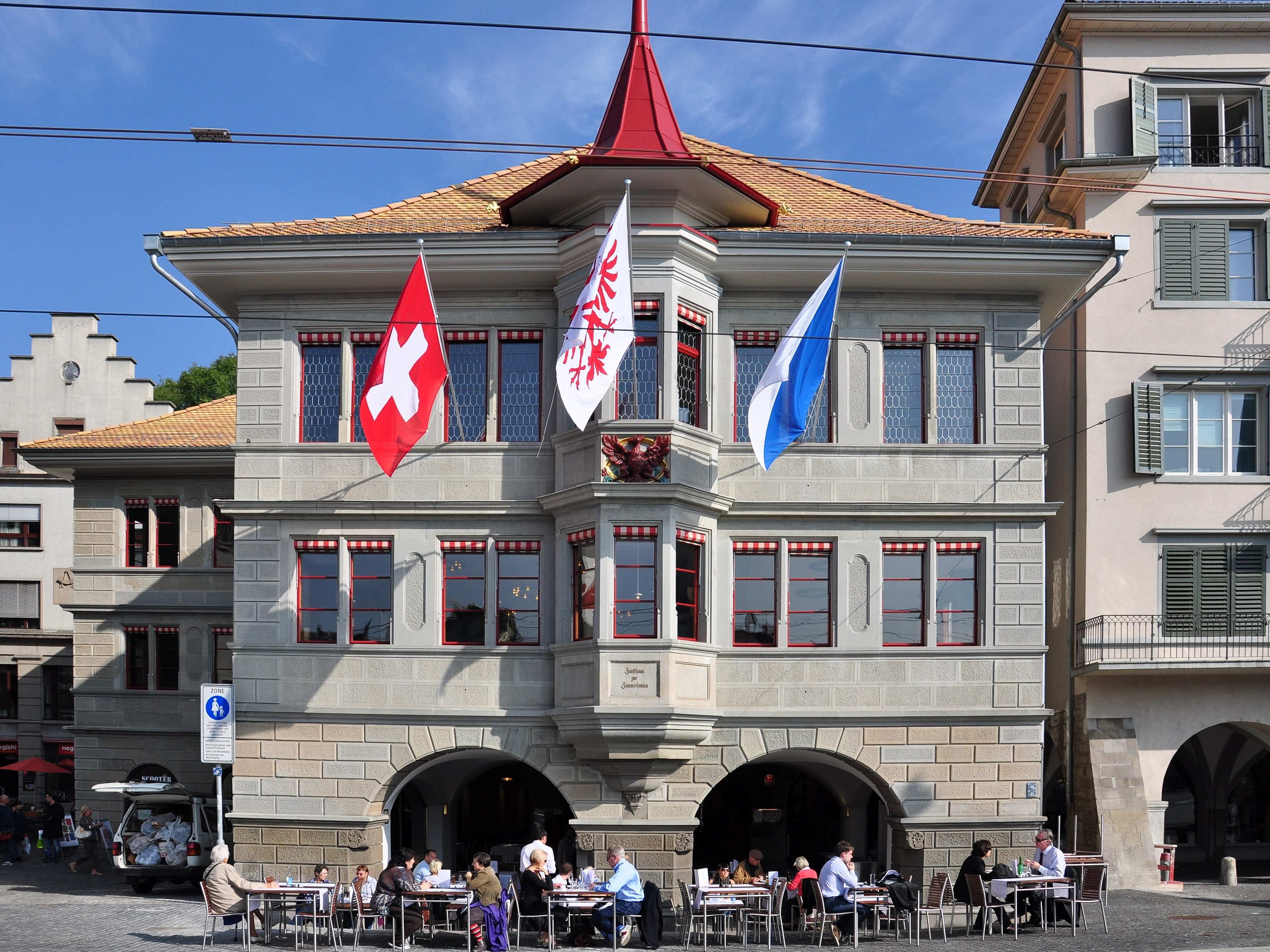
A type of guild was known in Roman times. Known as collegium, collegia or corpus, these were organised groups of merchants who specialised in a particular craft and whose membership of the group was voluntary. One such example is the corpus naviculariorum, the college of long-distance shippers based at Rome's port, Ostia Antica. The Roman guilds failed to survive the collapse of the Roman Empire.
Merchant guilds were reinvented during Europe's medieval period. In England, these guilds went by many different names including: fraternity, brotherhood, college, company, corporation, fellowship, livery, or society, amongst other terms. In Europe, merchant guilds were known as "natie", "consulado", or "hansa". A fraternity, formed by the merchants of Tiel in Gelderland (present-day Netherlands), in 1020 is believed to be the first example of a medieval guild. The first instance of usage of the term, "guild", was the gilda mercatoria used to describe a body of merchants operating out of Saint-Omer, France in the 11th century and London's Hanse was formed in the 12th century. The merchants of Cologne had their house in London as early as 1157 and the Guilda Teutonicorum (German merchants warehouse) was located at Cosin Lane and Thames Street in London on the 12th century.
These guilds controlled the way that trade was conducted in their region and codified rules governing the conditions of trade. Once established, merchant guild rules were often incorporated into the charters granted to market towns. By the 13th and 14th centuries, merchant guilds had acquired sufficient resources to erect guild halls in many major market towns.
Medieval guild halls were used to store goods and as places for celebratory events. When not required for guild members' events, the hall often became place where townspeople could hold entertainments such as Passion plays. Guild members often cleaned streets, removed rubbish, maintained a nightwatch and provided food relief to the poor. Some medieval guilds allowed market trading to occur on the ground floor of the guildhall.
In the City of London, the guilds are called "livery companies", and their guild halls are called livery halls.
In the Low Countries
The Low Countries used to have guildhalls in every city, often one gildenhuis (Dutch, literally "guild house") for each trade. They were often elaborate, ornate buildings, demonstrating the guild's status. Occasionally a single hall would be used by all the city's guilds.
The guildhall was used as the offices of the deken (deacon) and other guild officers, and for meetings by the overlieden (board of directors). The guild members would occasionally be called to the guildhall for meetings on important matters.
The guildhall of the merchants' guild also served as de facto market place. Therefore, there was no need in the Middle Ages for a separate building for this purpose.
In the Low Countries, each guildhall was marked by the coat of arms of that guild, hanging from the facade of the building. Occasionally, the coat of arms was replaced with a gable stone depicting a member of the guild, surrounded by the tools of his trade.
In the Netherlands
In Amsterdam, every guildhall had its gildeknecht (guild servant), often the guild's youngest member, and was guarded by a gildehond (guild dog). Every evening, the guild brothers gathered in the tavern room of the guildhall to discuss the events of the day while the gildeknecht served beer. Once a year, the guildmen would gather in the guildhall for a communal meal.
In Belgium
- The Round Table (or Tafelrond, in Dutch) in Leuven. Designed 1479 by Matheus de Layens, guildhall built 1480–1487 internally comprising three houses, demolished 1817, reconstructed following original plans 1921. The old building's meeting rooms had been let to the guilds; the new had been in use by a bank and became a personal private property.{{Cite web |access-date = 20 July 2011 |access-date = 20 July 2011 |url-status = dead |archive-url = https://web.archive.org/web/20110930134220/http://www.leuven.be/en/binaries/architectuurensculpturen_tcm20-26725.pdf |archive-date = 30 September 2011
- The Salmon (or De Zalm, in Dutch) in Mechelen. Built c. 1530 in early Renaissance style by architect Willem van Wechtere for the prosperous fishermen's guild, it is one of the city's finest historical houses. The artist (1839–1919) used to live there. In the mid-20th century it became city property and held a museum, then the Tourist Information Office, and later again a museum.
- In Brussels, the Grand-Place/Grote Markt is famous for its many Baroque guildhalls, each one belonging to one of the former Guilds of Brussels.
File:Makelaers Comptoir 1.jpg|The Makelaers Comptoir (brokers' guildhall) in Amsterdam File:Edificios en la Grand-Place, Bruselas, Bélgica, 2021-12-15, DD 07.jpg|Grand-Place/Grote Markt of Brussels. From right to left: Le Roy d'Espagne, La Brouette, Le Sac, La Louve, Le Cornet and Le Renard. File:Antwerp GroteMarkt3-13 017 7938.jpg|Guildhalls at the Grote Markt in Antwerp File:Tafelrond Leuven - 385958 - onroerenderfgoed.jpg|The Round Table (Tafelrond) at the Grote Markt in Leuven
References
References
- Bowsher, D., Dyson, T., Holder, N. and Howell, I., ''The London Guildhall: An Archaeological History of a Neighbourhood from Early Medieval to Modern Times'', London, MoLAS, 2007
- Royal Commission on the Ancient and Historical Monuments of Scotland. (1996). "Tolbooths and Townhouses: Civic Architecture in Scotland to 1833". Royal Commission on the Ancient and Historical Monuments of Scotland.
- Epstein, S. A., ''Wage Labor and Guilds in Medieval Europe'', [[University of North Carolina Press]], 1991, pp. 10–49
- Gelderblom, O. and Grafe, E., "The Persistence and Decline of Merchant Guilds: Re-thinking the Comparative Study of Commercial Institutions in Pre-modern Europe" [Working Paper], [[Yale University]], 2008
- (13 June 2024). "Merchant guild - trade association".
- Stow, J., ''A Survey of London'', [[Cambridge University Press]], 2015, p. 319
- Epstein S.A, ''Wage Labor and Guilds in Medieval Europe'', [[University of North Carolina Press]], 1991, pp. 50–100.
- Jovinelly, J. and Netelkos, J., ''The Crafts and Culture of a Medieval Guild'', The Rosen Publishing Group, 2006, pp 12-13
- (24 May 2023). "Town Hall and Guild Hall - VCH Explore".
- "Alphabetical list". City of London.
- Engel, Matthew. "British institutions: livery companies". Financial Times.
- The Dutch term {{usurped
- Johannes Gouw, ''De gilden: eene bijdrage tot de geschiedenis van het volksleven''. Portielje & Zoon, 1866, p. 38 (Dutch)
- Otto van Rees, ''Geschiedenis der staathuishoudkunde in Nederland tot het einde der achttiende eeuw'', Kemink, 1865, p. 121 (Dutch)
- Jacob Lennep & Johannes Gouw, ''De uithangteekens in verband met geschiedenis en volksleven beschouwd''. Gebroeders Kraay, 1868, p. 137 (Dutch)
- "De Zalm: thuis voor de Besloten Hofjes (in Dutch)".
- Hennaut, Eric. (2000). "La Grand-Place de Bruxelles". Éditions de la Région de Bruxelles-Capitale.
This article was imported from Wikipedia and is available under the Creative Commons Attribution-ShareAlike 4.0 License. Content has been adapted to SurfDoc format. Original contributors can be found on the article history page.
Ask Mako anything about Guildhall — get instant answers, deeper analysis, and related topics.
Research with MakoFree with your Surf account
Create a free account to save articles, ask Mako questions, and organize your research.
Sign up freeThis content may have been generated or modified by AI. CloudSurf Software LLC is not responsible for the accuracy, completeness, or reliability of AI-generated content. Always verify important information from primary sources.
Report