From Surf Wiki (app.surf) — the open knowledge base
Guided bus
Type of bus

Type of bus
Guided buses are buses capable of being steered by external means, usually on a dedicated track or roll way that excludes other traffic, permitting the maintenance of schedules even during rush hours. Unlike railbuses, trolleybuses or rubber-tyred trams, for part of their routes guided buses are able to share road space with general traffic along conventional roads, or with conventional buses on standard bus lanes. Guidance systems can be physical, such as kerbs or guide bars, or remote, such as optical or radio guidance.
A guided bus line can be categorised as bus rapid transit and may be articulated bus and bi-articulated bus, allowing more passengers, but not as many as light rail or trams, which are not constrained to a regulated maximum size in order to freely navigate public roads.
History

Precursors
The kerb-guided bus (KGB) guidance mechanism is a development of the early flangeways, pre-dating railways. The Gloucester and Cheltenham Tramroad of 1809 therefore has a claim to be the earliest guided busway. There were earlier flangeways, but they did not carry passengers. From 1861 to 1872 another system with one central grooved rail was used in the Manchester region.
Modern examples
The first modern guided busway system was opened in 1980 in Essen, Germany. This was initially a demonstration track, but it was periodically expanded and is still in operation as of 2019.
The first guided busway in the United Kingdom was in Birmingham, the Tracline 65, 1968 ft long, experimentally in 1984. It closed in 1987.
Based on the experience in Essen, in 1986 the Government of South Australia opened the O-Bahn Busway in Adelaide. This is a 12-kilometre guided busway with 2 interchanges along the route. (Klemzig Interchange & Paradise Interchange) before ending at Tea Tree Plaza Interchange.
In Mannheim, Germany, from May 1992 to September 2005 a guided busway shared the tram alignment for a few hundred metres, which allowed buses to avoid a congested stretch of road where there was no space for an extra traffic lane. It was discontinued, as the majority of buses fitted with guide wheels were withdrawn for age reasons. There are no plans to convert newer buses.
The Nagoya Guideway Bus opened in March 2001 and is the only guided bus line in Japan.
The Cambridgeshire Guided Busway between Cambridge and St Ives, at 25 km, is the world's longest guided busway. It opened on 7 August 2011.
Between 2004 and 2008, a 1.5 km section of guided busway was in operation between Stenhouse and Broomhouse in the west of Edinburgh. The route was later converted for use by Edinburgh trams.
Rubber-tyred trams and translohr
Main article: Rubber-tyred tram#Retired systems
Main article: Translohr#List of translohr systems
Rubber-tyred trams
Guided buses are to be distinguished from rubber-tyred systems that cannot run other than along a dedicated trackway, or under fixed overhead power lines.
Tram-like guided busway (rubber-tyred tram) systems include:
- Bombardier Guided Light Transit
- Caen, France
- Nancy, France. The first one is replaced with conventional trams and the other is being used as a trolleybus without the guide system.
Translohr
- Clermont-Ferrand, France
- Île-de-France tramway Line 5,
- Île-de-France tramway Line 6 in Paris, France.
- Shanghai, China
- Tianjin, China
- Medellín, Colombia
- Padua, Italy
- Venice-Mestre, Italy Also called "trams on rubber tyres".
Autonomous Rail Rapid Transit
Main article: Battery electric bus#Charging
Autonomous Rapid Transit (ART) is equipped with various optical and other types of sensors to allow the vehicle to automatically follow a route defined by a virtual track of markings on the roadway. A steering wheel also allows the driver to manually guide the vehicle, including around detours. Just like guided busway, electric buses use batteries to power their electric motors, and ebus combine elements of guided trolleybuses introduce new IMC (In-Motion Charging) technology, and wireless charging technology from embedded coils in roadways to automated depot charging pads as for "opportunity charging" electric buses while they are on the road, typically at bus stops or terminals, rather than solely at the depot, electric road system, is a road that provides electric power to vehicles as they travel on it, guided bi-articulated bus system for urban passenger transport.
- Zhuzhou ART, China
- Yibin ART, China
- Lingang DRT, China
- Tren ligero de Campeche (ART) Tren de Tránsito Autónomo, Mexico
Guidance systems
Optical guidance


Optical guidance relies on the principles of image processing. A camera in the front of the vehicle scans the bands of paint on the ground representing the reference path. The signals obtained by the camera are sent to an onboard computer, which combines them with dynamic parameters of the vehicle (speed, yaw rate, wheel angle). The calculator transmits commands to the guidance motor located on the steering column of the vehicle to control its path in line with that of the reference.
Optical guidance is a means of approaching light rail performance with a fast and economical set-up. It enables buses to have precision-docking capabilities as efficient as those of light rail and reduces dwell times, making it possible to drive the vehicle to a precise point on a platform according to an accurate and reliable trajectory. The distance between the door steps and the platform is optimized not to exceed 5 cm. Level boarding is then possible, and there is no need to use a mobile ramp for people with mobility impairments.
Guided trolleybus
.jpg)
The Optiguide system, an optical guidance device developed by Siemens Transportation Systems, has been in revenue service since 2001 in Rouen and Nîmes (only at stations), France, and has been fitted to trolleybuses in Castellon (Spain) since June 2008 and will be in service on buses in the cities of Bologna (Italy).{{cite web |last=Hidalgo|first=Darío |access-date=2 September 2009}}
Autonomous rail rapid transit
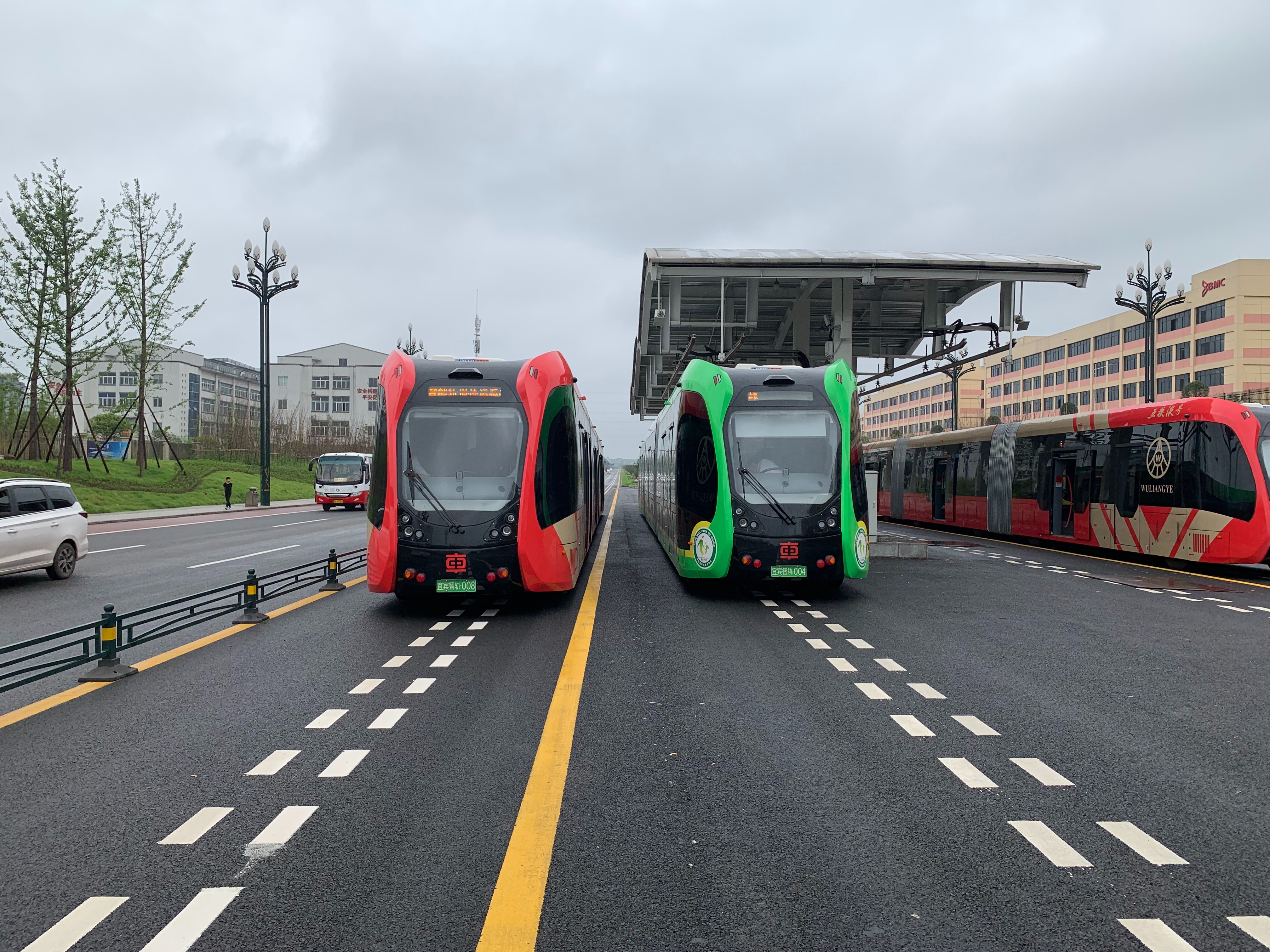
Another system was introduced in 2017. Called Autonomous Rail Rapid Transit (ART) and developed by CRRC, it uses optical systems to follow markers on a roadway. The ART system is frequently referred to as a "trackless tram" and occasionally as an "optically-guided bus".
Magnetic guidance
Other experimental systems have non-mechanical guidance, such as sensors or magnets buried in the roadway. In 2004, Stagecoach Group signed a deal with Siemens to develop an optical guidance system for use in the United Kingdom.
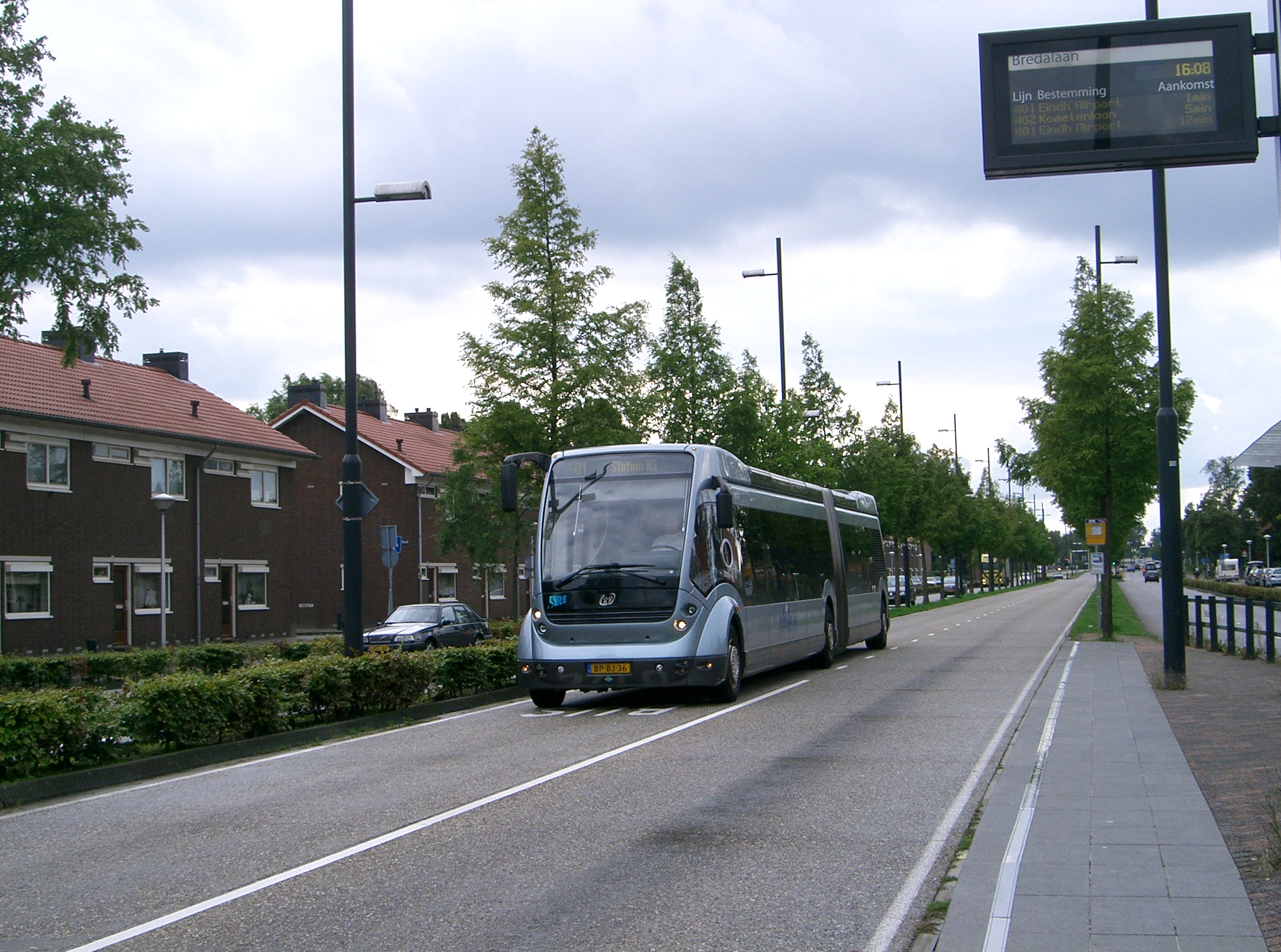
Two bus lines in Eindhoven, Netherlands, had used Phileas vehicles. Line 401 from Eindhoven station to Eindhoven Airport is 9 km long, consists largely of concrete bus lanes and has about 30 raised stop platforms. Line 402 from Eindhoven station to Veldhoven branches off from line 401 and adds another 6 km of bus lanes and about 13 stops. Years before the last trip of a Phileas bus in 2016, the regional authority for urban transport in the Eindhoven region (SRE) decided to discontinue the use of magnetic guidance system. In 2014 the manufacturer, APTS, was declared bankrupt.

The Douai region in France is developing a public transport network using APTS Phileas technology and dedicated infrastructure. The length of the lines will be 34 km. The first stage is a line of 12 km from Douai via Guesnain to Lewarde, passing close to Waziers, Sin-le-Noble, Dechy and Lambres-lez-Douai. 39 stop platforms will be provided with an average distance between the stops of 400 m. A number of stops will be placed on the right-hand side of each lane. Central stops between both lanes will be placed at locations with limited space at the right side. This requires vehicle to have doors on both sides. The buses using Phileas technology were in use from 2008 to 2014.
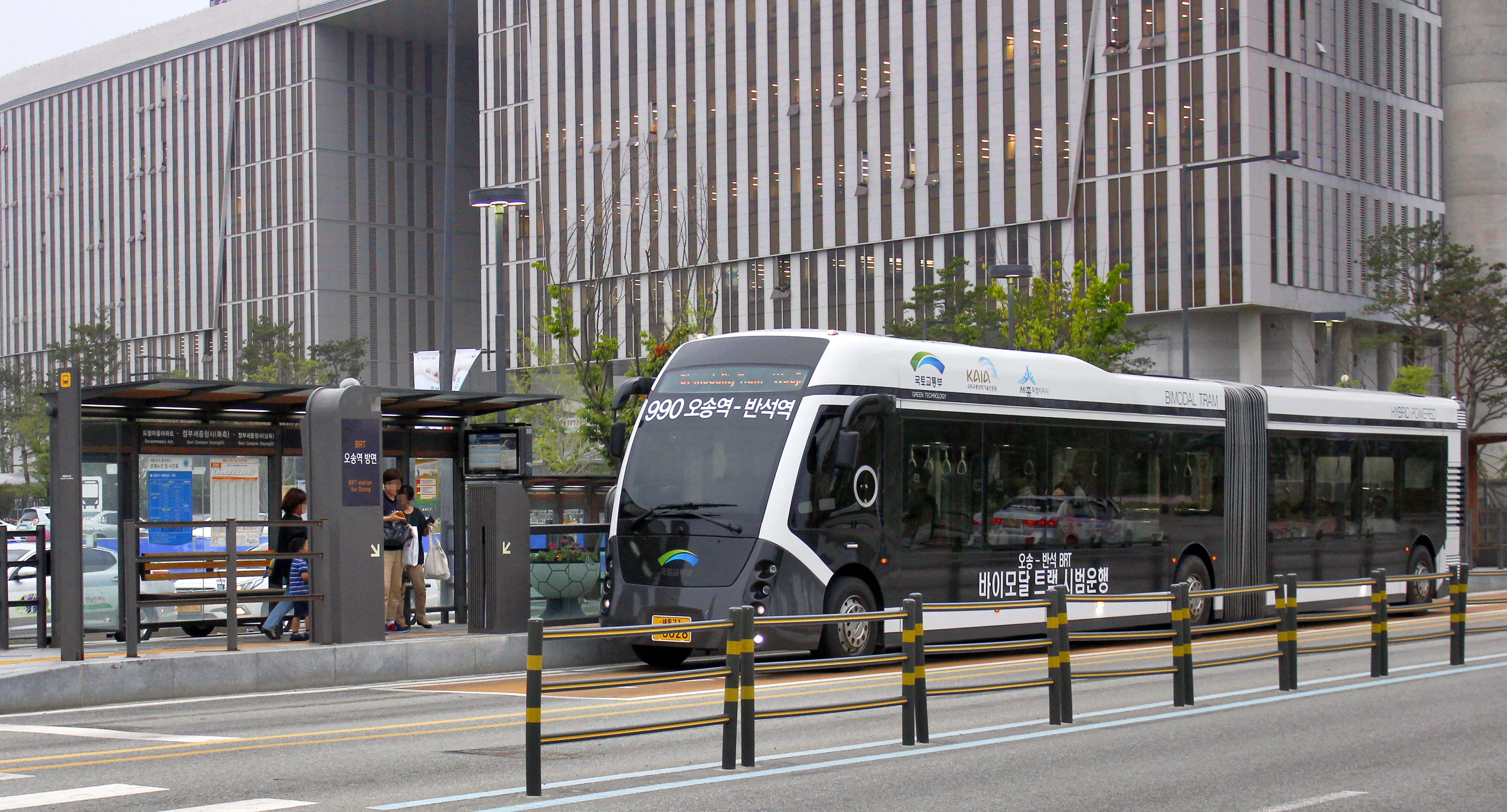
On 3 November 2005, a licence and technology transfer agreement was signed between Advanced Public Transport Systems (APTS) and the Korea Railroad Research Institute (KRRI). KRRI was to develop the Korean version of Phileas vehicle by May 2011.
Since June 2013, 3 miles (1.5 miles each way) of the Emerald Express (EmX) BRT in Eugene, Oregon, has used magnetic guidance in revenue service on an especially curvy section of the route that also entails small radius S-curves required for docking. The driver controls braking and acceleration.
Kerb guidance
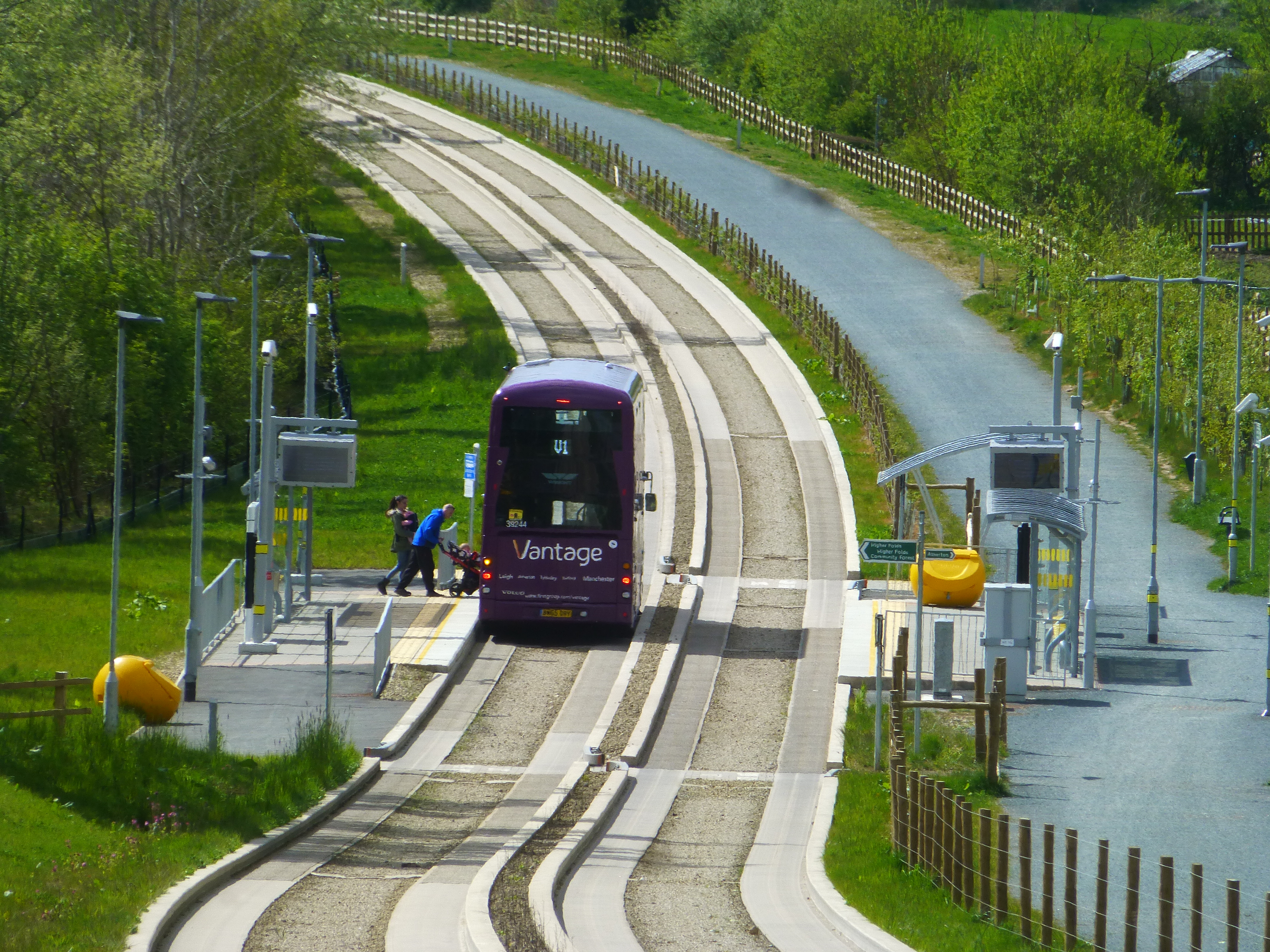

On kerb-guided buses (KGB) small guide wheels attached to the bus engage vertical kerbs on either side of the guideway. These guide wheels push the steering mechanism of the bus, keeping it centralised on the track. Away from the guideway, the bus is steered in the normal way. The start of the guideway is funnelled from a wide track to guideway width. This system permits high-speed operation on a narrow guideway and precise positioning at boarding platforms, facilitating access for the elderly and disabled. As guide wheels can be inexpensively attached to, and removed from, almost any standard model of bus, kerb guided busway systems are not tied to particular specialised vehicles or equipment suppliers. Characteristically, operators contracted to run services on kerb-guided busways will purchase or lease the vehicles, as second-hand vehicles (with guide wheels removed) have a ready resale market.

The kerb-guided system maintains a narrow track while still enabling buses to pass one another at speed. Consequently, kerb-guided track can be fitted into former double-track rail alignments without the requirement for additional land-take that might have been necessary were a disused railway to be converted into a public highway. Examples include the Cambridgeshire Guided Busway and Leigh-Salford-Manchester Bus Rapid Transit; in both schemes, it has proved possible to provide space for a wide multi-user path for leisure use alongside the kerb-guided double track, all within the boundaries of the disused railway route. Both the Cambridgeshire and Leigh-Salford-Manchester schemes have reported greatly increased levels of patronage (both on the buses themselves and the adjacent paths), high levels of modal transfer of travellers from private car use, and high levels of passenger satisfaction.
List of guided busways systems
Systems with conventional/modified buses:
| Country | City | System name | Started | Closure | Routes | Number of stations | Length | Notes |
|---|---|---|---|---|---|---|---|---|
| Australia | Adelaide | O-Bahn Busway | 9 March 1986 | - | 3 | 12 km | BRT system | |
| France | Douai | 8 February 2010 | 1 | 37 | 34 km | Guided busway (BRT system) | ||
| Nîmes | 29 September 2012 | 1 | 9 | 7.2 km | BRT system | |||
| Rouen | TEOR | 12 February 2001 | 4 | 64 | 39 km | BRT system | ||
| Germany | Essen | 1980 | 2 | - | 24.2 km | BRT system | ||
| Mannheim | O-Bahn | May 1992 | September 2005 | - | - | - | Guided busway system | |
| Italy | Bologna | Trolleybuses in Bologna | 4 Jan 1991 | 5 | - | - | Guided busway system | |
| Japan | Nagoya | Yutorito Line | 23 March 2001 | 4 | 9 | 6.5 km | BRT system | |
| Netherlands | Eindhoven | Phileas | 2003 | 3 | 32 | 15 km | BRT system | |
| South Korea | Sejong City | March 2016 | - | - | 20.1 km | BRT system | ||
| Spain | Castellón de la Plana | Trolleybuses in Castellón de la Plana | 25 June 2008 | 1 | 19 | 7.77 km | BRT system | |
| United Kingdom | Birmingham | Tracline 65 | 1984 | 1987 | - | - | - | Guided busway system |
| Bradford | Manchester Road Quality Bus Initiative Bradford end | October 2001 | - | - | - | BRT system | ||
| Bristol | MetroBus | 29 May 2018 | 5 | - | 50 km | BRT system | ||
| Cambridgeshire | Cambridgeshire Guided Busway | |||||||
| (Huntingdon to Trumpington) | 7 August 2011 | 3 | 8 | 25 km | BRT system | |||
| Crawley | Fastway BRT | October 2006 | 3 | 150 | 1.5 km | BRT system | ||
| Edinburgh | Edinburgh Fastlink | December 2004 | January 2009 | 2 | - | 1.5 km | Guided busway system | |
| Gosport | South East Hampshire Bus Rapid Transit (Eclipse Busway) | 22 April 2012 | 2 | 7 | 3.4 km | BRT system | ||
| Ipswich | Ipswich Rapid Transit | |||||||
| (Superroute 66) | 1995 | - | - | - | BRT system | |||
| Greater Manchester | Leigh-Salford-Manchester Bus Rapid Transit (Vantage-Leigh-Kerb Guided Busway) | 3 April 2016 | 2 | 14 | 7.2 km | BRT system | ||
| Leeds | Leeds Superbus | July 1998 | - | - | - | BRT system | ||
| Luton | Luton to Dunstable Busway | 24 September 2013 | - | - | 7.7 km | BRT system | ||
| United States | Eugene | Emerald Express | 14 January 2007 | 2 | 37 | 2.4 km | BRT system | |
| Las Vegas | ACE BRT (Max) | 30 June 2004 | - | 22 | 11.2 km | BRT system guided busway |
Gallery
Crawley London Road A23 guided busway.JPG|Crawley London Road A23 guided busway. MB O 405 Mannheim 100 1727.jpg|Mannheim guided bus. Ipswich-UK-guided-busway2.jpg|The kerb guide wheel of a bus in Ipswich, UK VantageBus-NewearthRd-KerbGuidedBusStop-P1400524.jpg|A double-decker bus on the Leigh-Salford-Manchester BRT Obahn test track1.JPG|A section of track used for testing O-Bahn Busway buses
References
References
- Bick, D. E.. (1968). "The Gloucester and Cheltenham Railway and the Leckhampton Quarry Tramroads". Oakwood Press.
- Schofield, R. B.. (2000). "Benjamin Outram 1764–1805: an engineering biography". Merton Priory.
- Wagonway Research Circle. (20 May 2010). "Plateways/tramways – overview and list of some available resources". Island Publishing.
- "Horse Trams on Rail and Road".
- "Bus Priority Systems (Bus Rapid Transit) – Special Feature on Kerb Guided Buses (O-Bahn)".
- Tracline 65 ''[[Buses (magazine). Buses]]'' issue 357 December 1984 page 538
- Back on Track ''[[Bus & Coach Preservation]]'' December 2019 pages 12–14
- O-Bahn is open for business ''[[Truck & Bus Transportation]]'' March 1986 pages 40–43
- Adelaide's O-Bahn ''[[Australian Bus Panorama]]'' issue 1/5 May 1986 pages 3–8
- The Adelaide O-Bahn Busway ''[[Australian Bus]]'' issue 32 March 2009 pages 23–27
- Smiler, Simon. (1998-01-20). "Special Feature On Kerb Guided Buses (O-Bahn)".
- (7 August 2011). "Cambridgeshire guided busway opens to passengers". [[BBC News]].
- (2 December 2004). "£10.5m bus project comes on track".
- "Edinburgh Western Corridor Busway (Fastlink)".
- Editorial Staff. (9 January 2025). "35 trolleybuses and 19 e-buses: new tender in Bologna (with option for further 35 trolleys)".
- Editorial Staff. (12 May 2025). "KIEPE has a solution to charge e-buses with power supply from overhead public transport lines".
- Editorial Staff. (30 May 2025). "Electreon: wireless charging on its way from demo to commercial deployments. Interview with Head of Global Strategy Charlie Levine".
- "Debunking the myths around the optically-guided bus (trackless trams)". The University of Sydney Business School.
- Simon Smiler. "New Era Hi-tech Buses". citytransport.info.
- "University of Berkley PATH Magnetic Guidance System – used on Snowploughs with trials including Transit Bus running and docking". Path.berkeley.edu.
- (8 December 2004). "Stagecoach signs deal with Siemens to develop new bus optical guidance system". Stagecoach Group.
- "APTS Phileas".
- "Bimodal Transportation Research Center(Korea)". Bimodaltram.com.
- Han-Shue Tan and Jihua Huang. (4 June 2014). ["The Design and Implementation of an Automated Bus In Revenue Service on a Bus Rapid Transit Line"](http://vecan.tongji.edu.cn/Conference/ACC2014/media/files/1246.pdf}}{{Dead link).
- Alan Brett. (2013). "Cambridgeshire Guided Busway – Usage Research". [[Cambridgeshire County Council]].
- (16 September 2016). "Presentation to BRT UK". [[Transport for Greater Manchester]].
- (31 August 2020). "Trolleybus system with optical guidance finally opened in Bologna".
- "Cambridgeshire County Council – Guided Busway homepage". Cambridgeshire.gov.uk.
This article was imported from Wikipedia and is available under the Creative Commons Attribution-ShareAlike 4.0 License. Content has been adapted to SurfDoc format. Original contributors can be found on the article history page.
Ask Mako anything about Guided bus — get instant answers, deeper analysis, and related topics.
Research with MakoFree with your Surf account
Create a free account to save articles, ask Mako questions, and organize your research.
Sign up freeThis content may have been generated or modified by AI. CloudSurf Software LLC is not responsible for the accuracy, completeness, or reliability of AI-generated content. Always verify important information from primary sources.
Report