From Surf Wiki (app.surf) — the open knowledge base
Guano Islands Act
Congressional act of the United States
Congressional act of the United States
| Field | Value |
|---|---|
| shorttitle | Guano Islands Act of 1856 |
| longtitle | An Act to authorize Protection to be given to Citizens of the United States who may discover Deposits of Guano |
| signeddate | August 18, 1856 |
| enacted by | 34th |
| effective date | August 18, 1856 |
| cite public law | |
| cite statutes at large | |
| title amended | |
| leghisturl | https://www.congress.gov/bill/34th-congress/senate-bill/339/all-info |
| introducedin | Senate |
| introducedbill | S. 339 |
| introducedby | William H. Seward (R–NY) |
| introduceddate | May 26, 1856 |
| committees | Foreign Relations |
| passedbody1 | Senate |
| passeddate1 | July 24, 1856 |
| passedbody2 | House |
| passedas2 | |
| passeddate2 | August 16, 1856 |
| agreeddate4 | |
| agreedvote4 | |
| signedpresident | Franklin Pierce |
| unsignedpresident | |
| unsigneddate | |
| vetoedpresident | |
| vetoeddate | |
| overriddenbody1 | |
| overriddendate1 | |
| overriddenvote1 | |
| overriddenbody2 | |
| overriddendate2 | |
| overriddenvote2 |
|the island in Antarctica|Guano Island (Antarctica)}} | cite statutes at large = The Guano Islands Act (, enacted August 18, 1856, codified at §§ 1411-1419) is a United States federal law passed by the Congress that enables citizens of the United States to take possession of unclaimed islands containing guano deposits in the name of the United States. The islands can be located anywhere, so long as they are not occupied by citizens of another country and not within the jurisdiction of another government. It also empowers the president to use the military to protect such interests and establishes the criminal jurisdiction of the United States in these territories.
Background
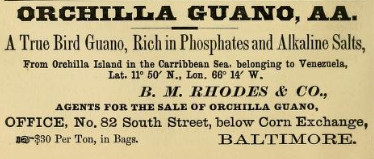
In the 1840s, guano became a prized agricultural fertilizer and source of saltpeter for gunpowder.
The U.S. began importing it in 1843 through New York. By the early 1850s, the U.K. imported over 200,000 tons a year, and U.S. imports totaled about 760,000 tons. The "guano mania" of the 1850s led to high prices in an oligopolistic market, government attempts to control prices, fear of resource exhaustion, and eventually the enactment of the Guano Islands Act of 1856 in August 1856. The Act authorizes U.S. citizens to take possession of unclaimed islands containing guano for the U.S., empowers the President to protect such claims with military intervention, and establishes jurisdiction of criminal offenses under the laws of the United States within the territories, thus claimed. This encouraged American entrepreneurs to search for and exploit new deposits on tiny islands and reefs in the Caribbean and Pacific.
This was the beginning of the concept of insular area in U.S. territories. Up until this time, any territory acquired by the U.S. was considered to have become an integral part of the country unless changed by treaty and eventually to have the opportunity to become a state of the Union. With insular areas, land could be held by the federal government without the prospect of it ever becoming a state in the Union.
On November 22, 1971, the United States handed over the Swan Islands to Honduras after signing the . Honduras began exercising this sovereignty on September 1, 1972.
Under the Act, the U.S. gained control of around 94 islands. By 1903, 66 of these islands were recognized as territories of the U.S.
Wording
Whenever any citizen of the United States discovers a deposit of guano on any island, rock, or key, not within the lawful jurisdiction of any other Government, and not occupied by the citizens of any other Government, and takes peaceable possession thereof, and occupies the same, such island, rock, or key may, at the discretion of the president, be considered as appertaining to the United States.
Section 1 of the Guano Islands Act
Criminal jurisdiction
Section 6 provides that criminal acts on or adjacent to these territories "shall be deemed committed on the high seas, on board a merchant ship or vessel belonging to the United States; and shall be punished according to the laws of the United States relating to such ships or vessels and offenses on the high seas". The provision was considered and ruled constitutional by the U.S. Supreme Court in Jones v. United States, .
Result
The Act continues to be part of the law of the United States. The most recent Guano Islands Act claim was made in 1997 to Navassa Island. However, the claim was denied because an American court ruled the island was already under American jurisdiction (a claim Haiti disputes).
Claims
While more than 100 islands have been claimed for the United States under the Guano Islands Act, all but ten have been withdrawn. The Act specifically allows the islands to be considered possessions of the U.S. The Act does not specify the territory's status after private U.S. interests abandon it or the guano is exhausted, creating neither obligation nor prohibition of retaining possession.
Current islands still claimed by the United States under the Act are:
- Baker Island
- Howland Island
- Jarvis Island
- Johnston Atoll
- Kingman Reef/Danger Rock
- Midway Atoll
- Navassa Island (claimed by Haiti)
- Bajo Nuevo Bank (disputed with Colombia)
- Serranilla Bank (disputed with Colombia)
- Swains Island (part of American Samoa; no evidence that guano was mined. Claimed by Tokelau)
Disputed claims
A few islands claimed by the United States under the Guano Act of 1856 are disputed.
- Navassa Island — de facto US control. To cement the U.S. claim to Navassa Island against Haiti, President James Buchanan issued Executive Orders establishing United States territorial jurisdiction beyond just the Guano Act of 1856. The United States Supreme Court in 1890 ruled the Guano Act constitutional and, citing the actions of the Executive Branch, amongst other points in law, determined Navassa Island as pertaining to the United States. Control of Navassa Island was transferred by the Department of the Interior to the Director of the Office of Insular Affairs under Order No. 3205 on January 16, 1997. The Department of the Interior and Insular Affairs would later grant administration responsibilities to the United States Fish and Wildlife Service under Order No. 3210 on December 3, 1999. Order No 3210 also established a 12 nmi territorial sea boundary for the United States around Navassa Island.
- Serranilla Bank and the Bajo Nuevo Bank. Serranilla Bank and the Bajo Nuevo Bank were ruled to be territory of Colombia by the International Court of Justice in 2001, against a claim by Nicaragua. The U.S. and Honduras have asserted claims. Colombia has granted fishing rights to Jamaica.
Private unrecognized claim
- In 1964, Leicester Hemingway, brother of author Ernest Hemingway, attempted to establish a country (or more appropriately, a micronation) dubbed the Republic of New Atlantis, on an 8 × bamboo raft anchored with an engine block outside the territorial waters of Jamaica, using the Guano Islands Act as part of a claim to sovereignty. His apparent intention was to use the new country as the headquarters for his own International Marine Research Society, with which he planned to further marine research and protect Jamaican fishing. Neither the U.S. nor Jamaica recognized his claim before the raft was destroyed in a storm in 1966.
References
References
- (July 25, 1856). "XXXIVth CONGRESS----First Session.; SENATE. HOUSE OF REPRESENTATIVES.". [[The New York Times]].
- (August 18, 1856). "Article 12 -- No Title". [[The New York Times]].
- Smil, Vaclav. (2004). ''Enriching the Earth: Fritz Haber, Carl Bosch, and the Transformation of World Food Production.'' Massachusetts: The MIT Press, pp.42.
- Skaggs & Wines, R. A. (1985). ''Fertilizer in America.'' Philadelphia: Temple University Press, pp. 54-70.
- [https://treaties.un.org/doc/Publication/UNTS/Volume%20851/volume-851-I-12199-English.pdf Treaty of the Swan Islands] UN
- (1972). "United States Treaties and Other International Agreements". [[Department of State]].
- [https://books.google.com/books/about/The_Ecology_of_Agroecosystems.html?id=AFRQSuQGHiIC The Ecology of Agroecosystems] p149
- Guano Islands Act ({{USStat. 11. 119
- Underhill, Kevin. (July 8, 2014). "The Guano Islands Act".
- Fesperman, Dan. (1998-07-19). "A Man's Claim to Guano Knee-Deep in Bureaucracy". Baltimore Sun.
- "Acquisition Process of Insular Areas". [[United States Government]], [[United States Department of the Interior.
- Stahr, Walter. (2012). "Seward: Lincoln's Indispensable Man". Simon and Schuster.
- Skaggs, Jimmy M.. (1994). "The Great Guano Rush: Entrepreneurs and American Overseas Expansion". Palgrave Macmillan US.
- ''Jones v. United States'', 137 U. S. 202 (1890).
- "Latest developments {{!}} Territorial and Maritime Dispute (Nicaragua v. Colombia) {{!}} International Court of Justice".
- Hale, Russell. "Contents of a Country: Leicester Hemingway's Republic of New Atlantis". University of Texas Humanities Research Center.
- (2013). "Surveying the American Tropics: A Literary Geography from New York to Rio". Liverpool University Press.
This article was imported from Wikipedia and is available under the Creative Commons Attribution-ShareAlike 4.0 License. Content has been adapted to SurfDoc format. Original contributors can be found on the article history page.
Ask Mako anything about Guano Islands Act — get instant answers, deeper analysis, and related topics.
Research with MakoFree with your Surf account
Create a free account to save articles, ask Mako questions, and organize your research.
Sign up freeThis content may have been generated or modified by AI. CloudSurf Software LLC is not responsible for the accuracy, completeness, or reliability of AI-generated content. Always verify important information from primary sources.
Report