From Surf Wiki (app.surf) — the open knowledge base
Grullo
Color of horses in the dun family

Color of horses in the dun family
Grullo (pronounced GREW-yo)
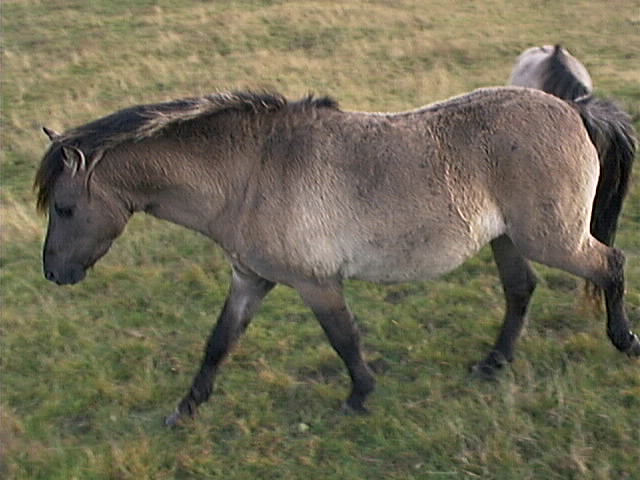
In terms of equine coat color genetics, all of these shades are based on the dun gene acting as a dilution gene over the black gene. Because the grulla color is not due to the gray gene, a grulla horse remains the same basic color from birth, though some minor shade variation may occur from summer to winter coats. If a grulla also carries the gray gene, it will be born a mouse tan-gray shade, usually with bold primitive markings, but then lighten and eventually develop a white hair coat with age. Because black is less common in general than bay or chestnut, grulla is likewise less common than red duns or bay (classic or zebra) duns. For example, only 0.7% of quarter horses registered each year with the AQHA are grulla.
The most obvious ways to tell whether a horse is grulla are not only the gray or tan-gray body color, but also its primitive markings, which include some or all of the following: dark face, cobwebbing around the eyes and forehead, dark mottling on the body, leg barring (sometimes called tiger striping), dark ear tips and edging, dark ear barring, dark shadowing of the neck, dark dorsal and transverse striping, and light guard hairs bordering a dark mane and tail.
Terminology
The word "grulla" in Spanish means crane. (The original Spanish noun is pronounced in American Spanish and in Peninsular Spanish.) Though the Spanish word for "crane" is always "grulla" regardless of gender, some people call male horses "grullo" and female horses "grulla", including in Spanish.
Grulla is also called mouse dun or blue dun.
Distribution
The tarpan (Equus ferus ferus) was a relative of the domestic horse that became extinct in the nineteenth century, and which appears to have had grulla coloration. The tarpan has been considered a true wild horse, an undomesticated relative or ancestor of the domestic horse. However, some authorities in the early twentieth century held the opinion that most equines called tarpans were actually domestic or feral horses, not a separate species.
Several breeds with the grulla color have been developed in efforts to recreate ("breed back") the tarpan. These breeds include the Heck horse and Konik. One of the first experiments in this regard was published in 1906 by James Cossar Ewart, who obtained a "tarpan-like" horse by crossing a Shetland mare and a black Welsh pony.
References
References
- "Horse-Breeding Basics: Quarter Horse Color".
- "Grulla". Cedar Ridge Quarter Horses.
- "Merriam-Webster Grulla".
- "grulla". Real Academia Española.
- (2017). "Equine Color Genetics". Wiley Blackwell.
- "grullo, lla". Real Academia Española.
- J. C. Ewart. (1906). "The tarpan and its relationship with wild and domestic horses". Nature.
This article was imported from Wikipedia and is available under the Creative Commons Attribution-ShareAlike 4.0 License. Content has been adapted to SurfDoc format. Original contributors can be found on the article history page.
Ask Mako anything about Grullo — get instant answers, deeper analysis, and related topics.
Research with MakoFree with your Surf account
Create a free account to save articles, ask Mako questions, and organize your research.
Sign up freeThis content may have been generated or modified by AI. CloudSurf Software LLC is not responsible for the accuracy, completeness, or reliability of AI-generated content. Always verify important information from primary sources.
Report