From Surf Wiki (app.surf) — the open knowledge base
Grozny
Capital of Chechnya, Russia

Capital of Chechnya, Russia
| Field | Value |
|---|---|
| en_name | Grozny |
| ru_name | Грозный |
| loc_name1 | Соьлжа-ГӀала, Sölƶa-Ġala |
| loc_lang1 | Chechen |
| image_skyline | {{multiple image |
| border | infobox |
| perrow | 1/2/2/2/2 |
| total_width | 250 |
| image1 | Мечеть "Сердце Чечни".jpg |
| image2 | Akhmad Kadyrov Mosque at night, Grozny, Chechnya, Russia.jpg |
| image3 | Грозный Сити - panoramio.jpg |
| image4 | Национальный музей Чеченской Республики 3.jpg |
| image5 | Building of Vainakh ensemble 38.jpg |
| footer | Clockwise from the top, Kadyrov Square, Grozny City Towers, Vaynakh School of Dance, National Museum of the Chechen Republic, The Courtyard of Akhmad Kadyrov Mosque at night}} |
| pushpin_map | Russia Chechnya#European Russia#Europe |
| coordinates | |
| image_flag | Flag of Grozny (Chechnya).svg |
| image_coa | Coat of Arms of Grozny (Chechnya).svg |
| holiday | October 5 |
| holiday_ref | |
| federal_subject | Chechen Republic |
| federal_subject_ref | |
| adm_inhabloc_jur | city of republic significance of Grozny |
| adm_inhabloc_jur_ref | |
| capital_of | Chechen Republic |
| capital_of_ref | |
| adm_ctr_of1 | city of republic significance of Grozny |
| adm_ctr_of1_ref | |
| inhabloc_cat | City |
| inhabloc_cat_ref | |
| urban_okrug_jur | Grozny Urban Okrug |
| urban_okrug_jur_ref | |
| mun_admctr_of1 | Grozny Urban Okrug |
| mun_admctr_of1_ref | |
| mun_admctr_of2 | Groznensky Municipal District |
| mun_admctr_of2_ref | |
| leader_title | |
| leader_title_ref | |
| leader_name | Khas-Magomed Kadyrov |
| leader_name_ref | |
| representative_body | Council of Deputies |
| representative_body_ref | |
| area_km2 | 324.16 |
| pop_latest | 331402 |
| pop_latest_date | 2023 |
| pop_latest_ref | |
| established_date | 1818 |
| established_date_ref | |
| current_cat_date | 1869 |
| current_cat_date_ref | |
| postal_codes | 364000, 364001, 364006, 364008, 364011, 364013–364018, 364020–364022, 364024, 364028–364031, 364034, 364035, 364037, 364038, 364040, 364042, 364043, 364046, 364047, 364049, 364051, 364052, 364058, 364060–364063, 364066, 364068, 364700, 366000 |
| dialing_codes | 8712 |
| website | grozmer.ru |
Grozny (, ; ){{cite web|url= https://geonames.nga.mil/gns/html/Romanization/TABLE%20OF%20CORRESPONDENCES%20FOR%20CHECHEN.pdf
The city lies on the Sunzha River. According to the 2021 census, it had a population of 328,533 — up from 210,720 recorded in the 2002 census, but still less than the 399,688 recorded in the 1989 census. It was previously known as Groznaya (until 1870).
Names
In Russian, "Grozny" means "fearsome", "menacing", or "redoubtable", the same word as in Ivan Grozny (Ivan the Terrible). While the official name in Chechen is the same, informally the city is known as "Соьлжа-Гӏала" ("Sölƶa-Ġala"), which literally means "the city (гӏала) on the Sunzha River (Соьлжа)".
In 1996, during the First Chechen War, the authorities of the Chechen republic of Ichkeria renamed the city Dzhokhar-Ghala (), literally Dzhokhar City, or Dzhokhar/Djohar for short, after Dzhokhar Dudayev, the first president of the republic, was killed by Russia. In December 2005, the Chechen parliament voted to rename the city Akhmad-Ghala (), after Akhmad Kadyrov) – a proposition which was rejected by his son Ramzan Kadyrov, the prime minister at the time and later president of the republic.
History
Russian fort
The fortress of Groznaya (Гро́зная; fearsome – a feminine form of Grozny, as the word fortress, "крепость", is feminine in Russian) was founded in 1818 as a Russian military outpost on the Sunzha River by general Aleksey Petrovich Yermolov. As the fort was being built, the workers were fired upon by the Chechens. The Russians found a solution by strategically positioning a cannon outside the city walls. When night fell and the Chechens came out of their hiding places to drag the gun away, all the other guns opened up with grapeshot. When the Chechens recovered their senses and began to carry away the bodies, the guns fired again. When it was over, 200 dead were counted. Thus did the "fearsome" fort receive its baptism of fire. It was a prominent defense centre during the Caucasian War.
Russian poets Alexander Griboedov, Alexander Polezhayev, Mikhail Lermontov, the classic of Russian literature Leo Tolstoy, the Decembrist and writer Alexander Bestuzhev and other famous figures of Russian culture visited the fortress. After the annexation of the region by the Russian Empire, the military use of the old fortress was obsolete and on it was granted town status and renamed Grozny, as the word town, "город", is masculine in Russian. As most of the residents there were Terek Cossacks, the town grew slowly until the development of oil reserves in the early 20th century. The founder of the Nobel Prize, Alfred Nobel, took part in the development of the oil industry of the city of Grozny, as well as members of the Rothschild family. In addition to the Nobels and Rothschilds, British companies played an important role in the oil industry from 1893 onward. Alfred Stuart, an English engineer, completed the first well in Grozny by drilling in 1893 the largest oil field in the Caucasus region outside the Baku district.
Eleven firms drilled 116 wells before 1900. This encouraged the rapid development of industry and petrochemical production. In addition to the oil drilled in the city itself, the city became a geographical centre of Russia's network of oil fields, and in 1893 became part of the Transcaucasia–Russia-proper railway. The result was the population almost doubled from 15,600 in 1897 to 30,400 in 1913. During the Russian Empire, the city was the administrative capital of the Groznensky Okrug of the Terek Oblast.
Soviet regional capital
One day after the October Revolution, on 8 November 1917, the Bolsheviks headed by N. Anisimov seized Grozny. As the Russian Civil War escalated, the Proletariat formed the 12th Red Army, and the garrison held out against numerous attacks by Terek Cossacks from 11 August to 12 November 1918. However, with the arrival of Denikin's armies, the Bolsheviks were forced to withdraw and Grozny was captured on 4 February 1919, by the White Army. Underground operations were carried out, but only the arrival of the Caucasus front of the Red Army in 1920 allowed the city to permanently end up with the Russian SFSR on 17 March. Simultaneously it became part of the Soviet Mountain Republic, which was formed on 20 January 1921, and was the capital of the Chechen National Okrug inside it.
On 30 November 1922, the mountain republic was dissolved, and the national okrug became the Chechen Autonomous Oblast (Chechen AO) with Grozny as the administrative centre. At this time most of the population was still Russian, but of Cossack descent. As Cossacks were viewed as a potential threat to the Soviet nation, Moscow actively encouraged the migration of Chechens into the city from the mountains. In 1934 the Chechen-Ingush Autonomous Oblast was formed, becoming the Chechen-Ingush ASSR in 1936.
Due to its oil, Grozny with Maikop were the main strategic objectives of the German Fall Blau operation in summer of 1942 (See Battle of the Caucasus).
The failure to take Grozny was a major defeat for Germany and was a factor in holding fast at the Battle of Stalingrad, as that city could have served as a base from which to take Grozny or cut off oil supplies up the Volga River from Astrakhan. The failure to prioritize Grozny, even transferring critical Panzer divisions north to the Siege of Leningrad, was a major factor in Adolf Hitler taking operational level control of the Wehrmacht from his generals who had repeatedly prioritized the two major cities over the oil supplies – against Hitler's express orders. Soviet doctrine however never failed to prioritize the food of Ukraine nor the oil of the Caucasus, which resulted in drastic action after Germany's expulsion/retreat in 1943.
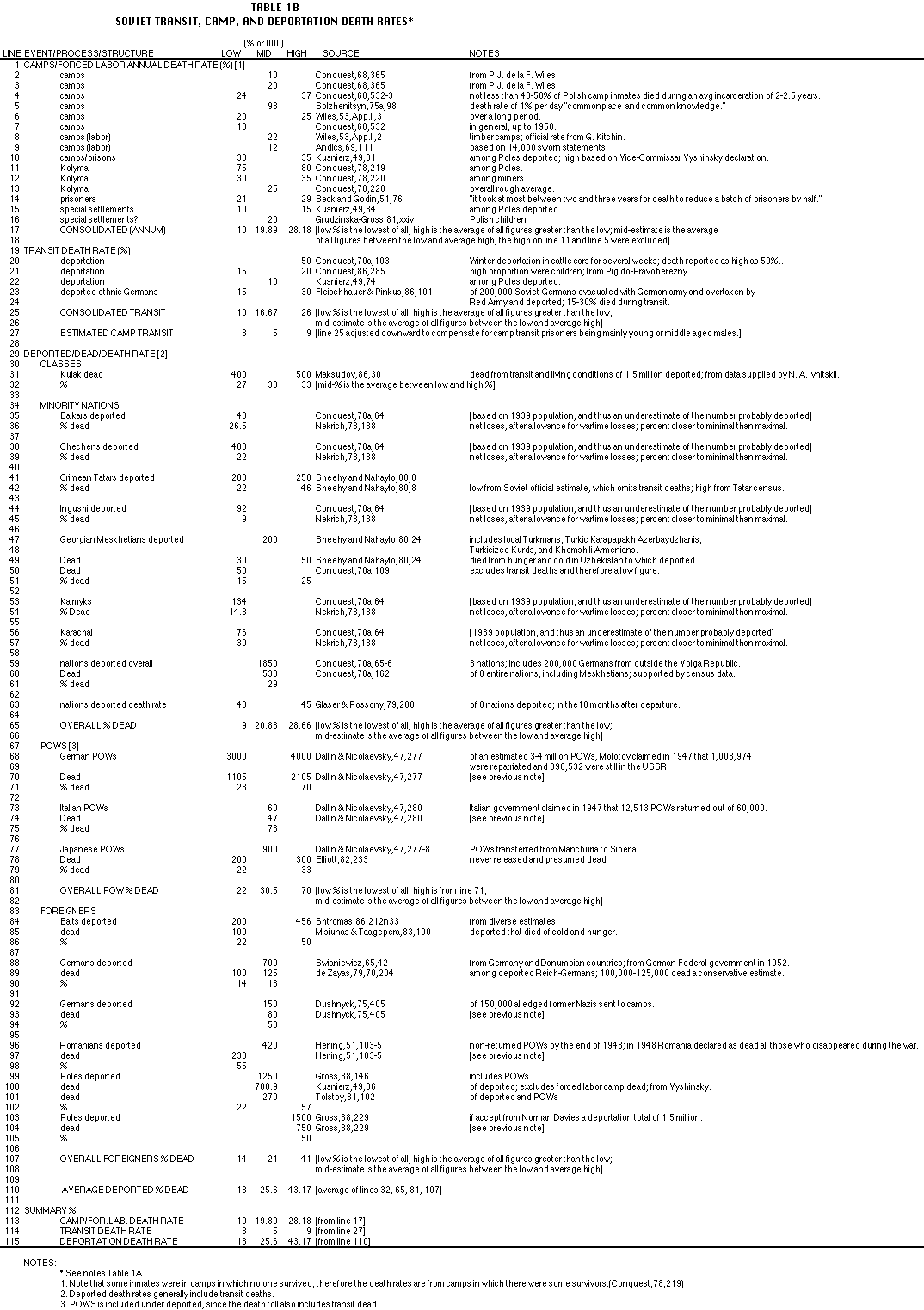
In 1944, the entire population of Chechens and Ingush was deported after being falsely accused of collaborating with advancing armed forces of Nazi Germany. Large numbers of people who were not deemed fit for transport were "liquidated" on the spot, and the adverse situation with transport and the stay in Siberia caused many deaths as well. According to internal NKVD data, a total of 144,704 died in 1944–1948 alone (death rate of 23.5% per all groups). Authors such as Alexander Nekrich, John Dunlop and Moshe Gammer, based on census data from the period estimate a death toll of about 170,000–200,000 among Chechens alone, thus ranging from over a third of the total Chechen population that was deported to nearly half dying during those four years (rates for other groups for those four years hover around 20%). All traces of them in the city, including books and graveyards, were destroyed by the NKVD troops. The act was recognized by the European Parliament as an act of genocide in 2004.
Grozny became the administrative centre of Grozny Oblast of the Russian SFSR, and the city at the time was again wholly Russian. In 1957, the Chechen-Ingush ASSR was restored, and the Chechens were allowed to return. The return of the Chechens to Grozny, which had been lacking of Nakh for thirteen years, would cause massive disruptions to the social, economic and political systems of what had been a Russian city for the period until their return. This caused a self-feeding cycle of ethnic conflict between the two groups, both believing the other's presence in the city was illegitimate. Once again migration of non-Russians into Grozny continued whilst the ethnic Russian population, in turn, moved to other parts of the USSR, notably the Baltic states, after inter-ethnic conflict broke out briefly in 1958.

According to sociologist Georgy Derluguyan, the Checheno-Ingush Republic's economy was divided into two spheres – much like French settler-ruled Algeria – and the Russian sphere had all the jobs with higher salaries, while non-Russians were systematically kept out of all government positions. Russians (as well as Ukrainians and Armenians) worked in education, health, oil, machinery, and social services. Non-Russians (excluding Ukrainians and Armenians) worked in agriculture, construction, a long host of undesirable jobs, as well as the so-called "informal sector" (i.e. illegal, due to the mass discrimination in the legal sector).
At the same time a great deal of development occurred in the city. Like many other Soviet cities, the Stalinist style of architecture was prevalent during this period, with apartments in the centre as well as administrative buildings including the massive Council of Ministers and the Grozny University buildings being constructed in Grozny. Later projects included the high-rise apartment blocks prominent in many Soviet cities, as well as a city airport. In 1989, the population of the city was almost 400,000 people.
Collapse of Russian authority
After the collapse of the Soviet Union, Grozny became the seat of a separatist government led by Dzhokhar Dudayev. According to some, many of the remaining Russian and other non-Chechen residents fled or were expelled by groups of militants, adding to a harassment and discrimination from the new authorities. These events are perceived by some as an act of an ethnic cleansing of non-Chechens, which has been reflected in the materials of General Prosecutor's office of the Russian Federation.
This view is disputed by authors, such as Russian economists Boris Lvin and Andrei Illarionov, who argue that Russian emigration from the area was no more intense than in other regions of Russia at the time. According to this view of the ethnic situation in Ichkeria, the primary cause of Russian emigration was the extensive bombing of Grozny (where four out of five, or nearly 200,000 Russians in Chechnya lived before the war) by the Russian military during the First Chechen War.
The covert Russian attempts of overthrowing Dudayev by means of armed Chechen opposition forces resulted in repeated failed assaults on the city. Originally, Moscow had been backing the political opposition of "peacefully" (i.e. without supplying the opposition with weapons and encouraging them to try a coup). However, this changed in 1994, after the coups in neighbouring Georgia and Azerbaijan (both of which Moscow was involved with), when Russia encouraged armed opposition, and occasionally assisted. In August 1994 Avturkhanov attacked Grozny, but was repelled first by Chechen citizens who were then joined by Grozny government troops; Russian helicopters covered his retreat. On 28 September, one of these helicopters was shot down and its Russian pilot was held as a prisoner-of-war by the Chechen government. The last assault, on 26 November 1994, ended with capture of 21 Russian Army tank crew members who had secretly been hired as mercenaries by the FSK (former KGB, not long after renamed FSB); their capture was sometimes cited as one of the reasons for Boris Yeltsin's decision to openly intervene. In the meantime, Grozny airport and other targets were bombed by unmarked Russian aircraft.
First Chechen War
During the First Chechen War, Grozny was the site of an intense battle lasting from December 1994 to February 1995 and ultimately ending with the capture of the city by the Russian military. Intense fighting and carpet bombing carried out by the Russian Air Force destroyed much of the city. Thousands of combatants on both sides died in the fighting, alongside civilians, many of whom were reportedly ethnic Russians; unclaimed bodies were later collected and buried in mass graves on the city outskirts. The main federal military base in Chechnya was located in the area of Grozny air base.
Chechen guerrilla units operating from nearby mountains managed to harass and demoralize the Russian Army by means of guerilla tactics and raids, such as the attack on Grozny in March 1996, which added to political and public pressure for a withdrawal of Russian troops. In August 1996, a raiding force of 1,500 to 3,000 militants recaptured the city in a surprise attack. They surrounded and routed its entire garrison of 10,000 MVD troops, while fighting off the Russian Army units from the Khankala base. The battle ended with a final ceasefire and Grozny was once again in the hands of Chechen separatists. The name was changed to Djohar in 1997 by the President of the separatist Ichkeria republic, Aslan Maskhadov. By this time most of the remaining Russian minority had fled.
Second Chechen War
Grozny was once again the epicentre of fighting after the outbreak of the Second Chechen War, which further caused thousands of fatalities. During the early phase of the Russian siege on Grozny on 25 October 1999, Russian forces launched five SS-21 ballistic missiles at the crowded central bazaar and a maternity ward, killing more than 140 people and injuring hundreds. During the massive shelling of the city that followed, most of the Russian artillery were directed toward the upper floors of the buildings; although this caused massive destruction of infrastructure, civilian casualties were much less than in the first battles.
The final seizure of the city was set in early February 2000, when the Russian military lured the besieged militants to a promised safe passage. Seeing no build-up of forces outside, the militants agreed. One day prior to the planned evacuation, the Russian Army mined the path between the city and the village of Alkhan-Kala and concentrated most firepower on that point. As a result, both the city mayor and military commander were killed; a number of other prominent separatist leaders were also killed or wounded. Afterwards, the Russians slowly entered the empty city and on 6 February raised the Russian flag in the centre. Many buildings and even whole areas of the city were systematically destroyed. A month later, it was declared safe to allow the residents to return to their homes, although demolition continued for some time. In 2003, the United Nations called Grozny the most destroyed city on Earth, with not a single building left undamaged.
After the wars
The federal government representatives of Chechnya are based in Grozny. Since 2003, the city has been rebuilt from scratch. Out of several dozens of industrial enterprises, three have been partially rebuilt – the Grozny Machine-Building Factory, the Krasny Molot (Red Hammer) and Transmash factories.
Although most of the city's infrastructure was destroyed during the war, the city's sewage, water, electricity and heating systems have since been repaired, along with 250 km of roads, 13 bridges and some 900 shops. Before the war, Grozny had about 79,000 apartments, and the city authorities expected to be able to restore about 45,000 apartments; the rest were in buildings that were completely destroyed.
Railway connection was restored in 2005, and Grozny's airport was reopened in 2007 with three weekly flights to Moscow. In 2009 the IAC gave Grozny's Severny airport the international certificate after checking and evaluating the airport's airworthiness. On 16 November 2009, the airport had its first international flight, taking pilgrims on Hajj to Saudi Arabia via a Boeing 747.
After four years of construction, the Akhmad Kadyrov Mosque was formally opened to the public on 16 October 2008, and is one of the largest mosques in Europe. In 2009, the city of Grozny was honoured by the UN Human Settlements Program for transforming the war-scarred city and providing new homes for thousands.
Administrative and municipal status
|1897 | 16000 |1926 | 70898 |1939 | 172448 |1959 | 242068 |1970 | 341259 |1979 | 375326 |1989 | 399688 |2002 | 210720 |2010 | 271573 |2021 | 328533 |2025 | 399286 Grozny is the capital of the republic. Within the framework of administrative divisions, it is incorporated as the city of republic significance of Grozny – an administrative unit with the status equal to that of the districts. As a municipal division, the city of republic significance of Grozny is incorporated as Grozny Urban Okrug. The city also serves as the administrative centre of Groznensky Municipal District, but not of the corresponding administrative district.
{{ill|Administrative divisions of Grozny|lt=City divisions|ru|Административное деление Грозного}}
For administrative purposes, the city is divided into four city districts: , , , .
Culture and education
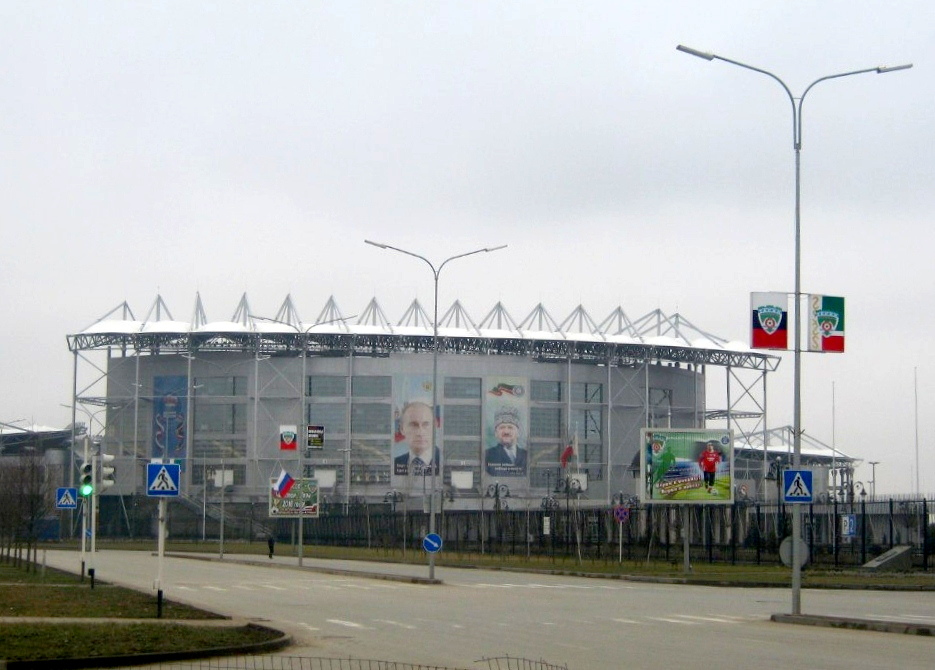
Grozny is known for its modern architecture and as a spa town and although nearly all the town was destroyed or seriously damaged during the Chechen Wars, it has since been entirely rebuilt. It is home to Chechen State University, one of the leading in Russia About Grozny. The FC Akhmat Grozny, which after a fifteen-year absence from its home town returned to Grozny in March 2008, is the local football club. Also in Grozny is Chechen State Pedagogical Institute and Grozny State Oil Technical University.
The main objects of the cultural life of Grozny are About Grozny:
- Grozny Russian Drama Theater named after M. Lermontov.
- Chechen State Drama Theater named after Kh. Nuradilov
- Chechen State Theater for Young People
- Chechen State Youth Theater Serlo
- The State Symphony Orchestra of the Chechen Republic
- The National Library of the Chechen Republic
- The Republican Children’s Library of the Chechen Republic
- The National Museum of the Chechen Republic
- Chechen State Philharmonic
Transportation
Train

The first train pulled into the Grozny Railway station on 1 May 1893. It has been running continuously since then.
Trams and trolleybuses
On 5 November 1932, the Grozny tram system was opened to the public, and by 1990 it was 85 km long, with 107 new Russian-built KTM-5 trams that it received in the late 1980s, and two depots. The Grozny trolleybus system began operation on 31 December 1975, and by 1990 was approximately 60 km long, with 58 buses and one depot. Both types of transport came under difficult pressure in the early 1990s, with frequent theft of equipment, staff not being properly paid and resultant strikes. A major planned trolleybus route extension to the airport was cancelled.
With the outbreak of the First Chechen War both transport services stopped operation in November 1994. During the destructive battles, the tram tracks were blocked or damaged, and cars and buses were turned into barricades. The trolleybus system was luckier, as most of its equipment, including the depot, survived the war. In 1996 it was visited by specialists from the Vologda Trolleybus Company, who repaired some of the lines, with services planned to restart in 1997. However, after specialists left, most of the equipment was stolen. The surviving buses were transported to Volzhsky where they were repaired and used on the new trolleybus system there.
After the Second Chechen War, little of the infrastructure of either system was left. The Ministry of Transport of the Chechen Republic, created in 2002, decided not to rebuild the tram system (considered too expensive and no longer meeting the city's needs, as it had by then lost half of its population). Rebuilding of the trolleybus system, however, is still under consideration.
Airport

The city is served by Grozny Airport.
Sharing system
In 2018 the Delimobil car sharing company officially provided the capital of the Chechen Republic with 30 Hyundai Solaris. To drive the automobiles, the user has to book them through the app of the owning company.
In the same year the Delisamokat provided the city with 120 electric scooters and some scooter stations.
Sports
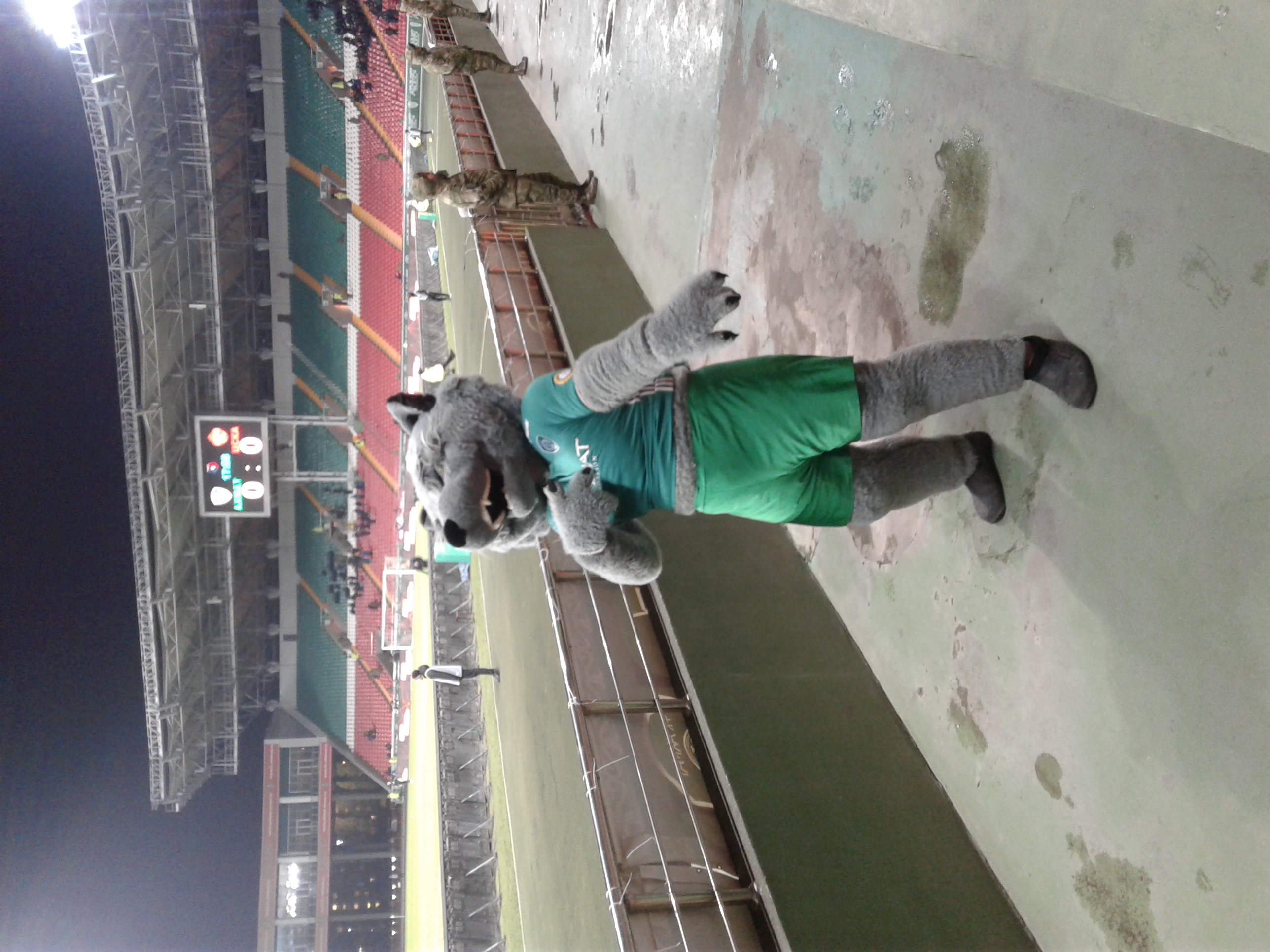
Grozny is home to Russian Football Premier League club FC Akhmat Grozny. After winning promotion by coming 2nd in the Russian First Division in 2007, Akhmat Grozny finished 10th in the Russian Premier League in 2008. The team still plays in the top tier. The club is owned by Ramzan Kadyrov and plays in the recently built city's Akhmat Stadium.
The city is also home to the Fort Grozny motor racing circuit, which opened in 2015.
Geography
.jpg)
The city is located along the Sunzha River, a major tributary of the Terek River. The city is located in a valley approximately 80 kilometres (50 miles) north of the main range of the Greater Caucasus Mountains.
Climate
Grozny has a humid continental climate (Köppen Dfa) with hot summers and cold winters. Precipitation peaks during early summer, where sunshine hours also peak. | Jan record high C = 15.7 | Feb record high C = 22.3 | Mar record high C = 32.9 | Apr record high C = 33.7 | May record high C = 38.1 | Jun record high C = 39.1 | Jul record high C = 42.0 | Aug record high C = 41.4 | Sep record high C = 40.7 | Oct record high C = 32.5 | Nov record high C = 23.7 | Dec record high C = 20.2 | year record high C = 42.0 | Jan record low C = -31.5 | Feb record low C = -30.8 | Mar record low C = -19.1 | Apr record low C = -7.6 | May record low C = -3.1 | Jun record low C = 5.6 | Jul record low C = 9.2 | Aug record low C = 5.0 | Sep record low C = -2.7 | Oct record low C = -9.6 | Nov record low C = -23.5 | Dec record low C = -26.6 | year record low C = -31.5
Twin towns – sister cities
Grozny is twinned with:
- TUR Ardahan, Turkey
- AZE Baku, Azerbaijan
- MDA Comrat, Moldova
- TUR Sivas, Turkey
- GEO Tbilisi, Georgia
Former twin towns:
- POL Warsaw, Poland (from 1997 to 2022, status terminated as a result of the Russian invasion of Ukraine)
Notable people
- Anatoly Karatsuba (1937–2008), mathematician
- Artur Sarkisov (born 1987), former Armenian soccer player
- Bekkhan Agayev (born 1975), political figure
- Gennady Troshev (1947–2008), colonel general
- Israil Arsamakov (born 1962), weightlifter
- Khassan Baiev (born 1963), surgeon
- Ludmilla Tourischeva (born 1952), Olympic gymnast
- Makka Sagaipova (born 1987), singer and dancer
- Maksharip Muzhukhoev (1942–2015), historian (dr. of historical sciences), archeologist
- Mamed Khalidov (born 1980), mixed martial arts fighter
- Magomed Adiyev (born 1977), soccer coach
- Magomed Ozdoyev (born 1992), soccer player
- Meseda Bagaudinova (born 1983), pop singer
- Pasikhat Dzhukalaeva (1881–2005), supercentenarian
- Sukhrab Akhmedov (born 1974), colonel
- Timur Aliev (born 1973), journalist
- Timur Eneev (1924–2019), mathematician
- Yuliya Yefimova (born 1992), swimmer
- Yuri Radonyak (1935–2013), boxer
- Zelim Bakaev (born 1992), singer
- Natalia Estemirova (1958–2009), human rights activist
Visitor attractions
- Akhmad Kadyrov Mosque
- Grozny-City Towers Facade Clocks
References
Sources
- Olga Oliker, Russia's Chechen Wars 1994–2000: Lessons from Urban Combat. (Santa Monica CA: RAND Arroyo Center, 2001)
Bibliography
References
- Charter of Grozny, Article 2
- Charter of Grozny, Article 47
- "Mayor of Grozny". Official website of Grozny.
- Charter of Grozny, Article 28
- "Численность постоянного населения Российской Федерации по муниципальным образованиям на 1 января 2023 года (с учётом итогов Всероссийской переписи населения 2020 г.)".
- {{ru-pop-ref. 2021Census
- {{ru-pop-ref. 2002Census
- {{ru-pop-ref. 1989Census
- [[RIA Novosti]]. [http://ria.ru/spravka/20051214/42491220.html City of Grozny. Reference Information] {{in lang. ru
- RIA Novosti. [http://ria.ru/politics/20051216/42530249.html Путин считает закрытой тему переименования города Грозного] (''Putin Considers the Proposal to Rename the City of Grozny Closed'') {{in lang. ru
- (2003). "Энциклопедия Города России". Большая Российская Энциклопедия.
- John F. Baddeley, Russian Conquest of the Caucasus, Ch VII
- "Записки краеведа - А.А. Ваксман".
- (1999). "Oil and Geopolitics in the Caspian Sea Region". Praeger.
- (2007). "The Oil and the Glory: The Pursuit of Empire and Fortune on the Caspian Sea". Random House.
- [http://www.history.neu.edu/fac/burds/Burds-FifthColumnists.pdf "The Soviet War against 'Fifth Columnists': The Case of Chechnya, 1942–1944" by Jeffrey Burds] {{webarchive. link. (November 16, 2010 , p.39)
- Dunlop, John. ''Russia Confronts Chechnya: The Roots of a Separatist Conflict''. Pages 67–69
- Bugai, Nikolai Fedorovich. ''The Truth about the Deportation of the Chechen and Ingush People.'' Printed in English in ''Soviet Studies in History'', Fall 1991. Originally in Russian in ''Voprosy istorii'', June 1990.
- Wood, Tony. ''Chechnya: The Case for Independence''. page 37-38
- Nekrich, ''Punished Peoples''
- Dunlop.''Russia Confronts Chechnya'', pp 62–70
- Gammer.''Lone Wolf and the Bear'', pp166-171
- "Soviet Transit, Camp, and Deportation Death Rates".
- (1944-02-23). "Chechnya: Rewriting History". Iwpr.net.
- link. (February 13, 2012)
- [http://www.unpo.org/article/438 Chechnya: European Parliament recognizes the genocide of the Chechen People in 1944], 27 February 2004
- Derluguyan, Georgi. (2005). "Bourdieu's Secret Admirer in the Caucasus". University of Chicago Press.
- "Avtoshliakhovyk Ukrayiny". The State Enterprise - The State Road Transport Research Institute - SE SRTRI.
- Hughes, James. (2007). "Chechnya: from nationalism to jihad". University of Pennsylvania Press.
- "Русская линия / Библиотека периодической печати: Судьба русских из Грозного".
- Boris Lvin and Andrei Illarionov. ''Moscow News''. February 24- March 2, 1995
- Carlotta Gall and Thomas de Waal. Pages 197, 227
- Carlotta Gall and Thomas De Waal. ''Small Victorious War''. p151-2
- Carlotta Gall and Thomas De Waal. ''Small Victorious War''. p151
- Carlotta Gall and Thomas De Waal.''Chechnya:Calamity in the Caucasus''.Pages 155–157
- W., Kelly, Michael. (2012-08-09). "Grozny". Monterey, California: Naval Postgraduate School;Springfield, Va.: Available from National Technical Information Service.
- (2007-03-03). "Programmes {{pipe}} From Our Own Correspondent {{pipe}} Scars remain amid Chechen revival". BBC News.
- (November 25, 2016). "Seven years after the end of the war, is it safe to travel in Chechnya?". [[RBTH]].
- (2017-06-01). "Introduction". Cornell University Press.
- [http://au.businessinsider.com/the-glittering-new-face-of-the-once-war-torn-capital-of-chechnya-2012-2 The Glittering New Face Of The Once War-Torn Capital Of Chechnya] {{webarchive. link. (June 28, 2013 Retrieved on April 23, 2012)
- Chivers, By C.J.. "Under the Kremlin's iron hand, Chechnya is reborn - International Herald Tribune".
- [http://chechnyatoday.com/en/content/view/2245/314/ International Certificate goes to Grozny Airport] {{webarchive. link. (November 28, 2009)
- "UN-HABITAT.:. World Habitat Day 2009 | The 2009 Scroll of Honour Award Winners".
- "Численность постоянного населения Российской Федерации по муниципальным образованиям на 1 января 2025 года". [[Federal State Statistics Service (Russia).
- Constitution of the Chechen Republic, Article 59
- Constitution of the Chechen Republic
- Law #44-RZ
- Law #12-RZ
- Decree #500
- "Делимобиль - каршеринг для твоих достижений.".
- "GROZNYJ 1961–1990". NOAA.
- "Yeniulke".
- (3 March 2022). "Rada Warszawy: najważniejszym zadaniem jest stworzyć uchodźcom drugi dom".
This article was imported from Wikipedia and is available under the Creative Commons Attribution-ShareAlike 4.0 License. Content has been adapted to SurfDoc format. Original contributors can be found on the article history page.
Ask Mako anything about Grozny — get instant answers, deeper analysis, and related topics.
Research with MakoFree with your Surf account
Create a free account to save articles, ask Mako questions, and organize your research.
Sign up freeThis content may have been generated or modified by AI. CloudSurf Software LLC is not responsible for the accuracy, completeness, or reliability of AI-generated content. Always verify important information from primary sources.
Report