From Surf Wiki (app.surf) — the open knowledge base
Ground rule double
Baseball rule that awards two bases due to the ball leaving play

Baseball rule that awards two bases due to the ball leaving play
A ground rule double is a baseball rule that awards two bases from the time of pitch to all baserunners including the batter-runner, as a result of the ball leaving play after being hit fairly and leaving the field under a condition of the ground rules in effect at the field where the game is being played. An automatic double is the term used to refer to a fairly hit ball leaving the field in circumstances that do not merit a home run, such as when the ball's first bounce was within the field. The automatic double (or rule-book double) is commonly called a ground rule double.
Application
Major League Baseball (MLB) has a set of universal ground rules that apply at all ballparks, two of which award two bases to the batter and any baserunners:
- A batted ball lodged in the roof above fair territory (unless outlined otherwise in the home park ground rules)
- Any batted ball in fair territory that, in flight, strikes the facing of a lower wall and then bounds over a higher wall
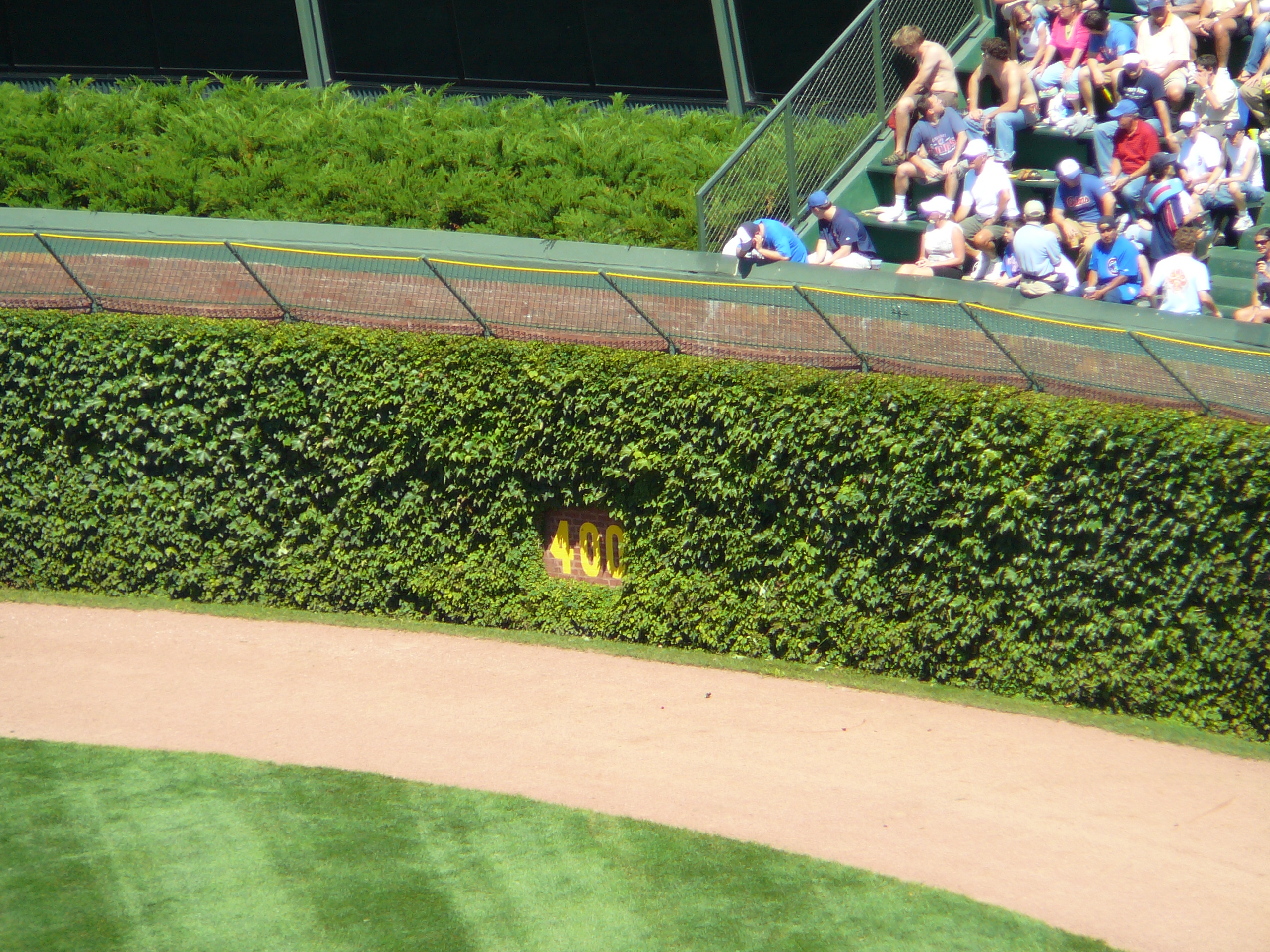
Two bases can also be awarded per home park ground rules—rules created to provide for unique playing conditions of a specific ballpark. For example, ground rules govern the situation when a batted ball is lodged in the ivy at Wrigley Field, or the walkways near the ceiling of Tropicana Field, a domed stadium.
The far more commonly occurring automatic double results from the generally applicable MLB rules 5.05(a)(6) through 5.05(a)(9). These rules govern how to treat the batter (and any runners on base) when a batted ball is hit fair but passes out of the field of play or becomes artificially obstructed while in the field of play. For example, these rules cover balls that hit the ground in fair territory and land out of play, typically by bouncing over a fence or wall in the outfield. The rules also provide generically for the award of a double when a batted ball goes through or under a fence; and when it goes through or sticks in shrubbery or vines on the fence.

MLB rule 5.05(a)(9) governs when fair fly balls are deflected into the stands by a fielder: "The batter becomes a runner when... Any fair fly ball is deflected by the fielder into the stands, or over the fence into foul territory, in which case the batter shall be entitled to advance to second base; but if deflected into the stands or over the fence in fair territory, the batter shall be entitled to a home run. However, should such a fair fly be deflected at a point less than 250 ft from home plate, the batter shall be entitled to two bases only."
When two bases are awarded by either ground rules or the automatic rule, any baserunners ahead of the batter are entitled to advance two bases from their positions at the time of pitch. Only in the case of interference is the umpire vested with discretion to award more bases (see MLB rule 6.01).
History
In the early years of baseball, batted balls that cleared the fence in fair territory on the fly or after a bounce were counted as home runs. The rule was changed by the American League before the season and by the National League before the season. Baseball records did not differentiate between home runs that cleared the fence on the fly and those that bounced over. Notably, this includes most of Babe Ruth's career, including when he hit 60 home runs in 1927, although there is no evidence any of Ruth’s home runs bounced before going over the fence. The last "bounce" home run in MLB was hit by Al López of the Brooklyn Robins on September 12, 1930, at Ebbets Field.
References
References
- (2011). "The Dickson Baseball Dictionary". W. W. Norton & Company.
- "Universal Ground Rules".
- Sullivan, Paul. (October 21, 2015). "Wrigley Field Ivy Has an Appetite for Baseballs". [[Chicago Tribune]].
- (2015). "J.D. Martinez Robbed of Home Run by Tropicana Field Catwalk".
- (2019). "Official Baseball Rules". Office of the Commissioner of Baseball.
- Snyder, Matt. (October 21, 2015). "Umpires should have discretion on ground-rule doubles".
- "New York Mets at Chicago Cubs NLCS Game 3 Highlights October 20, 2015".
- (December 17, 1930). "Changes are Made in the Baseball Playing Rules by Joint Rules Committee". Santa Cruz Evening News.
- (July 19, 1998). "Babe's Bounces". [[The New York Times]].
- O'Gara, Connor. "Future Hall of Famer Al López Hits the Last 'Bounce' Home Run in Big League History".
This article was imported from Wikipedia and is available under the Creative Commons Attribution-ShareAlike 4.0 License. Content has been adapted to SurfDoc format. Original contributors can be found on the article history page.
Ask Mako anything about Ground rule double — get instant answers, deeper analysis, and related topics.
Research with MakoFree with your Surf account
Create a free account to save articles, ask Mako questions, and organize your research.
Sign up freeThis content may have been generated or modified by AI. CloudSurf Software LLC is not responsible for the accuracy, completeness, or reliability of AI-generated content. Always verify important information from primary sources.
Report