From Surf Wiki (app.surf) — the open knowledge base
Grise Fiord

| Field | Value |
|---|---|
| official_name | Grise Fiord |
| native_name | ᐊᐅᔪᐃᑦᑐᖅ |
| iu | |
| settlement_type | Hamlet |
| image_skyline | Downtown Grise Fiord.jpg |
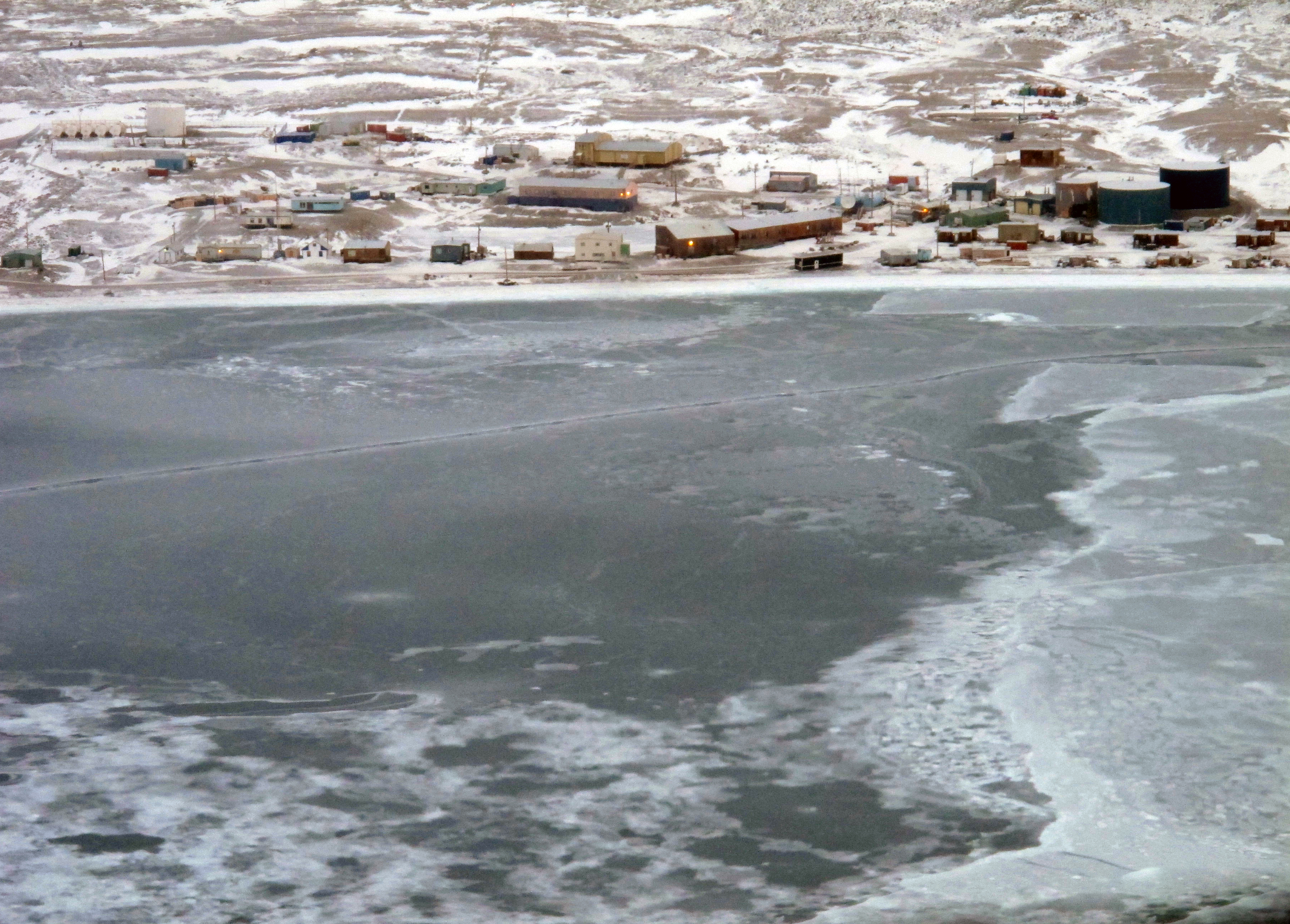
| image_caption | Downtown Grise Fiord, March 2004 |
| flag_size | 150x75px |
| pushpin_map | Canada Nunavut#Canada |
| subdivision_type | Country |
| subdivision_name | Canada |
| subdivision_type1 | Territory |
| subdivision_name1 | Nunavut |
| subdivision_type2 | Region |
| subdivision_name2 | Qikiqtaaluk |
| subdivision_type3 | Electoral district |
| subdivision_name3 | Quttiktuq |
| government_footnotes | |
| leader_title | Mayor |
| leader_name | Meeka Kiguktak |
| leader_title1 | MLA |
| leader_name1 | Steven Taqtu |
| established_title | High Arctic relocation |
| established_date | 1953 |
| area_footnotes | |
| area_total_km2 | 332.90 |
| population_as_of | 2021 |
| population_footnotes | |
| population_total | 144 |
| population_density_km2 | 0.4 |
| timezone | EST |
| utc_offset | −05:00 |
| timezone_DST | EDT |
| utc_offset_DST | −04:00 |
| coordinates | |
| elevation_footnotes | (at airport) |
| elevation_ft | 135 |
| postal_code_type | Canadian Postal code |
| postal_code | X0A 0J0 |
| area_code | 867, Exchange: 980 |
iu
Grise Fiord (; it is the largest community (and only public community) on Ellesmere Island. Created by the Canadian Government in 1953 through a relocation of Inuit families from Inukjuak, Quebec, it is Canada's northernmost public community. It is also one of the coldest inhabited places in the world, with an average yearly temperature of -16.5 C.
History
Creation
Main article: High Arctic relocation
This community (and that of Resolute) was created by the Canadian government in 1953, partly to assert sovereignty in the High Arctic during the Cold War. Eight Inuit families from Inukjuak, Quebec (on the Ungava Peninsula), were relocated after being promised homes and game to hunt, but the relocated people discovered no buildings and very little familiar wildlife. They were told that they would be returned home after "two or three years" if they wished. This offer was later withdrawn however, for it would have damaged Canada's claims to sovereignty in the area; the Inuit were forced to stay. Eventually, the Inuit learned the local beluga whale migration routes and were able to survive in the area, hunting over a range of 18000 km2 each year.
In 1993, the Canadian government held hearings to investigate the relocation program. The Royal Commission on Aboriginal Peoples issued a report entitled The High Arctic Relocation: A Report on the 1953–55 Relocation, recommending a settlement. The government paid CAD10 million to the survivors and their families, and gave a formal apology in 2010.
In 2009, artist and Grise Fiord resident Looty Pijamini was commissioned by Nunavut Tunngavik Incorporated to build a monument to commemorate the Inuit who sacrificed so much as a result of the Government's forced relocation programme of 1953 and 1955. Pijamini's monument, located in Grise Fiord, depicts a woman with a young boy and a husky, with the woman sombrely looking out towards Resolute Bay. Amagoalik's monument, located in Resolute, depicts a lone man looking towards Grise Fiord. This was meant to show separated families, and depicting them longing to see each other again. The Grise Fiord monument was unveiled by John Duncan, at the time, Minister of Aboriginal Affairs and Northern Development and Federal Interlocutor for Métis and Non-Status Indians, on September 10, 2010.
Grise Fiord was the location for a 1995 BBC television documentary entitled Billy Connolly: A Scot in the Arctic, in which the comedian Billy Connolly camped alone for a week on the pack ice near to the community, armed with a rifle to protect him from polar bears.
Geography
Located at the southern tip of Ellesmere Island, Grise Fiord is one of three permanently inhabited places on the island. Farther north on the island, Environment Canada has a permanent weather station at Eureka, and at Alert there is a permanent Canadian Forces Base (CFS Alert) and weather station. Grise Fiord lies 1160 km north of the Arctic Circle, and is the northernmost civilian community in Canada.
Grise Fiord is cradled by the Arctic Cordillera mountain range.
Climate
Grise Fiord has a tundra climate (Köppen: ETf; Trewartha: Ftkd) with very short, cool summers and long, cold winters lasting almost the entire year.
Demographics
|1976|121 |1981|106 |1986|114 |1991|130 |1996|148 |2001|163 |2006|141 |2011|130 |2016|129 |2021|144
In the 2021 Canadian census conducted by Statistics Canada, Grise Fiord had a population of 144 living in 58 of its 64 total private dwellings, a change of from its 2016 population of 129. With a land area of 332.9 km2, it had a population density of in 2021.
Community and fiord names
Just to the north of the community is the actual fiord, Grise Fiord, which means "pig inlet" in Norwegian. Otto Sverdrup from Norway so named it during an expedition around 1900 because he thought walruses in the area sounded like pigs.
The Inuktitut name is ᐊᐅᔪᐃᑦᑐᖅ (Aujuittuq), which means "place that never thaws".
Living conditions

The houses are wooden and built on platforms to cope with the freezing and thawing of the permafrost. Hunting is still an important part of the lifestyle of the mostly Inuit population. Quota systems allow the villagers to supply many of their needs from populations of seals, walruses, narwhal and beluga whales, polar bears and muskox. Ecotourism is developing as people come to see the northern wildlife found on Ellesmere and surrounding islands.
Transportation
There are no connecting roads on Ellesmere Island, so Grise Fiord is connected to the rest of the world by a small airstrip (Grise Fiord Airport), 1675 ft in length. Surrounded by mountains, it has one of the most difficult approaches for aircraft; it is cautioned that only very experienced pilots of Pilatus PC-12, DHC-6 Twin Otter and DHC-7 aircraft attempt the approach.

For local travel needs, the villagers use all-terrain vehicles in the summer and snowmobiles in the winter. During the winter months travel is limited to the town site and a small patch of land to the east, called Nuvuk, due to mountains and ice fields that cut off the town from the rest of the island. Small boats are used in summer to reach hunting grounds, and to hunt sea mammals on the ocean. Once a year large ships (sealift) arrive with supplies and fuel.
Economy, development, and sustainability
The local cooperative is the main place to purchase supplies. There are local guide and outfitting operations, which are an important source of income for many families, as are carving, traditional clothing and other Inuit crafts. Due to the extreme location, the economy is subsistence-based. Because of the potential for avalanches and falling rocks from mountains, there is no room for expansion.
Communications

In 1970, Bell Canada established what was then the world's most northerly telephone exchange (operated since 1992 by Northwestel). It is in the 867 area code (formerly 819 before October 1997) with its only exchange code of 980.
Since 2005, the community has been served by the Qiniq network, a fixed wireless service to homes and businesses that connects to the outside world via a satellite backbone. In 2017 the network, designed and operated by SSI Micro, was upgraded to 4G LTE technology, and 2G-GSM for mobile voice. In 2019, Bell Mobility became available to Grise Fiord.
Crime and safety
A Simon Fraser University study of Royal Canadian Mounted Police (RCMP) activity in the Baffin Region states that Grise Fiord had the lowest rate of criminal offences of all communities examined in 1992, and cites a 1994 Statistics Canada survey indicating that the hamlet has the highest perception of personal safety.
Politics
| Election | Con | Lib | NDP | Green | Other | Total | Votes | % | Votes | % | Votes | % | Votes | % | Votes | % | Votes | Turnout | ||
|---|---|---|---|---|---|---|---|---|---|---|---|---|---|---|---|---|---|---|---|---|
| 2025 | 4 | 15.4 | 12 | CA | Liberal}}; color:white;" | 46.2 | 10 | 38.5 | – | 26 | 40.3% | |||||||||
| 2021 | 4 | 10.0 | 8 | 20.0 | 28 | CA | NDP}}; color:white;" | 70.0 | – | 40 | 47.1% | |||||||||
| 2019 | 10 | 23.3 | 15 | 34.9 | 16 | CA | NDP}}; color:white;" | 37.2 | 2 | 4.7 | – | 43 | 56.1% | |||||||
| 2015 | 14 | 29.8 | 22 | CA | Liberal}}; color:white;" | 46.8 | 11 | 23.4 | 0 | 0.0 | – | 47 | 55.2% | |||||||
| 2011 | 13 | 28.9 | 21 | CA | Liberal}}; color:white;" | 46.7 | 7 | 15.6 | 4 | 8.9 | – | 45 | 60.0% | |||||||
| 2008 | 6 | 13.6 | 18 | CA | Liberal}}; color:white;" | 40.9 | 14 | 31.8 | 6 | 13.6 | – | 44 | 53.7% | |||||||
| 2006 | 20 | CA | Conservative}}; color:white;" | 33.9 | 15 | 25.4 | 6 | 10.2 | 6 | 10.2 | 12 | 20.3 | 59 | 48.8% | ||||||
| 2004 | 15 | 33.3 | 21 | CA | Liberal}}; color:white;" | 46.7 | 1 | 2.2 | 1 | 2.2 | 7 | 15.6 | 45 | 54.9% |
Notable people
- P.J. Akeeagok, 6th premier of Nunavut
References
Notes
References
- "Municipal Election Results 2019-2020". [[Elections Nunavut]].
- "2021 General Election". [[Elections Nunavut]].
- {{Cite cgndb. OAGQA. Grise Fiord
- {{CFS
- "Census Profile, 2021 Census of Population". Statistics Canada.
- [https://www.cbc.ca/news/canada/north/grise-fiord-church-fire-1.4555531 Grise Fiord's only church a 'total loss' after late night fire]
- "Grise Fiord: History". Grisefiord.ca.
- "Wayback Machine".
- McGrath, Melanie. ''The Long Exile: A Tale of Inuit Betrayal and Survival in the High Arctic''. Alfred A. Knopf, 2006 (268 pages) Hardcover: {{ISBN. 0-00-715796-7 Paperback: {{ISBN. 0-00-715797-5
- "The High Arctic Relocation".
- Royte, Elizabeth. (8 April 2007). "Trail of Tears". The New York Times.
- "Apology for the Inuit High Arctic relocation".
- [http://www.nnsl.com/northern-news-services/stories/papers/may11_09cr.html "Carvers chosen for Arctic monuments"] {{webarchive. link. (25 March 2012, ''Northern News Services''. Retrieved 1 June 2011.)
- [http://www.ainc-inac.gc.ca/ai/mr/nr/s-d2010/23404-eng.asp "Minister Duncan Attends Unveiling of Inuit Relocation Monuments"] {{webarchive. link. (9 October 2010, ''Indian and Northern Affairs Canada''. Retrieved 1 June 2011.)
- [http://www.nunatsiaqonline.ca/stories/article/110910_for_grise_fiords_exiles_an_apology_that_came_too_late/ Gabriel Zarate, "For Grise Fiord’s exiles, an apology that came too late"] {{Webarchive. link. (5 November 2013 , ''Nunatsiaq Online''. Retrieved 1 June 2011.)
- (8 October 2014). "Grise Fiord fire hall catches fire". CBC News.
- (May 1992). "1981 Census of Canada: Census subdivisions in decreasing population order". [[Statistics Canada]].
- (September 1987). "1986 Census: Population - Census Divisions and Census Subdivisions". [[Statistics Canada]].
- (April 1992). "91 Census: Census Divisions and Census Subdivisions - Population and Dwelling Counts". [[Statistics Canada]].
- (April 1997). "96 Census: A National Overview - Population and Dwelling Counts". [[Statistics Canada]].
- (15 August 2012). "Population and Dwelling Counts, for Canada, Provinces and Territories, and Census Subdivisions (Municipalities), 2001 and 1996 Censuses - 100% Data (Nunavut)". [[Statistics Canada]].
- (20 August 2021). "Population and dwelling counts, for Canada, provinces and territories, and census subdivisions (municipalities), 2006 and 2001 censuses - 100% data (Nunavut)". [[Statistics Canada]].
- (25 July 2021). "Population and dwelling counts, for Canada, provinces and territories, and census subdivisions (municipalities), 2011 and 2006 censuses (Nunavut)". [[Statistics Canada]].
- (8 February 2017). "Population and dwelling counts, for Canada, provinces and territories, and census subdivisions (municipalities), 2016 and 2011 censuses – 100% data (Nunavut)". [[Statistics Canada]].
- (9 February 2022). "Population and dwelling counts: Canada, provinces and territories, and census subdivisions (municipalities), Nunavut". [[Statistics Canada]].
- "ᐊᐅᔪᐃᑦᑐᖅ". [[Elections Nunavut]].
- "Hamlet of Grise Fiord".
- "Grise Fiord: Wildlife".
- "Sealift Services".
- [https://cartt.ca/article/cts-2018-its-not-easy-bring-wireless-top-world CTS 2018: It's not easy to bring wireless to the top of the world]
- (2017-09-19). "Competitive cell service coming to all Nunavut communities by 2019".
- Curt Taylor Griffiths, Gregory Saville, Darryl S. Wood, and Evelyn Zellerer. ''POLICING THE BAFFIN REGION, N.W.T.: Findings From the Eastern Arctic Crime and Justice Study'', 1995 [http://www.justiceexpert.com/pdfs/Policing%20in%20the%20Arctic.pdf]{{Dead link. (June 2024)
- "Aboriginal Peoples Survey", Statistics Canada, 1994, cited on p17 of Curt Taylor Griffiths, Gregory Saville, Darryl S. Wood, and Evelyn Zellerer, ''POLICING THE BAFFIN REGION, N.W.T.: Findings From the Eastern Arctic Crime and Justice Study'' [http://www.justiceexpert.com/pdfs/Policing%20in%20the%20Arctic.pdf]{{Dead link. (June 2024)
- (17 November 2021). "P.J. Akeeagok has been selected as Nunavut's next premier". [[CBC North]].
This article was imported from Wikipedia and is available under the Creative Commons Attribution-ShareAlike 4.0 License. Content has been adapted to SurfDoc format. Original contributors can be found on the article history page.
Ask Mako anything about Grise Fiord — get instant answers, deeper analysis, and related topics.
Research with MakoFree with your Surf account
Create a free account to save articles, ask Mako questions, and organize your research.
Sign up freeThis content may have been generated or modified by AI. CloudSurf Software LLC is not responsible for the accuracy, completeness, or reliability of AI-generated content. Always verify important information from primary sources.
Report