From Surf Wiki (app.surf) — the open knowledge base
Grieco elimination
Chemical reaction
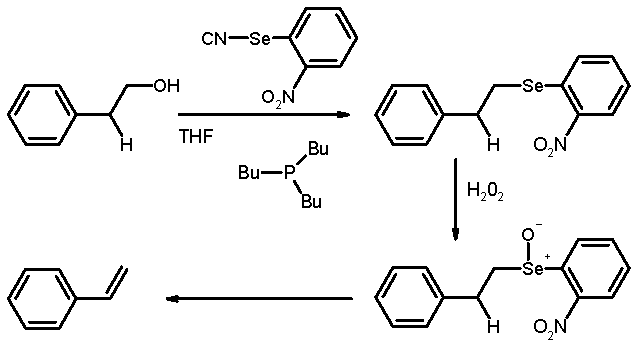
Chemical reaction
The Grieco elimination is an organic reaction describing the elimination reaction of an aliphatic primary alcohol through a selenide to a terminal alkene. It is named for Paul Grieco.
The alcohol first reacts with o-nitrophenylselenocyanate and tributylphosphine to form a selenide via a nucleophilic substitution on the electron-deficient selenium. In the second step, the selenide is oxidized with hydrogen peroxide to give a selenoxide. This structure decomposes to form an alkene by an Ei elimination mechanism with expulsion of a selenol in a fashion similar to that of the Cope elimination. This reaction takes part in the synthesis of ring C of the Danishefsky Taxol synthesis.
The elimination step is common with the Clive-Reich-Sharpless olefination that uses PhSeX as the selenium source.
References
References
- (1976). "Organoselenium chemistry. A facile one-step synthesis of alkyl aryl selenides from alcohols". [[J. Org. Chem.]].
- (1975). "Olefin synthesis. Rate enhancement of the elimination of alkyl aryl selenoxides by electron-withdrawing substituents". [[J. Org. Chem.]].
- (2011). "Organic Syntheses Based on Name Reactions: A Practical Guide to Over 800 Transformations.". Elsevier.
This article was imported from Wikipedia and is available under the Creative Commons Attribution-ShareAlike 4.0 License. Content has been adapted to SurfDoc format. Original contributors can be found on the article history page.
Ask Mako anything about Grieco elimination — get instant answers, deeper analysis, and related topics.
Research with MakoFree with your Surf account
Create a free account to save articles, ask Mako questions, and organize your research.
Sign up freeThis content may have been generated or modified by AI. CloudSurf Software LLC is not responsible for the accuracy, completeness, or reliability of AI-generated content. Always verify important information from primary sources.
Report