From Surf Wiki (app.surf) — the open knowledge base
Green papaya salad
Spicy salad made from unripe papaya
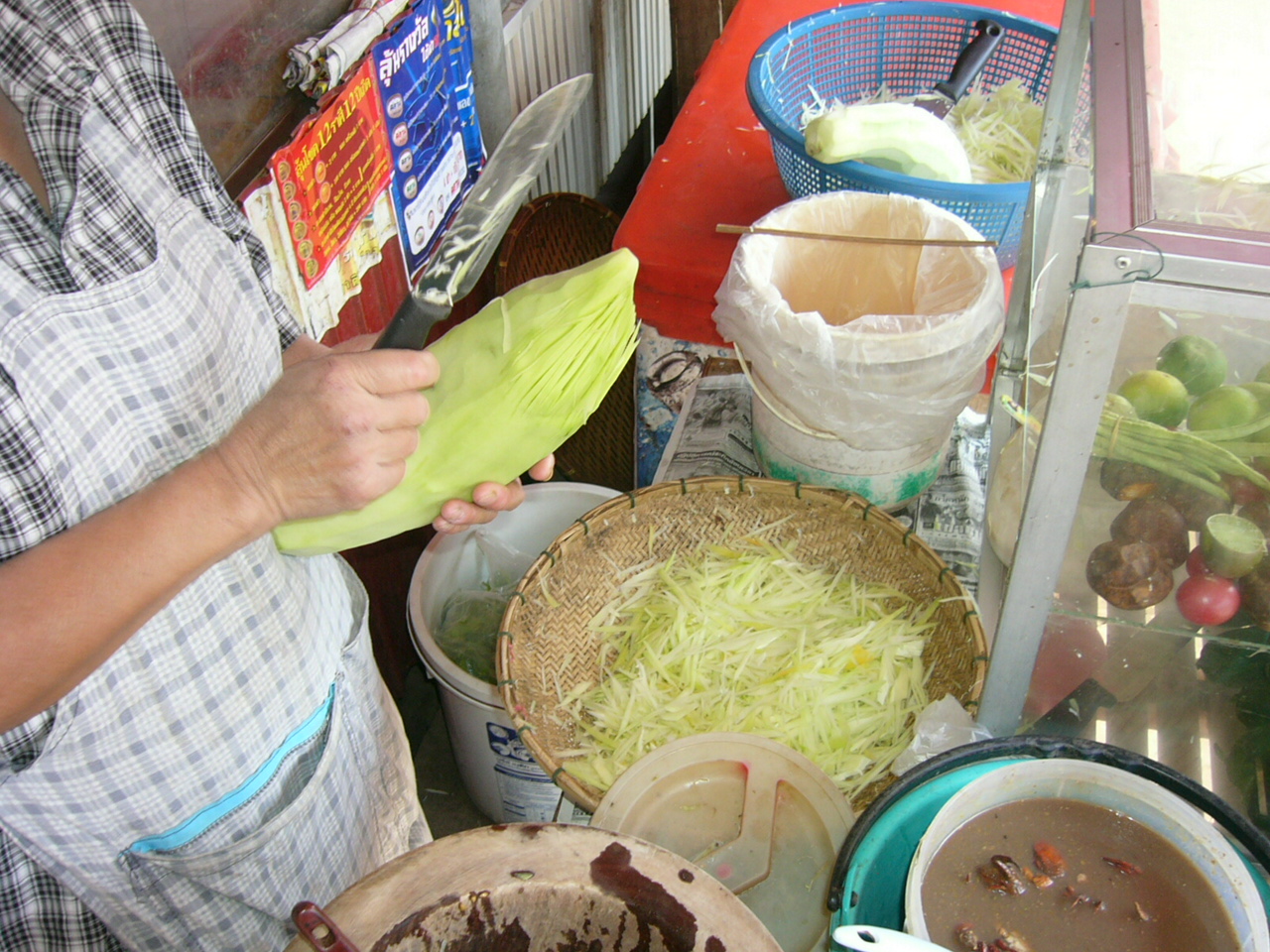
Spicy salad made from unripe papaya
| Field | Value |
|---|---|
| name | Green papaya salad |
| image | 2013 Tam Lao.jpg |
| image_size | 250px |
| caption | Green papaya salad with yardlong beans, chili, pla ra, brined crab, hog plum and lime |
| country | Laos |
| region | Southeast Asia |
| national_cuisine | Xishuangbanna (China), Burmese, Cambodian, Lao, Thai, Vietnamese |
| type | Salad |
| main_ingredient | Green papaya |
Green papaya salad is a spicy salad made from shredded unripe papaya. Originating in Laos, it is a national dish and a cornerstone of Lao cuisine, known locally as tam som or tam mak hoong. The dish exemplifies bold, vibrant flavors, blending sour, spicy, salty, and sweet elements, and holds deep cultural significance in Laos.
Green papaya salad is also widely popular in Thailand, particularly in the Isan region, which shares close ethnic and cultural ties with Laos due to its predominantly ethnic Lao population. Introduced to Thailand via Isan, the dish—called som tam in Thai—became a staple of Thai cuisine and spread nationwide. Beyond Laos and Thailand, green papaya salad has also gained regional prominence across continental Southeast Asia, including Cambodia, Myanmar, and Vietnam.
Etymology
The dish is deeply rooted in Lao cuisine, where it is traditionally called tam mak hoong (, , ) or tam som (, , ), in which the word tam () refers to the pounding of ingredients in a mortar, a method of preparation central to Lao and neighboring culinary traditions.
In Thailand, the salad is widely known as som tam (, , ), combining the Thai words som (ส้ม, "sour") and tam (ตำ, "pounded"). In Isan, a region with strong cultural and linguistic ties to Laos, the salad uses Lao-derived names tam bak hung () or tam som ().
Regional variations and names include:
- Burmese: သင်္ဘောသီးသုပ် (thìn bau: thi: thoùp)
- Khmer: បុកល្ហុង (bok l’hong)
- Rakhine: ပဒကာသီးသုပ် (pədəɡà θí θùp)
- Vietnamese: gỏi đu đủ (a general term for papaya salad, often less spicy)
History
Papayas and chili peppers were introduced to Southeast Asia by the Spanish and Portuguese explorers in the 17th century from the Americas in the Columbian Exchange. Simon de la Loubère (1642–1729), a French diplomat, mentioned in his book that the cultivation of papaya was already widespread in Siam in 1693.
Although it is unknown when papayas and chili peppers entered Laos specifically, they had already been fully integrated into the Lao territory by the time Jean-Baptiste Pallegoix and Henri Mouhot visited in mid-1800s, and were listed among key ingredients for preparing main Lao dishes. The Lao were introduced to papaya (mak hung) from Khmer Loeu living in provinces bordering the southeastern Laos (who called them l'hun or lohung/rohung in Khmer). Papaya, among other fruits, were cultivated in Cambodia in the 1500s.
Green papaya salad was mentioned as a favorite Lao dish by a former Lao politician, Katay Don Sasorith (1904–1959), in a memoir recounting his experience during his primary school years in 1910s. Furthermore, according to the travelogue “Nirat Wang Bang Yi Khan” written in 1869 by Thai poet Khun Phum, the dish was already known among members of the Lao royal family living as war hostages in Bang Yi Khan compound in Bangkok, Siam. Thai historian Sujit Wongthes has speculated that the green papaya salad originated during the late 18th to early 19th centuries in the communities of ethnic Chinese–Lao settlers living in what is now Central Thailand, where papayas were widely cultivated by Chinese immigrants. The Lao settlers, who were war captives deported from Lan Xang, adopted the ancient Lao tradition of preparing salads from fruits, called tam som, to make salads from papayas. The new dish became known as som tam (the reversed order of tam som) and, along with the papayas, then spread to today's Northeast Thailand following the construction of the Northeastern railway line during the turn of the 19th–20th centuries. The dish became more popular after the opening of Mittraphap Road in 1957, and has since become widely adopted by the ethnic Lao people of both Isan and Laos. Likewise, the hot flavour also spread to Isan and Laos from Central Thailand, which had been introduced to chilli peppers first.
However, papayas and chili peppers were already integrated in the Lao territory and Lao culinary recipes in mid-1800s to early 1900s while, during the 1950s and 1960s, green papaya salad and other Lao dishes were rarely known in Bangkok. They could only be found around the boxing stadium that gathered boxers and fans from Northeastern Thailand, as well as in mobile food carts outside construction sites with Northeastern workers and gas stations serving long-distance bus drivers. Some believe that som tam gained popularity among the young Thai generations following an active publicity in the 1970s.{{cite web |publication-date=31 October 2016|title=Open Source!!Somtum Song (เปิดที่มา!! "เพลงส้มตำ")
Others believe that som tam has evolved from a Thai dish called pu tam or tam pu ( หรือ ตำปู, ) mentioned in a recipe by chef, Khunying Plian Phatsakarawong in her 1908 cookbook. This dish shares similarities with modern-day som tam but does not include papaya as an ingredient. The earliest known recipe of som tam in Thailand appeared in the Yaowapha cookbook series by Princess Yaovabha Bongsanid in 1935, which included Som tam ton malako () or Khao man som tam (). This recipe is similar to som tam as prepared today and includes roasted peanuts and dried shrimp as key ingredients. It is often served with rice cooked in coconut milk.
Preparation
The dish combines the five main basic tastes: the sourness of the lime, spiciness of the chili, saltiness and savoriness of the fish sauce, and sweetness of palm sugar.
Pounded salads in Laos all fall under the parent category of tam som, which may or may not contain green papaya; when no specific type of tam som is mentioned, it is generally understood to refer to green papaya salad. For absolute clarity, however, the name tam maak hoong may be used, since this name means "pounded papaya".
In Thailand, it is customary for a customer to ask the preparer to make the dish suited to the customer's own tastes. To specifically refer to the original style of papaya salad as prepared in Laos or Isan, it is known as ส้มตำลาว or som tam Lao or simply as tam Lao and the dish as prepared in central Thailand may be referred to as som tam Thai.
Traditionally, the local variety of green papaya salad in the streets of Bangkok is very spicy due to the addition of a fistful of chopped hot bird's eye chili. However, with its rising popularity among tourists, it is now often served less spicy than it used to be in the past.
Additional ingredients
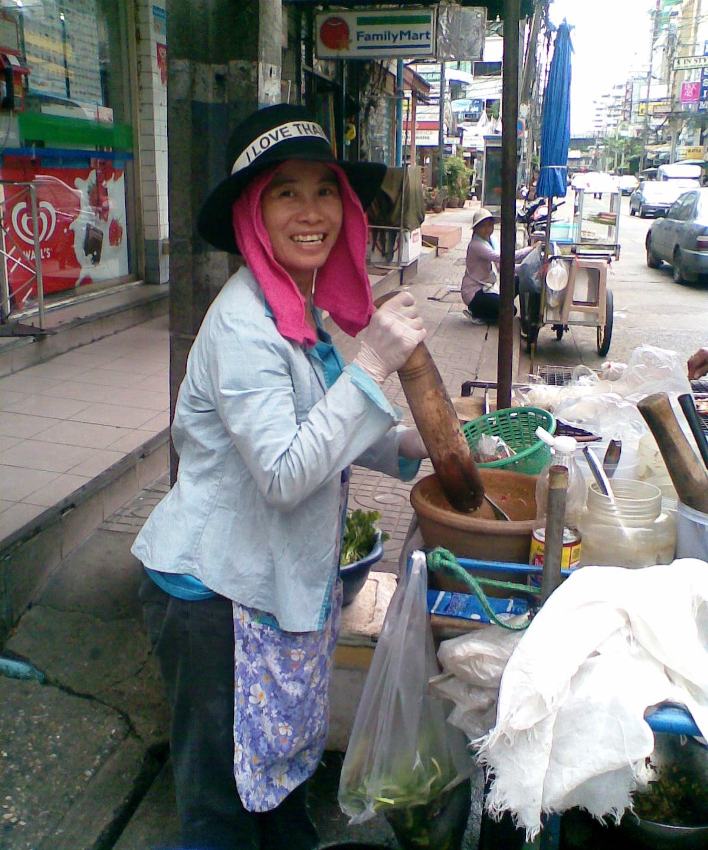

Together with the papaya, some or most of the following secondary items are added and pounded in the mortar with the pestle:
- Asparagus beans
- Brined "rice field crabs". These belong to the freshwater crab genera Sayamia, Chulathelphusa, and Esanthelphusa (previously classified as part of the genus Somanniathelphusa), which all belong to the Gecarcinucid crab subfamily Parathelphusinae. found in flooded rice fields and canals. Isan people eat the entire crab, including the shell.
- Chili pepper
- Dried shrimp
- Fish sauce
- Garlic
- Monosodium glutamate
- Hog plums
- Lime slice and lime juice
- Palm sugar
- Shrimp paste
- Fish paste
- Raw Thai eggplant
- Cherry or grape tomatoes (green or ripe)
Green papaya salad is often served with glutinous rice and kai yang/ping gai (grilled chicken). It can also be eaten with fresh rice noodles or simply as a snack by itself with, for instance, crispy pork rinds. The dish is often accompanied by raw green vegetables such as water spinach and white cabbage wedges on the side to mitigate the spiciness of the dish.
Variations
A non-spicy green papaya salad version exists in Laos, Vietnam and Thailand, which is much sweeter; it often contains crushed peanuts and is less likely to have fish paste or brined crab. Dried brine shrimp are used in this Central Thai version. There are also versions that make use of unripe mangoes, apples, cucumbers, carrots and other firm vegetables or unripe fruit. Besides using varieties of fruits or vegetables as the main ingredient a popular option is to use vermicelli rice noodles wherein the dish is known as tam sua.
Instead of papaya, other ingredients can be used as the main ingredient. Popular variations in Laos and Thailand include the salad with:
- Cucumber, usually the small variety (tam maak taeng, tam taengkwa)
- Green and unripe mango (tam maak muang, tam mamuang)
- Green and unripe bananas (tam maak kuai, tam kluai)
- Hard and unripe santol (tam krathon)
- Banana flowers (tam hua pli)
- Malay gooseberry (tam mayom)
- Pomelo (tam som o)
- Mu yo sausage (tam mu yo)
- Mixed fruit (tam phonlamai ruam)
- Coconut rice (khao man som tam)
File:Lao papaya salad.jpg|Lao papaya salad with pork rinds File:Luang Prabang papaya salad.jpg|Luang Prabang style Lao papaya salad from Northern Laos File:Lao papaya salad with seafood.jpg|Lao papaya salad with selected crustacea, mollusks, and shellfish in addition to papaya strips File:Som tam thai.JPG|Thai green papaya salad with peanuts File:Som tam pu.jpg|Green papaya salad with brined rice paddy crabs (som tam pu) File:Tam phonla mai ruam.jpg|Green papaya salad with mixed fruit (tam phonlamai ruam) File:Somtam huapli832.jpg|Green papaya salad with banana flowers (tam hua pli) File:Tam mu yo.jpg|Green papaya salad with mu yo sausage (tam mu yo) File:Tam mamuang pla haeng thot.jpg|A variation of the salad with green mango instead of papaya and dried anchovies (tam mamuang pla haeng thot) File:Tam maphrao on sen mi krop 02.jpg|Tam maphrao on sen mi krop: a variation with soft coconut meat and deep-fried rice noodle
Reception
The Thai variation som tam has been listed at number 46 on World's 50 most delicious foods compiled by CNN Go in 2011 and 2018.
Note
References
References
- (5 February 2015). "Laotian Food Is The International Cuisine You've Been Missing".
- (5 January 2010). "The Tao of Papaya".
- (2010). "Encyclopedia of Asian American Folklore and Folklife". [[ABC-CLIO]].
- Iverson, Kelly. (9 May 2017). "A Brief History of Som Tum, Thailand's Popular Green Papaya Salad".
- (24 August 2020). "The Curious History of Som Tum (Papaya Salad)".
- (24 October 2011). "10 National Dishes from Southeast Asia".
- (24 May 2017). "Papaya salad with shrimp, Laos". Deutsche Welle.
- "Southeast Asian Cuisine: What to Eat in Southeast Asia and Where to Find It".
- สุชาฎา ประพันธ์วงศ์. "ส้มตำไม่ใช่อาหารประจำชาติไทยจริงหรือไม่".
- Ian. "The Som Tum Thai Story".
- (n.d.). "Som Tam, the Ori-gins and Recipe/".
- (15 September 2022). "The Ultimate Guide to Som Tum (Papaya Salad)". Expique.
- (2023-04-06). "Som Tam Recipe (Thai Green Papaya Salad) from Chef David Thompson".
- (21 February 2018). "Best somtum places in Bangkok".
- (2008). "Cambodian Cooking: A humanitarian project in collaboration with Act for Cambodia". [[Periplus Editions]].
- (2014-02-04). "The Food of Myanmar: Authentic Recipes from the Land of the Golden Pagodas". Tuttle Publishing.
- Thida Koeut. (January 24, 2023). "Papaya Salad Recipe: How to Make Green Papaya Salad (Cambodian Version)".
- Van Esterik, Penny. (2008). "Food Culture of Southeast Asia". [[Greenwood Press]].
- (1693). "A New Historical Relation of the Kingdom of Siam A Description of the principal Fruits of Siam.".
- Bernard Maloney. (October 1999). "Environmental Reconstruction at Ayutthaya". Southeast Asian Archaeology Newsletter.
- Callis, Kristine Lee. (2005). "The History of Plant Use in Laos: Analysis of European Accounts of Plant Use for Primarily Religious and Medicinal Purposes". [[North Carolina State University]].
- Mouhot, Henri, and Ferdinand de. Lanoye. Voyage Dans Les Royaumes De Siam, De Cambodge, De Laos Et Autres Parties Centrales De L'Indo-Chine: Relation Extraite Du Journal Et De La Correspondance De L'auteur. Hachette, 1868. 322. Print
- Estrade, Docteur. (1895). "Manuel de conversation, franco-laotiens: prononciation en français avec signes conventionnel, transcription de tous les termes en caractères laotiens., deuxieme edition".
- (1872). "Voyage En Indo-Chine Et Dans L'empire Chinois. Paris: E. Dentu". E. Dentu.
- Massie, Victor-Alphonse. (1894). "Dictionnaire français-laotien: Mission Pavie, exploration de l' indochine (Latin characters)".
- (1969). "Notes ethnobotaniques sur quelques plantes en usage au Cambodge". Bulletin de l'École Française d'Extrême-Orient.
- (1965). "Les arbres fruitiers d'Indochine". Journal d'agriculture traditionnelle et de botanique appliquée.
- Sasorith, Katay D. (1958). "Souvenirs d'un ancien écolier de Paksé". Editions Lao Sedone.
- "Remnants of the Laos connection".
- "นิราศวังบางยี่ขัน".
- (25 December 2014). "′มะละกอ′มีกำเนิดจากทวีปอเมริกา มาเป็น′ส้มตำ′ เริ่มมีในบางกอก - สุวรรณภูมิในอาเซียน". Matichon.
- "ส้มตำของใคร?".
- "Lao Papaya Salad".
- "เปิดประวัติ ส้มตำ เมนูรสเด็ดที่ใคร ต่างก็ชื่นชอบ แถมยังสามารถทำทานเองได้ง่ายๆ".
- "ตำบักหุ่งนัวคัก".
- ธงชัย ลิขิตพรสวรรค์. (July 25, 2020). "สืบที่มา "ส้มตำ" เข้ากรุงเทพฯ เมื่อไหร่-คนกรุงสมัยก่อนกินส้มตำที่ไหน". ศิลปวัฒนธรรม.
- (1992). "From Marco Polo to McDonald's: Thai cuisine in transition". Food and Foodways: Explorations in the History and Culture of Human Nourishment.
- (1908). "แม่ครัวหัวป่าก์".
- Yaowaphapong Sanit HRH Princess Maha Chakri Sirindhorn. (1884–1934). "ตำหรับสายเยาวภา: บอกวิธีปรุงอาหารคาวหวาน มีภาพประกอบ". Thammasat University.
- คมกฤช อุ่ยเต็กเค่ง. (February 1, 2021). ""ลอ-กอ-ยอก" ปักษ์ใต้ก็มีส้มตำที่ไม่ได้มาจากกรุงเทพฯ หรืออีสาน".
- Ponchunchoovong, Samorn (2006). [http://sutir.sut.ac.th:8080/sutir/bitstream/123456789/1341/2/BIB1172_F.pdf Species identification of Thai Rice-field Crab in the lower north-eastern region of Thailand] {{Webarchive. link. (9 August 2017 .)
- "Clay's Kitchen : Tam Ra Ahan Thai (Thai Recipes) ตำราอาหารไทย". panix.com.
- (August 1, 2022). "Green Papaya Salad Recipe: 6 Papaya Salad Variations".
- (12 July 2017). "The world's 50 best foods".
- (21 July 2011). "World's 50 most delicious foods".
- (14 March 2018). "The world's 50 best foods".
This article was imported from Wikipedia and is available under the Creative Commons Attribution-ShareAlike 4.0 License. Content has been adapted to SurfDoc format. Original contributors can be found on the article history page.
Ask Mako anything about Green papaya salad — get instant answers, deeper analysis, and related topics.
Research with MakoFree with your Surf account
Create a free account to save articles, ask Mako questions, and organize your research.
Sign up freeThis content may have been generated or modified by AI. CloudSurf Software LLC is not responsible for the accuracy, completeness, or reliability of AI-generated content. Always verify important information from primary sources.
Report