From Surf Wiki (app.surf) — the open knowledge base
Green in Islam
Significance of the colour green in Islam

Significance of the colour green in Islam
The color green holds a distinct significance in Islamic culture, as it has appeared with symbolic meanings throughout various Islamic eras and among different schools and sects. It was present in the Qur’anic texts, especially in the descriptions of Paradise, as stated in the verse: "They will wear green garments of fine silk and brocade" (Qur’an 18:31). It is also mentioned in an authentic hadith that the Prophet Muhammad wore two green garments, as narrated by Abu Rimthah: “He had locks hanging down as far as the lobes of the ears stained with henna, and he was wearing two green garments.”
Quran
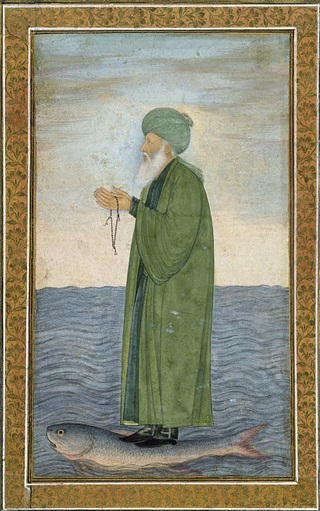
Al-Khidr ("The Green One") is a Qur’anic figure who met and traveled with Moses.
The present Green Dome over the Prophet’s tomb was added in 1818 under the Ottoman sultan Mahmud II.{{cite book
Islamic flags
Main article: Islamic flags
Main article: List of countries with the Islamic symbols displayed on their flag
Green flags were adopted by Shi'ites in the early Islamic period, although the most common Shi'a color was white, in symbolic opposition to Abbasid black. Thus in 817, when the Abbasid caliph al-Ma'mun adopted the Alid Ali al-Ridha as his heir-apparent, he also changed the dynastic color from black to green. The change was reverted al-Ma'mun had Ali killed, and returned to Baghdad in 819.
Various national flags use green as a symbol of Islam, including Algeria, Azerbaijan, Comoros, Mauritania, Pakistan, Saudi Arabia, Sri Lanka, and Tajikistan. Some Arab countries also use pan-Arab colors, which include green. These include: Iraq, Jordan, Kuwait, Lebanon, Sudan, Syria, and the United Arab Emirates, as well as several contested states including Palestine, Somaliland, and Western Sahara. Libya formerly also followed this principle, featuring green as its only component color (at the time the only flag in the world to use only one color) until 2011.
There are also several flags of Muslim-majority countries featuring green color that does not symbolize Islam. Examples include Bangladesh, Turkmenistan, Uzbekistan, Guinea, Guinea-Bissau, Mali, and Senegal (in the latter four cases, the green color is a component of the pan-African colors, which are also adopted by even Christian-majority countries such as Malawi and South Sudan).
In Islam, the color green holds significant symbolism and is often associated with nature, life, and renewal. It is frequently referenced in religious texts and traditions, symbolizing paradise and the lush landscapes described in the Qur'an. Beyond its use in national flags of some Islamic countries, such as Saudi Arabia and Iran, green is widely utilized in Islamic art, architecture, and attire. Its prevalence in mosques, Qur'anic manuscripts, and decorative elements underscores its importance in Islamic culture and aesthetics.
Green is a common color used by Islamist political parties.
Gallery
File:16th Century Barbary Corsairs Flag.svg|A green Barbary corsairs flag with a skull on it. File:BarbarosSancagi.svg|The flag of Hayreddin Barbarossa File:Flag of Saudi Arabia.svg|Flag of Saudi Arabia File:Flag of Pakistan.svg|Flag of Pakistan File:Flag of Bangsamoro.svg|Flag of Bangsamoro, Philippines File:Flag of Egypt (1922-1958).svg|Flag of the Kingdom of Egypt File:Flag of al-Qassam Brigades.svg|Flag of al-Qassam Brigades
References
- The Qur’an. Surah Al-Kahf 18:31.
- Abu Dawood, Sulayman ibn al-Ash‘ath al-Sijistani. Sunan Abu Dawood. Vol. 4, Hadith No. 4206, pp. 466–467. Translated by Nasiruddin al-Khattab, Darussalam, 2008. Archive.org
Sources
- Petersen, Andrew. Dictionary of Islamic Architecture. London and New York: Routledge, 2002. p. 184. Online version
Bibliography
- Abdul-Matin, Ibrahim. “Green Deen: What Islam Teaches about Protecting the Planet.” Green Deen: What Islam Teaches about Protecting the Planet, Kube Publishing, 2012.
References
- Abu Dawood, Sulayman ibn al-Ash‘ath al-Sijistani. ''Sunan Abu Dawood.'' Vol. 4, Hadith No. 4206, pp. 466–467. Translated by Nasiruddin al-Khattab, Darussalam, 2008. [https://archive.org/details/SunanAbuDawoodEnglish_201409/sunan_abu_dawud_vol.4-_ahadith_3242-4350/page/467/mode/2up Archive.org]
- Burge, S.R.. (2015-03-04). "The Search for Meaning: Tafsīr, Hermeneutics, and Theories of Reading". Arabica.
- Sharifah M. AlOboudi. (2015-07-01). "Najd, the Heart of Arabia". Arab Studies Quarterly.
- Tabataba’i, Sayyid Muhammad Husayn. (2023). "Al-Mizan: An Exegesis of the Qur'an". Tawheed Institute Australia Ltd..
- Tabataba’i, Sayyid Muhammad Husayn. (2023). "Al-Mizan: An Exegesis of the Qur'an". Tawheed Institute Australia Ltd..
- Catherine, David. "Al-Khidr, The Green Man".
- David-Weill, J.. "ʿAlam".
- {{The History of al-Tabari. link
- Hathaway, Jane. (2003). "A Tale of Two Factions: Myth, Memory, and Identity in Ottoman Egypt and Yemen". State University of New York Press.
- {{The Prophet and the Age of the Caliphates
- "Field Listing :: Flag Description". Central Intelligence Agency.
- "Information about national flag of Tajikistan".
- (1993). "Characteristics of the Islamic State". Islamic Studies.
- (2006). "Color Design Workbook: A Real World Guide to Using Color in Graphic Design". [[Rockport Publishers]].
- Giles Milton, ''White Gold '' (2004), p. 9: "The flags on their mainmasts depicted a human skull on a dark green background - the menacing symbol of a new and terrible enemy. It was the third week of July 1625, and England was about to be attacked by the Islamic corsairs of Barbary."
This article was imported from Wikipedia and is available under the Creative Commons Attribution-ShareAlike 4.0 License. Content has been adapted to SurfDoc format. Original contributors can be found on the article history page.
Ask Mako anything about Green in Islam — get instant answers, deeper analysis, and related topics.
Research with MakoFree with your Surf account
Create a free account to save articles, ask Mako questions, and organize your research.
Sign up freeThis content may have been generated or modified by AI. CloudSurf Software LLC is not responsible for the accuracy, completeness, or reliability of AI-generated content. Always verify important information from primary sources.
Report