From Surf Wiki (app.surf) — the open knowledge base
Green Boots
Unidentified deceased mountain climber

Unidentified deceased mountain climber
Green Boots is the body of an unidentified climber that became a landmark on the main Northeast ridge route of Mount Everest. There exist several theories regarding the body's identity; the most popular one claims the body belongs to Tsewang Paljor, an Indian member of the Indo-Tibetan Border Police expedition (ITBP) who died as part of the 1996 climbing disaster on the mountain wearing green Koflach mountaineering boots. All expeditions from the north side encountered the body curled in the limestone alcove cave at 8500 m until it was moved in 2014.
History
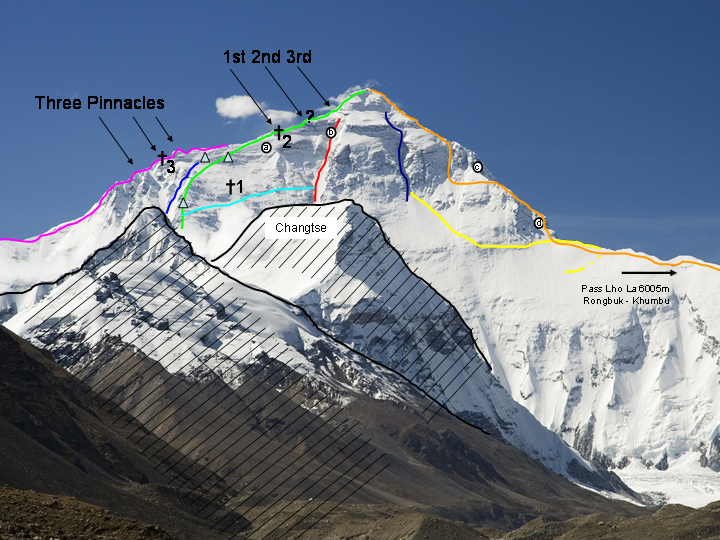
The first recorded video footage of Green Boots was filmed by British filmmaker and climber Matt Dickinson in May 1996. The footage was included in the Brian Blessed documentary Summit Fever. The film's narration describes the unidentified climber as from India.
Over time, the corpse became known as a landmark on the north route. In 2006, British mountaineer David Sharp was found in a hypothermic state in Green Boots' Cave by climber Mark Inglis and his party. Inglis continued his ascent after radioing for advice on how to help Sharp, which he could not provide. Sharp died of extreme cold some hours later. Approximately three dozen other climbers would have passed by the dying man that day; it has been suggested that those who noticed him mistook Sharp for Green Boots and, therefore, paid little attention.
In 2014, Green Boots was moved to a less conspicuous location by members of a Chinese expedition—likely by the China Tibet Mountaineering Association, which manages the north side of Everest.
Possible identities
Tsewang Paljor
Eight climbers died in the Everest disaster of 1996: five climbers from the Adventure Consultants and Mountain Madness expeditions on the southeast route, and three fatalities among the Indo-Tibetan Border Police (ITBP) expedition from India who perished on the northeast route. Green Boots is commonly believed to be Indian ITBP climber Tsewang Paljor, who was wearing green Koflach boots on the day he and two others in his party attempted to summit. The ITBP was led by Commandant Mohinder Singh and was the first Indian ascent of Everest from the east side.
On 10 May 1996, Subedar Tsewang Smanla, Lance Naik Dorje Morup, and Head Constable Tsewang Paljor were caught in a blizzard just short of the summit. While three of the six-member team turned back down, Smanla, Morup, and Paljor decided to go for the summit. At around 15:45 Nepal Time, the three climbers radioed to their expedition leader that they had arrived at the top. They left an offering of prayer flags, khatas, and pitons. Here, the leader, Smanla, decided to spend extra time on religious ceremonies and instructed the other two to move down.
There was no radio contact after that. Back at the camps below, team members saw two headlamps moving slightly above the Second Step, at 8570 m. None of the three returned to high camp at 8300 m.
Controversy later arose over whether or not a team of Japanese climbers from Fukuoka had seen and potentially failed to assist the missing Indian climbers. The group had left their camp at 8300 m at 06:15 Beijing time on 11 May, reaching the summit at 15:07. Along the way, they encountered others on the trail. Unaware of the missing Indians, they believed these others, all wearing goggles and oxygen masks under their hoods, were members of a climbing party from Taiwan. During their descent, which began at 15:30, they reported seeing an unidentifiable object above the Second Step. Below the First Step, they radioed in to report seeing one person on a fixed rope. Thereafter, one of the climbers, Shigekawa, exchanged greetings with an unidentifiable man standing nearby. At that time, they had only enough oxygen to return to C6.
At 16:00, the Fukuoka party discovered from an Indian in their group that three men were missing. They offered to join the rescue but were declined. Forced to wait a day due to bad weather, they sent a second party to the summit on 13 May. They saw several bodies around the First Step but continued to the summit.
Initially, there were some misunderstandings and harsh words regarding the actions of the Fukuoka team, which were later clarified. According to Reuters, the Indian expedition had claimed that the Japanese had pledged to help with the search but had pressed forward with their summit attempt. The Japanese team denied that they had abandoned or refused to help the dying climbers on the way up, a claim that the Indian-Tibetan Border Police accepted. Captain Kohli, an official of the Indian Mountaineering Federation, who earlier had denounced the Japanese, later retracted his claim that the Japanese had reported meeting the Indians on 10 May.
Dorje Morup
A lesser known theory, first proposed in a 1997 article titled "The Indian Ascent of Qomolungma by the North Ridge" published by P.M. Das in the Himalayan Journal, states that the body was that of Lance Naik Dorje Morup, a.k.a. Dorje. Das wrote that two climbers had been spotted descending by the light of their head-torches at 19:30, although they were soon lost from sight. The next day the leader of the second summit group of the expedition radioed base camp that they had encountered Morup moving slowly between the First and Second Steps. Das wrote that Morup "had refused to put on gloves over his frost-bitten hands" and "was finding difficulty in unclipping his safety carabiner at anchor points." According to Das, the Japanese team assisted in transitioning him to the next stretch of rope.
Sometime later, the Japanese group discovered the body of Tsewang Smanla above the Second Step. On the return trip, the group found that Morup was progressing slowly. Morup is believed to have died in the late afternoon of 11 May.
A second ITBP group also came across the bodies of Smanla and Morup on their return from the summit. Das wrote that they encountered Morup "lying under the shelter of a boulder near their line of descent, close to Camp 6" with intact clothing and his rucksack by his side.
Green Boots in perspective
Green Boots is among the roughly 200 corpses remaining on Everest by the early 21st century. It is unknown when the term "Green Boots" entered Everest parlance. Over the years, it became a common term, as all the expeditions from the north side encountered the climber's body curled up in the limestone alcove cave. The cave is at 27890 ft and is littered with oxygen bottles. It is below the first step on the path.
Another fallen climber who earned a nickname, "Sleeping Beauty", is Francys Arsentiev, who died in 1998 during an unsuccessful descent from Everest after summiting. Her body remained where she fell and was visible until 2007 when it was ceremonially hidden from view.
Additional bodies are in "Rainbow Valley", an area below the summit strewn with corpses wearing brightly colored mountaineering apparel. Yet another named corpse is that of Hannelore Schmatz, who, with a prominent position on the south route, earned the moniker "the German woman"; she summited in 1979 but died at 8,200 m altitude during her descent. She remained there for many years but was eventually blown further down the mountain.
References
References
- Nuwer, Rachel. (8 October 2015). "The tragic tale of Mt Everest's most famous dead body". BBC Future.
- Johnson, Tim. (20 May 2007). "Everest's Trail of Corpses". The Victoria Advocate.
- snowymatrix thru-walker. (2018-07-05). "Summit Fever (1996) Brian Blessed Everest Documentary".
- Quinlan, Mark. (25 May 2012). "Reclaiming the dead on Mt. Everest". CBC News.
- (18 July 2006). "Part II: Near top of Everest, he waves off fellow climbers: 'I just want to sleep'". Oh My News.
- (23 April 2019). "What's Being Done About Trash (and Bodies) on Everest This Year".
- Nuwer, Rachel. (9 October 2015). "Death in the clouds: The problem with Everest's 200+ bodies". BBC Future.
- (2011-07-22). "homage to heroes".
- Douglas, Ed. (15 August 2006). "Over the Top". Outside Magazine.
- Singh, Mohinder. (2003). "Everest: The First Indian Ascent from North". Indian Publishers Distributors.
- Krakauer, Jon. (1997). "Into Thin Air". Anchor Books.
- "India probes Everest deaths, questions Japanese team". Reuters.
- Saso, Hiroo. "Misunderstandings Beyond the North Ridge". International Mountaineering and Climbing Federation.
- Das, P. M.. (1997). "The Indian Ascent of Qomolungma by the North Ridge". Himalayan Journal.
- Nuwer, Rachel. (28 November 2012). "There Are Over 200 Bodies on Mount Everest, And They're Used as Landmarks". Smithsonian Magazine.
- Johnson, Tim. (7 June 2007). "Corpses litter the 'death zone' near Everest's summit, frozen for eternity". McClatchy Newspapers.
- Parker, Alan. (24 May 2012). "Everest: 'The open graveyard waiting above'".
- (17 April 2013). "Helga's Everest nightmare". DW.
This article was imported from Wikipedia and is available under the Creative Commons Attribution-ShareAlike 4.0 License. Content has been adapted to SurfDoc format. Original contributors can be found on the article history page.
Ask Mako anything about Green Boots — get instant answers, deeper analysis, and related topics.
Research with MakoFree with your Surf account
Create a free account to save articles, ask Mako questions, and organize your research.
Sign up freeThis content may have been generated or modified by AI. CloudSurf Software LLC is not responsible for the accuracy, completeness, or reliability of AI-generated content. Always verify important information from primary sources.
Report