From Surf Wiki (app.surf) — the open knowledge base
Great Zimbabwe
Ruins of an ancient/medieval city in southeast Zimbabwe

Ruins of an ancient/medieval city in southeast Zimbabwe
| Field | Value |
|---|---|
| name | Great Zimbabwe |
| image | Conical Tower - Great Enclosure III (33736918448).jpg |
| caption | Tower in the Great Enclosure, Great Zimbabwe |
| map_type | Zimbabwe#Africa |
| coordinates | |
| location | Masvingo Province, Zimbabwe |
| type | Settlement |
| part_of | Kingdom of Great Zimbabwe |
| area | 7.22 km2 |
| material | Granite |
| built | 11th century CE |
| abandoned | 16th or 17th century |
| epochs | Late Iron Age |
| cultures | Kingdom of Great Zimbabwe |
| embedded | {{Infobox UNESCO World Heritage Site |
| child | yes |
| Official_name | Great Zimbabwe National Monument |
| ID | 364 |
| Year | 1986 |
| Criteria | Cultural: i, iii, vi |
the city
Great Zimbabwe was a city in the south-eastern hills of the modern country of Zimbabwe, near Masvingo. It was settled from around 1000 CE, and served as the capital of the Kingdom of Great Zimbabwe from the 13th century. It is the largest stone structure in precolonial Southern Africa. Major construction on the city began in the 11th century until the 15th century, and it was abandoned in the 16th or 17th century. The edifices were erected by ancestors of the Shona people, currently located in Zimbabwe and nearby countries. The stone city spans an area of 7.22 km2 and could have housed up to 18,000 people at its peak, giving it a population density of approximately 2500 PD/km2. The Zimbabwe state centred on it likely covered 50,000 km² (19,000 sq mi). It is recognised as a World Heritage Site by UNESCO.
The site of Great Zimbabwe is composed of the Hill Complex, the Valley Complex, and the Great Enclosure (constructed at different times), and contained area for commoner housing within the perimeter walls. There is disagreement on the functions of the complexes among scholars. Some consider them to have been residences for the royals and elites at different periods of the site, while others infer them to have had separate functions. The Great Enclosure, with its 11 m (36 ft) high dry stone walls (that is, constructed without mortar), was built during the 13th and 14th centuries, and likely served as the royal residence, with demarcated public spaces for rituals.
The earliest document mentioning the Great Zimbabwe ruins was in 1531 by Vicente Pegado, captain of the Portuguese garrison of Sofala on the coast of modern-day Mozambique, who recorded it as Symbaoe. The first confirmed visits by Europeans were in the late 19th century, with investigations of the site starting in 1871. Great Zimbabwe and surrounding sites were looted by European antiquarians between the 1890s and 1920s. Some later studies of the monument were controversial, as the white government of Rhodesia pressured archaeologists to deny its construction by black Africans. Its African origin only became consensus by the 1950s. Great Zimbabwe has since been adopted as a national monument by the Zimbabwean government, and the modern independent state was named after it.
The word great distinguishes the site from the many smaller ruins, known as "zimbabwes", spread across the Zimbabwe Highveld. There are around 200 such sites in Southern Africa, such as Bumbusi in Zimbabwe and Manyikeni in Mozambique, with monumental, mortarless walls.
Name
Main article: Name of Zimbabwe
Zimbabwe is the Shona name of the ruins, first recorded in 1531 by Vicente Pegado, captain of the Portuguese garrison of Sofala. Pegado noted that "The natives of the country call these edifices Symbaoe, which according to their language signifies 'court.
The name contains dzimba, the Shona term for 'houses'. There are two theories for the etymology of the name. The first proposes that the word is derived from Dzimba-dze-mabwe, translated from Shona as 'large houses of stone' (dzimba = plural of imba, 'house'; mabwe = plural of bwe, 'stone'). A second suggests that Zimbabwe is a contracted form of dzimba-hwe, which means 'venerated houses' in the Zezuru dialect of Shona, as usually applied to the houses or graves of chiefs.
History and description
'_(11217936264).jpg)
Settlement
The Great Zimbabwe area was previously settled by the San dating back 100,000 years, and, starting around 150 BCE, by Bantu-speaking peoples who formed agricultural chiefdoms starting in the 4th century CE. Between the 4th and the 7th centuries, communities of the Gokomere or Ziwa cultures farmed the valley, and mined and worked iron, but built no stone structures. These are the earliest Iron Age settlements in the area identified from archaeological diggings, and the later Gumanye people are considered the ancestors of the Karanga (south-central Shona), who would construct Great Zimbabwe.
Construction and growth
Construction of the stone buildings started in the 11th century and continued for over 300 years. Agriculture and cattle played a key role in developing a vital social network, and served to "enfranchise management of goods and services distributed as benefits within traditional political and social institutions", while long distance trade was crucial for the transformation of localised organisations into regional ones. The ruling dynasty used their wealth to make houses out of thick daga (earthen daub), rather than daga and poles, and built stone walls to shield themselves from public view. The aforementioned process advanced rapidly in the 13th century, and saw the construction of large dry-stone walls.
The ruins at Great Zimbabwe are some of the oldest and largest structures located in Southern Africa. Its most formidable edifice, commonly referred to as the Great Enclosure, has walls as high as 11 m extending approximately 250 m. Its growth has been linked to the decline of Mapungubwe from around 1300, or the greater availability of gold in the hinterland of Great Zimbabwe. The institutionalisation of Great Zimbabwe's politico-religious ideology served to legitimise the position of the king (mambo), with a link between leaders, their ancestors, and God. According to Ken Mufuka the shrine in the Hill Complex was the home of spirit mediums (svikiro) who were tasked with acting as the conscience of the state, and preserving the traditions of the founders, reported to be Chigwagu Rusvingo (the first mambo), Chaminuka, Chimurenga, Tovera, and Soro-rezhou among others.
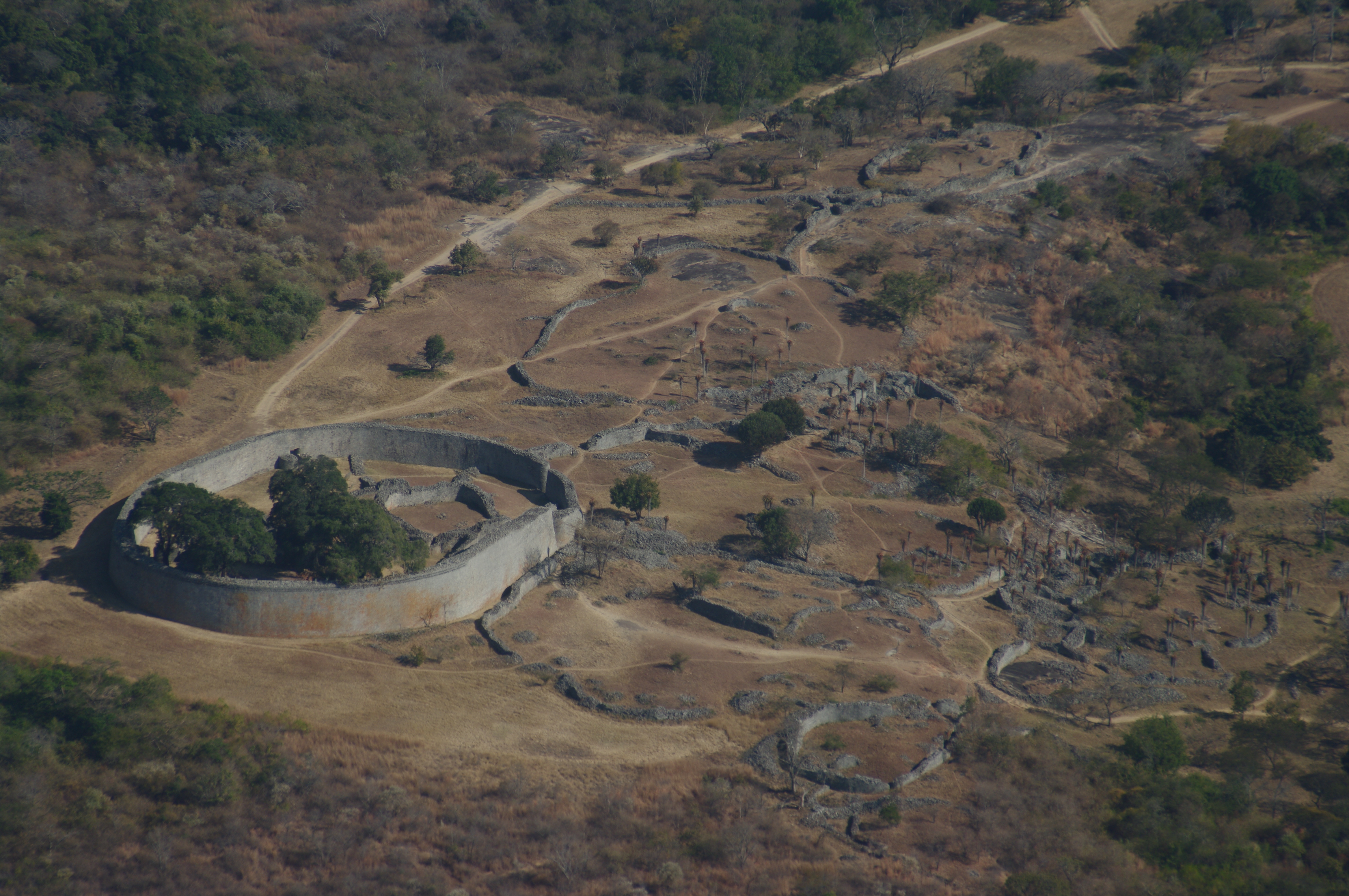
Traditional estimates are that Great Zimbabwe had as many as 18,000 inhabitants at its peak. However, a more recent survey concluded that the population likely never exceeded 10,000. The ruins that survive are built entirely of stone; they span 1800 acre. Great Zimbabwe covered a similar area to medieval London; while the density of buildings within the stone enclosures was high, in areas outside them it was much lower. The majority of the population lived in houses made out of mud on wooden frame structures, however the number of these can only be estimated. It is equally assumed that the stone structures were royal or official buildings, and elite dwellings. No burials have been found at the site to give another basis for estimating population.
Features of the ruins
In 1531, Vicente Pegado, Captain of the Portuguese Garrison of Sofala, described Zimbabwe thus:

The ruins form three distinct architectural groups. They are known as the Hill Complex, the Valley Complex and the Great Enclosure. The Hill Complex is the oldest, and was occupied from the 11th to 13th centuries. The Great Enclosure was occupied from the 13th to 15th centuries, and the Valley Complex from the 14th to 16th centuries. Notable features of the Hill Complex include the Eastern Enclosure, in which it is thought the Zimbabwe Birds stood, a high balcony enclosure overlooking the Eastern Enclosure, and a huge boulder in a shape similar to that of the Zimbabwe Bird. The Great Enclosure is composed of an inner wall, encircling a series of structures and a younger outer wall. The Conical Tower, 18 ft in diameter and 30 ft high, was constructed between the two walls. The Valley Complex is divided into the Upper and Lower Valley Ruins, with different periods of occupation.


There are different archaeological interpretations of these groupings. It has been suggested that the complexes represent the work of successive kings: some of the new rulers founded a new residence. The focus of power moved from the Hill Complex in the 12th century, to the Great Enclosure, the Upper Valley and finally the Lower Valley in the early 16th century. The alternative "structuralist" interpretation holds that the different complexes had different functions: the Hill Complex as an area for rituals, perhaps related to rain making, the Valley complex was for the citizens, and the Great Enclosure was used by the king. Structures that were more elaborate were probably built for the kings, although it has been argued that the dating of finds in the complexes does not support this interpretation.
Dhaka pits were closed depressions utilized by inhabitants of Great Zimbabwe as sources of water management in the form of reservoirs, wells and springs. Dhaka pits may have been in use since the mid-2nd millennium CE and the system could hold more than 18,000 m3 of water storage.
Notable artefacts

The most important artefacts recovered from the Monument are the eight Zimbabwe Birds. These were carved from a micaceous schist (soapstone) on the tops of monoliths the height of a person. Slots in a platform in the Eastern Enclosure of the Hill Complex appear designed to hold the monoliths with the Zimbabwe birds, but as they were not found in situ, the original location of each monolith and bird within the enclosure cannot be determined . Other artefacts include soapstone figurines (one of which is in the British Museum), pottery, iron gongs, elaborately worked ivory, iron and copper wire, iron hoes, bronze spearheads, copper ingots and crucibles, and gold beads, bracelets, pendants and sheaths. Glass beads and porcelain from China and Persia among other foreign artefacts were also found, attesting the international trade linkages of the Kingdom. The extensive, remaining stone ruins of the great city include eight monolithic soapstone birds. It is thought that they represent the bateleur eagle – a good omen, protective spirit and messenger of the gods in Shona culture.
Trade

Great Zimbabwe became a centre for trading, having replaced Mapungubwe around 1300. Regional networks were expansive, and salt, cattle, grain, and copper were traded as far north as the Kundelungu Plateau in present-day DR Congo. A significant portion of Great Zimbabwe's wealth came from the domination of trade routes from the goldfields of the Zimbabwean Plateau to the Swahili coast. Traders travelled the Save and Runde rivers, possibly using locally-produced canoes. Through Swahili city-states such as Sofala, they exported gold and ivory into the Indian Ocean trade. That international commerce was in addition to the local agricultural trade, in which cattle were especially important. The large cattle herd that supplied the city moved seasonally and was managed by the court. Chinese pottery shards, coins from Arabia, glass beads and other non-local items have been excavated at Zimbabwe. Despite these strong international trade links, there is no evidence to suggest exchange of architectural concepts between Great Zimbabwe and centres such as Kilwa.
Gold working
In archaeological research, Great Zimbabwe was a significant site for gold working in Southern Africa. Such discoveries indicated how gold production was a skill and needed practice rather than a common activity. Recent studies released evidence of debris left behind from gold working which confirmed that gold was processed in certain areas of the site. This acknowledged that gold working was a meaningful part in craft traditions and its value in economy. The excavations had revealed clay containers, crucibles, and tools which were used to heat gold and turn it into wire, beads, or decorative accessories. Remains of these tools and materials provided an understanding of the skilful artisans who lived in Great Zimbabwe and the major role of gold in their cultural and daily life.
Decline
It is unknown what caused Great Zimbabwe's demise and its eventual abandonment. It is unclear to what extent climate change played a role, however Great Zimbabwe's location in a favourable rainfall zone makes this unlikely to have been a primary cause. Great Zimbabwe's dominance over the region depended on its continual extension and projection of influence, as its growing population needed more farming land and traders more gold. Shona oral tradition attributes Great Zimbabwe's demise to a salt shortage, which may be a figurative way of speaking of land depletion for agriculturalists or of the depletion of critical resources for the community. It is plausible the aquifer Great Zimbabwe sat on top of ran out of water, or the growing population contaminated the water.
From the early 15th century, international trade began to decline amid a global economic downturn, reducing demand for gold, which adversely affected Great Zimbabwe. In response to this, elites possibly expanded regional trading networks, resulting in greater prosperity for other settlements in the region. By the late 15th century, the consequences of this decision would have begun to manifest, as offshoots from Great Zimbabwe's royal family formed new dynasties, possibly as a result of losing succession disputes. According to oral tradition, Nyatsimba Mutota, a member of Great Zimbabwe's royal family, led part of the population north in search for salt, and founded the Mutapa Empire. It was believed that only their most recent ancestors would follow them, with older ancestors staying at Great Zimbabwe and providing protection there. Angoche traders opened a new route along the Zambezi via Mutapa and Ingombe Ilede to reach the goldfields west of Great Zimbabwe, precipitating its decline and the rise of Khami, the capital of the Kingdom of Butua. By the 16th century, political and economic power had shifted away from Great Zimbabwe to the north and west. The site likely continued to be inhabited into the 17th century, before it was eventually abandoned.
History of research and origins of the ruins

From Portuguese traders to Karl Mauch
The first European visit may have been made by the Portuguese traveler António Fernandes in 1513–1515, who crossed twice and reported in detail the region of present-day Zimbabwe (including the Shona kingdoms) and also fortified centers in stone without mortar. However, passing en route a few kilometres north, and about 35 mi south of the site, he did not make a reference to Great Zimbabwe. Portuguese traders heard about the remains of the medieval city in the early 16th century, and records survive of interviews and notes made by some of them, linking Great Zimbabwe to gold production and long-distance trade.
In 1506, the explorer Diogo de Alcáçova described the edifices in a letter to Manuel I of Portugal, writing that they were part of the larger kingdom of Ucalanga (presumably Karanga, a dialect of the Shona people spoken mainly in Masvingo and Midlands provinces of Zimbabwe). João de Barros left another such description of Great Zimbabwe in 1538, as recounted to him by Moorish traders who had visited the area and possessed knowledge of the hinterland. He indicates that the edifices were locally known as Symbaoe, which meant "royal court" in the vernacular. As to the actual identity of the builders of Great Zimbabwe, de Barros writes:
Additionally, with regard to the purpose of the Great Zimbabwe ruins, de Barros asserted that: "in the opinion of the Moors who saw it [Great Zimbabwe] it is very ancient and was built to keep possessions of the mines, which are very old, and no gold has been extracted from them for years, because of the wars … it would seem that some prince who has possession of these mines ordered it to be built as a sign thereof, which he afterwards lost in the course of time and through their being so remote from his kingdom".
De Barros further remarked that Symbaoe "is guarded by a nobleman, who has charge of it, after the manner of a chief alcaide, and they call this officer Symbacayo … and there are always some of Benomotapa's wives therein of whom Symbacayo takes care." Thus, Great Zimbabwe appears to have still been inhabited as recently as the early 16th century.
Karl Mauch and the Queen of Sheba
The ruins were rediscovered by Europeans during a hunting trip in 1867 by Adam Render, a German-American hunter, prospector and trader in southern Africa, who had been living with a local tribe. In 1871 showed the ruins to Karl Mauch, a German explorer and geographer of Africa. Karl Mauch recorded the ruins and immediately discounted any possibility of native construction and proceeded to speculate about a possible Biblical association with King Solomon and the Queen of Sheba, an explanation which had been suggested by earlier writers such as the Portuguese João dos Santos. Mauch went so far as to favour a legend that the structures were built to replicate the palace of the Queen of Sheba in Jerusalem, and claimed a wooden lintel at the site must be Lebanese cedar, brought by Phoenicians. The Sheba legend, as promoted by Mauch, became so pervasive in the white settler community as to cause the later scholar James Theodore Bent to say,
Willi Posselt and W.G. Neal
A series of looters followed Mauch’s visit to the ruins, some employed by W.G. Neal who famously operated the Ancient Ruins Company. The first looter who found his way to the site, Willi Posselt, removed a native-made soapstone bird and managed to conceal others to retrieve at a later date. Over the following several years Neal and his company plundered the ruins, stripping it of anything of value and destroying what they presumably could not take to sell, including structures. It is unclear how much pottery, figurines and other artefacts were lost or stolen.
Carl Peters and Theodore Bent

Carl Peters collected a ceramic ushabti in 1905. Flinders Petrie examined it and identified a cartouche on its chest as belonging to the 18th Dynasty Egyptian Pharaoh Thutmose III and suggested that it was a statuette of the king and cited it as proof of commercial ties between rulers in the area and the ancient Egyptians during the New Kingdom (c. 1550–1077 BC), if not a relic of an old Egyptian station near the local gold mines. Johann Heinrich Schäfer later appraised the statuette, and argued that it belonged to a well-known group of forgeries. After having received the ushabti, Felix von Luschan suggested that it was of more recent origin than the New Kingdom. He asserted that the figurine instead appeared to date to the subsequent Ptolemaic era (c. 323–30 BC), when Alexandria-based Greek merchants would export Egyptian antiquities and pseudo-antiquities to southern Africa.
J. Theodore Bent undertook a season at Zimbabwe with Cecil Rhodes's patronage and funding from the Royal Geographical Society and the British Association for the Advancement of Science. This, and other excavations undertaken for Rhodes, resulted in a book publication that introduced the ruins to English readers. Bent had no formal archaeological training, but had travelled very widely in Arabia, Greece and Asia Minor. This lack of training likely contributed to his decision to recklessly dig in the conical tower of the Great Enclosure, which would subsequently ruin the stratigraphy of the environment. This in turn made it impossible for any archaeologist who came after him to determine the tower's age. Several artefacts were lost during this visit as well, this time being discarded as insignificant. Bent was aided by the expert cartographer and surveyor Robert M. W. Swan (1858–1904), who also visited and surveyed a host of related stone ruins nearby. Bent stated in the first edition of his book The Ruined Cities of Mashonaland (1892) that the ruins revealed either the Phoenicians or the Arabs as builders, and he favoured the possibility of great antiquity for the fortress. By the third edition of his book (1902) he was more specific, with his primary theory being "a Semitic race and of Arabian origin" of "strongly commercial" traders living within a client African city.

The Lemba
The construction of Great Zimbabwe is also claimed by the Lemba, as documented by William Bolts in 1777 (to the Austrian Habsburg authorities), and by an A. A. Anderson (writing about his travels north of the Limpopo River in the 19th century). Lemba speak the Bantu languages spoken by their geographic neighbours, but they have some religious practices and beliefs similar to those in Judaism and Islam, which they claim were transmitted by oral tradition.
David Randall-MacIver and medieval origin
The first scientific archaeological excavations at the site were undertaken by David Randall-MacIver for the British Association in 1905–1906. In Medieval Rhodesia, he rejected the claims made by Adam Render, Carl Peters and Karl Mauch, and instead wrote of the existence in the site of objects that were of Bantu origin. Randall-MacIver concluded that all available evidence led him to believe that the Zimbabwe structures were constructed by the ancestors of the Shona people. More importantly he suggested a wholly medieval date for the walled fortifications and temple. This claim was not immediately accepted, partly due to the relatively short and undermanned period of excavation he was able to undertake.
Gertrude Caton Thompson

In mid-1929, Gertrude Caton Thompson concluded, after a twelve-day visit of a three-person team and the digging of several trenches, that the site was indeed created by Bantu. She had first sunk three test pits into what had been refuse heaps on the upper terraces of the hill complex, producing a mix of unremarkable pottery and ironwork. She then moved to the Conical Tower and tried to dig under the tower, arguing that the ground there would be undisturbed, but nothing was revealed. Some further test trenches were then put down outside the lower Great Enclosure and in the Valley Ruins, which unearthed domestic ironwork, glass beads, and a gold bracelet. Caton Thompson immediately announced her Bantu origin theory to a meeting of the British Association in Johannesburg. Caton Thompson's claim was not immediately favoured, although it had strong support among some scientific archaeologists due to her modern methods. Her most important contribution was in helping to confirm the theory of a medieval origin for the masonry work of the 14th and 15th centuries. By 1931, she had modified her Bantu theory somewhat, allowing for a possible Arabian influence for the towers through the imitation of buildings or art seen at coastal Arabian trading cities.
Post-1945 research
Since the 1950s, there has been consensus among archaeologists as to the African origins of Great Zimbabwe. Artefacts and radiocarbon dating indicate settlement in at least the 5th century, with continuous settlement of Great Zimbabwe between the 12th and 15th centuries and the bulk of the finds from the 15th century. The radiocarbon evidence is a suite of 28 measurements, for which all but the first four, from the early days of the use of that method and now viewed as inaccurate, support the 12th-to-15th-centuries chronology. In the 1970s, a beam that produced some of the anomalous dates in 1952 was reanalysed and gave a 14th-century date. Dated finds such as Chinese, Persian and Syrian artefacts also support the 12th- and 15th-century dates.
Gokomere
Archaeologists generally agree that the builders spoke one of the Shona languages, based upon evidence of pottery, oral traditions and anthropology and DNA evidence and recent scholarship supports the construction of Great Zimbabwe (and the origin of its culture) by Shona and Venda peoples, who were probably descended from the Gokomere culture. The Gokomere culture, an eastern Bantu subgroup, existed in the area from around 200 AD and flourished from 500 AD to about 800 AD. Archaeological evidence indicates that it constitutes an early phase of the Great Zimbabwe culture. The Gokomere culture likely gave rise to both the modern Mashona people, an ethnic cluster comprising distinct sub-ethnic groups such as the local Karanga clan and the Rozwi culture, which originated as several Shona states. Gokomere peoples were probably also related to certain nearby early Bantu groups like the Mapungubwe civilisation of neighbouring North eastern South Africa, which is believed to have been an early Venda-speaking culture, and to the nearby Sotho.
Recent research

More recent archaeological work has been carried out by Peter Garlake, who has produced the comprehensive descriptions of the site, David Beach and Thomas Huffman, who have worked on the chronology and development of Great Zimbabwe and Gilbert Pwiti, who has published extensively on trade links. Today, the most recent consensus attributes the construction of Great Zimbabwe to the Shona people (a Bantu group). Some evidence also suggests an early influence from the probably Venda-speaking peoples of the Mapungubwe civilization.
Damage to the ruins
Damage to the ruins has taken place throughout the last century. European antiquarians looted and pillaged Great Zimbabwe and similar structures from the 1890s to 1920s, greatly inhibiting the work of future archaeologists by destroying its stratigraphy. The removal of gold and artefacts in amateurist diggings by early colonial antiquarians caused widespread damage, More extensive damage was caused by the mining of some of the ruins for gold. A continuing source of damage to the ruins has been visitation, with many cases of people climbing the walls, walking over archaeological deposits, and overusing paths, all of which have significantly affected structures at the site. This anthropogenic damage has combined with that from natural causes including erosion, settling of foundations, and damage from plant growth.
Political implications

Martin Hall writes that the history of Iron Age research south of the Zambezi shows the prevalent influence of colonial ideologies, both in the earliest speculations about the nature of the African past and in the adaptations that have been made to contemporary archaeological methodologies. Preben Kaarsholm writes that both colonial and black nationalist groups invoked Great Zimbabwe's past to support their vision of the country's present, through the media of popular history and of fiction. Examples of such popular history include Alexander Wilmot's Monomotapa (Rhodesia) and Ken Mufuka's Dzimbahwe: Life and Politics in the Golden Age; examples from fiction include Wilbur Smith's The Sunbird and Stanlake Samkange's Year of the Uprising.
When white colonialists like Cecil Rhodes first saw the ruins, they saw them as a sign of the great riches that the area would yield to its new masters. Gertrude Caton-Thompson recognised that the builders were indigenous Africans, but she characterised the site as the "product of an infantile mind" built by a subjugated society. The official line in Rhodesia during the 1960s and 1970s was that the structures were built by non-blacks. Archaeologists who disputed the official statement were censored by the government. According to Paul Sinclair, interviewed for None But Ourselves:
This suppression of archaeology culminated in the departure from the country of prominent archaeologists of Great Zimbabwe, including Peter Garlake, Senior Inspector of Monuments for Rhodesia, and Roger Summers of the National Museum.


To black nationalist groups, Great Zimbabwe became an important symbol of achievement by Africans: reclaiming its history was a major aim for those seeking majority rule. In 1980 the new internationally recognised independent country was renamed for the site, and its famous soapstone bird carvings were retained from the Rhodesian flag and Coat of Arms as a national symbol and depicted in the new Zimbabwean flag. After the creation of the modern state of Zimbabwe in 1980, Great Zimbabwe has been employed to mirror and legitimise shifting policies of the ruling regime. At first it was argued that it represented a form of pre-colonial "African socialism" and later the focus shifted to stressing the natural evolution of an accumulation of wealth and power within a ruling elite. An example of the former is Ken Mufuka's booklet, although the work has been heavily criticised. A tower of the Great Zimbabwe is also depicted on the coat of arms of Zimbabwe.
Some of the carvings had been taken from Great Zimbabwe around 1890 and sold to Cecil Rhodes, who was intrigued and had copies made which he gave to friends. Most of the carvings have now been returned to Zimbabwe, but one remains at Rhodes' old home, Groote Schuur, in Cape Town.
Local perspectives
Local narratives, despite each clan claiming the site of Great Zimbabwe, are very similar in lamenting both the European antiquarians and the professional archaeologists for desecrating and appropriating a sacred site. They hold the government responsible for the "silence" and "closure" of Great Zimbabwe due to their refusal to "acknowledge the ownership and control of the site by the ancestors and Mwari".
Great Zimbabwe University
Main article: Great Zimbabwe University
In the early 21st century, the government of Zimbabwe endorsed the creation of a university in the vicinity of the ruins. This university is an arts and culture based university which draws from the rich history of the monuments. The university main site is near the monuments with other campuses in the City centre and Mashava. The campuses include Herbet Chitepo Law School, Robert Mugabe School of Education, Gary Magadzire School of Agriculture and Natural Science, Simon Muzenda School of Arts, and Munhumutapa School of Commerce.
Gallery
File:Great Zimbabwe (Donjon).jpg| The Conical Tower File:Soapstone birds on pedestals.jpg|Three of the Zimbabwe Birds found in the ruins, photographed around 1891. File:Wood Carving in Zimbabwe 01.jpg|Modern wood carving at the entrance of the Great Zimbabwe File:Zimbabwe wall.jpg|The Great Enclosure File:Wall of the great enclosure, Great Zimbabwe.JPG|The Great Enclosure (close) File:Wall of the great enclosure (far), Great Zimbabwe.JPG|The Great Enclosure (far) File:Great-Zimbabwe-3.jpg|The Hill Complex from the Valley File:Zimbabwe wooden lintel.jpg|Wooden lintel in doorway
Notes
References
Sources
References
- (January 2023). "The Conundrum of Great Zimbabwe". Journal of Urban Archaeology.
- Chirikure, Shadreck. (2020-06-01). "New Perspectives on the Political Economy of Great Zimbabwe". Journal of Archaeological Research.
- Pikirayi, Innocent. (2020). "Great Zimbabwe, 1100–1600 AD, Rise, Development, and Demise of". Springer International Publishing.
- (10 March 2017). "Great Zimbabwe: African City of Stone".
- Fleminger, David. (2008). "Mapungubwe Cultural Landscape". 30 Degrees South.
- M. Sibanda, H. Moyana et al. 1992. ''The African Heritage. History for Junior Secondary Schools. Book 1''. Zimbabwe Publishing House. {{ISBN. 978-0-908300-00-6
- Newitt, M. D. D.. (2002). "East Africa". Ashgate.
- Michel Lafon. (1994). ["Shona Class 5 revisited: a case against *ri as Class 5 nominal prefix"](http://archive.lib.msu.edu/DMC/African%20Journals/pdfs/Journal%20of%20the%20University%20of%20Zimbabwe/vol21n1/juz021001005.pdf}}. See also {{cite journal). Zambezia.
- Garlake (1973) 13
- (2016). "Primordialism and the 'Pleistocene San' of southern Africa". Antiquity.
- Pikirayi (2001) p129
- (2009). "Becoming Zimbabwe: a history from the pre-colonial period to 2008".
- Summers (1970) p163
- (2013-12-01). "New Pathways of Sociopolitical Complexity in Southern Africa". African Archaeological Review.
- (October 2001). "Great Zimbabwe (11th–15th century) – Thematic Essay". The Metropolitan Museum of Art.
- Pikirayi, Innocent. (2020). "Great Zimbabwe, 1100–1600 AD, Rise, Development, and Demise of". Springer International Publishing.
- Beach, David. (1980). "The Shona & Zimbabwe 900-1850: An Outline of Shona History". Pearson Education.
- Pikirayi, Innocent. (2020). "Great Zimbabwe, 1100–1600 AD, Rise, Development, and Demise of". Springer International Publishing.
- Gilbert Pwiti. (1991). "Trade and economies in southern Africa: the archaeological evidence". Zambezia.
- (2015). "Coercion and Warfare in the Rise of State Societies in Southern Zambezia". The African Archaeological Review.
- Huffman, Thomas N.. (2014-04-01). "Ritual Space in the Zimbabwe Culture". Journal of Archaeological, Ethnographic and Experimental Studies.
- Mufuka, Kenneth. (2005). "Great Zimbabwe: Origins and Rise". Routledge.
- Kuklick, Henrika. (1991). "Colonial situations: essays on the contextualization of ethnographic knowledge". Univ of Wisconsin Press.
- Chirikure, S.. (2017). "What was the population of Great Zimbabwe (CE1000 – 1800)". PLOS ONE.
- Garlake (1973) 27
- Garlake (1973) 29
- (1998). "Cognitive Archaeology and Imaginary History at Great Zimbabwe". Current Anthropology.
- Shadreck Chirikure. (2008). "Inside and outside the dry stone walls: revisiting the material culture of Great Zimbabwe". Antiquity.
- Collett, D. P.. (1992). "The chronology of the Valley Enclosures: implications for the interpretation of Great Zimbabwe". African Archaeological Review.
- Innocent, Pikirayi. (2022). "Climate-smart harvesting and storing of water: The legacy of dhaka pits at Great Zimbabwe". Anthropocene.
- Garlake (2002) 158
- Garlake (1973) 119
- "figure".
- Garlake (2002) 159–162
- Summers (1970) p166
- "Great Zimbabwe National Monument".
- Ndoro, Webber. (2005-01-01). "Great Zimbabwe".
- Nelson, Jo. (2019). "Historium". Big Picture Press.
- Ndoro, Webber. (2005-01-01). "Great Zimbabwe".
- (2015-10-01). "Mapungubwe Reconsidered: A Living Legacy: Exploring Beyond the Rise and Decline of the Mapungubwe State". Real African Publishers Pty Ltd..
- Mlambo, A. S.. (2014). "A history of Zimbabwe". New York, NY : Cambridge University Press.
- Hawarden, Rosanne. (2018). "Early Maritime Cultures in East Africa and the Western Indian Ocean". Archaeopress.
- (2024). "Turning South African History Upside Down: Ivory and Gold Production, the Indian Ocean Trading System and the Shaping of Southern African Society, 600–1900 AD". Journal of Southern African Studies.
- Ndoro, Webber. (2005-01-01). "Great Zimbabwe".
- Garlake (2002) 185
- Mukwende, Tawanda. (2025-05-27). "Great Zimbabwe - The Metropolitan Museum of Art".
- Vieri, Jasmine. (2023-08-03). "Archaeological science, globalisation, and local agency: gold in Great Zimbabwe". Archaeological and Anthropological Sciences.
- Silva, Alberto da Costa. "A enxada e a lança: a África antes dos Portugueses". Editora Nova Fronteira Participações S.A..
- Pikirayi, Innocent. (2006). "Cities in the World: 1500-2000: v. 3". Routledge.
- Pikirayi, Innocent. (2024-05-01). "Granite Landforms and Water Storage at Great Zimbabwe". The Medieval History Journal.
- Newitt, Malyn. (2018-05-24). "Southern Zambezia States and Indian Ocean Trade, 1450–1900".
- Huffman, T. N.. (1972). "The Rise and Fall of Zimbabwe". The Journal of African History.
- Waarden, Catrien Van. (2012). "Butua and the End of an Era: The Effect of the Collapse of the Kalanga State on Ordinary Citizens: an Analysis of Behaviour Under Stress". Archaeopress.
- Fontein, Joost. (2006). "The silence of Great Zimbabwe: contested landscapes and the power of heritage". London : UCL.
- (2018-07-23). "BBC World Service - Witness History, The Whitewashing of Zimbabwe's History".
- Leaver, Daniel. (2005). "Great Zimbabwe: Colonial historiography". Routledge.
- Frederikse, Julie. (1990). "None But Ourselves". Oral Traditions Association of Zimbabwe with Anvil Press.
- (December 1968). "The Pioneer Head". Rhodesiana.
- Oliver, Roland & Anthony Atmore (1975). Medieval Africa 1250–1800. Cambridge: Cambridge University Press. p. 738
- McCall-Theal, G.. (1900). "Records of South-eastern Africa". Cape Colony Printers.
- McCall-Theal, G.. (1900). "Records of South-eastern Africa". Cape Colony Printers.
- (1981). "The Empire of Monomotapa: From the Fifteenth to the Nineteenth Century". Mambo Press.
- "The Demise of Great Zimbabwe, ad 1420–1550". Post-Med Archaeology.
- (2000). "Great Zimbabwe: eine ethnologische Untersuchung". R. Köppe.
- Note: double translations (local language to Portuguese to English) should be taken cautiously and not literally.
- Rosenthal, Eric. (1966). "Southern African Dictionary of National Biography". Frederick Warne.
- Ndoro, Webber. (2005-01-01). "Great Zimbabwe".
- (18 December 1892). "Vast Ruins in South Africa- The Ruined Cities of Mashonaland". [[The New York Times]].
- Pikirayi (2001) p9
- Peters, Carl. (1902). "The Eldorado of the Ancients". C. Pearson.
- (1903). "Archæological Report". Egypt Exploration Fund.
- van Warmelo, N.J.. (1966). "Zur Sprache und Herkunft der Lemba". Deutsches Institut für Afrika-Forschung.
- David Randall-MacIver 1873-1945 by David Ridgway, 1984
- (14 April 1906). "Solomon's Mines". [[The New York Times]].
- Randall-MacIver, David. (1906). "The Rhodesia Ruins: their probable origins and significance". The Geographical Journal.
- (20 October 1929). "Ascribes Zimbabwe to African Bantus". [[The New York Times]].
- Davidson, Basil. (1959). "The Lost Cities of Africa". Little Brown.
- (1997). "Africa from the twelfth to the sixteenth century". James Currey.
- Garlake (2002) 146
- (2009). "Mapungubwe and Great Zimbabwe: The origin and spread of social complexity in southern Africa". Journal of Anthropological Archaeology.
- Garlake (1982) 34
- Garlake (1982) 10
- Garlake, Peter. (1978). "Pastoralism and Zimbabwe". The Journal of African History.
- Loubser, Jannie H. N.. (1989). "Archaeology and early Venda history". Goodwin Series.
- Evers, T.M.. (1988). "On why pots are decorated the way they are". Current Anthropology.
- Summers (1970) p195
- Summers (1970) p164
- (2019). "Ancient DNA Analysis of the Thulamela Remains: Deciphering the Migratory Patterns of a Southern African Population". Journal of African Archaeology.
- [[Webber Ndoro. Ndoro, W.]], and Pwiti, G. (1997). Marketing the past: The Shona village at Great Zimbabwe. Conservation and Management of Archaeological Sites 2(3): 3–8.
- Beach, D. N. (1994). A Zimbabwean past: Shona dynastic histories and oral traditions.
- (2009). "Mapungubwe and Great Zimbabwe: The origin and spread of social complexity in southern Africa". Journal of Anthropological Archaeology.
- Nelson, Jo. (2019). "Historium". Big Picture Press.
- Huffman, Thomas N.. (1991). "The chronology of Great Zimbabwe". The South African Archaeological Bulletin.
- Summers (1970) p35
- Chikuhwa, Jacob W.. (October 2013). "Zimbabwe: The End of the First Republic". Author House.
- Copson, Raymond W.. (1 January 2006). "Zimbabwe: Background and Issues". Nova Publishers.
- Isichei, Elizabeth Allo, ''A History of African Societies to 1870'' Cambridge University Press, 1997, {{ISBN. 978-0521455992 page 435
- Garlake (2002)
- Garlake (1973)
- Garlake (1982)
- Beach, David N. (1990) [http://archive.lib.msu.edu/DMC/African%20Journals/pdfs/Journal%20of%20the%20University%20of%20Zimbabwe/vol17n2/juz017002006.pdf "Publishing the Past: Progress in the 'Documents from the Portuguese' Series"]. Zambezia, Vol. 17, No. 2, 1990, pp. 175–183.
- Beach, David N. (1999) [http://archive.lib.msu.edu/DMC/African%20Journals/pdfs/Journal%20of%20the%20University%20of%20Zimbabwe/vol26n1/juz026001003.pdf "Pre-colonial History, Demographic Disaster and the University"]. Zambezia, Vol. 26, No. 1, 1999, pp. 5–33.
- Huffman, Thomas N. (05-1985) [https://www.sfu.ca/~wwl10/huffman%20soapstone%20birds.pdf "The Soapstone Birds from Great Zimbabwe."] {{Webarchive. link. (5 July 2012 African Arts, Vol. 18, No. 3, May 1985, pp. 68–73 & 99–100.)
- Gilbert Pwiti. (2004). "Economic change, ideology and the development of cultural complexity in northern Zimbabwe". Azania: Archaeological Research in Africa.
- Pwiti, Gilbert (1996). Continuity and change: an archaeological study of farming communities in northern Zimbabwe AD 500–1700. Studies in African Archaeology, No.13, Department of Archaeology, Uppsala University, Uppsala:.
- Joost Fontein. (2006). "Closure at Great Zimbabwe: Local Narratives of Desecration and Alienation". Journal of Southern African Studies.
- Hall, Martin. (1984). "The Burden of Tribalism: The Social Context of Southern African Iron Age Studies". American Antiquity.
- Caton-Thompson. (1931). "The Zimbabwe Culture: ruins and reactions". Clarendon Press.
- Garlake (2002) 23
- Ucko (1995) 37
- Garlake (2002) 24
- De Baets, Antoon. (2002). "Censorship of Historical Thought: a World Guide 1945–2000". Greenwood Press.
- Garlake (2002) 23–25
- (1983). "Dzimbahwe: Life and Politics in the Golden Age, 1100–1500 A.D.". Harare Publishing House.
- Kaarsholm, Preben. (1992). "The past as battlefield in Rhodesia and Zimbabwe". Collected Seminar Papers. Institute of Commonwealth Studies.
- Garlake, Peter. (1984). "Ken Mufuka and Great Zimbabwe". Antiquity.
- Fontein, Joost. (2006-12-01). "Silence, Destruction and Closure at Great Zimbabwe: Local Narratives of Desecration and Alienation". Journal of Southern African Studies.
This article was imported from Wikipedia and is available under the Creative Commons Attribution-ShareAlike 4.0 License. Content has been adapted to SurfDoc format. Original contributors can be found on the article history page.
Ask Mako anything about Great Zimbabwe — get instant answers, deeper analysis, and related topics.
Research with MakoFree with your Surf account
Create a free account to save articles, ask Mako questions, and organize your research.
Sign up freeThis content may have been generated or modified by AI. CloudSurf Software LLC is not responsible for the accuracy, completeness, or reliability of AI-generated content. Always verify important information from primary sources.
Report