From Surf Wiki (app.surf) — the open knowledge base
Great Year
Length of time
Length of time
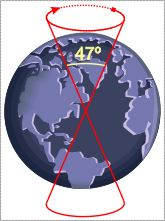
The term Great Year has multiple meanings. In scientific astronomy, it refers to the time required for the equinoxes to complete one full cycle around the ecliptic, a period of approximately 25,800 years. According to Ptolemy, his teacher Hipparchus discovered this phenomenon by comparing the position of the vernal equinox against the fixed stars, noting that it shifts westward by about one degree every 72 years. This means that a full cycle through all the zodiac constellations takes roughly 25,920 years. In the heliocentric model, this precession can be visualized as the Earth’s rotational axis slowly tracing a circular path around the normal to the plane of the ecliptic. Currently, Earth's axis points close to Polaris, the North Star, but due to precession, this alignment is temporary and will shift over time, returning only after one complete Great Year has passed.
By extension, the term "Great Year" can be used for any concept of eternal return in the world's mythologies or philosophies. Historian Otto Neugebauer writes:
Description of the science
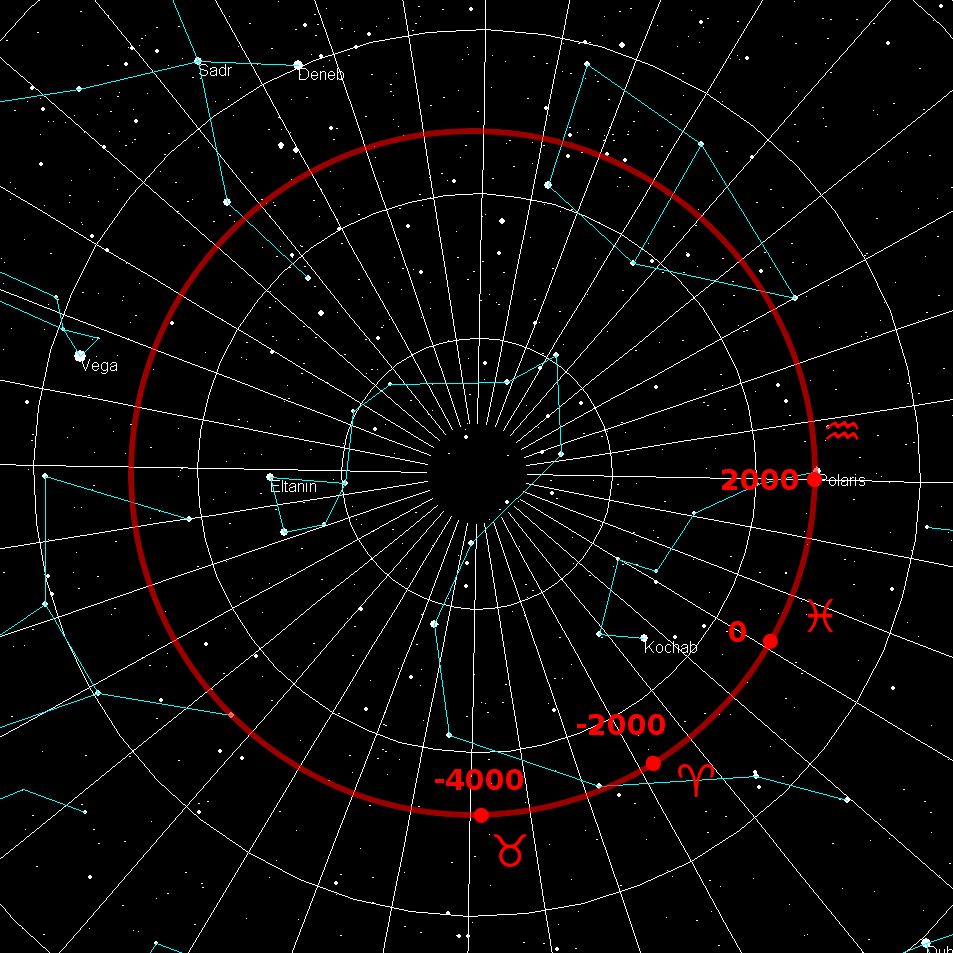
The plane of the ecliptic is the plane described by the apparent motion of the Sun against the starry background. It is the Earth's orbital motion about the Sun which causes this apparent motion to occur. The Earth's axis of rotation is not set perpendicular to this plane but at a present angle of 23.5 degrees to the perpendicular. The alignment of the axis is maintained throughout the year so that the point of sky above the north or south poles remains unchanged throughout the Earth's annual rotation around the Sun.
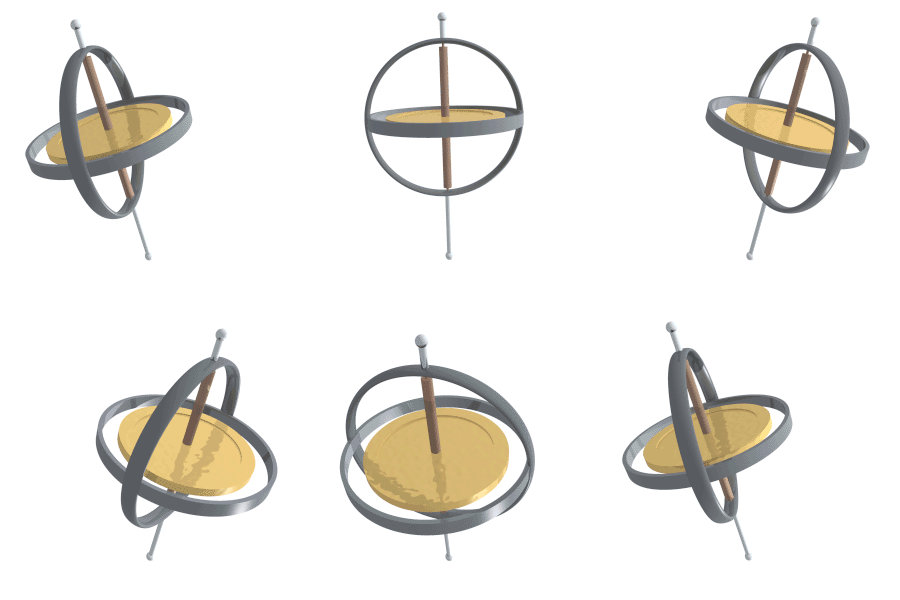
A slow conical motion of the Earth's polar axis about its normal to the plane of the ecliptic is caused by the attractive force of the other heavenly bodies on the equatorial protuberance of the Earth. A similar conical motion can also be observed in a gyroscope that is subjected to lateral forces.
The resultant motion of the Earth's axis is called general precession and the equinox points in the ecliptic move westward along the ecliptic at the rate of about 50.3 seconds of arc per year as a result. In 25,772 years, the points are once again at the same point in the sky where observations began.
In addition the tilt, or obliquity, of the Earth's axis is not constant but changes in a cycle of its own. During a cycle that averages about 40,000 years, the tilt of the axis varies between 22.1 and 24.5 degrees.
History of both definitions
Plato (c. 360 BC) used the term "perfect year" to describe the return of the celestial bodies (planets) and the diurnal rotation of the fixed stars (circle of the Same) to their original positions; there is no evidence he had any knowledge of axial precession. The cycle which Plato describes is one of planetary and astral conjunction, which can be postulated without any awareness of axial precession.
Hipparchus (c. 120 BC) is the first Greek credited with discovering axial precession roughly two hundred years after Plato's death (see below).
Cicero (1st century BC) followed Plato in defining the Great Year as a combination of solar, lunar and planetary cycles.
Plato's description of the perfect year is found in his dialogue Timaeus:
In De Natura Deorum, Cicero wrote
Macrobius (early fifth century AD) in his commentary on Cicero's Somnium Scipionis states that 'the philosophers' reckon the Great Year as 15,000 years.
Censorinus (3rd century AD) wrote that Aristarchus of Samos reckoned a Great Year as 2484 years: but it has been argued that this is a miscopying of 2434, which represents 45 Exeligmos cycles.
The origin of the Platonic Year would seem to have no connection with the precession of the equinoxes as this was unknown in Plato's time. Two centuries after Plato, Hipparchus is credited with discovering the period of equinox precession, and the term "Great Year" eventually came to be applied to the period of that precession caused by the slow gyration of the Earth's axis.
A confusion between the two definitions of the Great Year is believed to have originated with the astronomer Ptolemy (c. 170 AD), who adopted the larger, incorrect figure of 36,000 years. This led to the increasing conflation of the Platonic Great Year—based on planetary cycles—with the precessional Great Year, defined by the movement of the stars. Some scholars have even accused Ptolemy of scientific fraud, suggesting that he may have fabricated observations to support the 36,000-year cycle, despite having access to data that could have led him much closer to the correct figure of 26,000 years.
Josephus (first century AD) refers to a 'Great Year' () of 600 years.
It has been suggested that he obtained this value from Berossos (c. 3rd century BC) who reckoned time in intervals of 60, 600 and 3600 years.
Isaac Newton (1642 – 1726/27) determined the cause of precession and established the rate of precession at 1 degree per 72 years, very close to the best value measured today, thus demonstrating the magnitude of the error in the earlier value of 1 degree per century.
Time scale when compared to other geological events and physical processes
The world's most recent volcanic supereruption, the Oruanui eruption of Taupō Volcano in New Zealand occurred almost exactly one great year ago. The half-life of Plutonium-239, 24110 years, is a little bit less. After one great year, the interstellar space probe Voyager 1 is expected to have almost passed through the theorized Oort cloud.
References
Works cited
References
- Neugebauer, O.. (1975). "A History of Ancient Mathematical Astronomy". Birkhäuser.
- "Aerospace Science and Technonlogy Dictionary P Section".
- (1989-10-18). "Aerospace Science and Technology Dictionary G Section". Hq.nasa.gov.
- (2000-03-24). "Milutin Milankovitch".
- Wood, Michael. (2010-06-24). "The Platonic Year". Oxford University Press.
- (1933). "Full text with an English translation by H. Rackham".
- Plato, Timaeus 39d, in John M. Cooper (ed.), ''"Plato: Complete Works"'' (Hackett Publishing Company, 1997), p. 1243
- North, J. D.. (1989). "Stars, Mind & Fate: Essays in Ancient and Mediaeval Cosmology". Bloomsbury Academic.
- Aristarchos & System B 2002, DIO 11.1 May 31 (p. 6) [http://www.dioi.org/vols/wb1.pdf Comments on the Aristarchan Evidence]
- Stahl, William Harris. (1952). "Macrobius: Commentary on the Dream of Scipio". Columbia University Press.
- (1989-10-18). "Aerospace Science and Technology Dictionary G Section". Hq.nasa.gov.
- Newton, R. R.. (1974). "The Authenticity of Ptolemy's Star Data". Quarterly Journal of the Royal Astronomical Society.
- [http://www.sacred-texts.com/jud/josephus/ant-1.htm Josephus – Antiquities of the Jews – Book I, Chapter 3, Paragraph 9]
- Josephus, ''Jewish Antiquities'', Loeb, p.1, note a
- "Internet History Sourcebooks". Fordham.edu.
This article was imported from Wikipedia and is available under the Creative Commons Attribution-ShareAlike 4.0 License. Content has been adapted to SurfDoc format. Original contributors can be found on the article history page.
Ask Mako anything about Great Year — get instant answers, deeper analysis, and related topics.
Research with MakoFree with your Surf account
Create a free account to save articles, ask Mako questions, and organize your research.
Sign up freeThis content may have been generated or modified by AI. CloudSurf Software LLC is not responsible for the accuracy, completeness, or reliability of AI-generated content. Always verify important information from primary sources.
Report