From Surf Wiki (app.surf) — the open knowledge base
Great triambic icosahedron
| [[File:Great triambic icosahedron stellation facets.svg | 240px]]Stellation diagram |
|---|
In geometry, the great triambic icosahedron and medial triambic icosahedron (or midly triambic icosahedron) are visually identical dual uniform polyhedra. The exterior surface also represents the De2f2 stellation of the icosahedron. These figures can be differentiated by marking which intersections between edges are true vertices and which are not. In the above images, true vertices are marked by gold spheres, which can be seen in the concave Y-shaped areas. Alternatively, if the faces are filled with the even–odd rule, the internal structure of both shapes will differ.
The 12 vertices of the convex hull matches the vertex arrangement of an icosahedron.
Great triambic icosahedron
The great triambic icosahedron is the dual of the great ditrigonal icosidodecahedron, U47. It has 20 inverted-hexagonal (triambus) faces, shaped like a three-bladed propeller. It has 32 vertices: 12 exterior points, and 20 hidden inside. It has 60 edges.
The faces have alternating angles of \arccos(\frac{1}{4})-60^{\circ}\approx 15.522,487,814,07^{\circ} and \arccos(-\frac{1}{4})\approx 104.477,512,185,93^{\circ}. The sum of the six angles is 360^{\circ}, and not 720^{\circ} as might be expected for a hexagon, because the polygon turns around its center twice. The dihedral angle equals \arccos(-\frac{1}{3})\approx 109.471,220,634,49.
Medial triambic icosahedron
The medial triambic icosahedron is the dual of the ditrigonal dodecadodecahedron, U41. It has 20 faces, each being simple concave isotoxal hexagons or triambi. It has 24 vertices: 12 exterior points, and 12 hidden inside. It has 60 edges.
The faces have alternating angles of \arccos(\frac{1}{4})-60^{\circ}\approx 15.522,487,814,07^{\circ} and \arccos(-\frac{1}{4})+120^{\circ}\approx 224.477,512,185,93^{\circ}. The dihedral angle equals \arccos(-\frac{1}{3})\approx 109.471,220,634,49.
Unlike the great triambic icosahedron, the medial triambic icosahedron is topologically a regular polyhedron of index two. By distorting the triambi into regular hexagons, one obtains a quotient space of the hyperbolic order-5 hexagonal tiling:
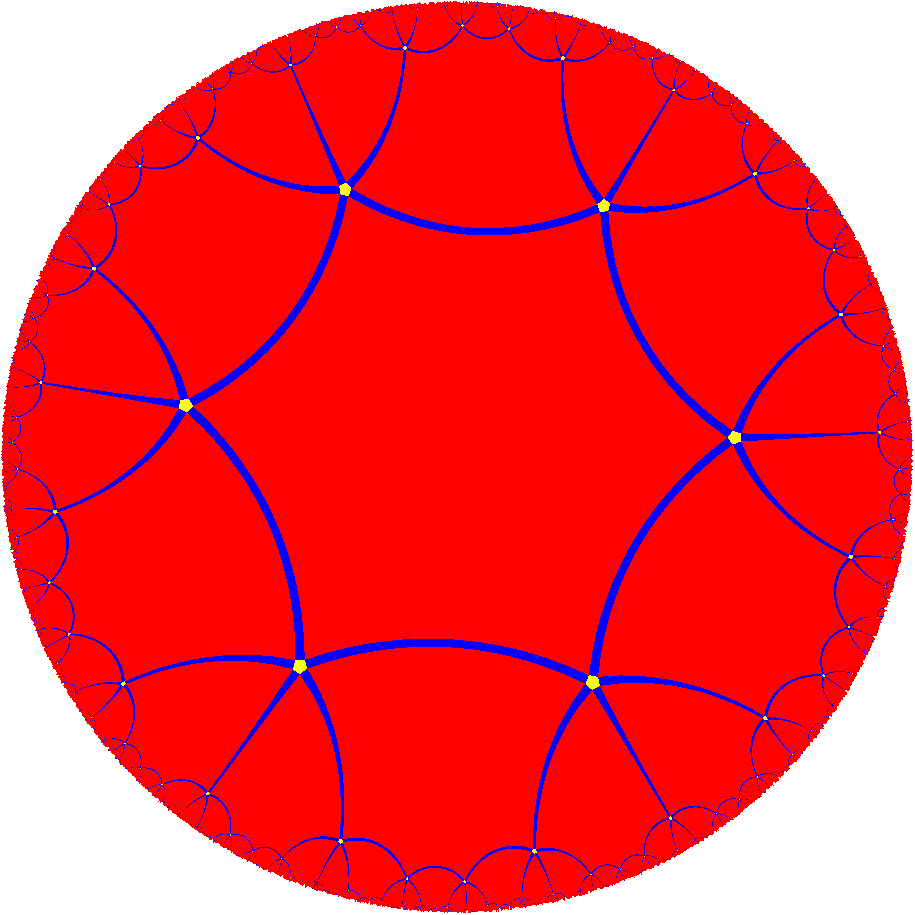
As a stellation
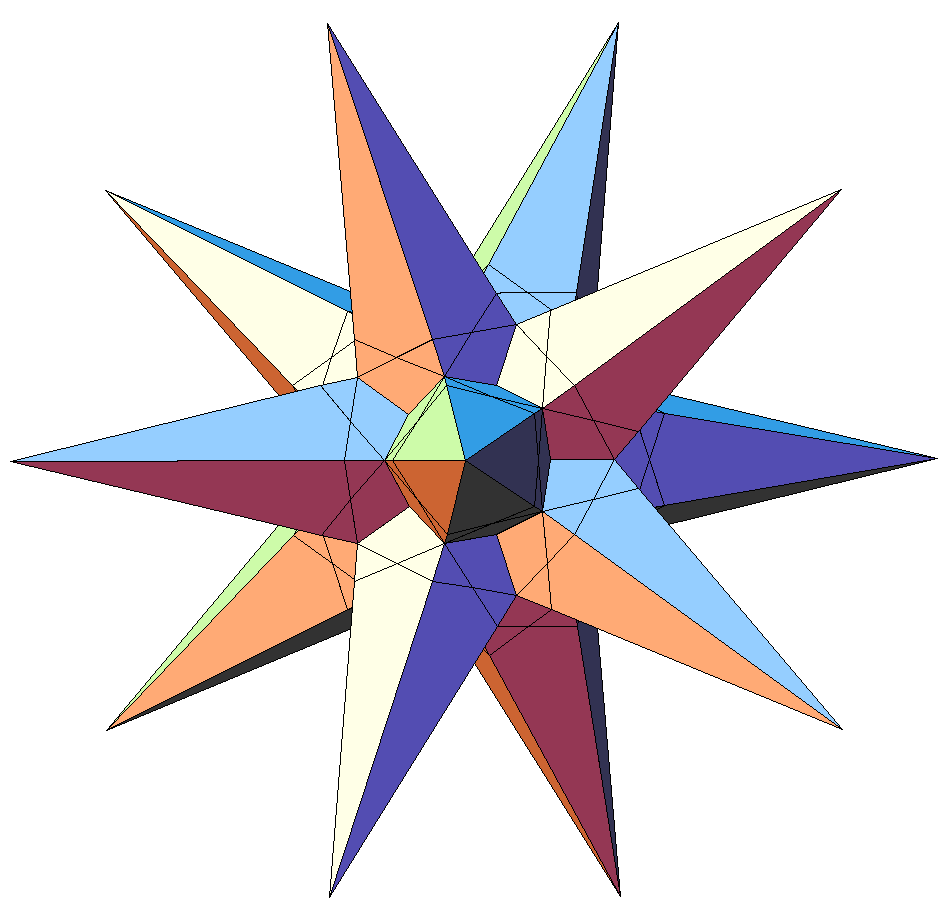
It is Wenninger's 34th model as his 9th stellation of the icosahedron
References
- H.S.M. Coxeter, Regular Polytopes, (3rd edition, 1973), Dover edition, , 3.6 6.2 Stellating the Platonic solids, pp.96-104
References
- [http://homepages.wmich.edu/~drichter/regularpolyhedra.htm The Regular Polyhedra (of index two)] {{Webarchive. link. (2016-03-04 , David A. Richter)
This article was imported from Wikipedia and is available under the Creative Commons Attribution-ShareAlike 4.0 License. Content has been adapted to SurfDoc format. Original contributors can be found on the article history page.
Ask Mako anything about Great triambic icosahedron — get instant answers, deeper analysis, and related topics.
Research with MakoFree with your Surf account
Create a free account to save articles, ask Mako questions, and organize your research.
Sign up freeThis content may have been generated or modified by AI. CloudSurf Software LLC is not responsible for the accuracy, completeness, or reliability of AI-generated content. Always verify important information from primary sources.
Report