From Surf Wiki (app.surf) — the open knowledge base
Great Ocean Road
Road in Victoria, Australia
Road in Victoria, Australia
| Field | Value | |
|---|---|---|
| type | Highway | |
| road_name | Great Ocean Road | |
| state | vic | |
| image | 2009-0825-GreatOceanRoadsign.jpg | |
| caption | Great Ocean Road memorial arch at Eastern View, 2009 | |
| location | Great ocean road map.png | |
| est | ||
| length | 240 | |
| length_ref | ||
| route | B100 (1996–present) | |
| former | State Route 100 (1986–1996) | |
| tourist | Tourist Drive 21 | |
| (Eastern View–Torquay) | ||
| direction_a | East | |
| direction_b | West | |
| end_a | Surf Coast Highway | |
| Torquay, Victoria | ||
| end_b | Princes Highway | |
| Allansford, Victoria | ||
| exits | {{plainlist | |
| through | , , |
(Eastern View–Torquay) Torquay, Victoria Allansford, Victoria
- Bells Boulevarde
- Anglesea Road
- Otway Lighthouse Road
- Princetown Road
The Great Ocean Road is an Australian National Heritage-listed 240 km stretch of road along the south-eastern coast of Australia, between the Victorian towns of Torquay and Allansford. Built by returned soldiers between 1919 and 1932, and dedicated to soldiers killed during World War I, the road is the world's largest war memorial. Winding through varying terrain along the coast, and providing access to several prominent landmarks, including the Twelve Apostles limestone stack formations, the road is an important tourist attraction.

The city of Geelong, close to Torquay, experiences great benefit from Australian and international visitors to the road, with Geelong Otway Tourism affirming it as an invaluable asset. In 2008, the Royal Automobile Club of Victoria (RACV) listed the road as the state's top tourism experience in its Victoria 101 survey, based on places that members of the public would recommend to visitors.
Route
The Great Ocean Road starts at Torquay and runs westward to finish at Allansford, near Warrnambool. The road is two lanes (one in each direction), and has a speed limit which varies between 50 km/h and 100 km/h.


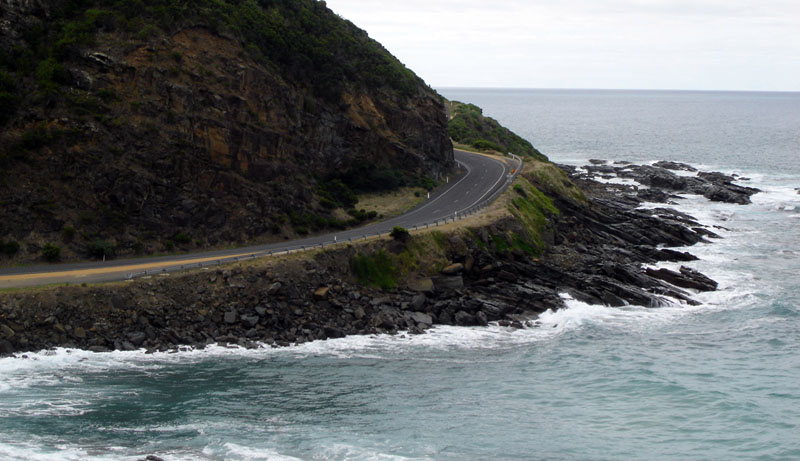
A prime tourist attraction, much of the road hugs the coastline along what is known, east of the Otway Ranges, as the Surf Coast and, west of Cape Otway, as the Shipwreck Coast. It provides extensive views over Bass Strait and the Southern Ocean.
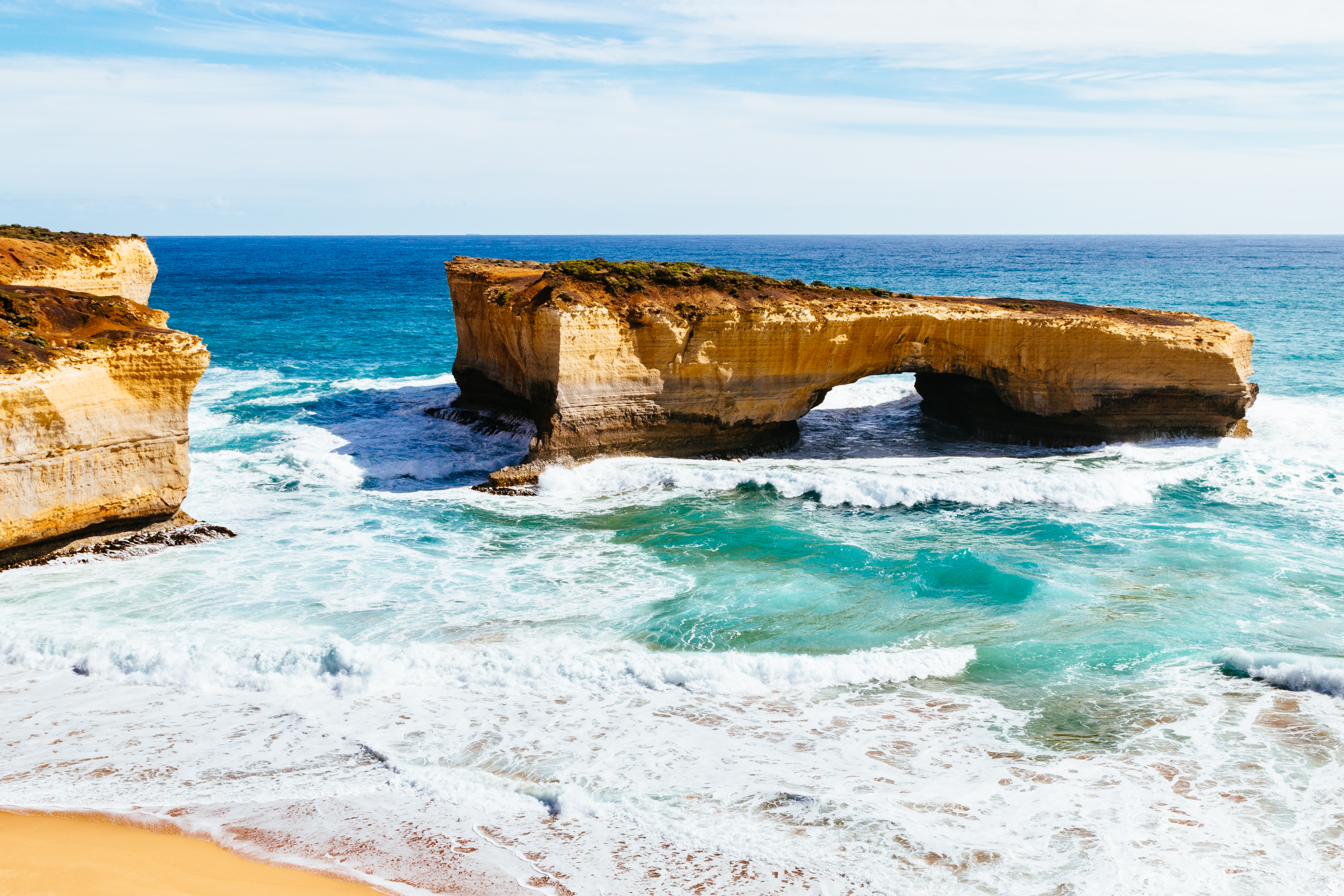
The road runs through rainforests, as well as alongside beaches and cliffs composed of limestone and sandstone, which are susceptible to erosion. The road travels via Anglesea, Lorne, Apollo Bay, and Port Campbell, the latter being notable for its natural limestone and sandstone rock formations, including Loch Ard Gorge, The Grotto, London Bridge and The Twelve Apostles. The stretch of the Great Ocean Road nearer to Torquay closely follows the coast, with some sheer cliffs on the seaward side. Road signs warn motorists of possible rockfalls.

History

The Great Ocean Road was first planned towards the end of World War I, when Chairman of the Country Roads Board, William Calder, asked the State War Council for funds to be provided for returned soldiers to work on roads in sparsely populated areas in the Western District. At the time, the rugged south-west coast of Victoria was accessible only by sea or rough bush track. It was envisaged that the road would connect isolated settlements on the coast and become a vital transport link for the timber industry and tourism.
Surveying of the road, tentatively titled the South Coast Road, started in 1918. It was suggested that it run from Barwon Heads in the east, follow the coast west around Cape Otway, and end near Warrnambool. In 1918, the Great Ocean Road Trust was formed as a private company, under the helm of president Howard Hitchcock. The company managed to secure £81,000 in capital from private subscriptions and borrowing, with Hitchcock himself contributing £3000. The money was to be repaid by charging drivers a toll until the debt was cleared, and the road would then be gifted to the state.
Construction
Construction began on 19 September 1919. Approximately 3,000 returned servicemen worked on the project, which was a war memorial for servicemen killed in World War I. The advance survey team progressed through dense scrub at a rate of approximately three kilometres a month. Construction was mostly by hand, using explosives, pick and shovel, wheelbarrows, and some small machinery, and was at times perilous, with several workers being killed. The final sections, along steep coastal cliffs, were the most difficult to work on. Anecdotal evidence from ABC archives in 1982 suggested workers would rest detonators on their knees during travel, because it gave the explosives the softest ride.
Workers were paid 10 shillings and sixpence for an eight-hour day, also working a half-day on Saturdays. They were accommodated in tents, and were provided with meals in a communal dining marquee. Food cost up to 10 shillings a week. Despite the isolation of the camps, the workers had access to a piano, gramophone, games, newspapers and magazines.
In 1924, the coastal steamer Casino became stranded near Cape Patton, after having hit a reef at Point Hawdon, near the Grey River. Legend has it that 500 barrels of beer and 120 cases of spirits were jettisoned and that road workers salvaged them, resulting in an unscheduled two-week-long drinking break. However, Museums Victoria notes only that most of the cargo, largely composed of Christmas goods, was dumped into the sea. The Age reported that, "The Great Ocean-road [sic] proved a boon to the passengers, who were enabled without much inconvenience to reach Wood's farm house, Apollo Bay. However, if the road were finished, the vessel's cargo could be safely conveyed to either Apollo Bay, the Wye River, or Lorne."
Completion and early use


On 18 March 1922, the section from Eastern View to Lorne was officially opened, with celebrations. However, it was then closed from 10 May 1922 for further work, opening again on 21 December, along with tolls to help recoup construction costs. The charge, payable at the Eastern View toll gate, was two shillings for motor cars, and 10 shillings for wagons with more than two horses.
In November 1932, the section from Lorne to Apollo Bay was finished, bringing the road to completion. It was officially opened by Victoria's Lieutenant-Governor Sir William Irvine, during a ceremony near the Grand Pacific Hotel at Lorne, and the road has subsequently been acknowledged as the world's largest war memorial. At the time, The Age commented, "In the face of almost insurmountable odds, the Great Ocean Road has materialised from a dream or 'wild-cat scheme', as many dubbed it, into concrete reality". Although Hitchcock had died of heart disease on 22 August 1932, before the road was completed, his car was driven behind the governor's in the procession along the road during the opening ceremony. A memorial in his name was constructed on the road at Mount Defiance, near Lorne, and he is generally considered to be the Father of the Road.
In its original state, the road was considered a formidable drive, comfortably accommodating only a single vehicle at a time. Areas with sheer cliffs were the most hazardous, with only few places where drivers could pull over to allow others to proceed in the opposite direction. For £5, any "public-spirited citizen" could request that a crossover be cut into the road. On 2 October 1936, the road was handed to the State Government, with the deed for the road being presented to the Victorian Premier at a ceremony at the Cathedral Rock toll gate. Tolls were removed at that time.
In 1939, following the death of the chairman of the Country Roads Board, W.T.B. McCormick, who was also honorary engineer for the Great Ocean Road Trust, it was decided to build a memorial arch in his honour, across the road at Eastern View. The arch was opened 4 November 1939, and was built of timber logs on a stone base, with a tablet memorial to Mr McCormick on one side, and another to the returned servicemen on the other. The arch was rebuilt in 1973 when the road was widened, and again in 1983, after being destroyed in the Ash Wednesday bushfires. It had to be rebuilt yet again after it collapsed during a storm in 1990.
In 1962, the Tourist Development Authority deemed the road to be "one of the world's great scenic roads". Despite improvements, the road was still considered a challenging drive, and the Victorian Police motor school was using it for training around 1966.
Over its life, the Great Ocean Road has been susceptible to natural elements. In 1960, the section at Princetown was partially washed away by water during storms. There were landslides on 11 August 1964, and 1971, both closing sections of the road near Lorne. Because of the terrain surrounding the road, it was also closed due to bushfires in 1962 and 1964, particularly in areas with nearby campsites. In January 2011, a section of a cutting collapsed due to heavy rain.
In 2011, the road was added to the Australian National Heritage List.
Road classification
Great Ocean Road was signed as State Route 100 between Torquay and Allansford in 1986. With Victoria's conversion to the newer alphanumeric system in the late 1990s, this was updated to route B100 in 1996.
The passing of the Road Management Act 2004 granted the responsibility of overall management and development of Victoria's major arterial roads to VicRoads: in 2004, VicRoads re-declared the road as Great Ocean Road (Arterial #4890), beginning at Surf Coast Highway at Torquay and ending at Princes Highway in Allansford.
Great Ocean Walk
In 2004, the Great Ocean Walk opened, connecting 104 km of walking trails that follow the coastline near the Great Ocean Road, stretching from Apollo Bay to the 12 Apostles.
Engineering heritage award
The road received an Engineering Heritage National Marker from Engineers Australia as part of its Engineering Heritage Recognition Program.{{cite web | access-date = 2020-04-28
''Great Ocean Road Protection Act''
In December 2020, the Great Ocean Road and Environs Protection Act 2020 went into effect, giving legal protection to the Great Ocean Road.
Events
Great Ocean Road Marathon
A 45-kilometre section of the Great Ocean Road, between Lorne and Apollo Bay, is the location of the annual "Great Ocean Road Marathon". First run in 2005, the marathon is part of the Great Ocean Road Running Festival. The course record of 2:27:37 was set in 2019 by English runner Nick Earl. Earl broke the previous record of 2:27:42 set in 2011 by James Kipkelwon of Kenya, who also won the event in 2012.
Cycling
In July 2015, former World Road Cycling Champion and Tour de France winner Cadel Evans announced that the Great Ocean Road would play host to the Cadel Evans Great Ocean Road Race in early 2015, including elite races for men and women and a mass participation People's Ride. As of 2019, the People's Ride includes three distance options—35 km, 65 km, or 115 km.
Wiggle Amy's Gran Fondo cycling event is held in September and uses the section between Lorne and Skenes Creek. One of the only cycling events in Australia held on a fully closed road, it is named for Amy Gillett, who was killed in a collision between the Australian women's cycling squad and a driver in Germany in 2005.
Major intersections
|LGA-S=Surf Coast
References
References
- "Great Ocean Road".
- Harper, Jane. (17 July 2008). "Geelong has a billion reason to thank tourists". Geelong Advertiser.
- (29 September 2008). "Great Ocean Road 'top tourism experience'". Queensland Newspapers.
- Waters, Kim. (20 May 2010). "Critics slam policy to ban coast wind farms". Star News Group.
- "Surf Coast Towns & Villages – Visit Great Ocean Road".
- "Shipwreck Coast, Great Ocean Road". Sightseeing Tours Australia.
- Campbell, David. (2 January 2006). "Preserving the fragile Great Ocean Road". The Age.
- Goggin, Eleanor. (30 May 2010). "Surfing the vineyards on the Ocean Road". Sunday Independent.
- "The Lonely Planet online guide to the road".
- Southern, Roger J.. (1979). "William Calder (1860–1928)".
- Downes. (26 November 1982). "Great Ocean Road turns 50". The Age.
- "Moment in Time – Episode 27". Australian Broadcasting Corporation.
- Wynd, Ian. (1983). "Howard Hitchcock (1866–1932)".
- (24 April 1935). "The Great Ocean Road". [[The Sydney Mail]].
- (2010-05-30). "Surfing the vineyards on the Ocean Road". Independent.ie.
- (August 2019). "Photograph – Victorian Collections".
- (23 October 1924). "S. Casino Still Aground: Position Precarious". The Age.
- Grant, Roger. (9 June 2010). "Extra Tiger flights make Geelong a must-see". geelongadvertiser.com.au.
- Rood, David. (10 April 2007). "Road's still great, 75 years on". The Age.
- Davis, Michael. (14 April 2007). "Hard road to honouring Diggers". The Australian.
- (10 June 1961). "Double Lines Needed on Ocean Road". The Age.
- (1939-06-06). "Memorial Arch at Eastern View". The Age (Melbourne).
- (1939-11-04). "Ocean Road Pioneer". The Age (Melbourne).
- "Great Ocean Road Memorial Arch".
- (1991-01-30). "Vicroads to put famous archway together again". The Echo.
- (15 August 1962). "Great Ocean Road in World Class". The Age.
- (4 December 1966). "Tighter averages on poor roads in tough run". The Sydney Morning Herald.
- (23 April 1960}}{{Dead link). "Washaways". The Age.
- (12 August 1964). "Landslide Closes Great Ocean Road". The Age.
- (9 December 1971). "Ocean Road open – but watch out". The Age.
- (20 January 1962). "Fire Survey Finds Another 200 Homes were Lost". The Age.
- (8 January 1964). "Great Ocean Road Closed". The Age.
- Johnston, Matt. (7 April 2011). "Great Ocean Road added to Australia's national heritage lis". Herald Sun.
- (27 August 1997). "VicRoads Annual Report 1996-97". Victorian Government Library Service.
- State Government of Victoria. "Road Management Act 2004". Government of Victoria.
- VicRoads. "VicRoads – Register of Public Roads (Part A) 2015". Government of Victoria.
- "Great Ocean Walk". Tourism Victoria.
- "The Great Ocean Walk, Great Ocean Road and Region, Victoria, AustraliaGreat Ocean Walk".
- Victoria, Parks. (8 August 2019). "Great Ocean Walk". Victorian Government, Parks Victoria.
- "Great Ocean Road and Environs Protection Act 2020". State Government of Victoria.
- "Great Ocean Road Running Festival – Australia's Most Stunning Marathon".
- "Community Sports: Melbourne high for local runner".
- (18 May 2019). "2019 Marathon Results: Great Ocean Road Run Festival".
- Sum. (22 May 2012). "Highton man second in marathon".
- . (17 July 2014). ["Cadel Evans Great Ocean Road Race announced"](http://www.sbs.com.au/cyclingcentral/news/55596/cadel-evans-great-ocean-road-race-announced).
- "Overview".
- "What To Expect at the Cadel Evans Great Ocean Road Race People's Ride".
- "Amy's Gran Fondo – Wiggle Amy's Gran Fondo 2019".
- "Riding Amy's Gran Fondo – Great Ocean Road, Australia {{!}} Bike Tour Buzz".
This article was imported from Wikipedia and is available under the Creative Commons Attribution-ShareAlike 4.0 License. Content has been adapted to SurfDoc format. Original contributors can be found on the article history page.
Ask Mako anything about Great Ocean Road — get instant answers, deeper analysis, and related topics.
Research with MakoFree with your Surf account
Create a free account to save articles, ask Mako questions, and organize your research.
Sign up freeThis content may have been generated or modified by AI. CloudSurf Software LLC is not responsible for the accuracy, completeness, or reliability of AI-generated content. Always verify important information from primary sources.
Report