From Surf Wiki (app.surf) — the open knowledge base
Great Northern Railway (U.S.)
Defunct American Class I railroad
Defunct American Class I railroad
| Field | Value |
|---|---|
| railroad_name | Great Northern Railway |
| logo_filename | Great Northern Herald.png |
| logo_size | 100 |
| system_map | GN Route Map.png |
| map_caption | GN system map, c. 1918; dotted lines represent nearby railroads. |
| map_size | 250 |
| marks | GN |
| image | File:Great Northern Railway Empire Builder.JPG |
| image_size | 300 |
| image_caption | The Empire Builder traveling through Glacier Park Montana. (1947) |
| founders | {{Unbulleted list |
| locale | |
| start_year | 1889 |
| end_year | 1970 |
| successor_line | Burlington Northern Railroad |
| gauge | |
| length | 8368 mi |
| hq_city | Railroad and Bank Building |
| Saint Paul, Minnesota |
the US railway
| James J. Hill | John S. Kennedy | Norman Kittson | Donald Smith | George Stephen Saint Paul, Minnesota
The Great Northern Railway was an American Class I railroad. Running from Saint Paul, Minnesota, to Seattle, Washington, it was the creation of 19th-century Canadian-American railroad entrepreneur James J. Hill and was developed from the Saint Paul & Pacific Railroad. The Great Northern's route made it the northernmost transcontinental railroad in the U.S.
In 1970, the Great Northern Railway merged with three other railroads to form the Burlington Northern Railroad, which merged in 1996 with the Atchison, Topeka and Santa Fe Railway to form the Burlington Northern and Santa Fe Railway.
History

|1925|8,521|1933|5,434|1944|19,583|1960|15,831|1967|17,938}}The Great Northern was built in stages, slowly creating profitable lines, before extending the road further into undeveloped Western territories. In a series of the earliest public relations campaigns, contests were held to promote interest in the railroad and the ranchlands along its route. Fred J. Adams used promotional incentives such as feed and seed donations to farmers getting started along the line. Contests were all-inclusive, from the largest farm animals to the largest freight carload capacity, and were promoted heavily to immigrants and newcomers from the East.
The very first predecessor railroad to the company was the St. Paul and Pacific Railroad owned by William Crooks. He had gone bankrupt running a small line between St. Paul and Minneapolis. He named the locomotive he ran for himself and the William Crooks would be the first locomotive of the Great Northern Railway. J.J. Hill convinced New York banker John S. Kennedy, Norman Kittson (a wealthy fur trader friend), Donald Smith (a Hudson's Bay Company executive), George Stephen (Smith's cousin and president of the Bank of Montreal), and others to invest $5.5 million in purchasing the railroad. On March 13, 1878, the road's creditors formally signed an agreement transferring their bonds and control of the railroad to J.J. Hill's investment group. On September 18, 1889, Hill changed the name of the Minneapolis and St. Cloud Railway (a railroad which existed primarily on paper) to the Great Northern Railway. On February 1, 1890, he consolidated his ownership of the StPM&M, Montana Central Railway, and other rail lines to the Great Northern.
The Great Northern had branches that ran north to the Canada–US border in Minnesota, North Dakota, and Montana. It also had branches that ran to Superior, Wisconsin, and Butte, Montana, connecting with the iron range of Minnesota and copper mines of Montana. In 1898 Hill purchased control of large parts of the Mesabi Iron Range in Minnesota and its rail lines. The Great Northern began large-scale shipment of ore to the steel mills of the Midwest.
The railroad's best-known engineer was John Frank Stevens, who served from 1889 to 1903. Stevens was acclaimed for his 1889 exploration of Marias Pass in Montana and determined its practicability for a railroad. Stevens was an efficient administrator with remarkable technical skills and imagination. He discovered Stevens Pass through the Cascade Mountains, set railroad construction standards in the Mesabi Range, and supervised the construction of the Oregon Trunk Line. He then became the chief engineer of the Panama Canal.
The logo of the railroad, a Rocky Mountain goat, was based on a goat William Kenney, one of the railroad's presidents, had used to haul newspapers as a boy.
Locomotives and passenger cars were repaired and overhauled at the shops in St. Paul, Minnesota, while the shops at nearby St. Cloud were dedicated to freight cars beginning in 1890. In 1892, a new shop site was established five miles northeast of Spokane, Washington in Hillyard (named after James Hill) to serve the western half of the GN system.
Mainline
Later history

During World War II, the Army moved its Military Railway Service (MRS) headquarters to Fort Snelling, Minnesota. The MRS worked collaboratively with commercial railroading in the U.S. The Great Northern sponsored the 704th Grand Railroad Division. It was the second Grand Division that the Army stood up. The Great Northern also sponsored the 732nd Railroad Operating Battalion (ROB). They were one of two spearhead ROBs. The 732nd operated in support of the Patton's 3rd Armored Division crossing into Germany with them. The Officers of the 732nd were all previous employees of the Great Northern.
On March 2, 1970, the Great Northern, together with the Northern Pacific Railway, the Chicago, Burlington and Quincy Railroad and the Spokane, Portland and Seattle Railway, merged to form the Burlington Northern Railroad. The BN operated until 1996 when it merged with the Atchison, Topeka and Santa Fe Railway to form the Burlington Northern and Santa Fe Railway.
Passenger service
GN operated various passenger trains, but the Empire Builder was their premier passenger train. It was named in honor of James J. Hill, known as the "Empire Builder." Amtrak still operates the Empire Builder today, running it over the old Great Northern's Northern Transcon north of St. Paul. The GN had commuter service in the Minneapolis area running between Great Northern Depot and Hutchinson.
Named trains
- Alexandrian: St. Paul–Fargo
- Badger Express: St. Paul-Superior/Duluth (later renamed Badger)
- Cascadian: Seattle–Spokane (1909-1959)
- Dakotan: St. Paul-Minot
- Eastern Express: Seattle-St. Paul (1903–1906) (replaced by Fast Mail in 1906)
- Empire Builder: Chicago-Seattle/Portland (1929–present)
- Fast Mail No. 27: St. Paul–Seattle (1906–1910) (renamed The Oregonian in 1910)
- Glacier Park Limited: St. Paul–Seattle (1915-1929) (replaced by Empire Builder in 1929)
- Gopher: St. Paul-Superior/Duluth
- Great Northern Express: (1909–1918) Kansas City-Seattle
- International: Seattle-Vancouver, B.C.
- Oregonian : St. Paul–Seattle (1910–1915) (replaced by Glacier Park Limited in 1915)
- Oriental Limited : Chicago-St. Paul-Seattle (replaced by Western Star in 1951)
- Puget Sound Express: St. Paul-Seattle (1903–1906) (replaced by Fast Mail in 1906)
- Red River Limited: Grand Forks-St. Paul (later renamed Red River)
- Seattle Express
- Southeast Express: (1909–1918) Seattle-Kansas City
- Western Star : Chicago-St. Paul-Seattle-Portland
- Winnipeg Limited: St. Paul-Winnipeg
Rolling stock
In 1951 the company owned 844 locomotives, including 568 steam, 261 diesel-electric and 15 all-electric, as well 822 passenger-train cars and 43,897 freight-train cars.
Paint schemes
The Great Northern had numerous paint scheme variations and color changes over the years, but Rocky the goat was consistently featured.
Preservation
Preserved steam locomotives
| Image | Locomotive no. | Class | Type | Built | Retired | City | Location | Extra information | |
|---|---|---|---|---|---|---|---|---|---|
| [[File:St. Paul & Pacific William Crooks steam locomotive.jpg | 150x150px]] | 1 - William Crooks | 1 | 4-4-0 | 1861 | 9/1897 | Duluth, Minnesota | Lake Superior Railroad Museum | In June 1962, the Great Northern transferred ownership to the Minnesota Historical Society |
| Was at Saint Paul Union Depot from June 1954 to 1975 | |||||||||
| [[File:The Engine - Great Northern No. 1147 - August 2013.jpg | 150x150px]] | 1147 | F-8 | 2-8-0 | 8/1902 | 6/1956 | Wenatchee, Washington | Lions Locomotive Park | |
| 1100 South Wenatchee Avenue | Location also called "Mission Street Park" | ||||||||
| [[File:Nrm-1246.jpg | 150x150px]] | 1246 | F-8 | 2-8-0 | 11/1907 | 7/1953 | Snoqualmie, Washington | Northwest Railway Museum | Purchased from Fred Kepner Collection upon his death in 2021 |
| Was stored by Kepner in Merrill, Oregon. Acquired by Northwest Railway Museum in April 2023. | |||||||||
| [[File:Great Northern locomotive 1355 1.JPG | 166x166px]] | 1355 | H-5 | 4-6-2 | Rebuilt from E-14 1020 5/1924 | 7/1955 | Sioux City, Iowa | Milwaukee Shops | Undergoing restoration to operating condition |
| [[File:Locomotive Great Northern 2507 preserved at Wishram station in 2006.jpg | 150x150px]] | 2507 | P-2 | 4-8-2 | 10/1923 | 12/1957 | Wishram, Washington | Wishram Depot | Hidden under shelter |
| [[File:Great Northern P-2--Kandiyohi, MN-02.jpg | 150x150px]] | 2523 | P-2 | 4-8-2 | 10/1923 | 4/1958 | Willmar, Minnesota | Kandiyohi County Historical Society | |
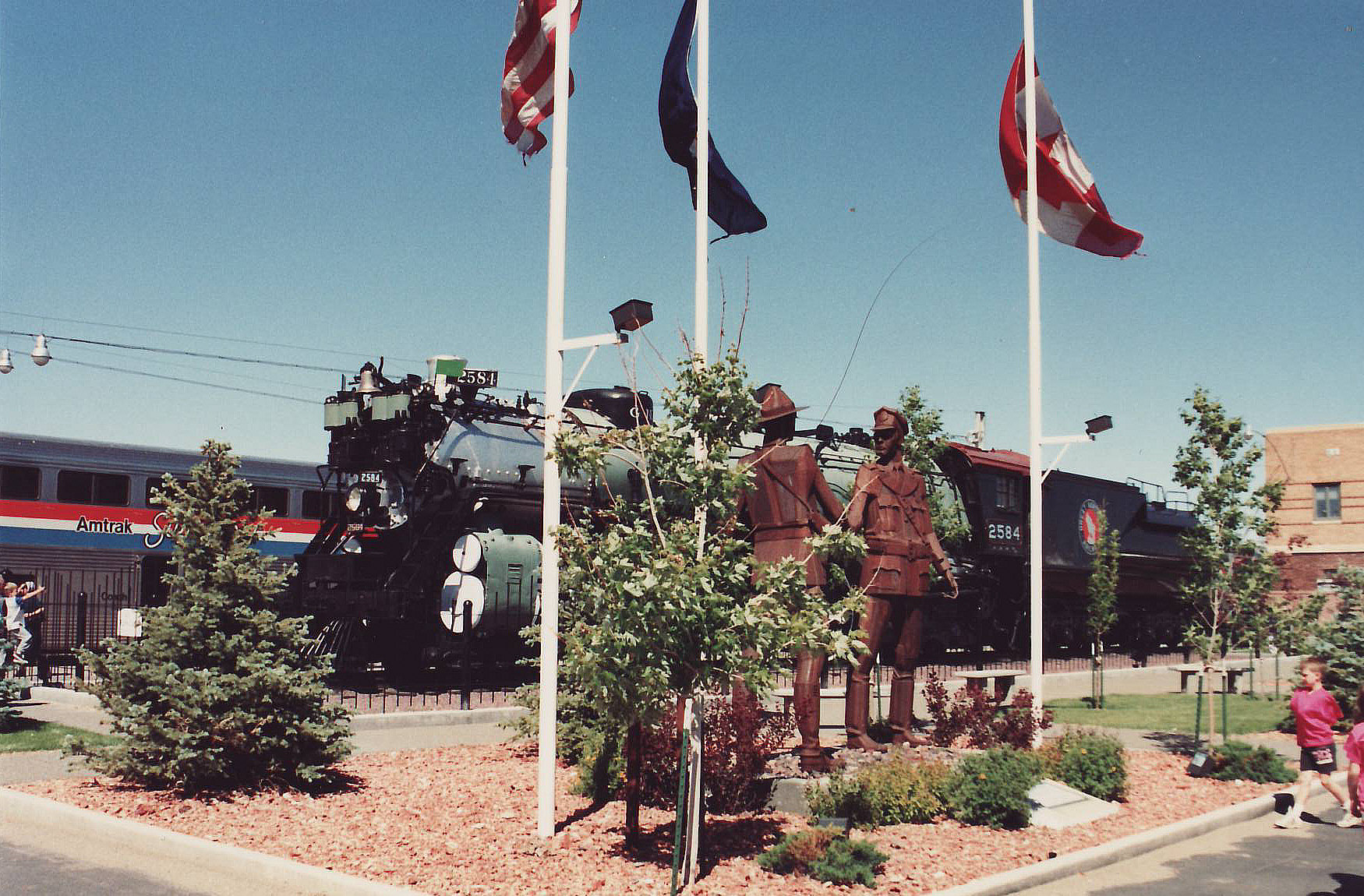
| [[File:Great Northern Railway Steam Engine No. 2584, Havre Train Station, Havre, Montana - September 2011.jpg | 150x150px]] | 2584 | S-2 | 4-8-4 | 3/1930 | 12/1957 | Havre, Montana | Havre Depot | Largest surviving GN steam locomotive |
| [[File:Great Northern Railway Locomotive 3059, Railroad Park, Williston, ND - 51583222365.jpg | 150x150px]] | 3059 | O-1 | 2-8-2 | 2/1913 | 12/1957 | Williston, North Dakota | Williston Depot |
Preserved diesel locomotives
- EMD SD45 #400 "Hustle Muscle"
Rails to Trails
In addition to the Stone Arch Bridge, parts of the railway have been turned into pedestrian and bicycle trails. In Minnesota, the Cedar Lake Trail is built in areas that were formerly railroad yards for the Great Northern Railway and the Minneapolis and St. Louis Railway. Also in Minnesota, the Dakota Rail Trail is built on 26.5 miles of the railroad right-of-way. In Kalispell, Montana the original Great Northern grade from 1892 has been converted into a trail. The trail starts in Kila, MT, and goes to Kalispell Montana, travelling through downtown, right past the Kalispell Depot. The section of rails from Kila to West Kalispell was taken out in the early 1900s, while the section from downtown to where the current end of rail is, was taken out in 2021. Further west, the Iron Goat Trail in Washington follows the late 19th-century route of the Great Northern Railway through the Cascades and gets its name from the railway's logo. The Spokane and Inland Empire Railroad that James J. Hill purchased in 1929 became a bicycle path between Spokane, Wa and Coeur d'Alene, Id. and Spokane, Wa. and Pullman, Wa.
In popular culture

Appearances in popular culture:
- The Great Northern Railway is considered to have inspired (in broad outline, not in specific details) the Taggart Transcontinental railroad in Ayn Rand's Atlas Shrugged.
- The song Great Northern by the Western band Riders In The Sky featured on their 2002 album Ridin' The Tweetsie Railroad describes a journey along the Great Northern Railway.
- The Great Northern is mentioned in the song "Jack Straw," written by Bob Weir and Robert Hunter and originally performed by The Grateful Dead.
Footnotes
References
- Hofsommer, Don L. "Rivals for California: The Great Northern and the Southern Pacific, 1905-1931." Montana: The Magazine of Western History 38.2 (1988): 58–67.
- {{cite book |url-access=registration
- {{cite book
- {{cite book | url-access = registration
- {{Cite book
- {{cite book
- {{cite book
- {{cite book
References
- (1939). "The Great Northern Goat".
- Downs, Winfield Scott. (1940). "Encyclopedia of American Biography". American Historical Company.
- (November 12, 1931). ""Kenney's Goat" Story Recalled". Spokane Daily Chronicle.
- "GN Steam Locos".
- "GNRHS : GN Paint Schemes".
- Lennon, J. "Establishing Trails on Rights-of-Way". [[United States Department of the Interior]].
- "Glacier Park Limited". Ted's Great Northern Homepage.
- "Transcontinental Trains". Ted's Great Northern Homepage.
- "Great Northern Express". Ted's Great Northern Homepage.
- "Archives West: Great Northern Railway Company Wellington Disaster records, 1907–1911".
- (c. 1912). "Three Daily Trains". Great Northern Railway.
- "Great Northern History".
- [https://rgusrail.com/wagn1147.html rgusrail.com]
- "Major private collection of steam locomotives is sold to Oregon Coast Scenic Railroad".
- (1 February 2010). "60 Hikes Within 60 Miles: Seattle: Including Bellevue, Everett, and Tacoma". Menasha Ridge Press.
- Mike McQuaide. (2005). "Day Hike! Central Cascades: The Best Trails You Can Hike in a Day". Sasquatch Books.
- Cusic, Don. (2003). "It's The Cowboy Way: The Amazing True Adventures of Riders in the Sky". University Press of Kentucky.

This article was imported from Wikipedia and is available under the Creative Commons Attribution-ShareAlike 4.0 License. Content has been adapted to SurfDoc format. Original contributors can be found on the article history page.
Ask Mako anything about Great Northern Railway (U.S.) — get instant answers, deeper analysis, and related topics.
Research with MakoFree with your Surf account
Create a free account to save articles, ask Mako questions, and organize your research.
Sign up freeThis content may have been generated or modified by AI. CloudSurf Software LLC is not responsible for the accuracy, completeness, or reliability of AI-generated content. Always verify important information from primary sources.
Report