From Surf Wiki (app.surf) — the open knowledge base
Great Heathen Army
Norse invasion of England in 865
.jpg)
Norse invasion of England in 865
| Field | Value |
|---|---|
| conflict | Great Heathen Army |
| partof | the Viking invasions of England |
| image | England Great Army map.svg |
| image_size | 300px |
| caption | A map of the routes taken by the Great Heathen Army from 865 to 886 |
| date | 865–878 |
| place | England |
| result | Treaty of Alfred and Guthrum |
| combatant1 | Vikings |
| combatant2 | Anglo-Saxon kingdoms: |
| commander1 | Halfdan Ragnarsson |
| Ivar the Boneless | |
| Ubba | |
| Guthrum the Old | |
| Bagsecg | |
| commander2 | Æthelwulf of Wessex |
| Æthelred of Wessex | |
| Alfred the Great | |
| Ælla of Northumbria | |
| Osberht of Northumbria | |
| Burgred of Mercia | |
| Edmund of East Anglia | |
| strength1 | Unknown |
| strength2 | Unknown |
- Creation of the Danelaw
- Danes
- Norwegians
- Swedes
- Norse–Gaels
- Wessex
- Northumbria
- Mercia
- East Anglia Ivar the Boneless Ubba Guthrum the Old Bagsecg Æthelred of Wessex Alfred the Great Ælla of Northumbria Osberht of Northumbria Burgred of Mercia Edmund of East Anglia The Great Heathen Army, also known as the Viking Great Army, was a coalition of Scandinavian warriors who invaded England in AD 865. Since the late 8th century, the Vikings had been engaging in raids on centres of wealth, such as monasteries. The Great Heathen Army was much larger and aimed to conquer and occupy the four kingdoms of East Anglia, Northumbria, Mercia and Wessex.
The name Great Heathen Army is derived from the Anglo-Saxon Chronicle. The force was led by three of the five sons of the semi-legendary Ragnar Lodbrok, including Halfdan Ragnarsson, Ivar the Boneless and Ubba. The campaign of invasion and conquest against the Anglo-Saxon kingdoms lasted 14 years. Surviving sources give no firm indication of its numbers, but it was described as amongst the largest forces of its kind.
The invaders initially landed in East Anglia, where King Edmund provided them with horses for their campaign in return for peace. They spent the winter of 865–866 at Thetford, before marching north to capture York in November 866. York had been founded as the Roman legionary fortress of Eboracum and revived as the Anglo-Saxon trading port of Eoforwic. During 867, the army marched deep into Mercia and wintered in Nottingham. The Mercians agreed to terms with the Viking army, which moved back to York for the winter of 868–869. In 869, the Great Army returned to East Anglia, conquering it and killing its king. The army moved to winter quarters in Thetford.
In 871, the Vikings moved on to Wessex, where Alfred the Great paid them to leave. The army then marched to London to overwinter in 871–872. The following campaigning season the army first moved to York, where it gathered reinforcements. This force campaigned in northeastern Mercia, after which it spent the winter at Torksey, on the Trent close to the Humber.
By this time, only the kingdom of Wessex had not been conquered. In May 878 Alfred the Great defeated the Vikings at the Battle of Edington, and a treaty was agreed whereby the Vikings were able to remain in control of much of northern and eastern England, a region later known as the Danelaw, which was formalised in the Treaty of Alfred and Guthrum.
The Anglo-Saxon Chronicle does not mention the reason for this invasion, perhaps because Viking raids were fairly common during that period. The Tale of Ragnar's Sons, on the other hand, mentions that the invasion of England by the Great Heathen Army was aimed at avenging the death of Ragnar Lodbrok, a legendary Viking ruler of Sweden and Denmark.{{efn|name=son2|There is nothing in the annals to suggest that the brothers invaded England to avenge their father's killing. Also there is no reference to them being the sons of Ragnar.
Background
Viking raids began in England in the late 8th century, primarily on monasteries. The Anglo-Saxon Chronicle entry for AD 787 reports the first confrontation with the Vikings in England.
This incident is regarded, by some, as the first raid on England. Æthelweard's version of the Chronicle, known as the Chronicon Æthelweardi, has a slightly different version of events, saying that the reeve, a certain Beaduheard, had spoken to the visitors in an "authoritative tone" and this is why they killed him. The designation of these "Hæretha-landers" as Danes is somewhat problematic. Sara María Pons-Sanz states, in "Analysis of the Scandinavian Loanwords in the Aldredian Glosses to the Lindisfarne Gospels", that they were either men from Harthæsysæl (Hardsyssel) in Jutland, so actually Danes, or from Hörthaland in Norway, so that in the last case the word "Danish" refers to all Scandinavian people.
The first monastery to be raided was in 793 at Lindisfarne, off the northeast coast; the Anglo-Saxon Chronicle described the Vikings as "heathen men". Monasteries and minster churches were popular targets as they were wealthy and had valuable, portable objects. The Anglo-Saxon Chronicle for 840 says that Æthelwulf of Wessex was defeated at Carhampton, Somerset, after 35 Viking ships had landed in the area. The Annals of St. Bertin also reported the incident, stating:
Despite this, Æthelwulf had some success against the Vikings. The Anglo-Saxon Chronicle has repeated references during his reign of victories won by ealdormen with the men of their shires. However, the raiding of England continued on and off until the 860s, when instead of raiding, the Vikings changed their tactics and sent a great army to invade England. This army was described by the Anglo-Saxon Chronicle as a "Great Heathen Army" (OE: mycel hæþen here or mycel heathen here).
The size of the army
Historians provide varying estimates for the size of the Great Heathen Army. According to the 'minimalist' scholars, such as Pete Sawyer, the army may have been smaller than traditionally thought. Sawyer notes that the Anglo-Saxon Chronicle of 865 referred to the Viking force as a Heathen Army, or in Old English "hæþen here".
The law code of King Ine of Wessex, issued in about 694, provides a definition of here (pronounced ) as "an invading army or raiding party containing more than thirty-five men", thus differentiating between the term for the invading Viking army and the Anglo-Saxon army that was referred to as the fyrd. The scribes who wrote the Anglo-Saxon Chronicle used the term here to describe the Viking forces. The historian Richard Abels suggested that this was to differentiate between the Viking war bands and those of military forces organised by the state or the crown. By the late 10th and early 11th century, here was used more generally as the term for an army, whether it was Viking or not.
Sawyer produced a table of Viking ship numbers, as documented in the Anglo-Saxon Chronicle, and assumes that each Viking ship could carry no more than 32 men{{efn|The Viking ship wrecks, discovered at Skuldelev, Denmark, indicate that a small longship (wreck 5) could carry approximately 30 men and a great longship (wreck 2) could carry 65–70. The saga of Ragnar's sons describes how they used knorrs (cargo ships) to carry warriors, each knorr carrying 250 men. Guy Halsall reported that, in the 1990s, several historians suggested that the Great Heathen Army would have numbered in the low thousands and acknowledged that there "is still much room for debate".
The army probably developed from the campaigns in Francia, where there was a conflict between Emperor Louis the Pious and his sons. One of the sons, Lothair I, had welcomed the support from a Viking fleet. By the time the war had ended, the Vikings had discovered that monasteries and towns situated on navigable rivers were vulnerable to attack. In 845, a raid on Paris was prevented by a large payment of silver to the Vikings. The opportunity for rich pickings drew other Vikings to the area, and by the end of the decade all the main rivers of West Francia were being patrolled by Viking fleets. In 862, the West Frankish king responded to the Vikings, fortifying his towns and defending his rivers, making it difficult for the Vikings to raid inland. The lower reaches of the rivers and the coastal regions were left largely undefended. Religious communities in these areas moved inland away from the reaches of the Viking fleets. With the changes in Francia making raiding more difficult, the Vikings turned their attention to England.
Invasion of England
The Viking leaders often joined together for mutual benefit and then dissolved once profit had been achieved.
The Vikings had been defeated by the West Saxon King Æthelwulf in 851, so rather than land in Wessex they decided to go further north to East Anglia. Legend has it that the united army was led by the three sons of Ragnar Lodbrok: Halfdan Ragnarsson, Ivar the Boneless (Hingwar), and Ubba.
Start of the invasion, 865
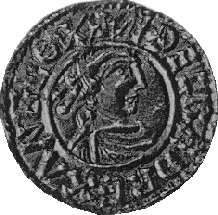
In late 865, the Great Heathen Army encamped in the Isle of Thanet and was promised by the people of Kent danegeld in exchange for peace. The Vikings did not abide by this agreement and rampaged across eastern Kent.
The Vikings used East Anglia as a starting point for an invasion. The East Anglians made peace with the invaders by providing them with horses. The Vikings stayed in East Anglia for the winter before setting out for Northumbria towards the end of 866, establishing themselves at York. In 867, the Northumbrians paid danegeld, and the Viking Army established a puppet leader in Northumbria before setting off for the Kingdom of Mercia, where in 867 they captured Nottingham. The king of Mercia requested help from the king of Wessex to help fight the Vikings. A combined army from Wessex and Mercia besieged the city of Nottingham with no clear result, so the Mercians settled on paying the Vikings off. The Vikings returned to Northumbria in autumn 868 and overwintered in York, staying there for most of 869. They returned to East Anglia and spent the winter of 869–870 at Thetford. While in Thetford, they were attacked by Edmund, king of East Anglia, with whom they had no peace agreement. The Viking army was victorious in these battles, and Edmund was captured, possibly tortured, and killed. He later came to be known as Edmund the Martyr.

In 871, the Great Summer Army arrived from Scandinavia, led by Bagsecg. The reinforced Viking army turned its attention to Wessex but the West Saxons, led by King Æthelred's brother Alfred, defeated them on 8 January 871 at the Battle of Ashdown, slaying Bagsecg in the process. Three months later, Æthelred died and was succeeded by Alfred (later known as Alfred the Great), who bought the Vikings off to gain time. During 871–872, the Great Heathen Army wintered in London before returning to Northumbria. It seems that there had been a rebellion against the puppet ruler in Northumbria, so they returned to restore power. They then established their winter quarters for 872–873 at Torksey in the Kingdom of Lindsey (now part of Lincolnshire). The Mercians again paid them off in return for peace, and at the end of 873 the Vikings took up winter quarters at Repton in Derbyshire.
In 874, following their winter stay in Repton, the Great Heathen Army drove the Mercian king into exile and finally conquered Mercia. The exiled Mercian king was replaced by Ceolwulf. According to Alfred the Great's biographer Asser, the Vikings then split into two bands. Halfdan led one band north to Northumbria, where he overwintered by the river Tyne (874–875). In 875, he ravaged further north to Scotland, where he fought the Picts and the Britons of Strathclyde. Returning south of the border in 876, he shared out Northumbrian land among his men, who "ploughed the land and supported themselves." This land was part of what became known as the Danelaw.
King Alfred's victory
According to Asser, the second band was led by Guthrum, Oscetel, and Anwend. This group also left Repton in 874 and established a base at Cambridge for the winter of 874–875. In late 875 they moved onto Wareham, where they raided the surrounding area and occupied a fortified position. Asser reports that Alfred made a treaty with the Vikings to get them to leave Wessex. The Vikings left Wareham, but it was not long before they were raiding other parts of Wessex, and initially they were successful. Alfred fought back, however, and eventually won victory over them at the Battle of Edington in 878. This was followed closely by what was described by Asser as the Treaty of Wedmore, where Guthrum agreed to be baptised and then for him and his army to leave Wessex. Then some time after, the Treaty of Alfred and Guthrum was agreed, that set out the boundaries between Alfred and Guthrum's territories as well as agreements on peaceful trade, and the weregild value of their people.
Aftermath
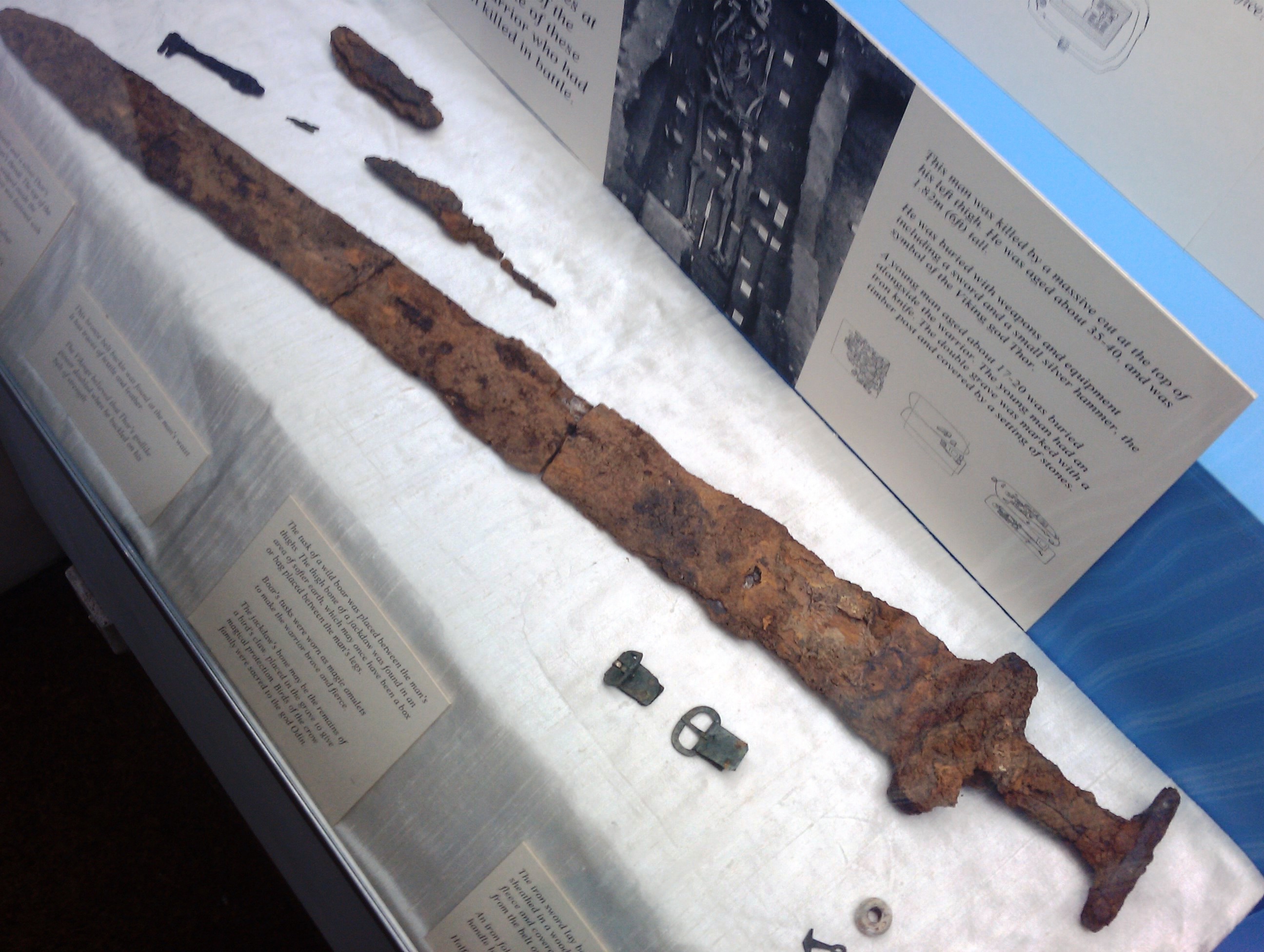
In late 878, Guthrum's band withdrew to Cirencester, in the kingdom of Mercia. Then, probably in late 879, it moved to East Anglia, where Guthrum, who was also known by his baptismal name of Aethelstan, reigned as king until his death in 890. The part of the army that did not go with Guthrum mostly went on to more settled lives in Northumbria and York. Some may have settled in Mercia. Evidence for this is the presence of two Viking cemeteries in Derbyshire that are believed to be connected to the Great Army, at Repton and at Heath Wood.
In 878, a third Viking army gathered on Fulham by the Thames. It seems they were partly discouraged by the defeat of Guthrum but also Alfred's success against the Vikings coincided with a period of renewed weakness in Francia. The Frankish emperor, Charles the Bald, died in 877 and his son shortly after, precipitating a period of political instability of which the Vikings were quick to take advantage. The assembled Viking army on the Thames departed in 879 to begin new campaigns on the continent.
In 892, the army that had encamped on Fulham, now comprising 250 ships, had returned and re-established itself in Appledore, Kent. Another army of 80 ships soon afterwards also encamped in Milton Regis, posing a threat to the West Saxons. The army subsequently launched a series of attacks on Wessex. Due in part to the King's efforts to resist the invaders and defend Wessex, the Heathen Army made less of an impact against the kingdom than hoped and saw little progress, eventually disbanding in 896.
Throughout the 880s, the Viking presence in his kingdom encouraged Alfred to protect Wessex. The King realised the importance of naval combat against the Vikings and saw to the creation of a navy; Alfred ordered the construction of specialised ships that were supposedly twice as long as Viking ships, some possessing 60 oars, others possessing even more. Alfred also reorganised the army and set up a powerful system of fortified towns known as burhs.
Alfred mainly used old Roman cities for his burhs, as he was able to rebuild and reinforce their existing fortifications. Every freeman in the land could be called out to protect the realm in times of trouble but the speed of Viking hit-and-run raids had been too quick for the local militias to act; part of Alfred's reforms was to create a standing army that could react rapidly to attacks. The Anglo-Saxon rural population lived within a 24 km (15-mile) radius of each burh, so they were able to seek refuge when necessary. To maintain the burhs, as well as the standing army, Alfred set up a system of taxation and conscription that is recorded in a document now known as the Burghal Hidage. The burhs were connected with a network of military roads, known as herepaths, enabling Alfred's troops to move swiftly to engage the enemy. As here was usually a reference to an invading army, then it follows that herepath was a road for use against a here.
Some historians believe that each burh would have had a mounted force ready for action against the Vikings. Based on figures from the Burghal Hidage, it is probable that a fifth of the adult male population of Wessex (27,000 men) would have been mobilised. A common Viking tactic was to seize a centre, usually some sort of fortification, that they could reinforce and then use as a base to plunder the surrounding district. From 884 Alfred's reforms prevented them from doing this in Wessex.
By 896, the Viking army was all but defeated and no longer saw any reason to continue their attacks and dispersed to East Anglia and Northumbria. Those that were penniless found themselves ships and went south across the sea to the Seine. Anglo-Saxon England had been torn apart by the invading Great Heathen Army and the Vikings had control of northern and eastern England, while Alfred and his successors had defended their kingdom and remained in control of Wessex.
Archaeological sites
The stone church of St Wystan at Repton was, in the 9th century, the site of an Anglo-Saxon monastery and church. Excavations at the site between 1974 and 1988 found a D-shaped earthwork on the river bank, incorporated into the church. Burials of Viking type were made at the east end of the church, and an existing building was cut down and converted into the chamber of a burial mound that revealed the disarticulated remains of at least 249 people, with their long bones pointing towards the centre of the burial. A large stone coffin was found in the middle of the mass grave, but the remains of this body did not survive. A study of the skeletal remains revealed that at least 80% of the bodies were male, and were between the ages of 15 and 45. A variety of Viking artefacts were also found among the bones.
Although initial radiocarbon dating suggested that the bodies had accumulated there over several centuries, in February 2018 a team from the University of Bristol announced that the remains could all be dated to the late 9th century, consistent with the time the army wintered in Derbyshire. They attributed the initial discrepancies to the high consumption of seafood by the Vikings. Because the carbon in the Earth's oceans is older than much of the carbon found by organisms on land, radiocarbon dating must be adjusted. This is called the marine reservoir effect.
The nearby Heath Wood barrow cemetery contains about sixty cremations (rather than burials). Finds of cremation sites in the British Isles are very rare, and this one was probably also associated with the Great Heathen Army.
Notes
References
Sources
References
- Hadley. "The Winter Camp of the Viking Great Army, AD 872–3, Torksey, Lincolnshire", ''Antiquaries Journal''. '''96''', pp. 23–67
- Frantzen ''Anglo-Saxon Keywords''. p 275
- Friis-Jensen. ''The Making of Christian Myths in the Periphery of Latin Christendom (c. 1000–1300)''. p. 198
- Munch. ''Norse Mythology: Legends of Gods and Heroes'', pp. 357–359.
- Richards, Julian D.. (2004). "Excavations at the Viking barrow cemetery at Heath Wood, Ingleby, Derbyshire". [[The Antiquaries Journal]].
- Higham, Nicholas. (2014). "Danelaw". Wiley Blackwell.
- Tunstall, Peter. (2005). "The Saga of Ragnar Lodrok and his Sons Ragnars Saga Loðbrókar ok sona hans". germanicmythology.com.
- }} In the Viking saga, Ragnar is said to have conducted a raid on Northumbria during the reign of King Ælla. The Vikings were defeated and Ragnar was captured by the Northumbrians. Ælla then had Ragnar executed by throwing him into a pit of venomous snakes. When the sons of Ragnar received news of their father's death, they decided to avenge him.Kane. ''History of the Vikings and Norse Culture''. pp. 72–74
- link. (7 September 2014)
- Sawyer. ''The Oxford Illustrated History of Vikings''. pp. 2–3
- Heath. ''The Vikings'', pp. 3–4
- Giles Tr., J.A, ed. ''Six Old English Chronicles: Æthelweard's Chronicle''. p. 19
- Forte et al. ''Viking Empires''. p. 125
- (2000). "Analysis of the Scandinavian Loanwords in the Aldredian Glosses to the Lindisfarne Gospels". Universitat de València.
- ''ASC'' 793 – English translation at [http://www.gutenberg.org/cache/epub/657/pg657.html Project Gutenberg]. Retrieved 16 January 2013
- Starkey. ''The Monarchy of England'', Vol. 1. p. 51
- ''ASC'' 840 – English translation at [http://www.gutenberg.org/cache/epub/657/pg657.html Project Gutenberg]. Retrieved 18 January 2013
- Nelson. ''The Annals of St-Bertin''. p. 59.
- Janet L. Nelson, "Æthelwulf (d. 858)", ''Oxford Dictionary of National Biography'', Oxford University Press, 2004 [http://www.oxforddnb.com/view/article/8921, accessed 18 Jan 2013]
- ''ASC'' 865 – English translation at [http://www.gutenberg.org/cache/epub/657/pg657.html Project Gutenberg]. Retrieved 16 January 2013
- Oliver. ''Vikings: A History''. p. 169 – in 865 the ''Anglo Saxon Chronicle'' made mention of it ... Great Army ''mycel here''..Great Heathen Army ''mycel heathen here''
- link. (17 October 2013 . Retrieved 20 August 2013. The entry for 867 refers to the Great Heathen Army as ''mycel hæþen here''.)
- Sturdy. ''Alfred the Great''. p. 111
- Smyth. ''King Alfred the Great''. p. 21
- Abels. ''Alfred the Great: War. Kingship, and Culture in Anglo-Saxon England''. p. 113
- Richard Abels. "Alfred the Great, the ''micel hæðen here'' and the Viking threat" in Timothy Reuter. ''Alfred the Great''. pp. 266–267
- Sawyer. ''The Age of Vikings''. pp. 124–125
- See Hashall's ''Warfare and Society in the Barbarian West 450–900'' Chapter 6 for a discussion on the size of medieval armies
- link. (12 February 2009 Retrieved 17 April 2013.
* The entry for 865 refers to the Heathen Army as ''hæþen here''.
* The entry for 866 describes the Great Army as ''micel here''.) - Vikinges Kibs Museet. "The five Viking ships – The Skuldelev Ships"
- }} leading to his conclusion that the army would have consisted of no more than 1,000 men. Other scholars give higher estimates. For example, Laurent Mazet-Harhoff observes that many thousands of men were involved in the invasions of the Seine area. Mazet-Harhoff concedes that the military bases that would accommodate these large armies have yet to be rediscovered.Laurent Mazet-Harhoff. The Incursion of the Vikings into the natural and cultural landscape of upper Normandy ''in'' Iben Skibsted Klæsøe, ''Viking Trade and Settlement in Western Europe'', p. 87
- Bernard Bachrach, ''Charlemagne's Early Campaigns (768–777): A Diplomatic and Military Analysis.'' (Volume 82 of History of Warfare) Brill, 2013. {{ISBN. 9004224106, p. 77
- Sawyer. ''The Oxford Illustrated History of Vikings'', pp. 9–11 and pp. 53–54
- Several of the Viking leaders who had been active in Francia and Frisia joined forces to conquer the four kingdoms constituting [[Anglo-Saxon England]]. The composite force probably contained elements from Denmark, Norway, Sweden, and Ireland as well as those who had been fighting on the continent. The Anglo-Saxon historian [[Æthelweard (historian)
- Brøndsted. ''The Vikings'', pp. 52–53
- Jones. ''A History of the Vikings'', pp. 218–219
- Christopher Wright. (1975). "Kent through the years". Batsford.
- Ridyard. ''The Royal Saints of Anglo-Saxon England'', p. 65
- Keynes/ Lapidge. ''Alfred the Great'', pp.16–17
- (1996). "The Cambridge Illustrated Atlas of Warfare: the Middle Ages". Cambridge University Press.
- Keynes/ Lapidge. ''Alfred the Great'', p. 244 Note 79
- D. and [[Julian D. Richards. Richards, J. D.]] (2016) [https://dx.doi.org/10.11141/ia.42.3 Haldenby The Viking Great Army and its Legacy: plotting settlement shift using metal-detected finds], Internet Archaeology 42.] Retrieved 13 December 2016 {{doi. 10.11141/ia.42.3
- (2021). "The Viking Great Army". Thames & Hudson.
- Keynes/ Lapidge. ''Alfred the Great'', pp.18–19
- Asser. Life of Alfred ''in'' Keyns/ Lapidge. ''Alfred the Great'', p. 82
- Sawyer. ''Illustrated History of Viking'', p. 55
- Holman. ''The A to Z of the Vikings'', p. 117
- Stenton. ''Anglo-Saxon England'', p. 253
- Smyth. ''The Medieval Life of Alfred'', pp. 26–27
- Smyth.''King Alfred the Great'', p. 92
- ''ASC'' 878 – English translation at [http://www.gutenberg.org/cache/epub/657/pg657.html Project Gutenberg]. Retrieved 16 January 2013
- ''ASC'' 879 – English translation at [http://www.gutenberg.org/cache/epub/657/pg657.html Project Gutenberg]. Retrieved 16 January 2013
- ''ASC'' 890 – English translation at [http://www.gutenberg.org/cache/epub/657/pg657.html Project Gutenberg]. Retrieved 16 January 2013
- Peter Sawyer. (2001). "The Oxford Illustrated History of the Vikings". Oxford University Press.
- Sawyer. ''Kings and Vikings: Scandinavia and Europe'', p. 91
- Peter Sawyer. (2001). "The Oxford Illustrated History of the Vikings". Oxford University Press.
- Peter Sawyer. (2001). "The Oxford Illustrated History of the Vikings". Oxford University Press.
- The Anglo-Saxon Chronicle
- Bertil Almgren. (1974). "The Viking". Wahlstrom and Widstrand.
- Lavelle. ''Fortifications in Wessex c. 800–1066''. p. 26
- Sawyer. ''The Oxford Illustrated History of the Vikings'', p. 57
- Starkey. ''Monarchy'', p. 63
- Welch. ''Anglo-Saxon England'', pp. 127–129
- Horspool. ''Why Alfred Burnt the Cakes'', p. 102
- Hooper and Bennett. The Cambridge Illustrated Atlas of Warfare: The Middle Ages, 768–1487. pp. 22–23
- Sawyer. ''Kings and Vikings'', p. 92
- ''ASC'' 897 – English translation at [http://www.gutenberg.org/cache/epub/657/pg657.html Project Gutenberg]. Retrieved 16 January 2013
- Kirby. ''The Earliest English Kings'', p. 178
- (1992). "Repton and the Vikings". Antiquity.
- University of Bristol. (2 February 2018). "Radiocarbon dating reveals mass grave did date to the Viking age". Eurekalert.
- (2 February 2018). "The Viking Great Army in England: new dates from the Repton charnel". Antiquity.
This article was imported from Wikipedia and is available under the Creative Commons Attribution-ShareAlike 4.0 License. Content has been adapted to SurfDoc format. Original contributors can be found on the article history page.
Ask Mako anything about Great Heathen Army — get instant answers, deeper analysis, and related topics.
Research with MakoFree with your Surf account
Create a free account to save articles, ask Mako questions, and organize your research.
Sign up freeThis content may have been generated or modified by AI. CloudSurf Software LLC is not responsible for the accuracy, completeness, or reliability of AI-generated content. Always verify important information from primary sources.
Report