From Surf Wiki (app.surf) — the open knowledge base
Great Chicago Fire
1871 conflagration in Illinois, US
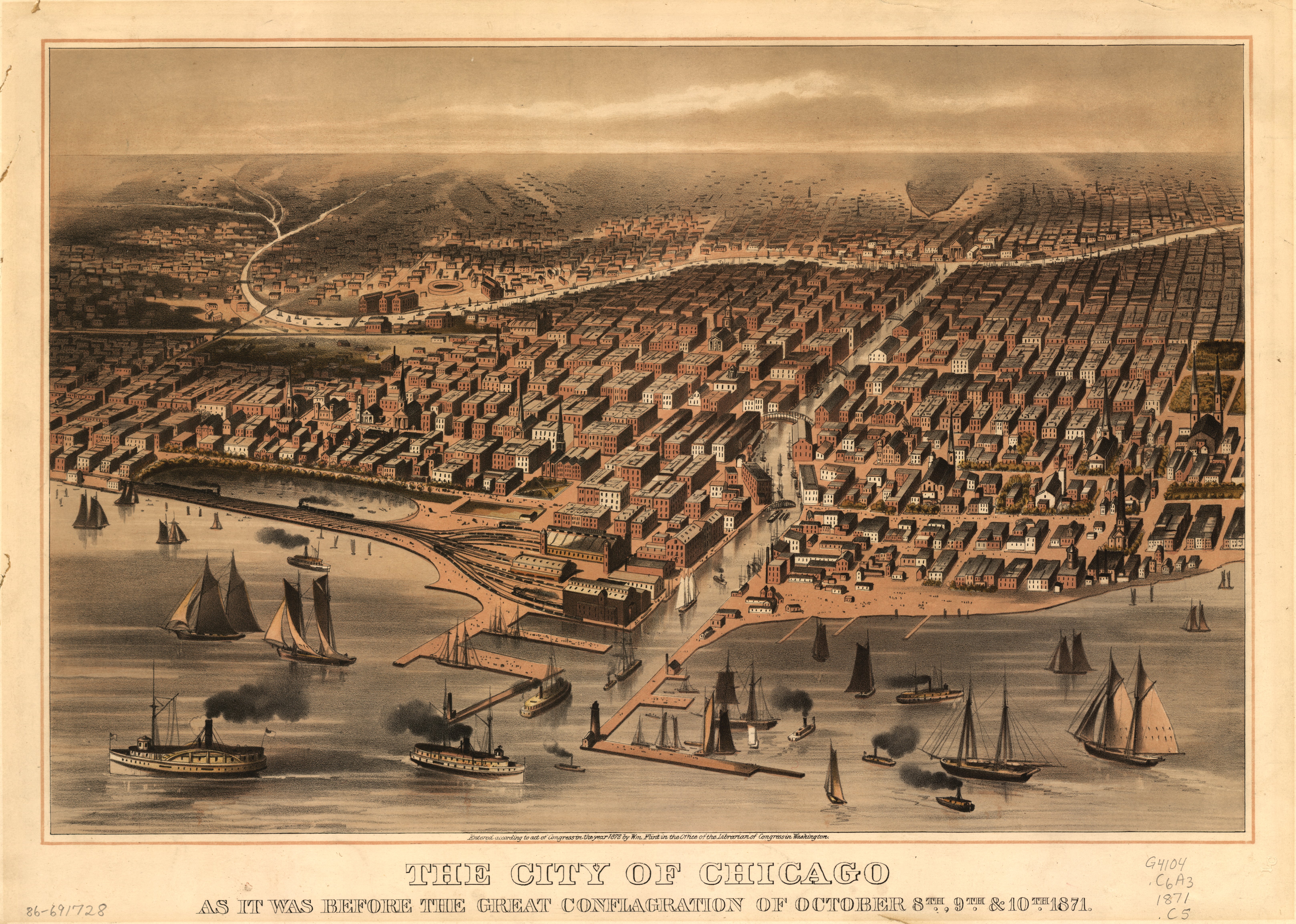
1871 conflagration in Illinois, US
| Field | Value |
|---|---|
| title | Great Chicago Fire |
| image | Chicago in Flames by Currier & Ives, 1871 (cropped).jpg |
| image_size | 320px |
| caption | An artist's rendering of the fire, by Currier and Ives. The view faces northeast across the Randolph Street Bridge. |
| date | – |
| location | Chicago, Illinois, United States |
| coordinates | |
| pushpin_map | |
| cost | $222 million (1871 USD) |
| (approx. $5.7 billion in 2025) | |
| area | 2,112 acres |
| buildings | 17,500 buildings |
| cause | Unknown |
| fatalities | 300 (estimate) |
(approx. $5.7 billion in 2025) The Great Chicago Fire was a conflagration that burned in the American city of Chicago, Illinois, during October 8–10, 1871. The fire killed approximately 300 people, destroyed 17,000 structures across roughly 3.3 sqmi, and left more than 100,000 residents homeless. The fire began in a neighborhood southwest of the city center. A long period of hot, dry, windy conditions, and the wooden construction prevalent in the city, led to the conflagration spreading quickly. The fire leapt the south branch of the Chicago River and destroyed much of central Chicago and then crossed the main stem of the river, consuming the Near North Side.
Help flowed to the city from near and far after the fire. The city government improved building codes to stop the rapid spread of future fires and rebuilt rapidly to those higher standards. A donation from the United Kingdom spurred the establishment of the Chicago Public Library.
Origin

According to Nancy Connolly, great-great granddaughter of Catherine O'Leary, the fire is said to have started at about 8:30 p.m. on October 8, in or around a small barn belonging to the O'Leary family that bordered the alley behind 137 W. DeKoven Street when Daniel "Peg-Leg" Sullivan accidentally knocked over a lantern while looking for beer for a party. The shed next to the barn was the first building to be consumed by the fire. City officials never determined the cause of the blaze, but the rapid spread of the fire due to a long drought in that year's summer, strong winds from the southwest, and the rapid destruction of the water pumping system explain the extensive damage of the mainly wooden city structures. There has been much speculation over the years on a single start to the fire. The most popular tale blames Mrs. O'Leary's cow, which allegedly knocked over a lantern; others state that a group of men were gambling inside the barn and knocked over a lantern. Still other speculation suggests that the blaze was related to other fires in the Midwest that day.
The fire's spread was aided by the city's use of wood as the predominant building material in a style called balloon frame. More than two-thirds of the structures in Chicago at the time of the fire were made entirely of wood, with most of the houses and buildings being topped with highly combustible tar or shingle roofs. All of the city's sidewalks and many roads were also made of wood. Compounding this problem, Chicago received only 1 in of rain from July 4 to October 9, causing severe drought conditions before the fire, while strong southwest winds helped to carry flying embers toward the heart of the city.
In 1871, the Chicago Fire Department had 185 firefighters with just 17 horse-drawn steam pumpers to protect the entire city. The initial response by the fire department was timely, but due to an error by the watchman, Mathias Schaffer, the firefighters were initially sent to the wrong place, allowing the fire to grow unchecked. An alarm sent from the area near the fire also failed to register at the courthouse where the fire watchmen were, while the firefighters were tired from having fought numerous small fires and one large fire in the week before. These factors combined to turn a small barn fire into a conflagration.
Spread

When firefighters finally arrived at DeKoven Street, the fire had grown and spread to neighboring buildings and was progressing toward the central business district. Firefighters had hoped that the South Branch of the Chicago River and an area that had previously thoroughly burned would act as a natural firebreak. All along the river, however, were lumber yards, warehouses, and coal yards, as well as barges, and numerous bridges across the river. As the fire grew, the southwest wind intensified and the temperature rose, causing structures to catch fire from the heat and from burning debris blown by the wind. Around midnight, flaming debris blew across the river and landed on roofs and the South Side Gas Works.
With the fire across the river and moving rapidly toward the heart of the city, panic set in. About this time, Mayor Roswell B. Mason sent messages to nearby towns asking for help. When the courthouse caught fire, he ordered the building to be evacuated and the prisoners jailed in the basement to be released. At 2:30 a.m. on the 9th, the cupola of the courthouse collapsed, sending the great bell crashing down. Some witnesses reported hearing the sound from a mile (1.6 km) away.
As more buildings succumbed to the flames, a major contributing factor to the fire's spread was a meteorological phenomenon known as a fire whirl. As hot air rises, it comes into contact with cooler air and begins to spin, creating a tornado-like effect. These fire whirls are likely what drove flaming debris so high and so far. Such debris was blown across the main branch of the Chicago River to a railroad car carrying kerosene. The fire had jumped the river a second time and was now raging across the city's north side.
Despite the fire spreading and growing rapidly, the city's firefighters continued to battle the blaze. A short time after the fire jumped the river, a burning piece of timber lodged on the roof of the city's waterworks. Within minutes, the interior of the building was engulfed in flames and the building was destroyed. With it, the city's water mains went dry and the city was helpless. The fire burned unchecked from building to building, block to block.
Late in the evening of October 9, it started to rain, but the fire had already started to burn itself out. The fire had spread to the sparsely populated areas of the north side, having thoroughly consumed the densely populated areas.
Aftermath
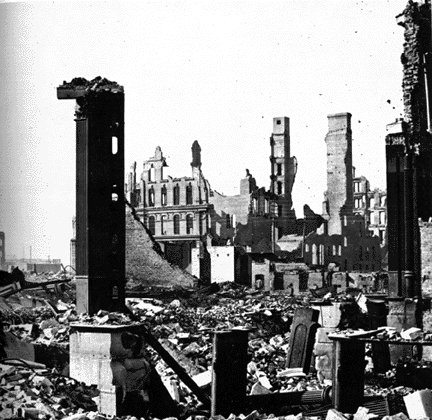
Once the fire had ended, the smoldering remains were still too hot for a survey of the damage to be completed for many days. Eventually, the city determined that the fire destroyed an area about 4 mi long and averaging 3/4 mi wide, encompassing an area of more than 2000 acre. Destroyed were more than 73 mi of roads, 120 mi of sidewalk, 2,000 lampposts, 17,500 buildings, and $222 million in property, which was about a third of the city's valuation in 1871.
On October 11, 1871, U.S. Army Lieutenant General Philip H. Sheridan came to the aid of the city. Chicago mayor Roswell B. Mason issued a proclamation that declared martial law and placed the city under Sheridan's temporary control: "The Preservation of the Good Order and Peace of the city is hereby intrusted to Lieut. General P.H. Sheridan, U.S. Army." Sheridan's command structure consisted of a mix of regular troops, militia units, police, and a specially organized civilian group "First Regiment of Chicago Volunteers". Former Lieutenant-Governor William Bross, and part owner of the Tribune, later recollected his response to the arrival of Gen. Sheridan and his soldiers: "Never did deeper emotions of joy overcome me. Thank God, those most dear to me and the city as well are safe." For two weeks, Sheridan's men patrolled the streets, guarded the relief warehouses, and enforced other regulations. On October 24 the troops were relieved of their duties and the volunteers were mustered out of service.

Of the approximately 324,000 inhabitants of Chicago in 1871, 90,000 Chicago residents (about 28% of the population) were left homeless. 120 bodies were recovered, but the death toll may have been as high as 300. The county coroner speculated that an accurate count was impossible, as some victims may have drowned or had been incinerated, leaving no remains.
In the days and weeks following the fire, monetary donations flowed into Chicago from around the country and abroad, along with donations of food, clothing, and other goods. These donations came from individuals, corporations, and cities. New York City gave $450,000 (equivalent to $ today) along with clothing and provisions, St. Louis gave $300,000 (equivalent to $ today), and the Common Council of London gave 1,000 guineas, as well as £7,000 from private donations. In Greenock, Scotland (pop. 40,000) a town meeting raised £518 on the spot. Cincinnati, Cleveland, and Buffalo, all commercial rivals, donated hundreds and thousands of dollars. Milwaukee, along with other nearby cities, helped by sending fire-fighting equipment. Food, clothing and books were brought by train from all over the continent. Mayor Mason placed the Chicago Relief and Aid Society in charge of the city's relief efforts.
Operating from the First Congregational Church, city officials and aldermen began taking steps to preserve order in Chicago. Price gouging was a key concern, and in one ordinance, the city set the price of bread at 8¢ for a 12 oz loaf. Public buildings were opened as places of refuge, and saloons closed at 9 in the evening for the week following the fire. Many people who were left homeless after the incident were never able to get their normal lives back since all their personal papers and belongings burned in the conflagration.
After the fire, A. H. Burgess of London proposed an "English Book Donation", to spur a free library in Chicago, in their sympathy with Chicago over the damages suffered.
The fire also led to questions about development in the United States. Due to Chicago's rapid expansion at that time, the fire led to Americans reflecting on industrialization. Based on a religious point of view, some said that Americans should return to a more old-fashioned way of life, and that the fire was caused by people ignoring traditional morality. On the other hand, others believed that a lesson to be learned from the fire was that cities needed to improve their building techniques. Frederick Law Olmsted observed that poor building practices in Chicago were a problem:
Chicago had a weakness for "big things", and liked to think that it was outbuilding New York. It did a great deal of commercial advertising in its house-tops. The faults of construction as well as of art in its great showy buildings must have been numerous. Their walls were thin, and were overweighted with gross and coarse misornamentation.

Olmsted also believed that with brick walls, and disciplined firemen and police, the deaths and damage caused would have been much less.
Almost immediately, the city began to rewrite its fire standards, spurred by the efforts of leading insurance executives, and fire-prevention reformers such as Arthur C. Ducat. Chicago soon developed one of the country's leading fire-fighting forces.

Business owners and land speculators such as Gurdon Saltonstall Hubbard quickly set about rebuilding the city. The first load of lumber for rebuilding was delivered the day the last burning building was extinguished. By the World's Columbian Exposition 22 years later, Chicago hosted more than 21 million visitors. The Palmer House hotel burned to the ground in the fire 13 days after its grand opening. Its developer, Potter Palmer, secured a loan and rebuilt the hotel to higher standards, across the street from the original, proclaiming it to be "The World's First Fireproof Building".
In 1956, the remaining structures on the original O'Leary property at 558 W. DeKoven Street were torn down for construction of the Chicago Fire Academy, a training facility for Chicago firefighters, known as the Quinn Fire Academy or Chicago Fire Department Training Facility. A bronze sculpture of stylized flames, entitled Pillar of Fire by Egon Weiner, was erected on the point of origin in 1961.
Surviving structures

The following structures from the burned district are still standing:
- St. Michael's Church, Old Town
- Chicago Water Tower
- Chicago Avenue Pumping Station
- Police Constable Bellinger's cottage at 21 Lincoln Place (2121 North Hudson, today).
- 2323 and 2339 North Cleveland Avenue also survived the blaze.
St. Michael's Church and the Pumping Station were both gutted in the fire, but their exteriors survived, and the buildings were rebuilt using the surviving walls. Additionally, though the inhabitable portions of the building were destroyed, the bell tower of St. James Cathedral survived the fire and was incorporated into the rebuilt church. The stones near the top of the tower are still blackened from the soot and smoke.
Panorama of damage
Precise start
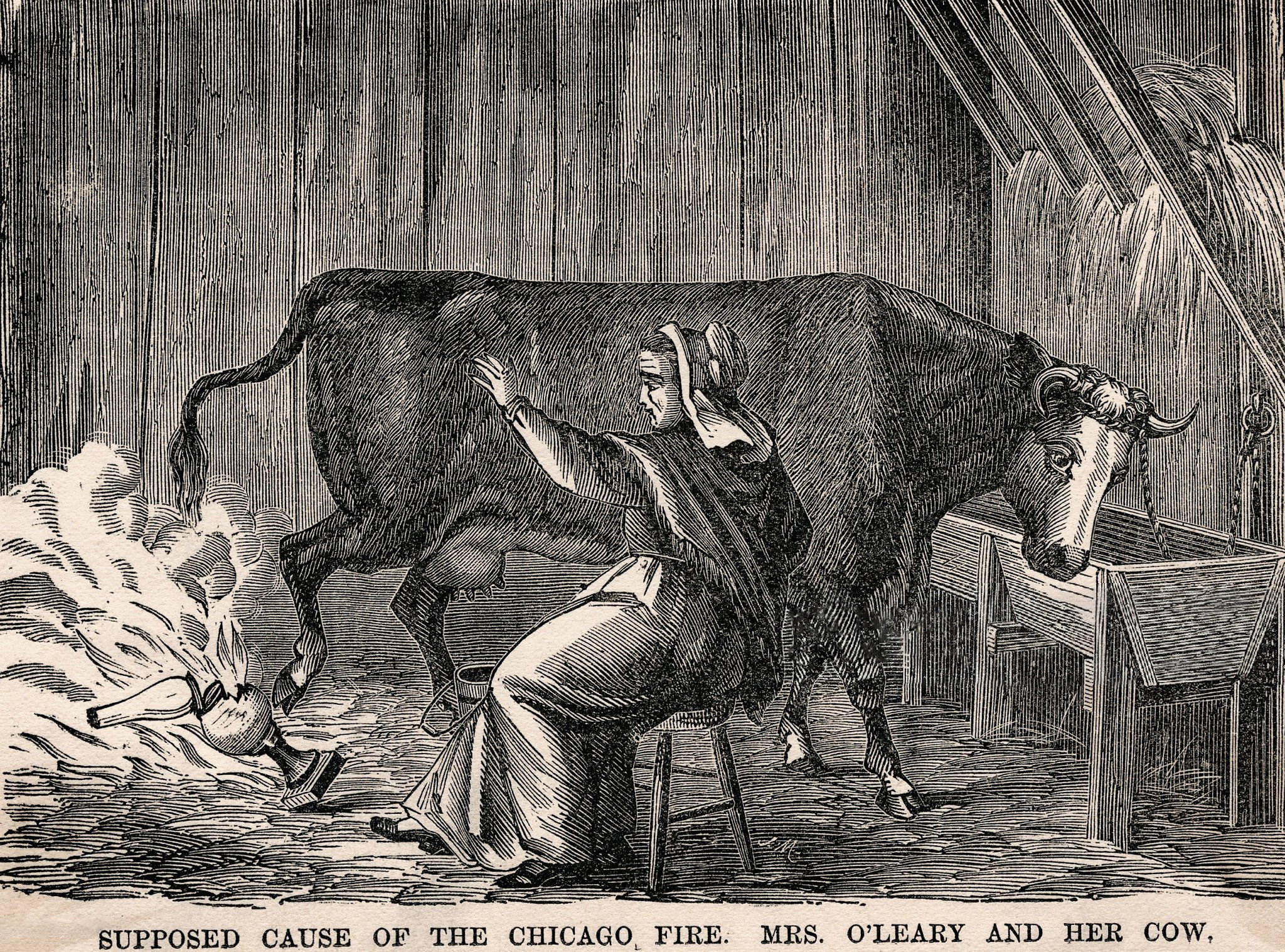
Almost from the moment the fire broke out, various theories about its cause began to circulate. The most popular and enduring legend maintains that the fire began in the O'Leary barn as Mrs. O'Leary was milking her cow. The cow kicked over a lantern (or an oil lamp in some versions), setting fire to the barn. The O'Leary family denied this, stating that they were in bed before the fire started, but stories of the cow began to spread across the city. Catherine O'Leary seemed the perfect scapegoat: she was a poor, Irish Catholic immigrant. During the latter half of the 19th century, anti-Irish sentiment was strong in Chicago and throughout the United States. This was intensified as a result of the growing political power of the city's Irish population.
Furthermore, the United States had been distrustful of Catholics (or papists, as they were often called) since its beginning, carrying over attitudes in England in the 17th century; as an Irish Catholic, Mrs. O'Leary was a target of both anti-Catholic and anti-Irish sentiment. This story was circulating in Chicago even before the flames had died out, and it was noted in the ''Chicago Tribune'''s first post-fire issue. In 1893 the reporter Michael Ahern retracted the "cow-and-lantern" story, admitting it was fabricated, but even his confession was unable to put the legend to rest. Although the O'Learys were never officially charged with starting the fire, the story became so engrained in local lore that Chicago's city council officially exonerated them—and the cow—in 1997.
Amateur historian Richard Bales has suggested the fire started when Daniel "Pegleg" Sullivan, who first reported the fire, ignited hay in the barn while trying to steal milk. Part of Bales's evidence includes an account by Sullivan, who claimed in an inquiry before the Fire Department of Chicago on November 25, 1871, that he saw the fire coming through the side of the barn and ran across DeKoven Street to free the animals from the barn, one of which included a cow owned by Sullivan's mother. Bales's account does not have consensus. The Chicago Public Library staff criticized his account in their web page on the fire. Despite this, the Chicago city council was convinced of Bales's argument and stated that the actions of Sullivan on that day should be scrutinized after the O'Leary family was exonerated in 1997.
Anthony DeBartolo reported evidence in two articles of the Chicago Tribune (October 8, 1997, and March 3, 1998, reprinted in Hyde Park Media) suggesting that Louis M. Cohn may have started the fire during a craps game. Following his death in 1942, Cohn bequeathed $35,000 which was assigned by his executors to the Medill School of Journalism at Northwestern University. The bequest was given to the school on September 28, 1944,
An alternative theory, first suggested in 1882 by Ignatius L. Donnelly in Ragnarok: The Age of Fire and Gravel, is that the fire was caused by a meteor shower. This was described as a "fringe theory" concerning Biela's Comet. At a 2004 conference of the Aerospace Corporation and the American Institute of Aeronautics and Astronautics, engineer and physicist Robert Wood suggested that the fire began when a fragment of Biela's Comet impacted the Midwest. Biela's Comet had broken apart in 1845 and had not been observed since. Wood argued that four large fires took place, all on the same day, all on the shores of Lake Michigan (see related events), suggesting a common root cause. Eyewitnesses reported sighting spontaneous ignitions, lack of smoke, "balls of fire" falling from the sky, and blue flames. According to Wood, these accounts suggest that the fires were caused by the methane that is commonly found in comets.
Meteorites are not known to start or spread fires and are cool to the touch after reaching the ground, so this theory has not found favor in the scientific community. Methane-air mixtures become flammable only when the methane concentration exceeds 5%, at which point the mixtures also become explosive, a situation unlikely to occur from meteorites. Methane gas is lighter than air and thus does not accumulate near the ground; any localized pockets of methane in the open air rapidly dissipate. Moreover, if a fragment of an icy comet were to strike the Earth, the most likely outcome, due to the low tensile strength of such bodies, would be for it to disintegrate in the upper atmosphere, leading to a meteor air burst like the Tunguska event.
The specific choice of Biela's Comet does not match with the dates in question, as the 6-year period of the comet's orbit did not intersect that of the Earth until 1872, one full year after the fire, when a large meteor shower was observed. A common cause for the fires in the Midwest in late 1871 is that the area had had a dry summer, so that winds from the front that moved in that evening were capable of generating rapidly expanding blazes from available ignition sources, which were plentiful in the region.
In popular culture
- The University of Illinois at Chicago athletic teams have been nicknamed Flames since 1982, in commemoration of the Great Chicago Fire.
- Although set in Philadelphia, Theodore Dreiser's 1912 novel The Financier portrays the nationwide impact the 1871 Chicago fire had on the stock markets and the financial world.
- The 1938 film In Old Chicago is centered on the fire, with a highly fictionalized portrayal of the O'Leary family as the main characters.
- A Dudley Do-Right segment in The Adventures of Rocky and Bullwinkle and Friends featured a bear character named Stokey who was hypnotized by the segment's villain and lights fires instead of preventing fires. In the end of the segment, Do-Right took Stokey to Chicago to stay with a friend, but the bear ends up starting major fires, with the implication that he started the Great Chicago Fire. The segment was later banned for more than four decades due to protests from the U.S. Forest Service who disliked the parody of Smokey Bear shortly after its original airing in 1961.
- In 1974, the Chicago Fire football team played in the short-lived World Football League. Another Chicago Fire played in the American Football Association.
- The 1976 made-for-TV movie Time Travelers has two doctors sent back to 1871 Chicago to find a cure for a disease thought lost to the fire. The Fire is shown starting when flames burst out from the O'Leary's barn and various attempts to stop the fire with a fire carriage and dynamiting buildings are depicted.
- A 1980 The Far Side strip by Gary Larson depicts two cows watching the 1871 fire from the outskirts of Chicago. One of them comments, "It seems that agent 6373 had accomplished her mission," alluding to O'Leary's cow.
- Events of the 1986 novel Illinois! by Noel Gerson writing as Dana Fuller Ross occur around the Great Chicago Fire.
- The 1987 Williams pinball "Fire!" was inspired by the Great Chicago Fire.
- In the 1987 film Near Dark, set in the 1980s, the immortal vampires Severen and Jesse Hooker are implied to have started the Chicago Fire.
- The 1995 book The Great Fire by Jim Murphy tells the story of the fire for children, and was a Newbery Honor book in 1996.
- A 1998 episode of the American television series Early Edition depicted Gary Hobson finding himself back in time in 1871 trying to prevent the fire. While he initially succeeds and stops the fire after the lantern is kicked over, subsequent events lead to the fire restarting, preserving the historical event while changing its origin.
- The Major League Soccer team Chicago Fire was founded on October 8, 1997, the 126th anniversary of the Great Chicago Fire.
- In 2014, the city of Chicago and Redmoon Theater partnered to create The Great Chicago Fire Festival. Held on October 4, 2014, the event fell victim to technical difficulties as replicas of 1871 houses on floating barges in the Chicago River failed to ignite properly due to electrical problems and heavy rain on the preceding days.
- The Beach Boys' instrumental track titled "Mrs. O'Leary's Cow" was inspired by the fabled cause of the Great Chicago Fire, and served as the representation for the classical element fire on their abandoned project Smile.
- Adopted on April 4, 1917, the flag of Chicago represents the Great Chicago fire with one of the four red stars present on the flag.
References
References
- "$222,000,000 in 1871 → 2026 | Inflation Calculator".
- Pierce, Bessie Louise. (2007). "A History of Chicago: Volume III: The Rise of a Modern City, 1871–1893". University of Chicago Press.
- Podgorski, Al. (October 8, 2014). "The true story about MRS O'Leary's Cow and the Chicago Fire of 1871". Sun-Times Media.
- Owens, L.L.. (2007-08-01). "The Great Chicago Fire". ABDO.
- (1995). "The Great Fire". Scholastic Inc.
- Miller, Donald. (1996). "City of the Century: The Epic of Chicago and the Making of America". Simon & Schuster.
- (October 8, 1871). "The Fire Fiend". Chicago Daily Tribune.
- Abbott, Karen. (October 4, 2012). "What (or Who) Caused the Great Chicago Fire?". Smithsonian Magazine.
- Rayfield, Jo Ann. (1997). "Tragedy in the Chicago Fire and Triumph in the Architectural Response". Illinois History Teacher.
- "Military Rule in Chicago".
- "Rescue and Relief".
- Grossman, Ron. (December 11, 2014). "Why it's called Sheridan Road – or how the general saved Chicago". Chicago Tribune.
- (January 25, 2011). "The Chicago Fire of 1871 and the 'Great Rebuilding'". National Geographic.
- (August 21, 2018). "Chicago Fire of 1871".
- (2011-01-25). "The Chicago Fire of 1871 and the 'Great Rebuilding'".
- ''[https://archive.org/details/historyofgreatfi00good_0/page/n6 The Great Fires in Chicago and The West]'', by a Chicago Clergyman, Published by J.W. Goodspeed, Chicago, 1871
- (17 October 1871). "The Chicago Fire". [[The Greenock Telegraph]].
- Pauly, John J.. (Winter 1984). "The Great Chicago Fire as a National Event". The Johns Hopkins University Press.
- Pierce, Betty Louise. (1957). "A History of Chicago: The Rise of a Modern City". University of Chicago Press.
- "CPL History, 1871–1872". Chicago Public Library.
- Pauly, John J.. (Winter 1984). "The Great Chicago Fire as a National Event". The Johns Hopkins University Press.
- (2011-01-25). "The Chicago Fire of 1871 and the 'Great Rebuilding'".
- (2020-01-03). "Of Grids and the Great Chicago Fire".
- "Chicago Landmarks".
- Schmidt, John R.. (July 19, 2011). "The Cider House and the Great Fire".
- Critchell, Robert Siderfin. (1909). "Recollections of a Fire Insurance Man: Including His Experience in U.S. Navy (Mississippi Squadron) During the Civil War". The author.
- (October 8, 1921). "The Great Chicago Fire: What Part Did the Celebrated O'Leary Cow Play in Disaster?". National Underwriter Company.
- Fedler, Fred. (August 1985). "Mrs. O'Leary's Cow and Other Newspaper Tales about the 1871 Great Chicago Fire". Association for Education in Journalism and Mass Communication.
- Mannard, Joseph G.. (1981). "American Anti-Catholicism and its Literature".
- Kaminski, John P.. (March 2002). "Religion and the Founding Fathers". Annotation (National Historical Publications and Records Commission).
- Carroll, Rory. (September 12, 2015). "America's Dark and Not-Very-Distant History of Hating Catholics". [[The Guardian]].
- Curran, Robert Emmett. (2014). "Papist Devils: Catholics in British America, 1574–1783". Catholic University of America Press.
- Ellis, John Tracy. (1969). "American Catholicism". University of Chicago Press.
- Cromie, Robert. (1994). "The Great Chicago Fire". Rutledge Hill Press.
- Mills, Steve. (October 6, 1997). "Mrs. O'Leary, Cow Cleared by City Council Committee". [[Chicago Tribune]].
- (2005). "The Great Chicago Fire and the Myth of Mrs. O'Leary's Cow". McFarland.
- Bales, Richard. (May 12, 2004). "Was Daniel "Peg Leg" Sullivan the Real Culprit? {{!}} the Cause of the Great Chicago Fire".
- (2009). "The Chicago Fire". Chicago Public Library.
- Soniak, Matt. (June 23, 2014). "Did a Cow Really Cause the Great Chicago Fire?".
- DeBartolo, Anthony. "Who Caused The Great Chicago Fire: The Cow? Or Louis M. Cohn?". Hyde Park Media.
- DeBartolo, Anthony. (October 8, 1997). "Col. Mustard with A Bic?". Chicago Tribune.
- DeBartolo, Anthony. (March 3, 1998). "Odds Improve That A Hot Game of Craps in Mrs. O'Leary's Barn Touched Off Chicago Fire". Chicago Tribune.
- Potash, Larry. (October 6, 2006). "The Great Debate over the Great Fire". Chicago Tribune.
- Wood, Robert. (February 3, 2004). "Did Biela's Comet Cause the Chicago and Midwest Fires?". American Institute of Aeronautics and Astronautics.
- Calfee, Mica. (February 2003). "Was It A Cow Or A Meteorite?". Meteorite Magazine.
- (July 27, 2001). "Meteorites Don't Pop Corn". [[NASA]].
- "Gases – Explosive and Flammability Concentration Limits". Engineering Tool Box.
- "Landfill Gas". [[Illinois Department of Public Health]].
- Beech, M.. (November 2006). "The Problem of Ice Meteorites". Meteorite Quarterly.
- (2003). "Firestorm at Peshtigo: A Town, Its People, and the Deadliest Fire in American History". Macmillan.
- Rosenwald, Michael S.. (December 6, 2017). "'The night America burned': The deadliest – and most overlooked – fire in U.S. history". Washington Post.
- Tasker, G.. (October 10, 2003). "Worst fire largely unknown". [[The Baltimore Sun]].
- Wilkins, A.. (March 29, 2012). "October 8, 1871: The Night America Burned". [[Gawker Media]].
- (1882). "History of Manistee, Mason and Oceana counties, Michigan". H. R. Page & Co..
- (March 7, 2008). "History Of The Urbana Fire Department". Urbana Firefighters Local 1147.
- (2002). "The Timeline: Fire of 1871". [[Windsor Public Library]].
- Royce, Julie Albrecht. (2007). "Traveling Michigan's Sunset Coast". Dog Ear Publishing.
- "History: UIC mascots". The University of Illinois at Chicago.
- (2010). "The Financier: The Critical Edition". University of Illinois Press.
- "In Old Chicago {{!}} film by King [1937]". Encyclopædia Britannica.
- (2000-08-27). "Stokey the Bear".
- "World Football League".
- AC. (2015-08-12). "Chicago Fire, American Football Association".
- (1986). "Illinois! (Wagons West, book 18)". Bantam Books.
- "Williams 'Fire! (Champagne Edition)'". Internet Pinball Machine Database.
- ''The Palgrave Handbook of the Vampire''. (2024:946). Germany: [[Springer International]].
- Murphy, Jim. (1995). "The great fire". Scholastic Incorporated.
- (1999-11-30). "1996 Newbery Medal and Honor Books".
- (February 23, 2012). "Chicago Fire History".
- Pratt, Gregory. (October 5, 2014). "Some feel burned by Great Chicago Fire Festival". Chicago Tribune.
- "The Chicago Flag".
This article was imported from Wikipedia and is available under the Creative Commons Attribution-ShareAlike 4.0 License. Content has been adapted to SurfDoc format. Original contributors can be found on the article history page.
Ask Mako anything about Great Chicago Fire — get instant answers, deeper analysis, and related topics.
Research with MakoFree with your Surf account
Create a free account to save articles, ask Mako questions, and organize your research.
Sign up freeThis content may have been generated or modified by AI. CloudSurf Software LLC is not responsible for the accuracy, completeness, or reliability of AI-generated content. Always verify important information from primary sources.
Report