From Surf Wiki (app.surf) — the open knowledge base
Graphite-Epoxy Motor
American solid rocket booster
American solid rocket booster
| Field | Value |
|---|---|
| image | GEM 40 at SLC-2 for OCO-2.png |
| imsize | 300 |
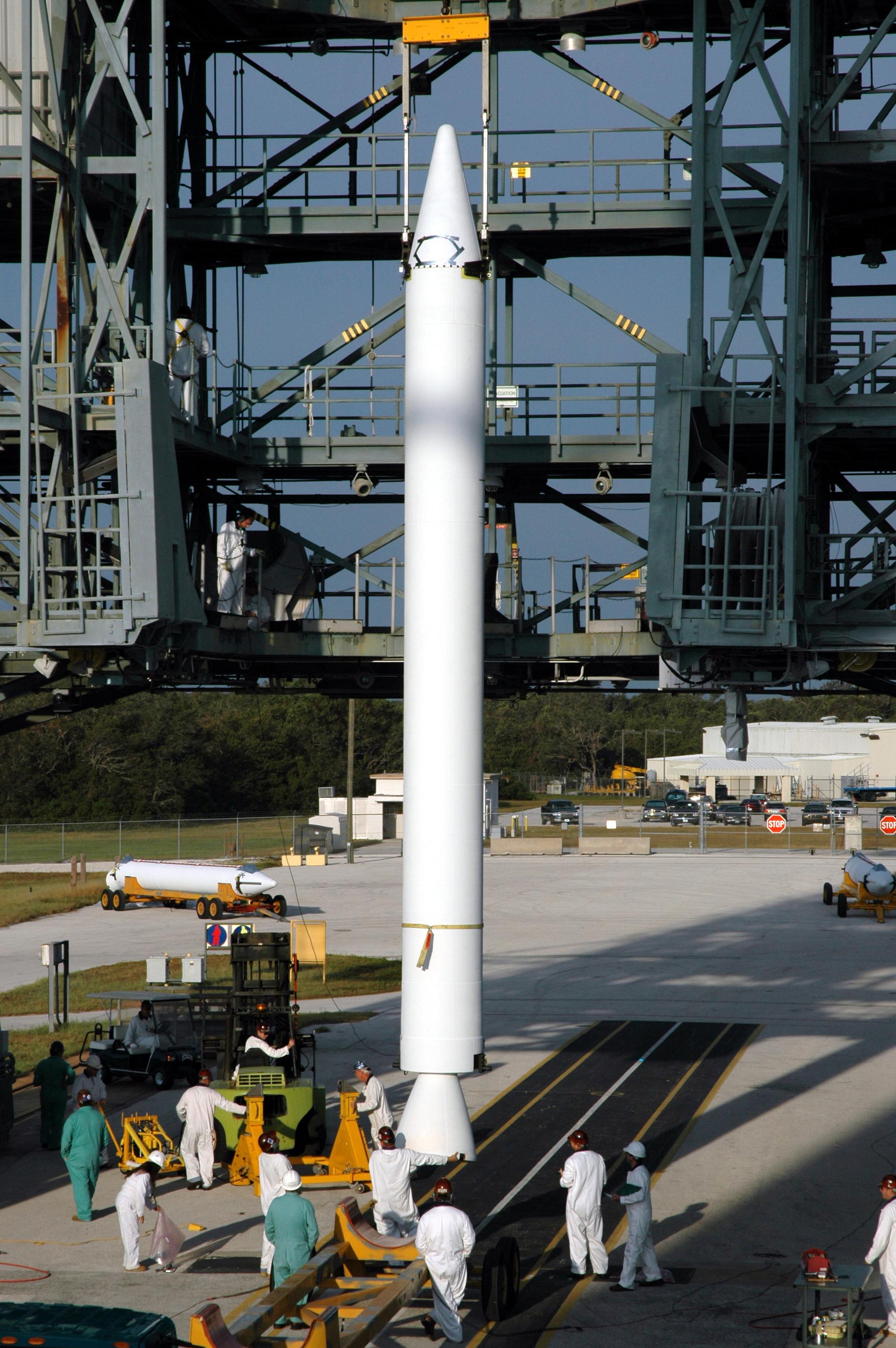
| caption | A GEM 40 solid rocket motor being prepared for integration with a Delta II launch vehicle |
| name | Graphite-Epoxy Motor |
| manufacturer | {{Ubli |
| country-origin | United States |
| rockets | |
| derivatives | |
| comparable | |
| status | Active |
| first | November 26, 1990 |
| last | |
| only | |
| payloads |
| Hercules (19901995) | Alliant Techsystems (19952015) | Orbital ATK (20152017) | Northrop Grumman (2017present) |country-origin = United States
The Graphite-Epoxy Motor (GEM) is a family of solid rocket boosters developed in the late 1980s and first flown in 1990. The motors use casings made from carbon-fiber-reinforced polymer and a propellant consisting of ammonium perchlorate composite propellant, formulated with hydroxyl-terminated polybutadiene as a binder, ammonium perchlorate as an oxidizer, and aluminum powder as a fuel.
Production of GEM motors has passed through several companies due to mergers and acquisitions. They were manufactured by Hercules from 1990 to 1995, Alliant Techsystems from 1995 to 2015, and Orbital ATK from 2015 to 2017, before being taken over by Northrop Grumman in 2017.
GEM boosters are currently used on the Atlas V and Vulcan Centaur launch vehicles operated by United Launch Alliance (ULA), as well as the Ground-Based Interceptor missile, and were previously flown on the Delta II, Delta III, and Delta IV. The motor names include numerals that denote the diameter of the booster in inches.
Active variants
GEM 63
The GEM 63 is a 63.2 in solid motor used on the Atlas V. It was developed by Orbital ATK as a "drop-in" replacement for the AJ-60A solid rocket booster built by Aerojet Rocketdyne and previously used with the Atlas V. Its dimensions are similar to those of the AJ-60A. The Atlas V first flew with the GEM 63 on the NROL-101 mission in 2020. According to ULA, the GEM 63 provides higher performance at about half the cost of the AJ-60A.
GEM 63XL
The GEM 63XL, developed by Northrop Grumman, is an extended version of the GEM 63, about 73 in longer. Each booster has a mass of about 117000 lb. Static test firings began in 2020, and the booster entered service with the Vulcan Centaur launch vehicle on its first flight on January 8, 2024. Up to six GEM 63XLs can be mounted on a Vulcan core, depending on mission requirements.
A variant equipped with a thrust-vectoring nozzle, the GEM 63XLT, was under development for the cancelled OmegA launch vehicle.
Anomaly
On October 4, 2024, a GEM 63XL experienced a partial failure 35 seconds after liftoff during the Vulcan Centaur Cert-2 mission. A change in the motor's exhaust plume and falling debris were observed. Analyses suggested that the nozzle was damaged or suffered a structural failure. Despite the anomaly, Vulcan Centaur Cert-2 reached orbit after burnout and separation of its two GEM 63XL boosters at about 2 minutes 10 seconds into flight. The nozzle failure was later attributed to manufacturing defects.
Retired variants
GEM 40
The GEM 40 was a 40.4 in solid rocket motor developed for the 7000-series Delta II launch vehicle beginning in 1987 by Hercules. Its first flight took place in 1990 on the USA-66 mission, when 9 boosters were used on a Delta II 7925 launcher. The use of composite materials allowed for casings lighter than the steel casings of the Castor 4 SRMs they replaced. The reduction in weight was used to extend the GEM 40 by 1.8 m compared to the Castor 4 used on 6000-series Delta II. Delta II vehicles could be configured with three, four, or nine GEM 40 boosters. When using three or four boosters, all GEM 40s were ignited on the ground. On nine-booster Delta II, six were ignited on the ground; the remaining three were ignited in flight after burnout of the first six. A variant with a thrust-vectoring nozzle, the GEM 40VN, was developed for the Ground-based Midcourse Defense anti-ballistic missile program, but GMD later switched to Orion-50-based missile.
Failures
On August 5, 1995, an air-lit GEM 40 failed to separate from a Delta II 7925 carrying Koreasat 1. The excess mass of the booster resulted in the satellite reaching a lower orbit than intended. The satellite was able to correct for the error using on-board propellant.
On January 17, 1997, a Delta II (Delta 241) exploded due to a catastrophic failure in a GEM 40. The failure triggered the launch vehicle's self-destruct function 13 seconds after ignition. An Air Force investigation determined that the motor's casing had been damaged prior to launch, causing the case to split open soon after ignition.
GEM 46
The GEM 46 was a 45.1 in solid rocket motor originally developed for Delta III by Alliant Techsystems. This solid motor variant included thrust vector control (TVC) to help steer the vehicle. After the discontinuation of the Delta III, GEM 46 motors (without TVC) were used on the Delta II to create the Delta II Heavy, which could only be launched from a modified pad at Cape Canaveral Air Force Station, SLC-17B. Both Delta III and Delta II Heavy used nine GEM 46s, with six ignited on the ground and three air-lit.
Failures
On August 27, 1998, the GEM 46 boosters on the first Delta III, carrying the Galaxy 10 satellite, depleted their hydraulic fluid used to control the thrust-vectoring nozzle. This was due to guidance issues with the rest of the rocket, which forced the solid rocket motors to make rapid adjustments to compensate, using up the supply of hydraulic fluid before burnout. The nozzles were then stuck in a position that turned the rocket over, triggering the vehicle's self-destruct function 70 seconds after ignition.
GEM 60
Version comparison
Data from Northrop Grumman catalog
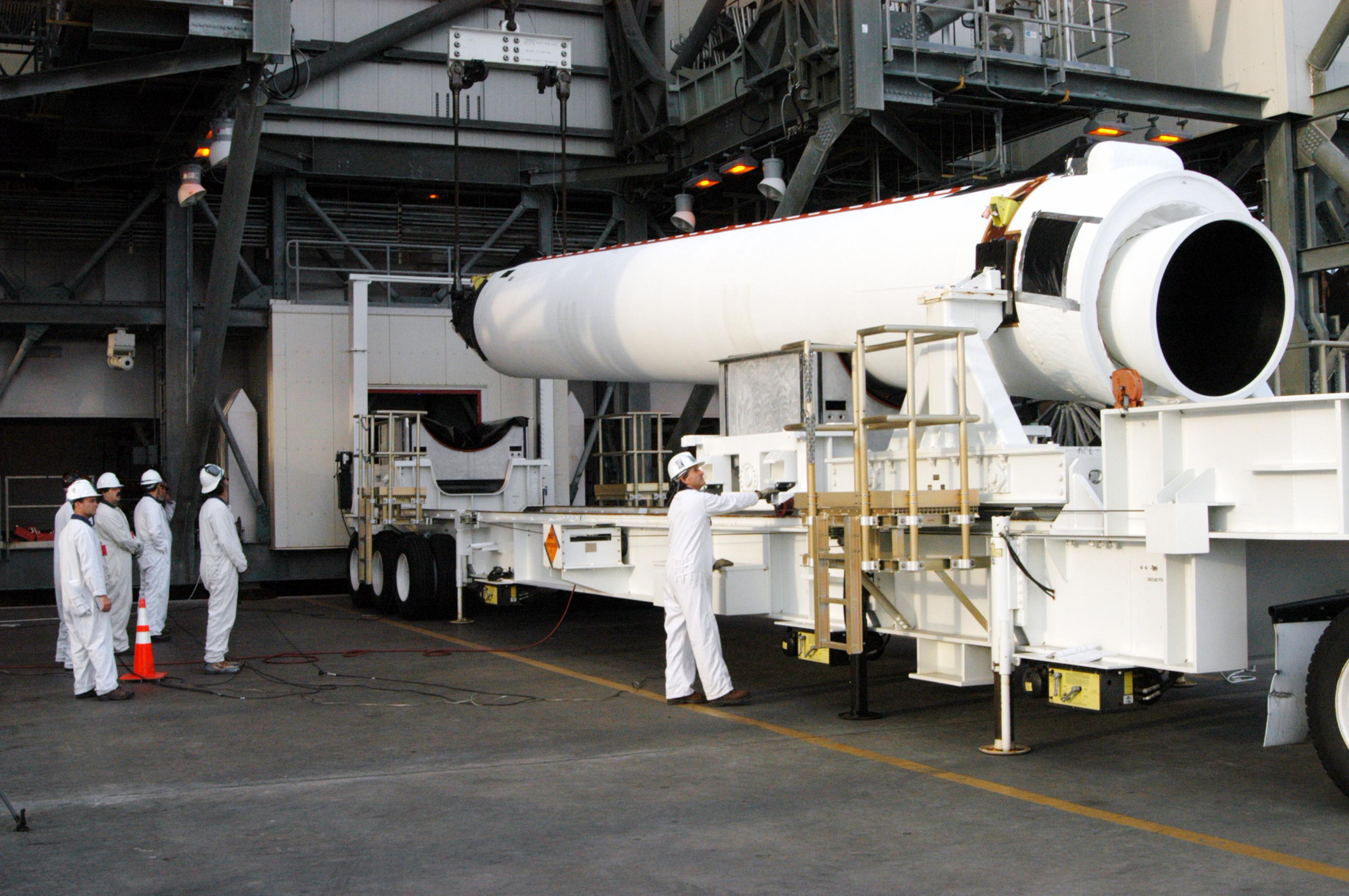
| Name | Application | Length | Diameter | Mass | Thrust | Specific impulse | Burn time (sec.) | Propellant | First flight | Final flight | Gross | Propellant | GEM 40 | GEM 46 | GEM 60 | GEM 63 | GEM 63XL | GEM 63XLT | |
|---|---|---|---|---|---|---|---|---|---|---|---|---|---|---|---|---|---|---|---|
| Delta II | 435 in | 40.4 in | 28,577 lb | 25,940 lb | {{Unbulleted list | SL: 144,740 lbf | Air-lit: 149,660 lbf | {{Unbulleted list | SL: 274 isp | Air-lit: 283.4 isp | 63 | AP/HTPB/Al | November 26, 1990 | September 15, 2018 | |||||
| Delta II, Delta III | 14.7 m | 45.1 in | 42,196 lb | 37,180 lb | 135,200 lbf | {{Unbulleted list | SL: 242 isp | Air-lit: 284 isp | 77 | August 26, 1998 | September 10, 2011 | ||||||||
| Delta IV | 518 in | 60 in | 74,158 lb | 65,471 lb | 197,500 lbf | SL: 245 isp | 91 | November 20, 2002 | August 22, 2019 | ||||||||||
| Atlas V | 792 in | 63.2 in | 108,600 lb | 97,500 lb | 373,800 lbf | vac: 279 isp | 94 | November 13, 2020 | |||||||||||
| Vulcan Centaur | 865 in | 117,700 lb | 105,800 lb | 455,400 lbf | vac: 280 isp | 84 | January 8, 2024 | ||||||||||||
| OmegA | OmegA rocket was cancelled, without ever being flown or produced. | name=OmegA}} |
Gallery
File:GEM 46 Booster of an Delta II 7925H rocket.jpg|alt=GEM 46 solid rocket booster is seen in the integration facility.|A GEM 46 motor prior to mating to a Delta II 7925H File:Rocket0722 09.jpg|Technicians prepare a GEM 46 booster File:GEM under tow prior to OCO-2 mission (KSC-2014-2126).jpg|GEM 40 booster is towed to the integration facility File:Delta IV Medium 4,2+ launch with GOES-N.jpg|alt=A Delta IV rocket blasts off with the help of GEM 60 solid rocket motors.|A Delta IV M+ (4,2) lifts off with 2 GEM 60 boosters File:Delta II Heavy ignition with GLAST.jpg|alt=A Delta II rocket ignites its engines, including 9 GEM 46 solid rockets.|A Delta II 7920H ignites 9 GEM 46 boosters File:STP-3 Mission (211107-X-KD758-1002).jpg|An Atlas V 541 lifts off with 4 GEM 63 boosters
Notes
References
References
- "NROL-101".
- Tory Bruno. (April 3, 2018). "Higher performance. Approaching half the cost.".
- "GEM 63 Updates".
- "Launching the Vulcan Rocket For the First Time – Smarter Every Day 297". YouTube.
- Foust, Jeff. (July 13, 2023). "Centaur modifications push first Vulcan launch to fourth quarter".
- (June 22, 2022). "ULA Vulcan Rocket Debut Slips To 2022".
- Clark, Stephen. (September 22, 2015). "Orbital ATK beats out Aerojet".
- "Vulcan".
- Northrop Grumman. (November 21, 2019). "We've started winding our first GEM 63XLT!".
- Foust, Jeff. (October 4, 2024). "Vulcan competes second flight despite SRB anomaly". SpaceNews.
- Foust, Jeff. (March 12, 2025). "Manufacturing defect blamed for Vulcan solid rocket motor anomaly".
- (1989). "Graphite epoxy motors (GEM) for the Delta II launch vehicle". American Institute of Aeronautics and Astronautics.
- McDowell, Jonathan. (May 7, 2022). "Launch Log".
- "Launch Vehicle: Solid Rocket Motors".
- "ATK Product Catalog".
- "Northrop Grumman GEM Capabilities".
- Kyle, Ed. (December 2, 2012). "Delta 2 Productive Years".
- Graham, William. (July 2, 2014). "ULA Delta II successfully lofts OCO-2 to orbit".
- "Propulsion Products Catalog GEM MOTOR SERIES pdf".
- "Boeing Pinpoints Cause of Delta III Failure, Predicts Timely Return to Flight".
- Furniss, Tim. (September 1, 1998). "Boeing Delta III explodes on maiden flight".
- Ray, Justin. (November 20, 2002). "Spaceflight Now {{!}} Delta Launch Report {{!}} Boeing's Delta 4 rocket debuts successfully".
- "Delta IV Medium+ (4,2)".
- Siegel, Jim. (August 25, 2019). "Delta IV Medium ends 17-Year run with 100% success".
- "Propulsion Products Catalog". [[Northrop Grumman]].
This article was imported from Wikipedia and is available under the Creative Commons Attribution-ShareAlike 4.0 License. Content has been adapted to SurfDoc format. Original contributors can be found on the article history page.
Ask Mako anything about Graphite-Epoxy Motor — get instant answers, deeper analysis, and related topics.
Research with MakoFree with your Surf account
Create a free account to save articles, ask Mako questions, and organize your research.
Sign up freeThis content may have been generated or modified by AI. CloudSurf Software LLC is not responsible for the accuracy, completeness, or reliability of AI-generated content. Always verify important information from primary sources.
Report