From Surf Wiki (app.surf) — the open knowledge base
Grandfather clock
Tall, freestanding, weight-driven pendulum clock

Tall, freestanding, weight-driven pendulum clock
A grandfather clock (also a longcase clock, tall-case clock, grandfather's clock, hall clock or floor clock) is a tall, freestanding, weight-driven pendulum clock, with the pendulum held inside the tower or waist of the case. Clocks of this style are commonly 1.8–2.4 metres (6–8 feet) tall with an enclosed pendulum and weights, suspended by either cables or chains, that have to be occasionally calibrated to keep the proper time. The case often features elaborately carved ornamentation on the hood (or bonnet), which surrounds and frames the dial, or clock face.
The English clockmaker William Clement is credited with developing the form in 1670. Pendulum clocks were the world's most accurate timekeeping technology until the early 20th century. Furthermore, longcase clocks, due to their superior accuracy, served as time standards for households and businesses. Today, they are kept mainly for their decorative and antique value, having been superseded by analog and digital timekeepers.
Naming
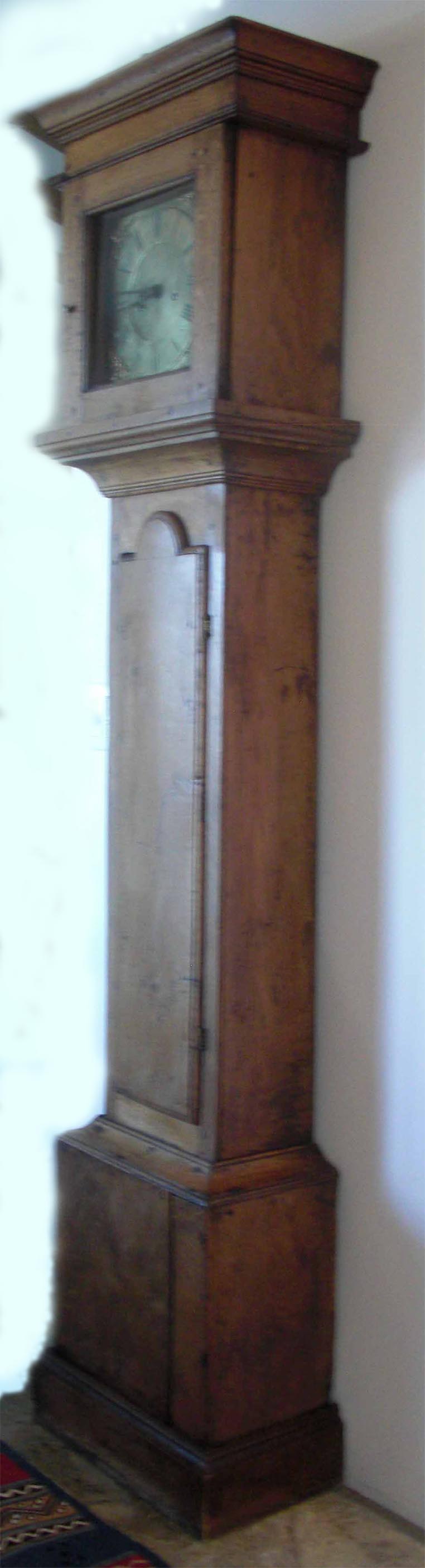
The Oxford English Dictionary states that the popular 1876 song My Grandfather's Clock is responsible for the common name "grandfather clock" being applied to the longcase clock.

The song was composed by the American songwriter Henry Clay Work, who discovered a longcase clock in The George Hotel in Piercebridge, County Durham, England. When he asked about the clock, he was informed that it had two owners. After the first owner died, the clock became inaccurate, and when the second owner died, the clock stopped working altogether. The story inspired Henry to create the song.
Grandfather clocks are of a certain height, generally at least 1.9 m. There are also so-called "grandmother" and "granddaughter" clocks, which are slightly shorter.
Origin

The advent of the longcase clock was due to the invention of the anchor escapement mechanism by Robert Hooke in about 1658. Before adopting the anchor mechanism, pendulum clock movements used an older verge escapement mechanism, which required very wide pendulum swings of about 80–100 degrees.{{cite magazine |access-date=June 6, 2007 |archive-url=https://web.archive.org/web/20091025120920/http://geocities.com/mvhw/anchor.html |archive-date=October 25, 2009 |url-status=dead

The anchor mechanism reduced the pendulum's swing to around 4 to 6 degrees, allowing clockmakers to use longer pendulums, which had slower "beats". They consumed less power, allowing clocks to run longer between windings, caused less friction and wear in the movement, and were more accurate. Almost all longcase clocks use a seconds pendulum (also called a "Royal" pendulum{{cite book | url-access = registration | access-date = June 19, 2008}}
British clockmaker William Clement, who disputed credit for the anchor escapement with Robert Hooke, had made the first longcase clocks by 1680.{{cite book
The first longcase clocks, like all clocks prior to the anchor escapement, had only one hand; an hour hand. The increased accuracy made possible by the anchor motivated the addition of the minute hand to clock faces in the next few decades.
Between 1680 and 1800, the average price of a grandfather clock in England remained steady at £1 10s. In 1680, that was the amount paid by an average working family for a year's rent, so the purchase of clocks was confined to the wealthy. By 1800, wages had increased enough to let many lower middle-class households own grandfather clocks.
Modern longcase clocks use a more accurate variation of the anchor escapement called the deadbeat escapement.
Description
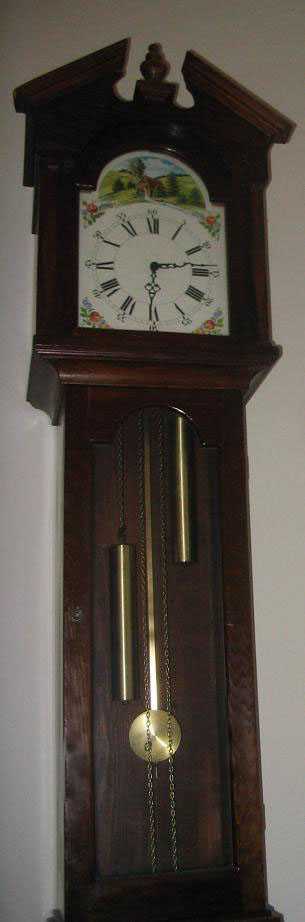
Longcase clocks were traditionally made with two types of movement: eight-day and one-day (30-hour) movements. A clock with an eight-day movement required winding only once a week, while generally less-expensive 30-hour clocks had to be wound daily. Eight-day clocks are often driven by two weights – one driving the pendulum and the other the striking mechanism, which typically consisted of a bell or chimes. Such movements usually have two keyholes, one on every side of the dial, to wind each weight.
By contrast, 30-hour clocks often had a single weight to drive the timekeeping and striking mechanisms. Some 30-hour clocks were made with false keyholes for customers who wanted guests to think that the household was able to afford the more expensive eight-day clock. All modern striking longcase clocks have eight-day mechanical quarter chiming and full hour striking movements. Most longcase clocks are cable-driven, meaning that cables suspend the weights. If the cable was attached directly to the weight, the load would cause rotation and untwist the cable strands, so the cable wraps around a pulley mounted to the top of each weight. The mechanical advantage of that arrangement also doubles the running time allowed by a given weight drop.
Cable clocks are wound by inserting a special crank (called a "key") into holes in the clock's face and turning it. Others are chain-driven, meaning that the weights are suspended by chains which wrap around gears in the clock's mechanism, with the opposite end of the chain hanging down next to the weight. To wind a chain-driven longcase clock, one pulls on the end of each chain, lifting the weights until they are just under the clock's face.

The world's tallest grandfather clock is 35 ft tall and is fully operational, with chimes on each quarter hour. It was made by Svoboda Industries in 1976 as a Bicentennial project and is located in Kewaunee, Wisconsin.
Elaborate striking sequences
In the early 20th century, quarter-hour chime sequences were added to longcase clocks. A full chime sequence sounds at the top of each hour, immediately followed by the hour strike. At 15 minutes after each hour, 1/4 of the chime sequence plays. Proceeding that, at the bottom of each hour, 1/2 of the chime sequence plays. Then finally, at 15 minutes before each hour, 3/4 of the chime sequence plays. The chime tune used in almost all longcase clocks is Westminster Quarters. Many also offer the option of Whittington chimes or St. Michael's chimes, selectable by a switch mounted on the right side of the dial, allowing one to silence the chimes if desired. As a result of adding chime sequences, all modern mechanical longcase clocks have three weights instead of two. The left weight provides power for the hour strike, the middle-weight provides power for the clock's pendulum and general timekeeping functions, and the right weight provides power for the quarter-hour chime sequences.
Types
Comtoise
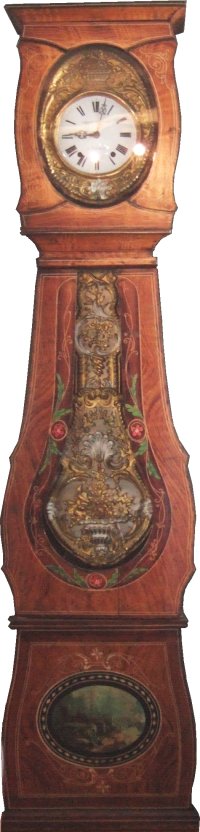
Comtoise clocks, also called Morbier clocks or Morez clocks, are a style of longcase clock made in the French region Franche-Comté (hence their name). Features distinguishing this style are a curving "potbellied" case and a greater use of curved lines. A heavy, elongated, ornamented pendulum bob often extends up the case (see photo).
Production of these clocks began in 1680 and continued for about 230 years. During the peak production years (1850–1890), over 60,000 clocks were made each year. These clocks were very fashionable across generations; they kept the time on farms throughout France. Many Comtoise clocks can be found in France, but they are also frequently found in Spain, Germany, and other parts of Europe, less in the United States. Many Comtoise clocks were also exported to other countries in Europe and even further, to the Ottoman Empire and as far as Thailand. A wooden sheath usually protected the metal mechanisms during transport.
Bornholm and Mora

Bornholm clocks are Danish longcase clocks and were made on Bornholm from 1745 to 1900. In Sweden, a special type of longcase clocks was made in Mora, called Mora clocks.
Bornholm clock-making began in the 1740s when an English ship, which had longcase clocks in its hold, was stranded. They were sent for repair to a turner named Poul Ottesen Arboe in Rønne. As a result of his repair of them, he learned enough about clocks to begin making his own.
Historical manufacturers

British
- John Alker or Alker of Wigan, Lancashire
- Allam & Clements
- Samuel Ashton, Ashbourne
- William Barrow, London
- Bilbie family, Somerset
- Thomas Birchall Nantwich, Cheshire
- Peter Bower, Redlynch, Wiltshire
- Joseph Bowles, Winbourne (i.e.: Wimbourne), Dorset; active 1791
- Samuel Bowles, Wimbourne, Dorset
- Robert Bryson, Edinburgh
- William Bucknall, Burslem (Stoke-on-Trent)
- Thomas Bullock, Bath, Somerset
- Samuel Buxton, Diss, Norfolk
- John Calver, Woodbridge, Suffolk
- Thomas Cartwright
- John Clement & Son (Tring, Hertfordshire)
- Thomas Dobbie, Gorbals, Glasgow
- Richard Donisthorp (fl. 1797), of Loughborough
- Matthew & Thomas Dutton
- Peter Fearnley, Wigan
- John Fernhill, Wrexham
- Thomas Hackney, London, c. 1700–1750
- Edward Harrison, Warrington
- John Harrison, Wakefield/Barrow upon Humber/London
- Enoch Hawksey (d. 1799) of Nantwich, Cheshire, active c. 1779 – 1799
- Nathaniel Hedge, Colchester, Essex
- Holmes
- Edward Houlgrave (1739 – 1789), b. Liverpool, active in London c. 1780s
- Ellis Houlgrave (1759 – 1793), son of Edward Houlgrave, b. Liverpool, active in London c. 1778 – 1789
- James Howden, Edinburgh
- Thomas Husband, Hull
- Thomas Johnson
- John Knibb, Oxford and London
- Joseph Knibb, Oxford and London
- William Lassell (1758–1790), Toxteth Park, Liverpool
- Timothy Mason, Gainsborough, Lincolnshire
- Alexander Miller, Montrose
- Peddie, Stirling, Scotland
- Daniel Quare
- Thomas Ross, Hull
- John Snelling, Alton
- John Trubshaw, London
- Warry, Bristol
- James Woolley Codnor
- Thomas Worswick, Lancaster
- Thomas Wright
- Henry Young, Swaffham, Norfolk
- John Wyld, Nottingham
- Stephen Harris, Tonbridge
- Watkin Owen, Llanrwst
Irish
- W Egan & Sons, Cork
- James Mangan, Cork
- Ezekiel Bullock, Lurgan
- Alexander Gordon, Dublin
Finnish
- Masters of Könni Könnin mestarit (1757–1865), Ilmajoki
- Finnish Museum of Horology is master of Jaakko Könni manufactured table clocks and pocket watches
- Ilmajoki Museum is Masters of Könni manufactured horse vehicles, clocks, looms, locks, tools, machine of gear "keervärkki"
Americans
- Ansonia Clock Company (1851–2006), Ansonia, Connecticut and Brooklyn, New York
- Benjamin Bagnall (1689–1773), Boston
- Aaron Brokaw (1768–1853), Bridge Town, New Jersey
- Isaac Brokaw (1746–1826), Bridge Town, New Jersey
- Silas Merriman (1733–1805), New Haven, Connecticut
- Aaron Miller ( –1778), Elizabeth Township, New Jersey
- Luman Watson (1790–1834), Cincinnati
- Simon Willard (1753–1848), Roxbury, Massachusetts
- Zachariah Grandfather Clocks (1975–1987), Chicago, Illinois
- Daniel White Griswold (1767-1844), Harwinton, Connecticut
Australian casemaker
- Harry Williams – Oxford Cabinet Company Pty Ltd (1946–1961), Granville, New South Wales, Australia
Current manufacturers
- Hermle Clocks – Amherst VA
- Howard Miller Clock Company – Zeeland MI
- Ridgeway Clocks (owned now by Howard Miller Clock Co.)
- Seth Thomas Clock Company - (reopened under the Colibri Group)
References
References
- "Oxford English Dictionary".
- (10 September 2009). "Difference Between a Grandfather & Grandmother Clock".
- "Grandfather Clock History and what you need to know".
- (17 January 2020). "The Origins of the Consumer Revolution". Joanne Sear.
- "World's Tallest Grandfather Clock {{!}} Travel Wisconsin".
- "Kewaunee Area Chamber of Commerce World's Tallest Grandfather Clock".
- (2024). "Nantwich Clockmakers: Enoch Hawksey".
- "Horology: The heritage of clocks and other timepieces".
- (1985). "187. Tall Clock: Boston, 1725-1740: Movement by Benjamin Bagnall (1689-1773)". The [[Metropolitan Museum of Art]] and [[Random House]].
This article was imported from Wikipedia and is available under the Creative Commons Attribution-ShareAlike 4.0 License. Content has been adapted to SurfDoc format. Original contributors can be found on the article history page.
Ask Mako anything about Grandfather clock — get instant answers, deeper analysis, and related topics.
Research with MakoFree with your Surf account
Create a free account to save articles, ask Mako questions, and organize your research.
Sign up freeThis content may have been generated or modified by AI. CloudSurf Software LLC is not responsible for the accuracy, completeness, or reliability of AI-generated content. Always verify important information from primary sources.
Report