From Surf Wiki (app.surf) — the open knowledge base
Grande-Terre, Guadeloupe
Eastern half of Guadeloupe

Eastern half of Guadeloupe
| Field | Value |
|---|---|
| name | Grande-Terre |
| image_name | Guadeloupe Grande-Terre Places of interest map-fr.svg |
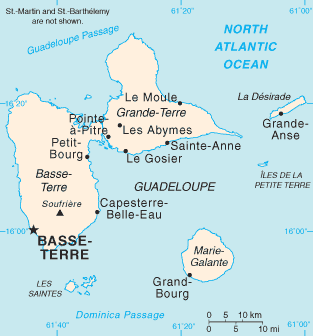
| image_caption | Map of places of interest in Grande-Terre, the eastern part of Guadeloupe island, a French island in the Antilles. |
| map_image | Caribbean - Grande Terre.PNG |
| location | Caribbean Sea |
| coordinates | |
| archipelago | Leeward Islands |
| area_km2 | 586.68 |
| highest_mount | Morne l'Escade |
| elevation_m | 129 |
| country | France |
| country_admin_divisions_title | Overseas department |
| country_admin_divisions | Guadeloupe |
| country_largest_city | Les Abymes |
| country_largest_city_population | 52,118 |
| population | 197,603 |
| population_as_of | 2006 |
| density_km2 | 337 |
| ethnic_groups | Black / Mulatto 66%, White 9%, Indo-Guadeloupean 14%, Lebanese / Syrians 6%, Chinese / others 5% |
Grande-Terre Island ( ; or Granntè) is the name of the eastern-half of Guadeloupe proper, in the Lesser Antilles. It is separated from the other half of Guadeloupe island, Basse-Terre, by a narrow sea channel called Rivière Salée (in English, Salt River). Pointe de la Grande Vigie, in Grande-Terre, is the northernmost point of Guadeloupe island. To the east lies La Désirade, and to the south lies Marie Galante.
Name
Despite its name, Grande-Terre (literally "Large Land" in French) is smaller than Basse-Terre Island. It was given the name in contrast with the much smaller Petite Terre Islands ("Small Land" Islands), two very small islands located about 10 km south-east of the Grande-Terre (see map to the left).
Geography
Grande-Terre's indented coastline is surrounded by coral reefs and the island itself is a limestone plateau. Its surface is a series of rolling hills, white sand beaches and cliffs. The island's beaches consist of both white and black sands, as well as beaches of golden sand. Of the two islands, Grande-Terre is home to the majority of Guadeloupe's farmlands and tourist resorts.
The island has a land area of 586.68 km2.
Population
At the 2006 census the population of Grande-Terre was 197,603 inhabitants living in 10 communes (municipalities). The population density was 337 inhabitants per km2 (872 inh. per sq. miles). The most populated communes are, in descending order of population, Les Abymes (part of the Pointe-à-Pitre urban area), Le Gosier (part of the Pointe-à-Pitre urban area), Pointe-à-Pitre (part of the Pointe-à-Pitre urban area), Le Moule, Sainte-Anne, and Morne-à-l'Eau.

History
Historically, Grande-Terre Island was called "cibuqueira", ("Gum tree island", in the Caribbean language) and the island of Basse-Terre, "Caloucaera" (Karukera), a word meaning "the island of beautiful waters" in the Caribbean language.
References
References
This article was imported from Wikipedia and is available under the Creative Commons Attribution-ShareAlike 4.0 License. Content has been adapted to SurfDoc format. Original contributors can be found on the article history page.
Ask Mako anything about Grande-Terre, Guadeloupe — get instant answers, deeper analysis, and related topics.
Research with MakoFree with your Surf account
Create a free account to save articles, ask Mako questions, and organize your research.
Sign up freeThis content may have been generated or modified by AI. CloudSurf Software LLC is not responsible for the accuracy, completeness, or reliability of AI-generated content. Always verify important information from primary sources.
Report