From Surf Wiki (app.surf) — the open knowledge base
Grade (slope)
Angle to the horizontal plane
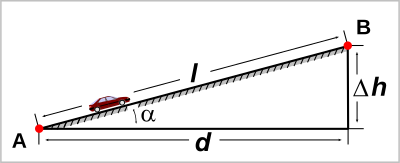
Angle to the horizontal plane
the grade of a topographic feature or constructed element
The grade (US) or gradient (UK) (also called slope, incline, mainfall, pitch or rise) of a physical feature, landform or constructed line is either the elevation angle of that surface to the horizontal or its tangent. It is a special case of the slope, where zero indicates horizontality. A larger number indicates higher or steeper degree of "tilt". Often slope is calculated as a ratio of "rise" to "run", or as a fraction ("rise over run") in which run is the horizontal distance (not the distance along the slope) and rise is the vertical distance.
Slopes of existing physical features such as canyons and hillsides, stream and river banks, and beds are often described as grades, but typically the word "grade" is used for human-made surfaces such as roads, landscape grading, roof pitches, railroads, aqueducts, and pedestrian or bicycle routes. The grade may refer to the longitudinal slope or the perpendicular cross slope.
Nomenclature
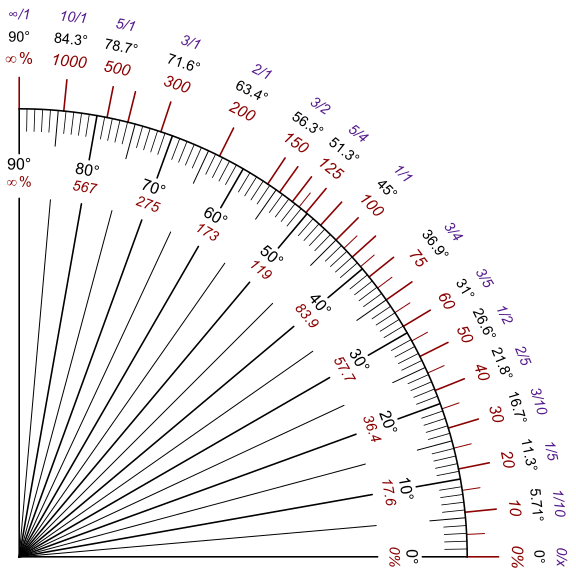

There are several ways to express slope:
- as an angle of inclination to the horizontal. (This is the angle α opposite the "rise" side of a triangle with a right angle between vertical rise and horizontal run.)
- as a percentage, the formula for which is 100 \times \frac{\text{rise}}{\text{run}}, which is equivalent to the tangent of the angle of inclination times 100. At a slope angle of 45 degrees, the run is equal to the rise. Expressed as a percentage, the slope of this angle is 100 percent. As the slope approaches 90 degrees (vertical), the percentage slope approaches infinity. In Europe and the U.S. percentage grade is the most commonly used figure for describing slopes.
- as a ‰ figure (denoted with the symbol ), the formula for which is 1000 \times \frac{\text{rise}}{\text{run}}, which could also be expressed as the tangent of the angle of inclination times 1000. This is commonly used in Europe to denote the incline of a railway. It is sometimes written using mm/m or m/km instead of the ‰ symbol.
- as a ratio of one part rise to so many parts run. For example, a slope that has a rise of 5 feet for every 1000 feet of run would have a slope ratio of 1 in 200. (The word in is normally used rather than the mathematical ratio notation of e.g. 1:200.) This is generally the method used to describe railway grades in Australia and the UK. It is used for roads in Hong Kong, and was used for roads in the UK until the 1970s.
- as a ratio of many parts run to one part rise, which is the inverse of the previous expression (depending on the country and the industry standards). For example, a slope expressed as 4:1 in this system means for a given vertical distance the horizontal distance travelled is four times as long.
Any of these may be used. When the term grade is used, the slope is usually expressed as a percentage. If one looks at red numbers on the chart specifying grade, one can see the quirkiness of using the grade to specify slope; the numbers go from 0 for flat, to 100% at 45 degrees, to infinity at vertical.
Slope may still be expressed when the horizontal run is not known: the rise can be divided by the hypotenuse (the slope length). This is not the usual way to specify slope; this nonstandard expression follows the sine function rather than the tangent function, so it calls a 45 degree slope a 71 percent grade instead of a 100 percent. But in practice the usual way to calculate slope is to measure the distance along the slope and the vertical rise, and calculate the horizontal run from that, in order to calculate the grade (100% × rise/run) or standard slope (rise/run). When the angle of inclination is small, using the slope length rather than the horizontal displacement (i.e., using the sine of the angle rather than the tangent) makes only an insignificant difference and can then be used as an approximation. Railway gradients are often expressed in terms of the rise in relation to the distance along the track as a practical measure. In cases where the difference between sin and tan is significant, the tangent is used. In either case, the following identity holds for all inclinations up to 90 degrees: \tan{\alpha} = \frac{\sin{\alpha}}{\sqrt{1-\sin^2{\alpha}}}. Or more simply, one can calculate the horizontal run by using the Pythagorean theorem, after which it is trivial to calculate the (standard math) slope or the grade (percentage).
In Europe, road gradients are expressed in signage as percentage.
Equations
Grades are related using the following equations with symbols from the figure at top.
Tangent as a ratio
:\tan{\alpha} = \frac{\Delta h}{d}
The slope expressed as a percentage can similarly be determined from the tangent of the angle: :%,\text{slope} = 100 \tan{\alpha}
Angle from a tangent gradient
:\alpha = \arctan{\frac{\Delta h}{d}}
If the tangent is expressed as a percentage, the angle can be determined as: :\alpha = \arctan{\frac{%,\text{slope}}{100}}
If the angle is expressed as a ratio (1 in n) then: :\alpha = \arctan{\frac{1}{n}}
Example slopes comparing the notations
For degrees, percentage (%) and per-mille (‰) notations, larger numbers are steeper slopes. For ratios, larger numbers n of 1 in n are shallower, easier slopes.
The examples show round numbers in one or more of the notations and some documented and reasonably well known instances.
| Degrees | Percentage (%) | Permillage (‰) | Ratio | Remarks | |||||||
|---|---|---|---|---|---|---|---|---|---|---|---|
| 60° | 173% | 1732‰ | 1 in 0.58 | ||||||||
| 47.7° | 110% | 1100‰ | 1 in 0.91 | Stoosbahn (funicular railway) | |||||||
| 45° | 100% | 1000‰ | 1 in 1 | ||||||||
| 35° | 70% | 700‰ | 1 in 1.428 | ||||||||
| 30.1° | 58% | 580‰ | 1 in 1.724 | Lynton and Lynmouth Cliff Railway (funicular railway) | |||||||
| 30° | 58% | 577‰ | 1 in 1.73 | ||||||||
| 25.5° | 47% | 476‰ | 1 in 2.1 | Pilatus Railway (steepest rack railway) | |||||||
| 20.3° | 37% | 370‰ | 1 in 2.70 | Mount Washington Cog Railway (maximum grade) | |||||||
| 20° | 36% | 363‰ | 1 in 2.75 | ||||||||
| 18.4° | 33% | 333‰ | 1 in 3 | ||||||||
| 16.9° | 30% | 300‰ | 1 in 3.3 | Extremely steep road [[File:Pente30%.jpg | frameless | left | middle | 30x30px | 30% warning (France)]] | ||
| 14.0° | 25% | 250‰ | 1 in 4 | Very steep road. Mount Washington Cog Railway (average grade) [[File:Devil's Staircase Wales.jpg | frameless | left | middle | 30x30px | 25% warning (Wales)]] | ||
| 11.3° | 20% | 200‰ | 1 in 5 | Steep road [[File:Steep Hill sign on Henside Road - geograph.org.uk - 680341.jpg | frameless | left | middle | 30x30px | 20% warning (North Yorkshire)]] | ||
| 8.13° | 14.2% | 142‰ | 1 in 7 | ||||||||
| 7.12° | 12.5% | 125‰ | 1 in 8 | Cable incline on the Cromford and High Peak Railway | |||||||
| 5.71° | 10% | 100‰ | 1 in 10 | Steep road [[File:Nederlands verkeersbord J6.svg | frameless | left | middle | 30x30px | 10% warning (Netherlands)]] | ||
| 4.0° | 7% | 70‰ | 1 in 14.3 | ||||||||
| 3.37° | 5.9% | 59‰ | 1 in 17 | Swannington incline on the Leicester and Swannington Railway | |||||||
| 2.86° | 5% | 50‰ | 1 in 20 | url=https://science.ksc.nasa.gov/facilities/crawler.html | title=Crawler-Transporter | publisher=NASA | date=April 21, 2003 | access-date=June 18, 2020 | archive-url=https://web.archive.org/web/20200601012639/https://science.ksc.nasa.gov/facilities/crawler.html | archive-date=June 1, 2020 | url-status=dead}} |
| 2.29° | 4% | 40‰ | 1 in 25 | Cologne–Frankfurt high-speed rail line | |||||||
| 2.0° | 3.5% | 35‰ | 1 in 28.57 | LGV Sud-Est, LGV Est, LGV Méditerranée | |||||||
| 1.97° | 3.4% | 34‰ | 1 in 29 | Bagworth incline on the Leicester and Swannington Railway | |||||||
| 1.89° | 3.3% | 33‰ | 1 in 30.3 | Rampe de Capvern on the | |||||||
| 1.52° | 2.65% | 26.5‰ | 1 in 37.7 | Lickey Incline | |||||||
| 1.43° | 2.5% | 25‰ | 1 in 40 | LGV Atlantique, LGV Nord. The Schiefe Ebene. | |||||||
| 1.146° | 2% | 20‰ | 1 in 50 | Railway near Jílové u Prahy. Devonshire Tunnel [[File:Skloník-klesání.jpg | frameless | left | middle | 30x30px | 20‰ Czech Republic]] | ||
| 0.819° | 1.43% | 14.3‰ | 1 in 70 | Waverley Route | |||||||
| 0.716° | 1.25% | 12.5‰ | 1 in 80 | Ruling grade of a secondary main line. Wellington Bank, Somerset | |||||||
| 0.637° | 1.11% | 11.11‰ | 1 in 90 | Dove Holes Tunnel | |||||||
| 0.573° | 1% | 10‰ | 1 in 100 | The long drag on the Settle & Carlisle line | |||||||
| 0.458° | 0.8% | 8‰ | 1 in 125 | Rampe de Guillerval | |||||||
| 0.2865° | 0.5% | 5‰ | 1 in 200 | , except for the rampe de Guillerval | |||||||
| 0.1719° | 0.3% | 3‰ | 1 in 333 | ||||||||
| 0.1146° | 0.2% | 2‰ | 1 in 500 | ||||||||
| 0.0868° | 0.1515% | 1.515‰ | 1 in 660 | Brunel's Billiard TableDidcot to Swindon | |||||||
| 0.0434° | 0.07575% | 0.7575‰ | 1 in 1320 | Brunel's Billiard TablePaddington to Didcot | |||||||
| 0° | 0% | 0‰ | 1 in ∞ (infinity) | Flat |
Roads
In vehicular engineering, various land-based designs (automobiles, sport utility vehicles, trucks, trains, etc.) are rated for their ability to ascend terrain. Trains typically rate much lower than automobiles. The highest grade a vehicle can ascend while maintaining a particular speed is sometimes termed that vehicle's "gradeability" (or, less often, "grade ability"). The lateral slopes of a highway geometry are sometimes called fills or cuts where these techniques have been used to create them.
In the United States, the maximum grade for federally funded highways is specified in a design table based on terrain and design speeds, with up to 6% generally allowed in mountainous areas and hilly urban areas with exceptions for up to 7% grades on mountainous roads with speed limits below 60 mph.
The steepest roads in the world according to the Guinness Book of World Records are Baldwin Street in Dunedin, New Zealand, Ffordd Pen Llech in Harlech, Wales and Canton Avenue in Pittsburgh, Pennsylvania. The Guinness World Record once again lists Baldwin Street as the steepest street in the world, with a 34.8% grade (1 in 2.87) after a successful appeal against the ruling that handed the title, briefly, to Ffordd Pen Llech.
A number of streets elsewhere have steeper grades than those listed in the Guinness Book. Drawing on the U.S. National Elevation Dataset, 7x7 (magazine) identified ten blocks of public streets in San Francisco open to vehicular traffic in the city with grades over 30 percent. The steepest, at 41 percent, is the block of Bradford Street above Tompkins Avenue in the Bernal Heights neighborhood. The San Francisco Municipal Railway operates bus service among the city's hills. The steepest grade for bus operations is 23.1% by the 67 Bernal Heights on Alabama Street between Ripley and Esmeralda Streets.
Likewise, the Pittsburgh Department of Engineering and Construction recorded a grade of 37% (20°) for Canton Avenue. The street has formed part of a bicycle race since 1983.
File:Nederlands verkeersbord J6.svg|10% slope warning sign, Netherlands File:Finland road sign 115.svg|7% descent warning sign, Finland File:Devil's Staircase Wales.jpg|25% ascent warning sign, Wales File:Pente30%.jpg|30% descent warning sign, over 1500 m. La Route des Crêtes, Cassis, France File:Seattle AM General trolleybus climbing James St near 5th Ave in 1983.jpg|A trolleybus climbing an 18% grade in Seattle B10 Enzweihinger Steige 20060528.JPG|Ascent of German Bundesstraße 10 File:DunedinBaldwinStreet_Parked_Car.jpg|A car standing on Baldwin Street, Dunedin, New Zealand File:CantonAve_Top.jpg|Looking down Canton Avenue, Pittsburgh, Pennsylvania
Environmental design
Grade, pitch, and slope are important components in landscape design, garden design, landscape architecture, and architecture for engineering and aesthetic design factors. Drainage, slope stability, circulation of people and vehicles, complying with building codes, and design integration are all aspects of slope considerations in environmental design.
Railways
Railroad gradient

Ruling gradients limit the load that a locomotive can haul, including the weight of the locomotive itself. Pulling a heavily loaded train at 20 km/h may require ten times the force climbing a 1% slope than on level track.
Early railways in the United Kingdom were laid out with very gentle gradients, such as 0.07575% (1 in 1320) and 0.1515% (1 in 660) on the Great Western main line, nicknamed Brunel's Billiard Table, because the early locomotives (and their brakes) were feeble. Steep gradients were concentrated in short sections of lines where it was convenient to employ assistant engines or cable haulage, such as the 1.2 km section from Euston to Camden Town.
Extremely steep gradients require mechanical assistance. Cable systems are used in cases like the Scenic Railway at Katoomba Scenic World in Australia, which reaches a maximum grade of 122% (52°) and is claimed to be the world's steepest passenger-carrying funicular. For somewhat gentler inclines, rack railways are employed, such as the Pilatus Railway in Switzerland, which has a maximum grade of 48% (26°) and is considered the steepest rack railway.
Gradients can be expressed as an angle, as feet per mile, feet per chain, 1 in n, x% or y per mille. Since designers like round figures, the method of expression can affect the gradients selected.

The steepest railway lines that do not use rack systems include:
- 13.5% (1 in 7.40)Lisbon tram, Portugal
- 11.6% (1 in 8.62)Pöstlingbergbahn, Linz, Austria{{cite web |access-date=2011-01-06 |url-status=dead |archive-url=https://web.archive.org/web/20110722040709/http://www.linzag.at/cms/media/en/linzagwebsite/dokumente/mobilittverkehr_1/pstlingbergbahn_1/folder_bergbahn.pdf |archive-date=2011-07-22}}
- 11.0% (1 in 9.09)Cass Scenic Railway, US (former logging line)
- 9.0% (1 in 11.11)Ligne de Saint Gervais – Vallorcine, France
- 9.0% (1 in 11.11)Muni Metro J Church, San Francisco, US{{cite web | access-date=September 20, 2016 | archive-url=https://web.archive.org/web/20161203183047/http://archives.sfmta.com/cms/rhomemu/genmuinfo.htm | archive-date=December 3, 2016 | url-status=dead
- 8.8% (1 in 11.4)Iași tram, Romania
- 8.65% (1 in 11.95)Portland Streetcar, Oregon, US{{cite press release |url-status=dead |access-date=15 December 2018 |archive-url=https://web.archive.org/web/20130927202015/http://www.lrta.org/mag/articles/art0110.html |archive-date=27 September 2013}}
- 8.33%(1 in 12)Nilgiri Mountain Railway Tamil Nadu, India
- 8.0% (1 in 12.5)Just outside the Tombstone Jct. Station in the Tombstone Junction Theme Park, Kentucky, US. The railroad line there had a ruling grade of 6% (1 in 16.7).
- 7.85% (1 in 12.7)Near Washington Street station on the Green Line B branch, Boston, Massachusetts, US.
- 7.1% (1 in 14.08)Erzberg Railway, Austria
- 7.0% (1 in 14.28)Bernina Railway, Switzerland
- 6.0% (1 in 16.7)Arica, Chile to La Paz, Bolivia
- 6.0% (1 in 16.6)Docklands Light Railway, London, UK
- 6.0% (1 in 16.6)Ferrovia Centrale Umbra, Italy{{cite web |access-date=23 May 2019}}
- 6.0% (1 in 16.6)Link light rail, Seattle, U.S.
- 5.89% (1 in 16.97)Madison, Indiana, US
- 5.6% (1 in 18)Flåm Line, Norway
- 5.3% (1 in 19)Foxfield Railway, Staffordshire, UK
- 5.1% (1 in 19.6)Saluda Grade, North Carolina, US
- 5.0% (1 in 20)Khyber Pass Railway, Pakistan
- 4.5% (1 in 22.2)The Canadian Pacific Railway's Big Hill, British Columbia, Canada (prior to the construction of the Spiral Tunnels)
- 4.3% (1 in 23)Colwall Old Tunnel, Malvern Hills, UK
- 4.0% (1 in 25)Cologne-Frankfurt high-speed rail line, Germany
- 4.0% (1 in 25)Bolan Pass Railway, Pakistan
- 4.0% (1 in 25)(211.2 ft per 1 mi )Tarana – Oberon branch, New South Wales, Australia.
- 4.0% (1 in 25)Matheran Light Railway, India
- 4.0% (1 in 26)Rewanui Incline, New Zealand. Fitted with Fell center rail but was not used for motive power, but only braking
- 3.6% (1 in 27)Ecclesbourne Valley Railway, Heritage Line, Wirksworth, Derbyshire, UK
- 3.6% (1 in 28)The Westmere Bank, New Zealand has a ruling gradient of 1 in 35, however peaks at 1 in 28
- 3.33% (1 in 30)Umgeni Steam Railway, South Africa
- 3.0% (1 in 33)several sections of the Main Western line between Valley Heights and Katoomba in the Blue Mountains Australia.
- 3.0% (1 in 33)The entire Newmarket Line in central Auckland, New Zealand
- 3.0% (1 in 33)Otira Tunnel, New Zealand, which is equipped with extraction fans to reduce chance of overheating and low visibility
- 3.0% (1 in 33)The approaches to the George L. Anderson Memorial Bridge crossing the Neponset River, Boston, Massachusetts, US. The Ruling Gradient of the Braintree Branch of the Red Line (MBTA).
- 2.7% (1 in 37)Braganza Ghats, Bhor Ghat and Thull ghat sections in Indian Railways, India
- 2.7% (1 in 37)Exeter Central to Exeter St Davids, UK (see Exeter Central railway station#Description)
- 2.7% (1 in 37)Picton- Elevation, New Zealand
- 2.65% (1 in 37.7)Lickey Incline, UK
- 2.6% (1 in 38)A slope near Halden on Østfold Line, NorwayOk for passenger multiple units, but an obstacle for freight trains which must keep their weight down on this international mainline because of the slope. Freight traffic has mainly shifted to road.
- 2.3% (1 in 43.5)Schiefe Ebene, Germany
- 2.2% (1 in 45.5)The Canadian Pacific Railway's Big Hill, British Columbia, Canada (after the construction of the Spiral Tunnels)
- 2.0% (1 in 48)Beasdale Bank (West Coast Scotland mainline), UK
- 2.0% (1 in 50)Numerous locations on New Zealand's railway network, New Zealand
- 1.66% (1 in 60)Section of track on the Dublin-Cork line between mile posts 164 and 162.
- 1.51% (1 in 66)(1 ft per 1 chain) New South Wales Government Railways, Australia, part of Main South line.
- 1.25% (1 in 80)Wellington Bank, Somerset, UK
- 1.25% (1 in 80)Rudgwick, UK (West Sussex) platform before regradingtoo steep if a train is not provided with continuous brakes.
- 0.77% (1 in 130)Rudgwick, UK platform after regradingnot too steep if a train is not provided with continuous brakes.
Compensation for curvature
Gradients on sharp curves are effectively a bit steeper than the same gradient on straight track, so to compensate for this and make the ruling grade uniform throughout, the gradient on those sharp curves should be reduced slightly.
Continuous brakes
In the era before they were provided with continuous brakes, whether air brakes or vacuum brakes, steep gradients made it extremely difficult for trains to stop safely. In those days, for example, an inspector insisted that Rudgwick railway station in West Sussex be regraded. He would not allow it to open until the gradient through the platform was eased from 1 in 80 to 1 in 130.
References
References
- "Understanding slope—ArcGIS Pro | Documentation".
- (January 1986). "Directives pour la mesure de l'uni des routes et l'étalonnage des appareils". [[World Bank]].
- ZEMBA, Baowendzooda Joël. (July 2015). "ETUDE D'AVANT-PROJET DETAILLE DE L'AMENAGEMENT D'UN PERIMETRE IRRIGUE DE 100 HA À BAGRE EN RIVE DROITE DU NAKANBE (BURKINA FASO)".
- (2013). "Site Engineering for Landscape Architects". Wiley Publishing.
- "Traffic signs".
- (April 21, 2003). "Crawler-Transporter". NASA.
- (October 1991). "Countdown! NASA Launch Vehicles and Facilities". NASA.
- (2001). "A Policy on Geometric Design of Highways and Streets". American Association of State Highway and Transportation Officials.
- (16 July 2019). "Welsh town claims record title for world's steepest street".
- "Kiwi climb: Hoofing up the world's steepest street".
- (8 April 2020). "Baldwin street in New Zealand reinstated as the world's steepest street".
- "The Real Top 10 List of Steepest Streets in San Francisco". 7x7.
- "Canton Avenue, Beechview, PA". Post Gazette.
- (December 2010). "The steepest road on Earth takes no prisoners".
- "Top five funicular railways". Sydney Morning Herald.
- (2 March 1920). "A wonderful railway". [[The Register (Adelaide).
- (2019-03-05). "Pantele din Iaşi pun probleme ofertanţilor".
- Massachusetts Bay Transportation Authority. (2017-03-06). "MBTA Green Line Track Charts".
- "Madisonview".
- (24 September 2014). "Going under the hills". [[BBC]].
- "The Matheran Light Railway (extension to the Mountain Railways of India)". UNESCO World Heritage Convention.
- Martin, Bruno. (September 2005). "Durban-Pietermaritzburg main line map and profile".
- [[Valley Heights railway station]]
- "Improving the Southeast Expressway: A Conceptual Plan".
- "Network Statement 2023". Irish Rail.
This article was imported from Wikipedia and is available under the Creative Commons Attribution-ShareAlike 4.0 License. Content has been adapted to SurfDoc format. Original contributors can be found on the article history page.
Ask Mako anything about Grade (slope) — get instant answers, deeper analysis, and related topics.
Research with MakoFree with your Surf account
Create a free account to save articles, ask Mako questions, and organize your research.
Sign up freeThis content may have been generated or modified by AI. CloudSurf Software LLC is not responsible for the accuracy, completeness, or reliability of AI-generated content. Always verify important information from primary sources.
Report