From Surf Wiki (app.surf) — the open knowledge base
Graben
Depressed block of planetary crust bordered by parallel normal faults

Depressed block of planetary crust bordered by parallel normal faults
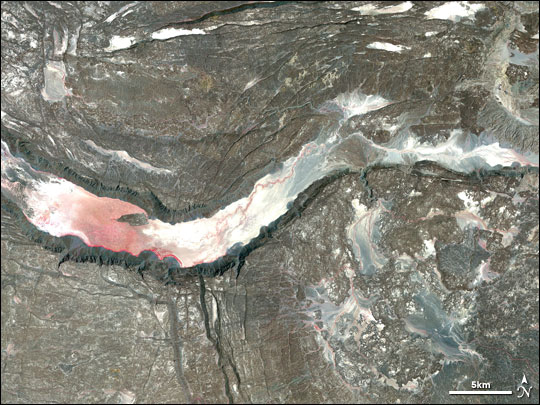
In geology, a graben () is a depressed block of the crust of a planet or moon, bordered by parallel normal faults.
Etymology
Graben is a loan word from German, meaning 'ditch' or 'trench', up to large valley like Upper Rhine Graben. The first known usage of the word in the geologic context was by Eduard Suess in 1883. The plural form, in German, is "Gräben", in English either graben or grabens.{{cite encyclopedia | access-date = 2012-11-15}}
Formation
A graben is a valley with a distinct escarpment on each side caused by the displacement of a block of land downward. Graben often occur side by side with horsts. Horst and graben structures indicate tensional forces and crustal stretching.
Graben are produced by sets of normal faults that have parallel fault traces, where the displacement of the hanging wall is downward, while that of the footwall is upward. The faults typically dip toward the center of the graben from both sides. Horsts are parallel blocks that remain between graben; the bounding faults of a horst typically dip away from the center line of the horst. Single or multiple graben can produce a rift valley.
Half-graben
Main article: Half-graben

In many rifts, the graben are asymmetric, with a major fault along only one of the boundaries, and these are known as half-graben. The polarity (throw direction) of the main bounding faults typically alternates along the length of the rift. The asymmetry of a half-graben strongly affects syntectonic deposition. Comparatively little sediment enters the half-graben across the main bounding fault because of footwall uplift on the drainage systems. The exception is at any major offset in the bounding fault, where a relay ramp may provide an important sediment input point. Most of the sediment will enter the half-graben down the unfaulted hanging wall side (e.g., Lake Baikal).

Examples
Africa
- East African Rift Valley
- Lucapa Graben, Lunda Norte Province, Angola
Antarctica
- Lambert Graben, Antarctica
Asia
- Narmada River Valley, central India
- lower Godavari River Valley, southern India
- Baikal Rift Zone, Siberia, Russia
- Moma Graben, Sakha Republic, Russia
- Büyük Menderes Graben, Turkey
- Fossa Magna, Honshu, Japan
- Ariake Sea as part of the Unzen graben, Kyushu, Japan
- Beppu–Shimabara graben, Kyushu, Japan
Europe
- Rhine valley, border area of west Germany and northeast France
- Oslo graben around Oslo, Norway
- Central Lowlands, Scotland
- Worcester Basin, England
- Central Graben, North Sea
- Viking Graben, North Sea
- Vättern, Sweden
- Lowtherville Graben, Ventnor, Isle of Wight, England
North America
Canada
- Ottawa-Bonnechere Graben, Ontario and Quebec, Canada
- Saguenay Graben, Quebec, Canada
Guatemala
- Guatemala City valley, Guatemala
United States
- Basin and Range Province of southwestern North America is an example of multiple horst/graben structures, including Death Valley, with Salt Lake Valley being the easternmost and Owens Valley being the westernmost.
- Lake George Basin, New York, U.S.
- Lake Tahoe Basin, California and Nevada, U.S.
- Republic Graben, Republic, Washington, U.S.
- Rio Grande Rift Valley in Colorado/New Mexico/Texas of the United States
- Rough Creek Graben, Kentucky, U.S.
- Santa Clara Valley, California, U.S.
- Western Snake River Plain, Idaho, U.S.
- Southwest San Bernardino Valley (Arizona), U.S.
Multi-national
- Eastern North America Rift Basins, Canada and the U.S.
- Midcontinent Rift System, Canada and the U.S.
- Salton Trough, Mexico and the U.S.
Oceania
- Firth of Thames of Hauraki Gulf and Hauraki Plains of Hauraki Rift (Hauraki half grabens), North Island, New Zealand
- Tikitere Graben within the Taupō Rift, North Island, New Zealand.
- Gulf St Vincent, South Australia, Australia
- Tamar Valley, Tasmania, Australia
South America
- Guanabara Graben, Rio de Janeiro, Brazil
Notes
References
References
- {{oed. graben
- [https://glossary.oilfield.slb.com/en/terms/g/graben Schlumberger Oilfield Glossary]
- (2000). "Physical Geography: A Landscape Appreciation". Prentice Hall.
- (1999). "Tectonic and sediment supply control of deep rift lake turbidite systems: Lake Baikal, Russia". Geology.
- CAREY, JONATHAN. (2011). "The Progressive Development and Post-failure Behaviour of Deep-seated Landslide Complexes". Durham University.
- Carey, Jonathan. (November 2014). "Patterns of movement in the Ventnor landslide complex, Isle of Wight, southern England". Landslides.
- (1979). "Geophysical study of the Hauraki Depression, North Island, New Zealand". New Zealand Journal of Geology and Geophysics.
- (2007). "A review of break-out floods from volcanogenic lakes in New Zealand". New Zealand Journal of Geology and Geophysics.
- Sprigg, R.C.. (1961). "The Oil and Gas Prospects of the St. Vincents Gulf Graben". The APPEA Journal.
- Stacey, A. R., and Berry, R. F., (2004). "[http://www.mrt.tas.gov.au/mrtdoc/tasxplor/download/05_5109/StructuralHistoryOfTasmana.pdf The Structural history of Tasmania: a review for petroleum explorers]", PESA Eastern Australasian Basins Symposium II
This article was imported from Wikipedia and is available under the Creative Commons Attribution-ShareAlike 4.0 License. Content has been adapted to SurfDoc format. Original contributors can be found on the article history page.
Ask Mako anything about Graben — get instant answers, deeper analysis, and related topics.
Research with MakoFree with your Surf account
Create a free account to save articles, ask Mako questions, and organize your research.
Sign up freeThis content may have been generated or modified by AI. CloudSurf Software LLC is not responsible for the accuracy, completeness, or reliability of AI-generated content. Always verify important information from primary sources.
Report