From Surf Wiki (app.surf) — the open knowledge base
Government of Karnataka
Indian State Government
Indian State Government
| Field | Value | |
|---|---|---|
| government_name | Government of Karnataka | |
| nativename | ka | |
| image | Seal of Karnataka.svg | |
| image_size | 150px | |
| caption | Official Emblem (Seal) of Karnataka | |
| division_type | Seat of Government | |
| division | {{bulleted list | |
| leader_type | Governor | |
| leader_title | Thawar Chand Gehlot | |
| leader_type2 | Chief Minister | |
| leader_title2 | Siddaramaiah (INC) | |
| leader_type3 | Deputy Chief Minister | |
| leader_title3 | D. K. Shivakumar (INC) | |
| leader_type4 | Chief Secretary of Government | |
| leader_title4 | Dr. Shalini Rajneesh, IAS | |
| legislature_label | Assembly | |
| legislature | ||
| speaker_label | Speaker | |
| speaker | U. T. Khader (INC) | |
| deputy_speaker | R. M. Lamani (INC) | |
| deputy_speaker_label | Deputy Speaker | |
| members_in_assembly_label | Members in Assembly | |
| members_in_assembly | 224 | |
| legislative_council_label | Council | |
| legislative_council | Karnataka Legislative Council | |
| chairman_label | Chair | |
| chairman | Basavaraj Horatti (BJP) | |
| deputy_chairman_label | Deputy Chair | |
| deputy_chairman | M. K. Pranesh (BJP) | |
| members_in_council_label | Members in Council | |
| members_in_council | 75 | |
| branch4 | Judiciary branch | |
| court_name | High Court | |
| court | High Court of Karnataka | |
| chief_justice_label | Chief Justice | |
| chief_justice | Vibhu Bakhru | |
| website | https://www.karnataka.gov.in/english | |
| seat | Bengaluru | |
| extra_courts_label | Additional Benches of High Court | |
| extra_courts | {{plainlist |
|Vidhana Soudha Bengaluru (summer session) (Main Seat) |Suvarna Vidhana Soudha, Belagavi (winter session) (Secondary Seat)
- Hubballi-Dharwad
- Kalaburagi
The Government of Karnataka, abbreviated as GoK or GoKA, formerly known as Government of Mysore (1956–1974), is a democratically elected state body with the governor as the ceremonial head to govern the Southwest Indian state of Karnataka. The governor who is appointed for five years appoints the chief minister and on the advice of the chief minister appoints their council of ministers. Even though the governor remains the ceremonial head of the state, the day-to-day running of the government is taken care of by the chief minister and their council of ministers in whom a great amount of legislative powers are vested.
Head Leaders
| Indian National Congress}};color:white"; | Office | Indian National Congress}};color:white"; | Leader | Indian National Congress}};color:white"; | Portrait | Indian National Congress}};color:white"; | Since | Constitutional Posts |
|---|---|---|---|---|---|---|---|---|
| Governor | Thawar Chand Gehlot | [[File:Thawar Chand Gehlot appointed as the new governor of karnataka (cropped).JPG | 108x108px]] | 11 July 2021 | ||||
| Chief Minister | Siddaramaiah | [[File:Siddaramaiah at the function to commemorate the serving of 2 billion meals of the Akshaya Patra Foundation in Karnataka (cropped).jpg | 115x115px]] | 20 May 2023 | ||||
| Deputy Chief Minister | D. K. Shivakumar | [[File:DKS in New Delhi on December 03, 2014.jpg | 115x115px]] | 20 May 2023 | ||||
| Chair | ||||||||
| Karnataka Legislative Council | Basavaraj Horatti | [[File:Basavaraj Horatti.jpg | 90px]] | 21 December 2022 | ||||
| Speaker | ||||||||
| Karnataka Legislative Assembly | U. T. Khader | [[File:U. T. Khader.jpg | 85px]] | 24 May 2023 | ||||
| Leader of the Floor | ||||||||
| Council | ||||||||
| (Upper House) | N.S. Boseraju | [[File:10258 27 5 2023 19 49 34 4 RCR NS BOSERAJU (1).jpg | 115x115px | 10258 27 5 2023 19 49 34 4 RCR NS BOSERAJU (1)]] | 3 July 2023 | |||
| Leader of the Floor | ||||||||
| Assembly | ||||||||
| (Lower House) | Siddaramaiah | [[File:Siddaramaiah at the function to commemorate the serving of 2 billion meals of the Akshaya Patra Foundation in Karnataka (cropped).jpg | 110x110px]] | 24 May 2023 | ||||
| Deputy Chair | ||||||||
| Karnataka Legislative Council | M. K. Pranesh | [[File:Mk pranesh.jpg | 95x95px | ]] | 29 January 2021 | |||
| Chief Whip | ||||||||
| Karnataka Legislative Council | Saleem Ahmed | [[File:Saleem ji congress.jpg | 85px | Saleemjicongress]] | 3 July 2023 | |||
| Deputy Speaker | ||||||||
| Karnataka Legislative Assembly | Rudrappa Manapa Lamani | 6 July 2023 | ||||||
| Chief Whip | ||||||||
| Karnataka Legislative Assembly | Ashok Pattan | [[File:Ashok pattan.jpg | 95x95px | ]] | 3 July 2023 | |||
| Leader of Opposition | ||||||||
| Karnataka Legislative Council | Chalavadi Narayanaswamy | 23 July 2024 | ||||||
| Leader of Opposition | ||||||||
| Karnataka Legislative Assembly | R. Ashoka | [[File:R. Ashoka.jpg | 95x95px]] | 17 November 2023 |
| Office | Leader | Portrait | Since | Constitutional Posts |
|---|---|---|---|---|
| Chief Justice of Karnataka | Nilay Vipinchandra Anjaria | 25 February 2024 | ||
| Advocate General of Karnataka | Shashi Kiran Shetty | 21 May 2023 | ||
| Commissioner, Karnataka State Election Commission | Dr B.Basavaraju, IAS., Retd | 26 February 2021 | ||
| Chairman, Karnataka Public Service Commission | Shivashankarappa S. Sahukar | 2020 | ||
| Chairperson Karnataka State Commission for Women | R. Pramila Naidu | 2021 |
| Office | Head | Portrait | Since | |
|---|---|---|---|---|
| Director General of Police | Chief Secretary of Karnataka | Dr. SHALINI RAJNEESH, IAS | ||
| Director General and Inspector General of Police, Karnataka | MA Saleem , IPS | 21 May 2025 | ||
| Director of Prosecution, Karnataka |
Council of Ministers
Main article: Second Siddaramaiah ministry
District In-charge Ministers
| Sr No. | District | Guardian_Minister | Party | Tenure | |
|---|---|---|---|---|---|
| 01 | Bagalkot | R. B. Timmapur | Indian National Congress | Indian National Congress}}" | |
| 02 | Bangalore Urban | D. K. Shivakumar | 13 May 2023 | ||
| 03 | Bangalore Rural | K. H. Muniyappa | 13 May 2023 | ||
| 04 | Belagavi | Satish Jarkiholi | 13 May 2023 | ||
| 05 | Ballari | B Nagendra | 13 May 2023 | ||
| 06 | Bidar | Eshwara Khandre | 13 May 2023 | ||
| 07 | Bijapur | M. B. Patil | 13 May 2023 | ||
| 08 | Chamarajanagar | K. Venkatesh | 13 May 2023 | ||
| 09 | Chikkaballapura | M. C. Sudhakar | 13 May 2023 | ||
| 10 | Chikmagalur | K. J. George | 13 May 2023 | ||
| 11 | Chitradurga | D. Sudhakar | 13 May 2023 | ||
| 12 | Dakshina Kannada | Dinesh Gundurao | 13 May 2023 | ||
| 13 | Davanagere | S. S. Mallikarjun | |||
| 14 | Dharwad | Santosh Lad | 13 May 2023 | ||
| 15 | Gadag | H. K. Patil | 13 May 2023 | ||
| 16 | Kalaburagi | Priyank Kharge | 13 May 2023 | ||
| 17 | Hassan | Krishna Byre Gowda | 07 aug 2025 | ||
| 18 | Haveri | Shivanand Patil | 13 May 2023 | ||
| 19 | Kodagu | N. S. Boseraju | 13 May 2023 | ||
| 20 | Kolar | Byrathi Suresh | 13 May 2023 | ||
| 21 | Koppal | Shivaraj Tangadagi | 13 May 2023 | ||
| 22 | Mandya | N. Chaluvaraya Swamy | 13 May 2023 | ||
| 23 | Mysore | H. C. Mahadevappa | 13 May 2023 | ||
| 24 | Raichur | Sharan Prakash Patil | 13 May 2023 | ||
| 25 | Ramanagara | Ramalinga Reddy | 13 May 2023 | ||
| 26 | Shivamogga | Madhu Bangarappa | 13 May 2023 | ||
| 27 | Tumakuru | G. Parameshwara | 13 May 2023 | ||
| 28 | Udupi | Lakshmi Hebbalkar | 13 May 2023 | ||
| 29 | Uttara Kannada | Mankala Vaidya | 13 May 2023 | ||
| 30 | Vijayanagara | B. Z. Zameer Ahmed Khan | 13 May 2023 | ||
| 31 | Yadgir | Sharanabasappa Darshanapur | 9 June 2023 |
By Departments
Administrative divisions
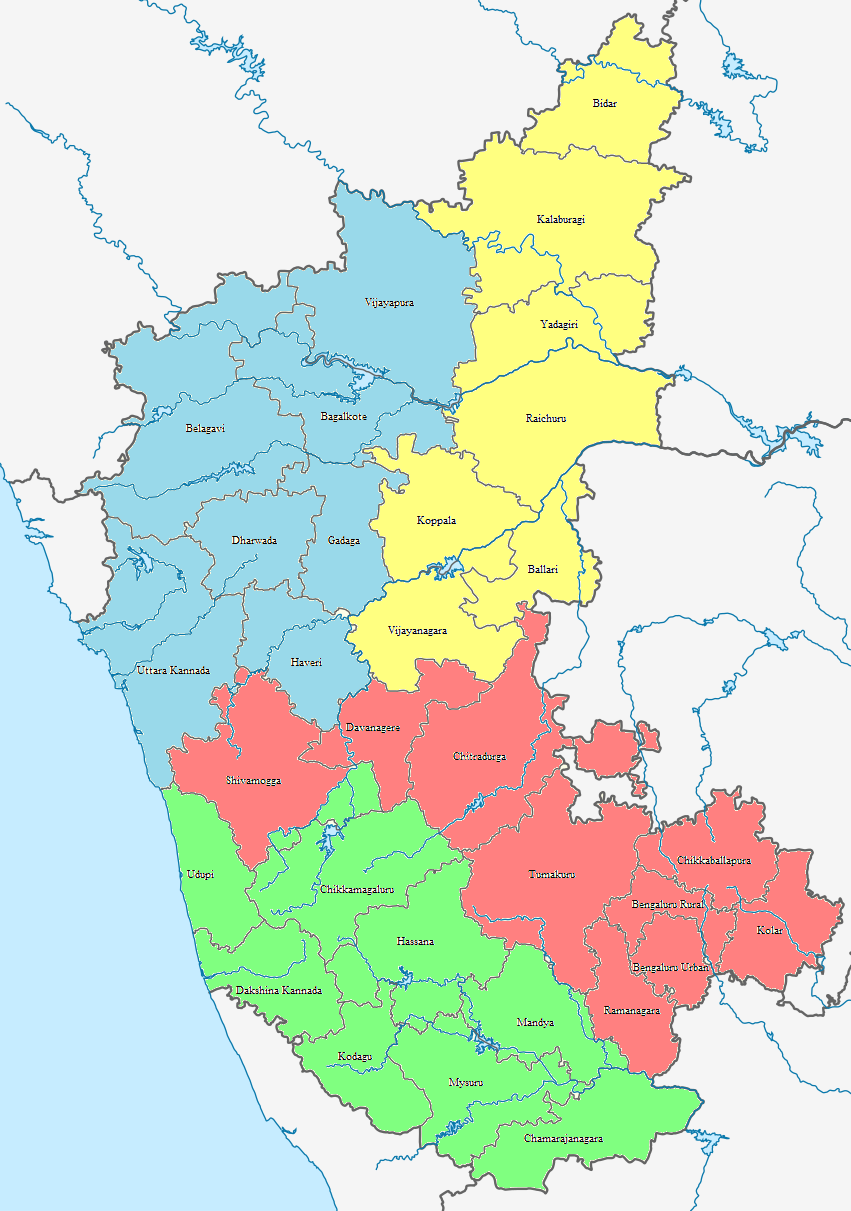
Karnataka State has been divided into 4 revenue divisions, 31 districts, 49 subdivisions, 237 taluks, 747 hoblies/ revenue circles and 6,022 villages for land revenue administrative purposes. The state has 281 towns and 7 municipal corporations. Bangalore is the largest urban agglomeration. It is among the fastest growing cities in the world.
Revenue administration
The state is divided into four administrative divisions for land revenue administration—Bengaluru, Mysuru, Belagavi, and Kalaburagi—each headed by a Regional Commissioner (formerly known as Divisional Commissioner, a senior IAS officer). Each division comprises multiple districts.
These divisions are subdivided into districts, each administered by a Deputy Commissioner (DC), an IAS officer. There are a total 31 districts in the state. Within a district, there are one or more revenue sub-divisions, overseen by an Assistant Commissioner. The Assistant Commissioners are designated as the Sub-Divisional Officers and Sub-Divisional Magistrates of the sub-division.
Each sub-division contains multiple taluks, administered by Tahsildars. There are a 236 Taluks in the state. Taluks are further divided into Hoblis, which are clusters of villages managed by Revenue Inspectors. At the grassroots level, each village is the smallest administrative unit and is managed by a Village Accountant.
Local government institutions
In Karnataka, rural governance is managed through a three-tier Panchayati Raj system: 5,958 Gram Panchayats at the village level, 233 Taluk Panchayats at the taluk level, and 31 Zilla Panchayats at the district level. These bodies collectively form the Panchayati Raj Institutions, responsible for local self-governance and rural development.
Urban governance in Karnataka is administered through Urban Local Bodies (ULBs), which are classified according to the population and size of the urban area. These include Bruhat Bengaluru Mahanagara Palike (BBMP), City Corporations, City Municipal Councils, Town Municipal Councils, and Town Panchayats.
Karnataka has a total of 278 Urban Local Bodies, including 1 BBMP, 11 City Corporations, 57 City Municipal Councils, 114 Town Municipal Councils, and 95 Town Panchayats, responsible for urban governance across the state.
Political and administrative reorganization
Main article: Unification of Karnataka
Karnataka took its present shape in 1956, when the states of Mysore and Coorg (Kodagu) were merged with the Kannada-speaking districts of the former states of Bombay and Hyderabad, and Madras. Mysore state was made up of 10 districts: Bangalore, Kolar, Tumkur, Mandya, Mysore, Hassan, Chikmagalur (Kadur), Shimoga and Chitradurga; Bellary was transferred from Madras state to Mysore in 1953, when the new Andhra State was created out of Madras' northern districts. Kodagu became a district, and Dakshina Kannada (South Kanara) district was transferred from Madras state, Uttara Kannada (North Kanara), Dharwad, Belgaum District, and Bijapur District from Bombay state, and Bidar District, Kalaburgi District, and Raichur District from Hyderabad state.
In 1989, Bangalore Rural district was carved out of Bangalore district. In 1997, Bagalkot district was carved out of Vijayapura district, Chamrajnagar out of Mysore, Gadag out of Dharwad, Haveri out of Dharwad, Koppal out of Raichur, Udupi out of Dakshina Kannada and Yadgir out of Kalaburagi. Davanagere district was created from parts of Bellary, Chitradurga, Dharwad and Shimoga. In 2020, Vijayanagara district was carved out of Ballari district, to become the 31st district in the state. As a result, the world heritage site of Hampi, the erstwhile capital of Vijayanagara empire, is now part of a new district - Vijayanagara.
Legislature

Main article: Karnataka legislature
The state legislature is bicameral and consists of the Legislative Assembly and the Legislative Council. The Legislative Assembly consists of 224 members with one member nominated by the governor to represent the Anglo-Indian community. The term of office of the members is five years and the term of a member elected to the council is six years. The Legislative Council is a permanent body with one-third of its members retiring every two years.
- Legislative Assembly (Vidhana Sabha): This is the lower house. Legislative Assembly members are elected directly by the people of Karnataka. The government is formed by the elected members of the assembly. The election to the Legislative Assembly is held once in five years which is also the tenure of an elected Government. But in case the Government loses the confidence of the Assembly, a mid-term election may become necessary. The first sitting of the Legislative Assembly was held on 19th December 1956 in the newly constructed Vidhana Soudha. The total seats in the assembly is 224.
- Legislative Council (Vidhana Parishat): This is the upper house. The Legislative Council is composed of 75 members, out of whom 25 are elected by Legislative Assembly members, 25 are elected by Local Authorities, 7 are elected by the Graduates, 7 are elected by Teachers and 11 members are nominated by the Governor of Karnataka.--
Ministry
The government is headed by the governor who appoints the chief minister and their council of ministers. The governor is appointed for five years and acts as the constitutional head of the state. Even though the governor remains the ceremonial head of the state, the day-to-day running of the government is taken care of by the chief minister and their council of ministers in whom a great deal of legislative powers is vested..
The secretariat headed by the secretary to the governor assists the council of ministers. The council of ministers consists of cabinet ministers, ministers of state and deputy ministers. The chief minister is assisted by the chief secretary, who is the head of the administrative services.
As of August 2021, the Government of Karnataka consists of 30 ministers including Chief Minister.
Chief Minister
The Chief Minister of Karnataka is the chief executive of the Indian state of Karnataka. As per the Constitution of India, the governor is a state's de jure head, but de facto executive authority rests with the chief minister. Following elections to the Karnataka Legislative Assembly, the state's governor usually invites the party (or coalition) with a majority of seats to form the government. The governor appoints the chief minister, whose council of ministers are collectively responsible to the assembly. Given that he has the confidence of the assembly, the chief minister's term is for five years and is subject to no term limits.
Karnataka Panchayat Raj
This is a 3-tier system in the state with elected bodies at the village (grama), taluka and district (zilla) levels. It ensures greater participation of people and effective implementation of rural development programs. There is a Grama Panchayat for a village (grama) or a group of villages (gramas), a Taluka Panchayat at the taluka level and a Zilla Panchayat at the district (zilla) level.
All the 3 institutions are made up of elected representatives and there is no provision for nomination by the governor to any of these councils. Karnataka was the first state in the country to enact the Panchayat Raj Act, incorporating all provisions of the 73rd Amendment to the Constitution.
In 2014, Karnataka State Grama Panchayats Delimitation Committee was constituted by the government of Karnataka, with Chairman S G Nanjaiahna Mutt and 6 members. The joint secretary of the committee was Dr. Revaiah Odeyar. The report was submitted on October 30, 2014. This resulted in the implementation of Gram Panchayath Elections in 2015.
Karnataka Panchayat Administrative Service (KPAS), is the civil service of Karnataka state. The Rural Development and Panchayat Raj Department conducts exams to recruit candidates for the service. The KPAS officers are usually appointed as Panchayat Development Officers (PDOs). They are trained under the Abdul Nazeer Sab State Institute of Rural Development and Panchayat Raj (ANSSIRDPR), Mysuru.
The Karnataka Gram Swaraj and Panchayat Raj Act, 1993 (5) was substituted by Act 44 of 2015 with effect from 25.02.2016, as follows:
CHAPTER XVI 1 [Administration, Inspection, Supervision and Creation of Commissionerate of Gram Swaraj and Panchayat Raj]
Section 232B of the Constitution of the Karnataka Panchayat Administrative Service: The Government shall constitute a Karnataka Panchayat Administrative Service consisting of such category of posts from the rural development and panchayat raj department, the number of posts, scale of pay, method of recruitment and minimum qualifications shall be such as may be prescribed]. Inserted by Act 44 of 2015 with effect from 25.02.2016.
Urban Local Governance
Urban areas in Karnataka are governed by different municipal bodies; 10 Municipal Corporations, 59 City Municipal Councils, 116 Town Municipal Councils, 97 Town Panchayats and 4 Notified Area Committees. The Municipal Corporations are administered under the State under Karnataka Municipal Corporations Act, 1976, while the rest are under the Karnataka Municipalities Act, 1964. The administration at Bruhat Bangalore Mahanagara Palike is overseen by the state government directly, while the Directorate of Municipal Administration does it for the rest of the urban local governments in Karnataka. The categorisation of urban areas is done on the following basis:
| Type | Type of Governing Body | Population Criteria | Density Criteria | Revenue Criteria | Economic Criteria |
|---|---|---|---|---|---|
| Transitory Areas | Town Panchayat | 10,000 to 20,000, | not less than 400 inhabitants to one square kilometer of area | - | percentage of employment in non-agricultural activities is not less than 50% of the total employment |
| Smaller Urban Areas | Town Municipal Council | 20,000 to 50,000 | not less than 1,500 inhabitants to one square kilometer of area | revenue generated for local administration from such area from tax and non-tax sources in the year of the last preceding census is not less than ₹9 lakhs per annum or a sum calculated at the rate of ₹45 per capita per annum, whichever is higher | |
| City Municipal Council | 50,000 to 3,00,000 | ||||
| Larger Urban Areas | City Municipal Corporation | 3,00,000 and above | not less than 3,000 inhabitants to one square kilo meter of area | revenue generated from such area for the local administration in the year of the last preceding census is not less than ₹6 crores per annum or an amount calculated at the rate of ₹200 per capita per annum, whichever is highe |
The Karnataka Municipal Corporations Act, 1976 mandates constituting both Ward Committees and Area Sabha in each corporation. The rules for setting these up are given in Karnataka Municipal Corporations (Wards Committees) Rules, 2016. Ward Committees in the state have been defunct in cities where they have been formed, with the meetings being erratic or not publicised to the ward members. Since the provision for setting up Ward Committees was only given in the municipal act meant for municipal corporations, only cities with population of 3 lakh or more were mandated to form them. In January 2020, the Urban Development Department of the Karnataka Government announced that Ward Committees would be formed in all urban local bodies in the state, irrespective of their population.
Executive
A district of an Indian state is an administrative unit headed by a deputy commissioner or district magistrate, an officer belonging to the Indian Administrative Service. The district magistrate or the deputy commissioner is assisted by a number of officers belonging to Karnataka Civil Service and other Karnataka state services.
A Superintendent of Police, an officer belonging to the Indian Police Service is entrusted with the responsibility of maintaining law and order and related issues of the district. The District SP is assisted by the officers of the Karnataka Police Service and other Karnataka Police officials. A Deputy Conservator of Forests, an officer belonging to the Indian Forest Service, is responsible for managing the forests, environment and wildlife related issues of the district. He is assisted by the officers of the Karnataka Forest Service and other Karnataka forest and wildlife officials. Sectoral development is looked after by the district head of each development department such as PWD, Health, Education, Agriculture, Animal husbandry, etc. These officers belong to the State Services.
Police Administration
The state is divided into 30 police districts, 77 sub-divisions, 178 circles, State Police consists of 20 police districts, 6 Police Commissioners at Bangalore, Mysore, Mangalore, Belagavi, Hubli-Dharwad and Kalaburgi cities, 77 sub-divisions, 178 circles, 927 police stations, and 317 police outposts. There are seven ranges: Central Range at Bangalore, Eastern Range at Davanagere, Northern Range at Belagavi, Southern Range at Mysore and Western Range at Mangalore, North Eastern Range Kalaburgi and Ballari range. The government Railway Police is headed by a ADGP of Police.
Units that assist the state in law and order include Criminal Investigation Department (Forest Cell, Anti-Dowry Cell, etc.), Dog Squad, Civil Rights Enforcement Wing, Police Wireless and Police Motor Transport Organization and special units. Village Defence Parties protect persons and property in the village and assist the police when necessary. The police force is at times supplemented by Home Guards.
Politics
Main article: Politics of Karnataka
Karnataka politics is dominated by the Indian National Congress (INC), Bharatiya Janata party (BJP) and Janata Dal (Secular).
In recent election conducted in May 2023, the Indian National Congress won in a landslide by getting 135 seats. The Bharatiya Janata Party and the Janata Dal (Secular) conceded defeat, finishing second and third, respectively.
Previously, in the 2018 Assembly Election, BJP emerged as single largest party with 104 seats leaving behind INC with 79, JDS with 38, BSP with 1 and other 2 independent seats. While B. S. Yeddyurappa went ahead with the intention of making the government and requested the governor to allow him to form a government without the numbers though. Governor allowed him to take oath as Chief Minister on 17 May 2018 although his happiness was short-lived, as SC struck down 2 weeks of time provided by the governor for the floor test to just 2 days. He was forced to resign unable to prove the majority. After his resignation H. D. Kumaraswamy was sworn in as the Chief Minister on 23 May 2018 with absolute majority support from Congress total of 117.
In later bypolls JDS+Congress combine won 4 out of 5 seats 3MP & 2 MLA seats making the numbers up by 119.
On 23 July 2019 the government headed by H. D. Kumaraswamy fell short of majority in the trust vote due to the resignation of 17 MLAs from the Congress and the JDS.
B. S. Yeddiyurappa once again took oath as the chief minister for the 4th time on 26 July 2019.
Elections
Last assembly elections: 2023 Karnataka Legislative Assembly election
References
References
- "Statistics - Karnataka state". Government of Karnataka.
- "Directorate of Municipal administration, Government of Karnataka".
- A Jayaram. "Council polls may not give Congress majority". 2002, The Hindu.
- "Karnataka Legislative Council". Government of India.
- "Origin and Growth of Karnataka Legislature". Government of Karnataka.
- [[Durga Das Basu]]. ''Introduction to the Constitution of India''. 1960. 20th Edition, 2011 Reprint. pp. 241, 245. LexisNexis Butterworths Wadhwa Nagpur. {{ISBN. 978-81-8038-559-9. Note: although the text talks about Indian state governments in general, it applies for the specific case of Karnataka as well.
- "About DMA".
- "About Us".
- "Karnataka Municipalities Act, 1964".
- "Karnataka Municipal Corporations Act, 1976".
- "Karnataka Municipal Corporations (Wards Committees) Rules, 2016".
- (2019-11-07). "Why ward committees are ineffective in Bengaluru: BBMP councillors' "Maharaja Complex"!".
- M, Akshatha. "Bengaluru's ward committees, set up after a fight, need another push". The Economic Times.
- Ramani, Chitra V.. (2018-07-27). "Ward Committees in name alone". The Hindu.
- (16 January 2020). "All cities, ULBs in Karnataka to have ward committees".
- "karnatakastatepolice.org".
This article was imported from Wikipedia and is available under the Creative Commons Attribution-ShareAlike 4.0 License. Content has been adapted to SurfDoc format. Original contributors can be found on the article history page.
Ask Mako anything about Government of Karnataka — get instant answers, deeper analysis, and related topics.
Research with MakoFree with your Surf account
Create a free account to save articles, ask Mako questions, and organize your research.
Sign up freeThis content may have been generated or modified by AI. CloudSurf Software LLC is not responsible for the accuracy, completeness, or reliability of AI-generated content. Always verify important information from primary sources.
Report