From Surf Wiki (app.surf) — the open knowledge base
Government of Argentina
None
.jpg)
None
| Field | Value |
|---|---|
| government_name | Government of Argentina |
| nativename | Gobierno de Argentina |
| image | Coat of arms of Argentina.svg |
| image_size | 100px |
| caption | Coat of arms |
| date | |
| jurisdiction | Argentina |
| url | |
| legislature | National Congress |
| meeting_place | Palace of the Congress |
| leader_title | President |
| headquarters | Casa Rosada |
| main_organ | Cabinet of Ministers |
| departments | 8 |
| court | Supreme Court |
| seat | Palace of Justice |
| document | Constitution |
The government of Argentina, within the framework of a federal system, is a presidential representative democratic republic. The president of Argentina is both head of state and head of government. Executive power is exercised by the president. Legislative power is vested in the National Congress. The Judiciary is independent from the Executive and from the Legislature, and is vested in the Supreme Court and the lower national tribunals. From the own government is also called Presidency of the Nation ().
Executive branch
The current composition of the executive branch includes solely the president, who is the head of state and is formally given the power over the administration to follow through with the interests of the nation. The president is also the chief of the Argentine Armed Forces.
The president and the vice president are elected through universal suffrage by the nation. The constitutional reform of 1994 introduced a two-round system, more popularly known in the country as ballotage, by which the winning presidential ticket has to receive either more than 45% of the overall valid votes, or at least 40% of it and a 10% lead over the runner-up. In any other case, the two leading tickets get to face a second round whose victor will be decided by a simple majority. This mechanism was not necessary in the 1995 election, when it could have first come into use, nor in the ones in 1999, 2007, 2011, and 2019. However, it was instrumental in the selection of Néstor Kirchner in 2003, of Mauricio Macri in 2015, and, most recently, of Javier Milei in 2023.
The cabinet of ministers is appointed by the president, but is not technically part of the executive power. The vice president belongs to the legislative branch, since they also hold the presidency of the senate.
Current presidency
| Portfolio | Incumbent | Since | Party | Coalition | President | Vice President | |||
|---|---|---|---|---|---|---|---|---|---|
| [[File:Mattarella_Milei_2024_(cropped).jpg | 80px]] | Javier Milei | 10 December 2023 | La Libertad Avanza}};" | Libertarian Party | La Libertad Avanza}};" | Freedom Advances | ||
| [[File:Villarruel_and_Richardson_(cropped).jpg | 75px]] | Victoria Villarruel | 10 December 2023 | Democratic Party (Argentina)}};" | Democratic Party | La Libertad Avanza}};" | Freedom Advances |
Current ministries
:
| Portfolio | Incumbent | Since | Party | Coalition | Chief of the Cabinet of Ministers | Ministry of Foreign Affairs, | ||||||||||
|---|---|---|---|---|---|---|---|---|---|---|---|---|---|---|---|---|
| International Trade and Worship | Ministry of Defense | Ministry of Economy | Ministry of Justice | Ministry of Security | Ministry of Health | Ministry of Human Capital | Ministry of Deregulation | |||||||||
| and State Transformation | ||||||||||||||||
| [[File:Guillermo Francos (cropped).jpg | 80px]] | Guillermo Francos | 28 May 2024 | Independent | La Libertad Avanza}}" | Freedom Advances | ||||||||||
| 75px | Gerardo Werthein | October 2024 | Independent | |||||||||||||
| [[File:Luis Petri (cropped).jpg | 75px]] | Luis Petri | 10 December 2023 | Radical Civic Union}};" | Radical Civic Union | Juntos por el Cambio}};" | Together for Change | |||||||||
| [[File:Luis Caputo 2023 (cropped).jpg | 85px]] | Luis Caputo | 10 December 2023 | Republican Proposal}};" | Republican Proposal | Juntos por el Cambio}};" | Together for Change | |||||||||
| 85px | Mariano Cúneo Libarona | 10 December 2023 | Independent | |||||||||||||
| [[File:Avelluto y Bullrich abrieron el Curso sobre Protección del Patrimonio Cultural - 26985391441 (cropped).jpg | 85px]] | Patricia Bullrich | 10 December 2023 | Republican Proposal}};" | Republican Proposal | Juntos por el Cambio}};" | Together for Change | |||||||||
| [[File:Mario Lugones 2025 (cropped).jpg | 85px]] | Mario Lugones | 26 September 2024 | Independent | ||||||||||||
| [[File:Sandra Pettovello (cropped).jpg | 85px]] | Sandra Pettovello | 10 December 2023 | Union of the Democratic Centre (Argentina)}};" | Union of the Democratic Centre | La Libertad Avanza}}" | Freedom Advances | |||||||||
| [[File:Federico Sturzenegger.JPG | 85px]] | Federico Sturzenegger | 5 July 2024 | Union of the Democratic Centre (Argentina)}};" | Union of the Democratic Centre | La Libertad Avanza}}" | Freedom Advances |
Legislative branch
The National Congress () constitutes the legislative branch of government. The Congress consists of the Senate (72 seats), presided by the Vice-President of the Nation, and the Chamber of Deputies (257 seats), currently presided by Julián Domínguez, deputy for Buenos Aires province. Senators stay in office for six years, and deputies, for four.
Each of the Provinces and the Autonomous City of Buenos Aires elect deputies and senators directly. Deputies are representatives of the whole people of the Nation, while Senators represent their districts. Each district elects a number of deputies roughly proportional to their overall population by proportional representation, and three senators: two for the majority, and one for the first minority. Members of both chambers are allowed indefinite re-elections.
Every two years, each of the 24 electoral districts (the twenty-three Provinces and the Autonomous City of Buenos Aires) elects one half of their lower chamber representatives. Districts with an odd number of Deputies elect one more or one fewer of them on each election. As for the Senators, the twenty-four districts are divided into three groups consisting of eight districts. Every two years all eight districts of one of those groups elect all their three senators, assigning two of them from the party that obtains the majority, and one from the first minority party. Six years later, the same group of districts will hold its next senatorial elections.
Judiciary branch
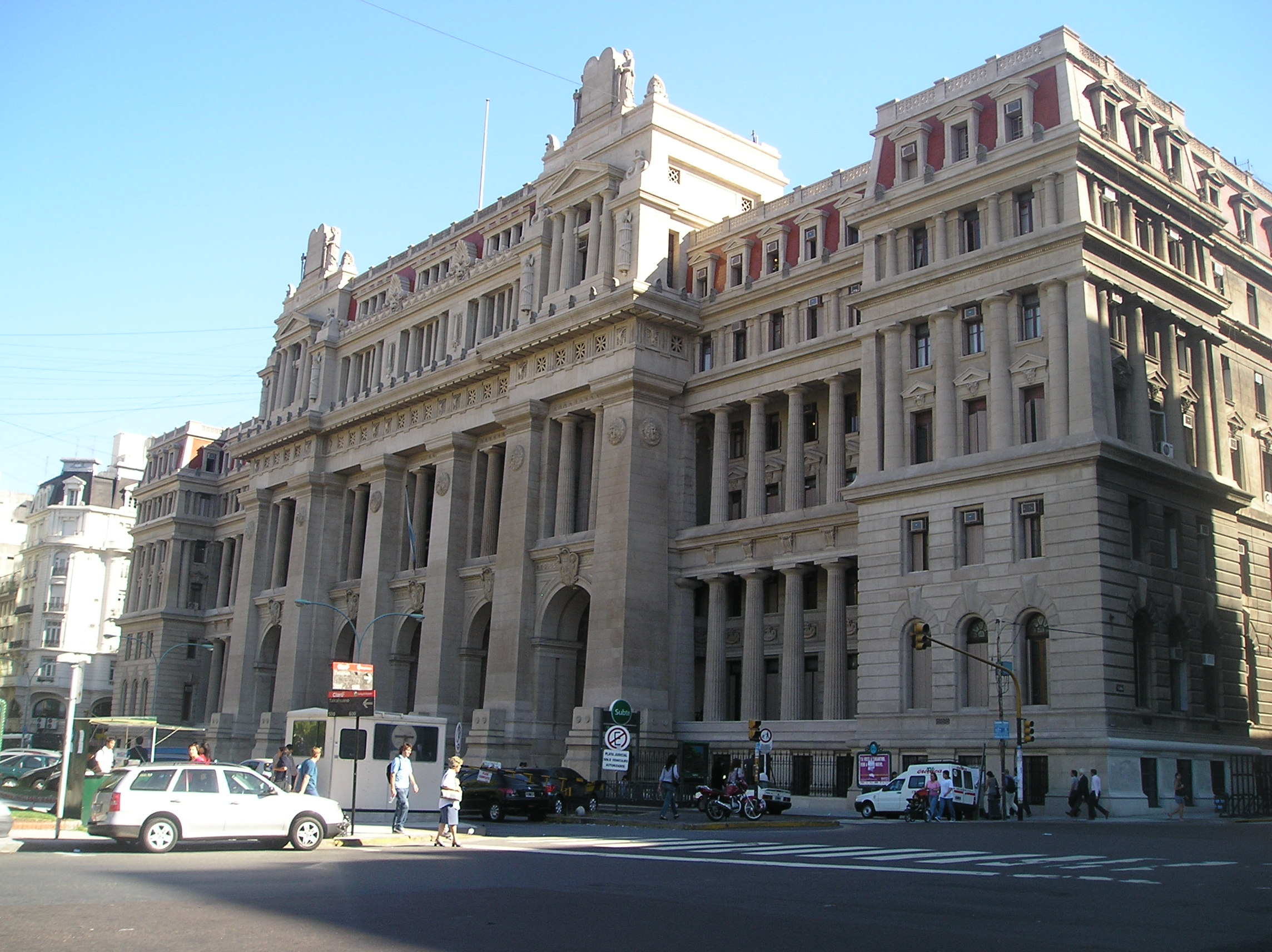
The Judiciary Branch is composed of federal judges and others with different jurisdictions and of a Supreme Court with nine members (one President, one Vice President, and seven Ministers), appointed by the President with approval of the Senate, who may be deposed by Congress. As of December 2015 there are six vacancies, which then President Kirchner stated she did not intend to fill.
- President of the Supreme Court: Dr. Horacio Rosatti
- Vice-President of the Supreme Court: Dr. Carlos Rosenkrantz
- Minister of the Court: Dr. Juan Carlos Maqueda
- Minister of the Court: Dr. Ricardo Lorenzetti
Provincial and municipal governments
Argentina is divided into 23 districts called Provinces and one autonomous district, which hosts the national capital, the Autonomous City of Buenos Aires (which is conurbated into the province of Buenos Aires). Each of the provinces has its own constitution, laws, authorities, form of government, etc., though these must first and foremost comply with the national constitution and laws.
The government of each province has three branches. The Executive, Legislative and Judiciary. The Executive branch is led by a governor. The Legislative Branch may be organized as a unicameral or a bicameral system, i.e:, with either one or two chambers or houses; currently, eight of the 24 provinces has a bicameral legislature.
Each province, except for Buenos Aires Province, is divided into districts called departments (departamentos). Departments are merely administrative divisions; they do not have governing structures or authorities of their own. They are in turn divided into municipalities (cities, towns and villages). Each province has its own naming conventions and government systems for different kinds of municipalities. For example, Córdoba Province has municipios (cities) and comunas (towns); Santa Fe Province further distinguishes between first- and second- tier municipios; Chaco Province refers to every populated center as municipios, in three categories.
The Province of Buenos Aires has a different system. Its territory is divided into 134 districts called partidos, each of which usually contains several cities and towns.
Regardless of the province, each department/partido has a head town (cabecera), often though not necessarily the largest urban center, and in some provinces often named the same as their parent district.
Municipalities are ruled by mayors, usually called Intendant (intendente) in the case of cities and towns (the larger categories). A city has a legislative body called the Deliberative Council (Concejo Deliberante). The smaller towns have simpler systems, often ruled by commissions presided by a communal president (presidente communal) or a similarly named authority.
Buenos Aires city, seat of the National Government, was declared an autonomous city by the 1994 constitutional reform. Its mayor, formerly chosen by the President of the Republic, is now elected by the people, and receives the title of Chief of Government (Jefe de Gobierno). Other than that, Buenos Aires, as the provinces, has its own Legislative Branch (a unicameral Legislature) and elect deputies and senators as representatives to the National Congress.
References
References
- (2013-04-04). "Argentina Constitution and Citizenship Laws Handbook: Strategic Information and Basic Laws". IBP, Inc..
- Malamud, Andrés and Martín Costanzo (2010) "[http://repositorio.ul.pt/handle/10451/11915 Bicameralismo subnacional: el caso argentino en perspectiva comparada] {{Webarchive. link. (13 January 2021 ". In: Igor Vivero Ávila (ed.), Democracia y reformas políticas en México y América Latina (pp. 219–246). Mexico: M. A. Porrúa.)
This article was imported from Wikipedia and is available under the Creative Commons Attribution-ShareAlike 4.0 License. Content has been adapted to SurfDoc format. Original contributors can be found on the article history page.
Ask Mako anything about Government of Argentina — get instant answers, deeper analysis, and related topics.
Research with MakoFree with your Surf account
Create a free account to save articles, ask Mako questions, and organize your research.
Sign up freeThis content may have been generated or modified by AI. CloudSurf Software LLC is not responsible for the accuracy, completeness, or reliability of AI-generated content. Always verify important information from primary sources.
Report