From Surf Wiki (app.surf) — the open knowledge base
Gostivar
City in Polog, North Macedonia

City in Polog, North Macedonia
| Field | Value | |
|---|---|---|
| <!-- Basic info ----------------> | name | Gostivar |
| native_name | Гостивар (Macedonian) | |
| Gostivari (Albanian) | ||
| settlement_type | ||
| total_type | ||
| motto | ||
| image_skyline | {{multiple image | |
| border | infobox | |
| perrow | 1/2/2/2/2 | |
| total_width | 250 | |
| image1 | Church Gostivar Macedonia.jpg | |
| image2 | Саат кула (Гостивар).jpg | |
| image3 | Градски парк Гостивар (07).jpg | |
| footer | From the top: Church of the Theotokos on the main square, Clock Tower and Clock Tower Mosque, City Park next to the Vardar River}} | |
| image_flag | Flag of Gostivar Municipality.svg | |
| image_seal | Coat of arms of Gostivar Municipality.svg | |
| image_map | Northwestern Macedonia.png | |
| map_caption | Location in Northwestern North Macedonia | |
| pushpin_map | North Macedonia | |
| pushpin_map_caption | Location within North Macedonia | |
| pushpin_mapsize | ||
| subdivision_type | Country | |
| subdivision_name | ||
| subdivision_type1 | Region | |
| subdivision_name1 | [[File:Logo of Polog Region.svg | 13px]] Polog |
| subdivision_type2 | Municipality | |
| subdivision_name2 | [[File:Coat of arms of Gostivar Municipality.svg | 13px]] Gostivar |
| parts_style | ||
| parts | ||
| p2 | ||
| leader_title | Mayor | |
| leader_name | Valbon Limani (AA) | |
| leader_title1 | ||
| established_title | ||
| established_date | ||
| unit_pref | ||
| area_total_km2 | 1.341 | |
| area_land_km2 | ||
| area_water_percent | ||
| elevation_footnotes | ||
| elevation_min_ft | ||
| population_as_of | 2021 | |
| population_total | 32,814 | |
| population_density_km2 | ||
| population_density_sq_mi | ||
| timezone | CET | |
| utc_offset | +1 | |
| timezone_DST | CEST | |
| utc_offset_DST | +2 | |
| coor_type | ||
| coordinates | ||
| <!-- Area/postal codes & others --------> | postal_code_type | |
| website | gostivari.gov.mk | |
| blank_name | Vehicle registration | |
| blank_info | GV | |
| blank1_name | Climate | |
| blank1_info | Cfb |
Gostivari (Albanian) Default is list if up to 5 items, coll if more than 5--
Gostivar ( ; Gostivari) is a city in North Macedonia, located in the upper Polog valley region. It is the seat of one of the larger municipalities in the country with a population of 59,770, and the town also covers 1.341 km2. Gostivar has road and railway connections with the other cities in the region, such as Tetovo, Skopje, Kičevo, Ohrid, and Debar. A freeway was built in 1995, from Gostivar to Tetovo, 24 km long. Gostivar is the seat of Gostivar Municipality.
Etymology
The name Gostivar comes from Slavic words gosti meaning "guests" and dvor meaning castle or fort.
Geography
Gostivar, at an elevation of 535 meters, is situated on the foothills of one of the Šar Mountains. Near to Gostivar is the village of Vrutok, where the Vardar river begins at an altitude of 683 m from the base of the Šar Mountains. Vardar River extends through Gostivar, cutting it in half, passes through the capital Skopje, goes through the country, enters Greece and finally reaches the Aegean Sea.
Demographics
Gostivar is attested in the 1467/68 Ottoman tax registry (defter) for the Nahiyah of Kalkandelen. The village had a total of 44 Christian households, 3 bachelors and 7 widows.
In statistics gathered by Bulgarian researcher Vasil Kanchov in 1900, the city of Gostivar was inhabited by 3,735 people, of whom 3,100 were Turks, 310 Bulgarian Christians, 200 Romani, 150 Muslim Albanians and 25 Vlachs. Kanchov wrote in 1900 that many Albanians declared themselves as Turks. In Gostivar, the population that declared itself Turkish "was of Albanian blood", but it "had been Turkified after the Ottoman invasion, including Skanderbeg", referring to Islamization.
The researcher Dimitar Gađanov wrote in 1916 that Gostivar was populated by 4,000 Albanians "who were Turkified", 100 Orthodox Albanians and 3,500 Bulgarians, while the surrounding area was predominantly Albanian.
According to the 2002 census, the city of Gostivar had a population of 35,847 inhabitants and the ethnic composition is the following:
- Albanians, 16,890 (47.1%)
- Macedonians, 11,885 (33.2%)
- Turks, 4,559 (12.7%)
- Roma, 1,899 (5.3%)
- others, 614 (1.7%)
The most common mother tongues in the city were the following:
- Albanian, 16,877 (47.1%)
- Macedonian, 13,843 (38.6%)
- Turkish, 4,423 (12.3%)
- Romani, 301 (0.8%)
- Serbian, 124 (0.3%)
- others, 279 (0.7%)
The religious composition of the city was the following:
- Muslims, 23,686 (66.1%)
- Orthodox Christians, 11,865 (33.1%)
- others, 296 (0.8%)
| Ethnic | |||||||||||||||||||||||||||||||||
|---|---|---|---|---|---|---|---|---|---|---|---|---|---|---|---|---|---|---|---|---|---|---|---|---|---|---|---|---|---|---|---|---|---|
| group | census 1948 | census 1953 | census 1961 | census 1971 | census 1981 | census 1994 | census 2002 | census 2021 | Number | % | Number | % | Number | % | Number | % | Number | % | Number | % | Number | % | Number | % | Total | 7,832 | 9,509 | 12,787 | 19,467 | 27,726 | 32,926 | 35,847 | 32,814 |
| Albanians | .. | .. | 4,313 | 45.4 | 2,904 | 22.7 | 6,044 | 31.1 | 10,791 | 38.9 | 14,128 | 42.3 | 16,890 | 47.1 | 13,585 | 41.4 | |||||||||||||||||
| Macedonians | .. | .. | 2,637 | 27.7 | 5,092 | 39.8 | 8,109 | 41.7 | 10,127 | 36.5 | 12,084 | 36.7 | 11,885 | 33.2 | 10,305 | 31.4 | |||||||||||||||||
| Turks | .. | .. | 1,924 | 20.2 | 4,349 | 34.0 | 4,449 | 22.9 | 4,378 | 15.8 | 4,475 | 13.6 | 4,559 | 12.7 | 4,725 | 14.4 | |||||||||||||||||
| Romani | .. | .. | 353 | 3.7 | 0 | 0.0 | 219 | 1.1 | 1254 | 4.5 | 1,609 | 4.9 | 1,899 | 5.3 | 1,648 | 5.0 | |||||||||||||||||
| Vlachs | .. | .. | 11 | 0.1 | 0 | 0.0 | 0 | 0.0 | 6 | 0.0 | 11 | 0.0 | 15 | 0.0 | 14 | 0.0 | |||||||||||||||||
| Serbs | .. | .. | 133 | 1.4 | 249 | 2.0 | 254 | 1.3 | 233 | 0.9 | 233 | 0.7 | 146 | 0.4 | 65 | 0.0 | |||||||||||||||||
| Bosniaks | .. | .. | 0 | 0.0 | 0 | 0.0 | 0 | 0.0 | 0 | 0.0 | 0 | 0.0 | 34 | 0.1 | 21 | 0.0 | |||||||||||||||||
| Others | .. | .. | 138 | 1.4 | 193 | 1.5 | 392 | 2.0 | 947 | 3.4 | 388 | 1.2 | 419 | 1.2 | 455 | 1.4 | |||||||||||||||||
| Administrative sources | 1,996 | 6.1 |
History
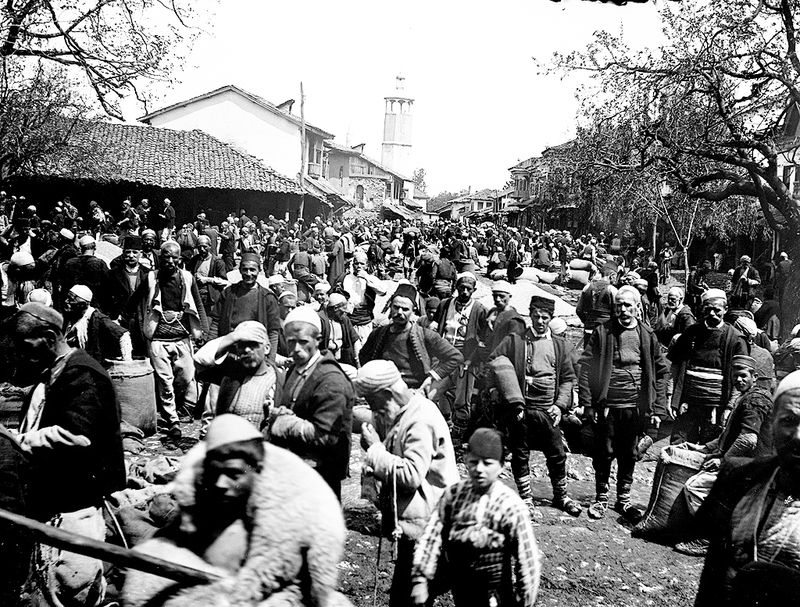

It is known that there was a town called Draudacum, Draudàkon (Δραυδάκον in Ancient Greek), built in 170 BCE, near or on the current locality of Gostivar.

Early mentions of the town was made by the Roman historian Livy. He records how during the Third Macedonian War the King of Macedon Perseus at the head of 10000 men, after taking Uskana (Kicevo), attacked Drau-Dak, today Gostivar.
Ottoman Period
In the late 14th century, Gostivar came under Ottoman rule along with the rest of Vardar Macedonia.
In the late 19th and early 20th century, Gostivar was part of the Kosovo Vilayet of the Ottoman Empire. During this period it became the centre of a kaza (municipality) and grew into one of the richer towns of Ottoman Vardar Macedonia.
Gostivar remained under Ottoman rule for more than 500 years until 1912, when it was occupied by Serbian troops during the First Balkan War.
Yugoslav Period
Jordan Ivanov, professor at the University of Sofia, wrote in 1915 that Albanians, since they did not have their own alphabet, due to a lack of consolidated national consciousness and influenced by foreign propaganda, declared themselves as Turks, Greeks and Bulgarians, depending on which religion they belonged to. The Orthodox Albanians of Gostivar were Bulgarianized by due to them being near the Bulgarian population.
From 1929 to 1941, Gostivar was part of the Vardar Banovina of the Kingdom of Yugoslavia, and then became part of Italian-occupied Albania.
From the 1950s onwards Orthodox Christian Albanian speakers from Upper Reka migrated cities like Gostivar, where they form the main population of Durtlok neighbourhood.
A policy of Turkification of the Albanian population was employed by the Yugoslav authorities in cooperation with the Turkish government, stretching the period of 1948-1959. A commission was created to tour Albanian communities in Macedonia, visiting Gostivar amongst other cities. Starting in 1948, six Turkish schools were opened in areas with large Albanian majorities, such as Tearce, Gorna Banjica, Dolna Banjica Vrapčište as well as in the outskirts of Tetovo and Gostivar. Contemporary analysis described cases of resistance to the Turkish schools in the Polog area, with Albanian speaking students and teachers refused to attend Turkish schools. A notable case happened in Gostivar, where a teacher from Banjica, who according to the committees analysis: "even though he was born in the same village and his mother tongue is Turkish, when the Turkish school was opened he refused to teach in Turkish and had asked to work in Albanian villages ...". Thus the Yugoslav committee characterized the local population as having adopted a "Greater Albanian political worldview". Resistance against the opening of Turkish schools was most prevalent in Tetovo and Gostivar. In Gostivar the nationalist activist Myrtezan Bajraktari was detained and interrogated by the Yugoslav secret police (UDBA). During his interrogation he stated he openly opposed the Turkish schools, and that he does so "just so Albanians can feel like patriots and not allow themselves to be Turkified."
Economy
In May 2015, an automotive company announced that it would open a new plant in Gostivar in the summer of 2015.
Tourism
Leaving Gostivar on the way to Ohrid, the village Vrutok has the gorge of the biggest river in North Macedonia, Vardar, which is 388 km long and flows into the Aegean Sea, at Thessaloniki. Gostivar is one of the biggest settlements in the Polog valley. The Polog valley can be observed from the high lands of Mavrovo and Galičnik.
The Mavrovo region hosts ski tournaments and other sport recreations. The peaks on the northern part of the Bistra mountain: Rusino Brdo, Sultanica and Sandaktas, host winter sport activities.
The range is 80 km long and 12 km wide and is covered with snow from November till March or April every year. Its highest peak, Titov Vrv, is situated on 2760 m above sea level. This provides opportunities for animal husbandry. Dairy products, mainly cheese and feta cheese, are made in the many sheepfolds on Šar and the adjacent mountains. These include several kinds of feta cheese, like Shara and Galicnik.
Located in the northwestern part of North Macedonia, Popova Shapka is another winter ski resort. It is situated on the Šar Mountain, 1780 m above the sea level, just 35 km from the capital Skopje. Popova Shapka has hotel accommodation.
Visitors not from the Republic of North Macedonia, and elsewhere other countries, use the facilities. Popova Shapka has been a host to both the European and Balkan Ski Championships. Not far from the resort, there are a number of small glacial lakes around on the mountain. There are two ways to get to Popova Shapka: by car, and by rope-railway with a starting location in Tetovo. The rope-railway is 6 km long and it takes about 36 minutes to reach the top.
Sports
Football club KF Gostivari has played in the Macedonian First League and stage their home games at the City Stadium Gostivar.
Notable people
Main article: List of people from Gostivar
References
Works cited
Gallery
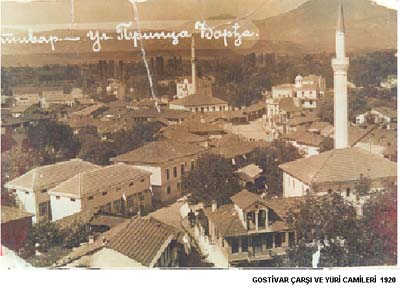
File:Gostivar, razglednica 1921.jpg|Gostivar at 1921 File:Gostivar od 1929 godina.jpg|Gostivar at 1929 File:Gostivar, razglednica od 1930ti godini.jpg|Gostivar at 1930 File:Gostivar, razglednica, 1930-ti.jpg|Gostivar at 1930 File:Gostivar, razglednica 1935.jpg|Gostivar at 1935
References
- [http://www.stat.gov.mk/pdf/kniga_13.pdf 2002 Census results]
- (2019). "North Macedonia : the Bradt travel guide".
- Турски документи за историјата на македонскиот народ кн.4, Методија Соколоски, д-р Александар Стојановски, Скопје 1971
- Vasil Kanchov (1900). ''[http://www.promacedonia.org/vk/vk_2_27.htm Macedonia: Ethnography and Statistics]''. Sofia. p. 213.
- Salajdin SALIHI. "DISA SHËNIME PËR SHQIPTARËT ORTODOKSË TË REKËS SË EPËRME". FILOLOGJIA - International Journal of Human Sciences 19:85-90.
- Macedonian Census (2002), [http://www.stat.gov.mk/publikacii/knigaX.pdf ''Book 5 - Total population according to the Ethnic Affiliation, Mother Tongue and Religion''], The State Statistical Office, Skopje, 2002, p. 87, 224, 361.
- [http://makstat.stat.gov.mk/pxweb2007bazi/Database/Censuses/Censuses%20of%20population%201948-2002/Censuses%20of%20population%201948-2002.asp Censuses of population 1948 - 2002] {{webarchive. link. (2013-10-14)
- {{harvnb. Mirčevska. 2007
- {{harvnb. Murati. 2011
- {{harvnb. Pieroni. Rexhepi. Nedelcheva. Hajdari. 2013
- (2009). "SHPËRNGULJA E SHQIPTARËVE NGA MAQEDONIA NË TURQI (1953-1959)". ITSH.
- (2009). "SHPËRNGULJA E SHQIPTARËVE NGA MAQEDONIA NË TURQI (1953-1959)". ITSH.
- (May 19, 2015). "Lear Corp. (LEA) to Open Automotive Plant in Macedonia". Nasdaq.
This article was imported from Wikipedia and is available under the Creative Commons Attribution-ShareAlike 4.0 License. Content has been adapted to SurfDoc format. Original contributors can be found on the article history page.
Ask Mako anything about Gostivar — get instant answers, deeper analysis, and related topics.
Research with MakoFree with your Surf account
Create a free account to save articles, ask Mako questions, and organize your research.
Sign up freeThis content may have been generated or modified by AI. CloudSurf Software LLC is not responsible for the accuracy, completeness, or reliability of AI-generated content. Always verify important information from primary sources.
Report