From Surf Wiki (app.surf) — the open knowledge base
Golok
| Field | Value | |
|---|---|---|
| name | Golok | |
| image | Golok naga indonesia.jpg | |
| image_size | 350 | |
| caption | A traditional Indonesian golok | |
| origin | Malay Archipelago | |
| type | Machete | |
| <!-- Type selection --> | is_bladed | Yes |
| used_by | Austronesian people | |
| wars | ||
| variants | ||
| length | 25-50 cm | |
| crew | ||
| blade_type | Single edge, convex grind | |
| hilt_type | Water buffalo horn, wood | |
| sheath_type | Water buffalo horn, wood |
a type of cutting tool
A golok is a cutting tool, similar to a machete, that comes in many variations and is found throughout the Malay Archipelago. It is used as an agricultural tool as well as a weapon. The word golok (sometimes misspelled in English as "gollock") is used in Indonesia and Malaysia. Both in Malaysia and in Indonesia, the term is usually interchangeable with the longer and broader parang. In the Sundanese region of West Java it is known as bedog. In the Philippines, the term gulok (also known as gunong), refers to different dagger weapons including the kris.
History
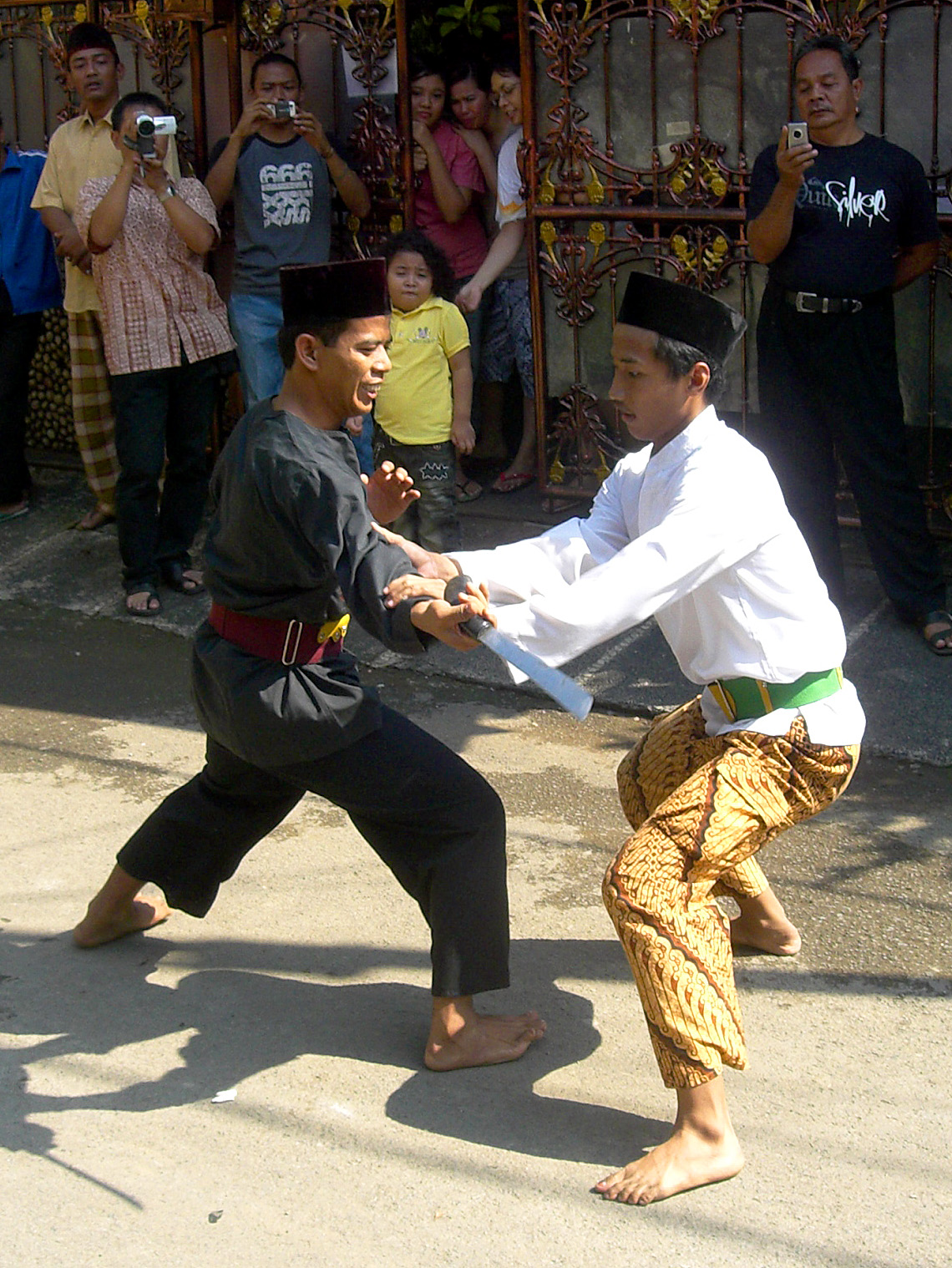
In Indonesia, the golok is often associated with the Sundanese and Betawi people. The Betawi recognize two types of golok; gablongan or bendo is the domestic tool used in the kitchen or field for agricultural purposes, and the golok simpenan or sorenam that is used for self-protection and traditionally always carried by Betawi men. The golok is a symbol of masculinity and bravery in Betawi culture. A jawara (local strongman or village champion) will always have a golok hung or tied around the waist at the hips. This custom, however, has ceased to exist since the 1970s, when authorities would apprehend those that carry the golok publicly and have it confiscated in order to uphold security, law and order, and to reduce gang fighting.
Sundanese, Javanese and Malay goloks have also been recorded. The use of golok in Sundanese was recorded in Sanghyang Siksa Kandang Karesian (text dated 1518) and in Malay was recorded as early as the Hikayat Hang Tuah (text dated 1700) and Sejarah Melayu (1612),
Description
Sizes and weights vary, as does blade shape, but the typical length is 25-50 cm. Goloks tend to be heavier and shorter than parangs or common machetes, typically being used for bush and branch cutting. Most traditional goloks use a convex edge or an edgewise taper, where the blade is less likely to get stuck in green wood than flat edged machetes. The blade is heaviest in the centre and flows away in a curve to a sharp point at the tip.
Goloks are traditionally made with a springy carbon steel blade of a softer temper than that of other large knives. This makes them easier to dress and sharpen in the field, but it also requires more frequent attention. Although many manufacturers produce factory-made goloks, there are still handmade productions that are widely and actively made in Indonesia.
Modern application

The golok style is noted for being the pattern for British Army-issue machetes used since the early 1950s.
References
References
- Stewart Binns. (2015). "The Darkness and the Thunder: 1915: The Great War Series". Penguin UK.
- (1973). "Kamus Utama Ejaan Baru". Pustaka Zaman.
- "Kamus Besar Bahasa Indonesia dalam Jaringan (KBBI daring) -entri Golok".
- "Notes on Maguindanao". Grid.
- G. J. Nawi. (2016). "Maen Pukulan -- Pencak Silat Khas Betawi: Dari Anak Betawi Untuk Insan Pencak Silat Dunia". Yayasan Pustaka Obor Indonesia.
- "Golok Pusaka Cibatu, Sukabumi, Jawa Barat: Pandai Besi Senjata yang Andal". Wonderful Indonesia.
- "Golok Jawa.".
- Carol Laderman. (1991). "Taming the Wind of Desire: Psychology, Medicine, and Aesthetics in Malay Shamanistic Performance". University of California Press.
- Kassim Ahmad. (1975). "Hikayat Hang Tuah: (Menurut naskhah Dewan Bahasa dan Pustaka)". Dewan Bahasa dan Pustaka.
- [http://mcp.anu.edu.au/N/Tuah_bib.html#b Hikayat Hang Tuah - malay concordance project]
- A. Samad Ahmad. (1986). "Sulalatus Salatin (Sejarah Melayu)". Dewan Bahasa dan Pustaka.
- Albert G Van Zonneveld. (2002). "Traditional Weapons of the Indonesian Archipelago". Koninklyk Instituut Voor Taal Land.
- Ed. Len Cacutt. (1988). "Survival". Marshall Cavendish Books.
This article was imported from Wikipedia and is available under the Creative Commons Attribution-ShareAlike 4.0 License. Content has been adapted to SurfDoc format. Original contributors can be found on the article history page.
Ask Mako anything about Golok — get instant answers, deeper analysis, and related topics.
Research with MakoFree with your Surf account
Create a free account to save articles, ask Mako questions, and organize your research.
Sign up freeThis content may have been generated or modified by AI. CloudSurf Software LLC is not responsible for the accuracy, completeness, or reliability of AI-generated content. Always verify important information from primary sources.
Report