From Surf Wiki (app.surf) — the open knowledge base
Goli Otok
Island in Primorje-Gorski Kotar County, Croatia

Island in Primorje-Gorski Kotar County, Croatia
| Field | Value |
|---|---|
| name | Goli Otok |
| native_name | |
| sobriquet | |
| image_name | Aerial image of Goli otok (view from the south).jpg |
| image_caption | Goli Otok seen from the air |
| mapframe | yes |
| mapframe-zoom | 9 |
| mapframe-stroke-width | 1 |
| mapframe-point | none |
| pushpin_map | Croatia |
| coordinates | |
| etymology | , |
| location | |
| GridReference | |
| waterbody | Adriatic Sea |
| area_km2 | 4.54 |
| area_footnotes | |
| title | Coastline lengths and areas of islands in the Croatian part of the Adriatic Sea determined from the topographic maps at the scale of 1 : 25 000 |
| journal | Geoadria |
| location | Zadar |
| volume | 9 |
| issue | 1 |
| pages | 5–32 |
| date | June 2004 |
| last1 | Duplančić Leder |
| first1 | Tea |
| last2 | Ujević |
| first2 | Tin |
| last3 | Čala |
| first3 | Mendi |
| doi | 10.15291/geoadria.127 |
| doi-access | free |
| length_km | |
| width_km | |
| coastline_km | |
| country | Croatia |
| country_admin_divisions_title | County |
| country_admin_divisions | Primorje-Gorski Kotar |
| country_area_km2 | |
| country_1_area_km2 | |
| population | 0 |
| mapframe-zoom = 9 | mapframe-stroke-width = 1 | mapframe-point = none | doi-access=free Goli Otok (; ) is a barren, uninhabited island that was the site of a political prison which was in use when Croatia was a part of Yugoslavia. The prison was in operation between 1949 and 1989.
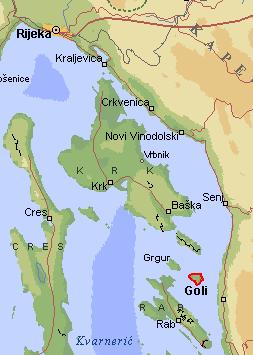
The island is located in the northern Adriatic Sea just off the coast of Primorje-Gorski Kotar County, with an area of approximately 4.5 km2. Exposed to strong bora winds, particularly in the winter, the island's surface is almost completely devoid of vegetation, giving Goli Otok (literally, 'barren island' in Croatian) its name. It is also known as the "Croatian Alcatraz" because of its history as a prison.
Prison
Socialist Republic of Croatia
Despite having long been an occasional grazing ground for local shepherds' flocks, the barren island was apparently never permanently settled other than by the prisoners during the 20th century. Throughout World War I, Austria-Hungary sent Russian prisoners of war from the Eastern Front to Goli Otok.
In 1949, the entire island was officially made into a high-security, top secret prison and labor camp set up by the authorities of the People's Federal Republic of Yugoslavia, together with the nearby Sveti Grgur island, which held a similar camp for female prisoners. Until 1956, following the Tito–Stalin split and throughout the Informbiro period, it was used to incarcerate political prisoners. These included known and alleged Stalinists, but also other Communist Party of Yugoslavia members or even non-party citizens accused of exhibiting sympathy or leanings towards the Soviet Union.
Many anti-communists (Serbian, Croatian, Macedonian, Bulgarian, Albanian and other nationalists etc.) were also incarcerated on Goli Otok. Non-political prisoners were also sent to the island to serve out simple criminal sentences and some of them were sentenced to death. A total of approximately 16,000 political prisoners served there, of which between 400 and 600 died on the island. Other sources, largely based on various individual statements, claim almost 4,000 prisoners died in the camp.
The prison inmates were forced to labor (in a stone quarry, pottery and joinery), without regard to the weather conditions: in the summer the temperature would rise as high as 40 C, while in the winter they were subjected to the chilling bora wind and freezing temperatures. The prison was entirely inmate-run, and its hierarchical system forced the convicts into beating, humiliating, denouncing and shunning each other. Those who cooperated could hope to rise up the hierarchy and receive better treatment.
After Yugoslavia normalized relations with the Soviet Union, Goli Otok prison passed to the provincial jurisdiction of the People's Republic of Croatia (as opposed to the Yugoslav federal authorities). Regardless, the prison remained a taboo topic in Yugoslavia until the early 1980s. Antonije Isaković wrote the novel Tren (Moment) about the prison in 1979, waiting until after Josip Broz Tito's death in 1980 to release it. The book became an instant bestseller. The prison was shut down on 30 December 1988 and completely abandoned in 1989. Since then it has been left to ruin. It has since become a tourist attraction and is visited by shepherds from Rab. Former Croatian prisoners are organized into the Association of Former Political Prisoners of Goli Otok. In Serbia, they are organized into the Society of Goli Otok.
Notable prisoners
- Šaban Bajramović, Serbian Romani musician
- Panko Brashnarov, Macedonian politician
- Vlado Dapčević, Yugoslav Montenegrin communist revolutionary and partisan
- Adem Demaçi, Kosovo Albanian politician and author
- Teki Dervishi, Albanian writer
- Vlado Dijak, Yugoslav Bosnian writer and partisan
- Nikola Kljusev, former Prime Minister of Macedonia
- Tine Logar, Slovenian linguist
- Venko Markovski, Macedonian writer
- Dragoljub Mićunović, Serbian partisan, sociologist, and politician
- Dragoslav Mihailović, Serbian writer
- Alfred Pal, Croatian painter and graphic designer
- Dobroslav Paraga, Croatian politician
- Aleksandar Popović, Serbian writer
- Igor Torkar, Slovenian writer
- Vlasta Velisavljević, Serbian actor
- Ante Zemljar, Croatian partisan and writer
- Savo Zlatić, Croatian physician and politician{{cite journal | trans-title=Interview with Savo Zlatić, M.D. | access-date=21 April 2014
- Vitomil Zupan, Slovenian writer
Literature

- 1981: Noč do jutra ('Night till Morning Comes') ‒ novel by Slovenian author Branko Hofman.
- 1981: Herezia e Dervish Mallutes – allegorical novel by Kosovar author Teki Dervishi.
- 1982: Tren 2 – novel by Antonije Isaković.
- 1984: Umiranje na obroke ('Dying by Installments') ‒ autobiographical book by Slovenian author Igor Torkar, about Goli Otok prison conditions.
- 1984: Goli Otok: The Island of Death ‒ non-fiction book by Bulgarian-Macedonian author Venko Markovski, detailing a history of Goli Otok prison.
- 1990: Goli Otok by Dragoslav Mihailović.
- 1993: Lov na stenice ('Hunting for Bedbugs') by Dragoslav Mihailović.
- 1996: Goli Otok: stratište duha ('Goli Otok: Gallows of the Soul') ‒ non-fiction book by Croatian author Mihovil Horvat, containing the events of his arrest and imprisonment during Informbiro period.
- 1997: Goli Otok: Italiani nel Gulag di Tito ('Goli Otok: Italians in Tito's Gulag') ‒ historical report by Italian-Croatian author Giacomo Scotti.
- 1997: Zlotvori ('Evildoers') – novel by Dragoslav Mihailović.
- 1997: Tito's Hawaii ‒ novel by author using the pen-name Rade Panic (name taken from a political victim of the same name whose wife was interred on the island; not his actual name).
- 2005: Razglednica s ljetovanja ('A Postcard From Summer Vacation') ‒ autobiographical short novel by the Croatian author Dubravka Ugrešić; published in the Belgrade literary review REČ časopis za književnost i kulturu, i društvena pitanja, br. 74/20, 2006, and in the book Nikog nema doma, ed. devedeset stupnjeva, Zagreb 2005. Italian translation Cartolina Estiva by Luka Zanoni Osservatorio Balcani e Caucaso, 2008.
- 2010: Island of the World - novel by Canadian author Michael D. O'Brien.
- 2019: Life Plays with Me (Published in North America as More Than I Love My Life) - novel by Israeli writer David Grossman. One of the main characters, Vera, was interned as a political prisoner in Goli Otok before immigrating to Israel.

- 2023: The Secret of Bald Island - non-fiction book by Claudia Sonia Colussi Corte, describing her father's (Cherubino Colussi Corte) return to Mali Lošinj, Yugoslavia, as part of the Italian Controesodo, his arrest on suspicion of being a Stalinist, and his imprisonment on Goli Otok during the Informbiro period.
Film and television
- 1996: The Seventh Chronicle (Sedma kronika) – Croatian feature film about a Goli Otok inmate who escapes by swimming to the island of Rab, based on a novel by Grgo Gamulin
- 2002: Eva ‒ documentary film told in German, Hebrew and English recounting the experiences of Eva Panić-Nahir, a former prisoner of the island; produced/directed by Avner Faingulernt
- 2009: Strahota - Die Geschichte der Gefängnisinsel Goli Otok ‒ German-language documentary film with 8 former prisoners; produced/directed by Reinhard Grabher
- 2012: Goli Otok ‒ documentary film directed by Darko Bavoljak
- 2013: Lost Survivors ‒ Travel Channel reality TV survival series episode entitled "Prison Island"
- 2014: Goli – documentary film directed by Tiha K. Gudac
- 2014: In the Name of the People ‒ exhibition in Belgrade; with an alphabetical list of 16,500 names of people who were jailed at the Goli Otok available for online search on their website
- 2019: Mysteries of the Abandoned ‒ Season 4 Episode 9 "Haunting on Plague Island"
References
Sources
References
- (2009). "The Parallax View". MIT Press.
- (1994). "Europe's Backyard War: The War in the Balkans". Mandarin.
- (2006). "The Making of Slovenia". National Museum of Contemporary History.
- "Donja Klada » Goli otok".
- (31 May 2006). "Višestruki ubojica s Golog otoka opet ubio". [[Jutarnji list]].
- Central Intelligence Agency. (20 November 1970). "Yugoslavia: The Outworn Structure".
- Gibbens, Sarah. (29 August 2017). "See the Haunting Ruins of a Prison Once Known as a 'Living Hell'". National Geographic.
- (25 July 2012). "Srbija nudi odštetu zatvorenicima na Golom otoku - devet dolara po danu". [[Slobodna Dalmacija]].
- [http://aestovest.osservatoriobalcani.org/luoghi/goli_otok.html Goli Otok], ''AestOvest'', [[Osservatorio Balcani e Caucaso]] 2008
- "scotti".
- Vežić, Goran. "Goli otok - zloglasna Titova kaznionica". [[Deutsche Welle]].
- "'Nikada nećemo saznati čija je konkretno ideja o osnivanju logora na Golom otoku'".
- Daniel J. Goulding, ''Liberated cinema: the Yugoslav experience, 1945-2001'', Indiana University Press, 2002. (p. 159)
- "Slobodna Dalmacija".
- (3 December 2007). "Spomen žrtvama Golog otoka na Adi - Glas javnosti".
- "BIO JE NEPONOVLJIV / Odrastao u bijedi, zbog djevojke pobjegao iz vojske pa završio na Golom otoku. Pio je i trošio kao da nema sutra, a umro u bijedi – 100posto.hr".
- Goli Otok: The Island of Death: a Diary in Letters, Venko Markovski, Social Science Monographs, Boulder, 1984, {{ISBN. 0880330554, р. 42.
- "Odiseja Vlada Dapčevića".
- (2014). "Croatia ponders fate of 'Tito's Guantanamo'".
- Magazin, X. X. Z.. (2017-03-14). "Ambasador boema - XXZ Portal".
- (6 April 2011). "Никола Кљусев".
- (2003-01-05). "LINGUIST List 14.1: Obituary: Tine Logar".
- Mikuš, Marek. (2018). "Frontiers of civil society : government and hegemony in Serbia".
- Čadež, Tomislav. "Alfred Pal: Preživio holokaust, dvaput bio na Golom otoku, a onda radio najljepše hrvatske knjige". [[Jutarnji list]].
- (1 January 2005). "Na Golom otoku žalio sam što nisam kriminalac". [[Večernji list]].
- ""Pitomac" Golog otoka".
- "NEVJEROJATAN ŽIVOT LEGENDE / Pobjegao je iz nacističkog logora, a robijao je na Golom otoku. Zbog toga ga se žena odrekla i nikad joj nije oprostio, a ni nakon 90. Ne želi u mirovinu – 100posto.hr".
- "Zemljar, Ante".
- "Tito's Hawaii, a novel about Goli Otok".
- Ugrešić, Dubravka. (2008). "Cartolina estiva". [[Osservatorio Balcani e Caucaso]].
- {{url. https://www.academia.edu/103126672/AO_4_Claudia_Sonia_Colussi_Corte_The_Secret_of_Bald_Island_trans_Konrad_Eisenbichler_
- "Baza HR kinematografije".
- "Eva".
- Peherstorfer, Markus. (5 May 2009). "Die vergessene Hölle der Adria". [[Der Standard]].
- "Goli otok". havc.hr.
- "Travel Channel's ''Lost Survivors'' episode, "Prison Island" partly filmed on Croati's Goli otok island". travelchannel.com.
- Godeč, Željka. (2 September 2014). "Moja potraga za istinom o djedovom zatočeništvu na Golom otoku". [[Jutarnji list]].
- "Mysteries of the Abandoned (TV Series 2017– ) - IMDb".
This article was imported from Wikipedia and is available under the Creative Commons Attribution-ShareAlike 4.0 License. Content has been adapted to SurfDoc format. Original contributors can be found on the article history page.
Ask Mako anything about Goli Otok — get instant answers, deeper analysis, and related topics.
Research with MakoFree with your Surf account
Create a free account to save articles, ask Mako questions, and organize your research.
Sign up freeThis content may have been generated or modified by AI. CloudSurf Software LLC is not responsible for the accuracy, completeness, or reliability of AI-generated content. Always verify important information from primary sources.
Report