From Surf Wiki (app.surf) — the open knowledge base
Goldsinny wrasse
Species of fish
Species of fish
- Cynaedus Swainson, 1839 Species:
- Labrus rupestris Linnaeus, 1758
- Ctenolabrus suillus (Linnaeus, 1758) (ambiguous name)
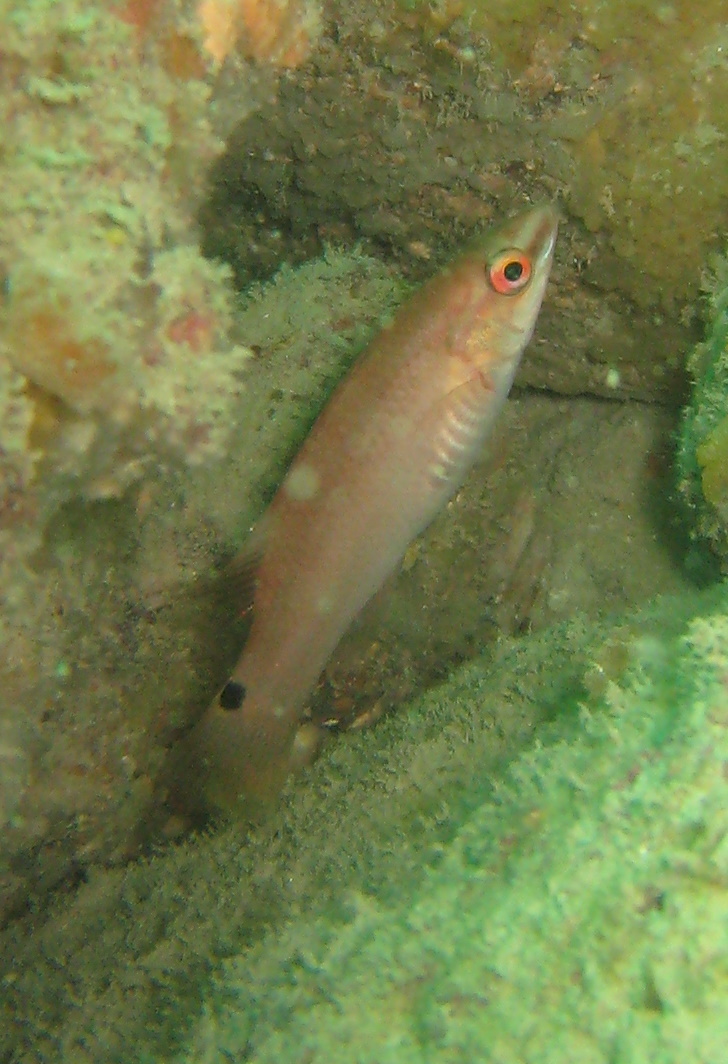
The goldsinny wrasse (Ctenolabrus rupestris) is a species of ray-finned fish, a wrasse from the family Labridae which is native to the eastern Atlantic Ocean and associated seas. This species is the only known member of its genus.
Description
The goldsinny wrasse can reach a total length of 18 cm,{{cite encyclopedia |author1 = Picton, B.E. | author2 = Morrow, C.C. | name-list-style = amp | year = 2016 | title = Ctenolabrus rupestris (Linnaeus, 1758) | encyclopedia = Encyclopedia of Marine Life of Britain and Ireland | url = http://www.habitas.org.uk/marinelife/species.asp?item=ZG6050 | publisher = National Museums of Northern Ireland | access-date = 2020-01-05}}
Distribution
The goldsinny wrasse is found in the eastern Atlantic Ocean from Norway south as far as Morocco. It is also found throughout the western and central Mediterranean Sea as far as Antalya in Turkey, but it is absent from the far eastern Mediterranean. It extends through the Sea of Marmara into the Black Sea.
Habitat and biology
The goldsinny wrasse is normally found in areas dominated by rock or by boulders and requires there to be many crevices for it to hide in. It is most frequently recorded at depths of between 10-50 m but it is infrequently recorded in rockpools near the low water mark. Their diet consists of bryozoan, small crustaceans and molluscs. it is often associated with beds of algae and eelgrass. These wrasses attain maturity at two years of age, with the life span being up to eight years, and they do not display sexual dimorphism. spawning takes place from the winter into summer. When breeding the males defend territories. Spawning happens in mid water and when the pelagic eggs hatch the larvae are planktonic.
Human uses
The goldsinny wrasse is fond of sea lice and has been used to clean salmon in commercial farms together with the Ballan wrasse. Both these wrasses are not easy to retain in the salmon farms, as they escape through the nets, being significantly smaller than the salmon. This species is caught as a food fish by local indigenous peoples and is popular as a game fish. It is also a popular fish for display in public aquaria.
References
References
- Pollard, D.. (2010). "''Ctenolabrus rupestris''".
- {{FishBase. (2013)
- Reeds, K.A.. (2004). "''Ctenolabrus rupestris'' Goldsinny". Marine Biological Association of the United Kingdom..
This article was imported from Wikipedia and is available under the Creative Commons Attribution-ShareAlike 4.0 License. Content has been adapted to SurfDoc format. Original contributors can be found on the article history page.
Ask Mako anything about Goldsinny wrasse — get instant answers, deeper analysis, and related topics.
Research with MakoFree with your Surf account
Create a free account to save articles, ask Mako questions, and organize your research.
Sign up freeThis content may have been generated or modified by AI. CloudSurf Software LLC is not responsible for the accuracy, completeness, or reliability of AI-generated content. Always verify important information from primary sources.
Report