From Surf Wiki (app.surf) — the open knowledge base
Goldfields Water Supply Scheme
Pipeline and dam project in Western Australia
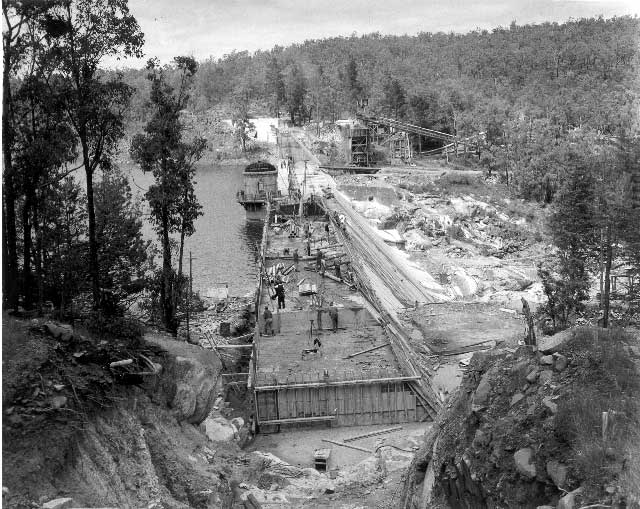
Pipeline and dam project in Western Australia
The Goldfields Water Supply Scheme is a pipeline and dam project that delivers potable water from Mundaring Weir in Perth to communities in Western Australia's Eastern Goldfields, particularly Coolgardie and Kalgoorlie. The project was commissioned in 1896 and completed in 1903.
The pipeline continues to operate today, supplying water to over 100,000 people in over 33,000 households as well as mines, farms and other enterprises.
Water scarcity
During the early 1890s, thousands of settlers had travelled into the barren and dry desert centre of Western Australia seeking gold, but the existing infrastructure for the supply of water was non-existent, and an urgent need arose.
Prior to the scheme, water condensers, irregular rain, and water trains were part of the range of sources. Railway dams were essential for water to supply locomotives to travel to the goldfields.
Origins of the scheme
Throughout the 1890s, water availability issues in Coolgardie and in the Kalgoorlie-Boulder region were causing concern. On 16 July 1896, the Premier of Western Australia, John Forrest introduced to Western Australian Parliament a bill to authorise the raising of a loan of £2.5million, equivalent to in , to construct the scheme: the pipeline would convey 23000 kl of water per day to the Goldfields from a dam on the Helena River near Mundaring in Perth.
The scheme consisted of three key elements – the Mundaring Weir, which dammed the Helena River in the Darling Scarp creating the Helena River Reservoir; a 760 mm diameter steel pipe which ran from the dam to Kalgoorlie 530 km away; and a series of eight pumping stations and two small holding dams to control pressures and to lift the water over the Darling Scarp.
Construction and criticism

The scheme was devised by C. Y. O'Connor who oversaw its design and most of the construction project. Although supported by Premier Forrest, O'Connor had to deal with widespread criticism and derision from members of the Western Australian Parliament as well as the local press based on a belief that the scope of the engineering task was too great and that it would never work.
There was also a concern that the gold deposits would soon be depleted, and the state would have a significant debt to repay but little or no commerce to support it.
Sunday Times editor Frederick Vosper – who was also a politician, ran a personal attack on O'Connor's integrity and ability through the paper. Timing was critical, Forrest as a supporter had moved into Federal politics, and the new Premier George Leake had long been an opponent of the scheme.
O'Connor died by suicide in March 1902, less than 12 months before the final commissioning of the pipeline.
Lady Forrest officially started the pumping machinery at Pumping Station Number One (Mundaring) on 22 January, and on 24 January 1903 water flowed into the Mount Charlotte Reservoir at Kalgoorlie. O'Connor's engineer-in-chief, C. S. R. Palmer took over the project after his death, seeing it through to its successful completion.
The government conducted an inquiry into the scheme and found no basis for the press accusations of corruption or misdemeanours on the part of O'Connor.
Pipeline
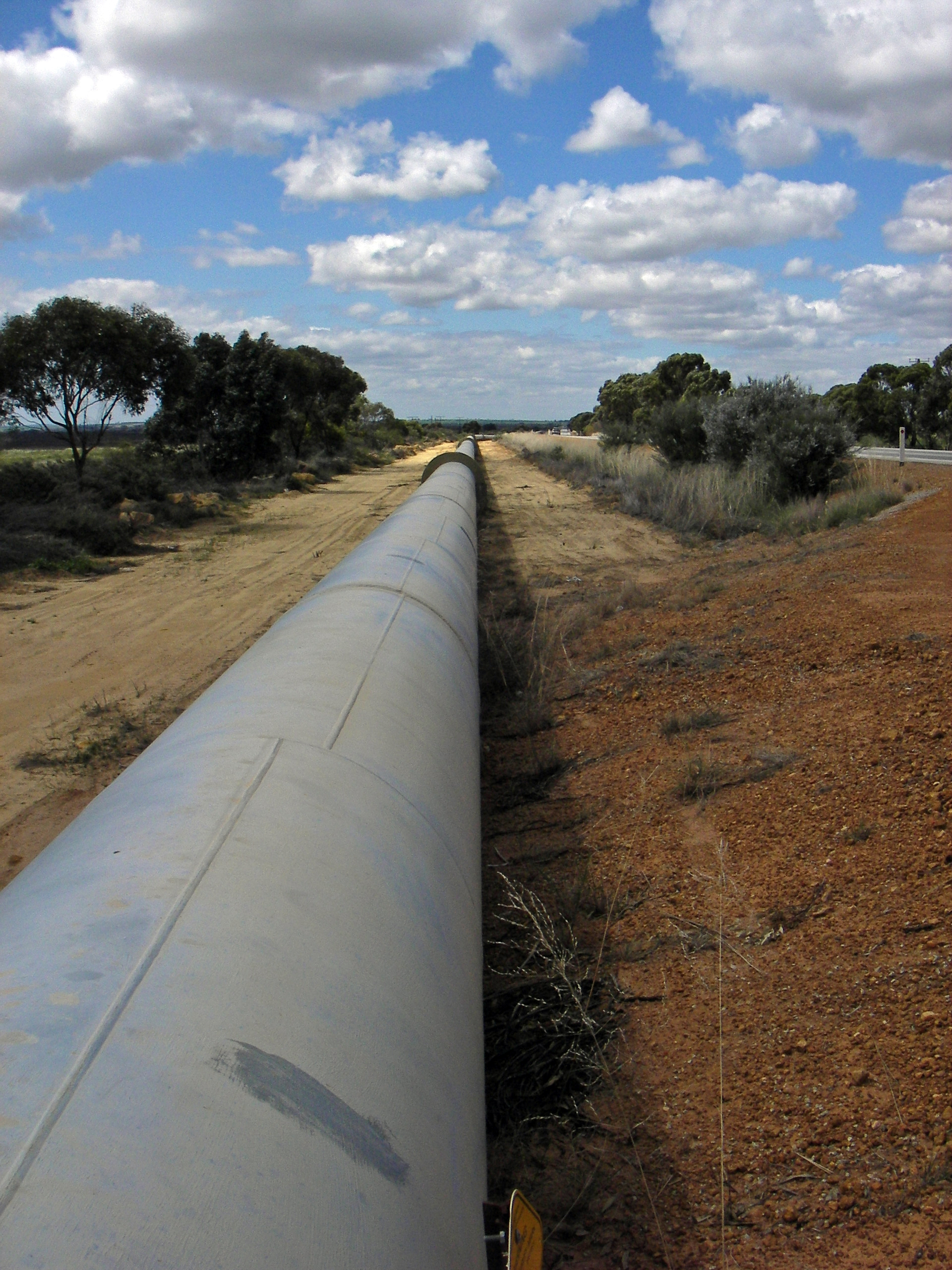
The pipes were manufactured locally from flat steel sheets imported from Germany and the United States. Mephan Ferguson was awarded the first manufacturing contract and built a fabrication plant at Falkirk (now known as the Perth suburb of Maylands) to produce half of the 60,000 pipes required. C & G Hoskins established a factory near Midland Junction (now known simply as Midland) to produce the other half.
When built, the pipeline was the longest fresh-water pipeline in the world.
The pipeline ran alongside the earlier route of the Eastern Railway and the Eastern Goldfields Railways for parts of its route, so that the railway service and the pipeline had an interdependence through the sparsely populated region between Southern Cross and Kalgoorlie.
The scheme required significant infrastructure in power generation to support the pumping stations. Communities oriented to the maintenance of the pipeline and pumping stations grew up along the route. With improved power supplies and modern machinery and automation, the scheme now has more unattended pumping stations operated by fewer people.
Dam

Main article: Mundaring Weir
Construction of the dam started in 1898. When completed in 1902 it was claimed to be the highest overflow dam in the world.
Shortly after World War II, raising the wall was proposed and by 1951 the height of the dam wall was increased by 9.7 m.
Mundaring Weir branch railway
Main article: Mundaring Weir branch railway
The Public Works Department originally constructed and ran the railway from the Mundaring railway station for the purpose of delivering materials to the construction site.
The Western Australian Government Railways took over the railway operation. It ceased operation in 1952, and the connecting railway line at Mundaring closed in 1954.
Design challenges
- The sudden Darling Range height rise between Mundaring and Northam required the location of Pumping Station number two to be close to number one.
- The Avon River in Northam required the construction of the Poole Street Bridge after failure of river bed pipes in 1917.
The distance was compounded by the height the water had to be lifted. To rise the almost 400 m in altitude, issues with friction meant that a head of 800 m had to be achieved. O'Connor had eight pumping stations that each pumped the water to the next of the receiving tanks in his plans.
Leakages were noted early; by the early 1930s, 1.7 Gl of water per yeara quarter of the total volume of water being pumped from Mundaring Weirwas leaking from the pipeline.
Pumping stations
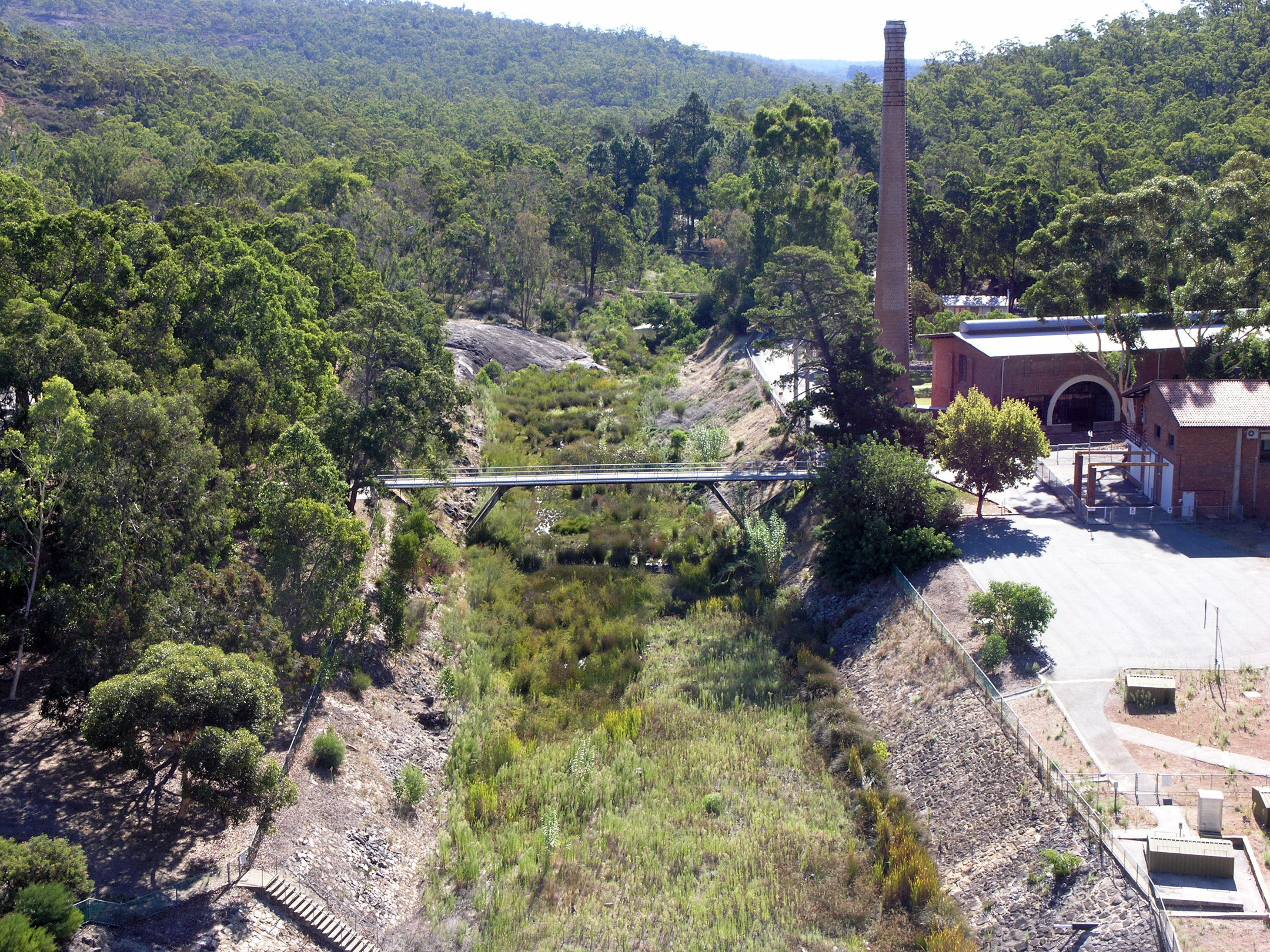
With most of the original stations being steam-driven, a ready supply of timber was needed to fire the boilers. Hence the pipeline route was closely aligned with the Eastern Railway. To enhance the reliability of the system, each pumping station was designed and constructed with a spare pumping unit. Due to pressure requirements related to the slope of the pipeline, stations one to four required two pumping units to be in operation. Stations five to eight only required one operating pump, due to a lower rise in height between those stations.
James Simpson and Co supplied 3,500 t of equipment in 5,000 separate boxes for the construction of the pumping sets.
Original pumping stations
All the original pumping stations were powered by steam.
- Number One – below Mundaring Weir (now a National Trust of Western Australia administered museum)
- Number Two – above Mundaring Weir (demolished in 1960s)
- Number Three – Cunderdin (now Cunderdin Museum)
- Number Four – Merredin (location of three generations of pump station)
- Number Five – Yerbillon
- Number Six – Ghouli
- Number Seven – Gilgai
- Number Eight – Dedari
Current pumping stations
- Mundaring
- Chidlow
- Wundowie
- Grass Valley
- Meckering
- Cunderdin
- Kellerberrin
- Baandee
- Merredin
- Walgoolan
- Yerbillon
- Nulla Nulla
- Southern Cross
- Ghooli
- Karalee
- Koorarawalyee
- Boondi
- Dedari
- Bullabulling
- Kalgoorlie
Branch mains, or extensions, were started as early as 1907.
Water from the pipeline was utilised for a number of country towns adjacent to its route, and also into the Great Southern region. The Public Works Department started this project in the 1950s following the raising of the weir wall in the early 1950s and it completed this work in 1961.
Centenary
The scheme was "interpreted" by the National Trust of Western Australia in its Golden Pipeline Project, which created guide books, web sites, and tourist trails along the scheme pipeline and tracing the older power station locations and communities that serviced the scheme. The Trust achieved the responsibility in an agreement with the Water Corporation in 1998. Most of the material was developed between 2001 and 2003.
Recent histories
In 2007 two items were produced that were overviews of the scheme:
''Pipe Dreams''
The history of the construction of the Goldfields Water Supply Scheme was detailed in the 2007 documentary Pipe Dreams, which was part of the ABC series Constructing Australia.
''River of Steel''
The book River of Steel, by Richard G. Hartley, won the Margaret Medcalf award of the State Records Office of Western Australia in 2008.
Lower Helena Dam
Lower Helena Pipehead Dam is now also used to supply water to the Goldfields region. Water from the dam is currently pumped back into Mundaring Weir.
Engineering heritage
The scheme is listed as a National Engineering Landmark by Engineers Australia as part of its Engineering Heritage Recognition Program, and an International Historic Civil Engineering Landmark by the American Society of Civil Engineers.{{cite web | access-date=2020-04-27
Notes
References
Sources
Note – the material on the scheme is in its entirety a significant collection, and although the Water Authority might hold a comprehensive bibliography, it has not been published.
;Primary sources
- Articles in The Golden Age relating to the water supply at Coolgardie 1894–1898. J S Battye Library
- Coolgardie Goldfields Water Supply : a new method of dealing with granite rocks.1894. West Australian, 10 Feb 1894.
- The Agricultural areas, Great Southern towns and Goldfields water supply scheme : constructed by the Public Works Department, Western Australia, completed November 1961 : form of proceedings at the function to commemorate the completion of the project, held at Mundaring Weir, on 24 November 1961 [Perth, W.A.] : Govt. Printer, 1961.
;Secondary sources
- Hartley, Richard G. (2007) River of steel : a history of the Western Australian Goldfields and Agricultural Water Supply 1895–2003 Bassendean, W.A. : Access Press. (pbk.)
- {{cite book
;Pamphlets
- The Politics of the Goldfields Water Supply Scheme, The Golden Pipeline Information Sheet Number 1. National Trust of Australia (Western Australia) No Date.
;Further reading
- Le Page, J. S. H. (1986) Building a state : the story of the Public Works Department of Western Australia 1829–1985 Leederville,W.A: Water Authority of Western Australia.
References
- [https://webarchive.nla.gov.au/awa/20070808002800/http://pandora.nla.gov.au/pan/34047/20070808-1028/www.thelearningfederation.edu.au/tlf2/sitefiles/los/r5515/description.html Mammoth government condenser at Coolgardie, 1902] ''pandora.nla.gov.au''{{cbignore
- (17 December 1897). "NORTHAM". [[Western Mail (Western Australia).
- link
- "Speech in the Legislative Assembly by The Hon. Sir John Forrest ... on moving the second reading of the Coolgardie Goldfields Water Supply Loan Bill, on Tuesday, 21st July, 1896". Richard Pether.
- (22 July 1898). "Statement by the Premier.". [[Western Mail (Western Australia).
- (8 September 1898). "HOUSE OF ASSEMBLY.". [[Western Argus.
- [https://adb.anu.edu.au/biography/forrest-sir-john-6211 When the Commonwealth of Australia was inaugurated, Forrest was elected unopposed for the electorate of Swan in the House of Representatives] ''adb.anu.edu.au''
- (27 July 1898). "HOUSE OF ASSEMBLY.". [[Kalgoorlie Miner]].
- (13 March 1902). "The late MR C. Y. O'CONNOR, C.M.G.". [[Bunbury Herald]].
- (23 January 1903). "THE GOLDFIELDS WATER SCHEME.". [[The West Australian]].
- (31 January 1903). "The Water Scheme Opening.". [[Western Mail (Western Australia).
- "Goldfields water scheme : a souvenir of the official opening and visit to the mines of the "Golden mile", Kalgoorlie, 24th and 26th January, 1903". Chamber of Mines of Western Australia.
- (14 June 1902). "New Engineer-in-chief.". [[Western Mail (Western Australia).
- (3 October 1902). "The COOLGARDIE WATER SCHEME.". [[The West Australian]].
- (20 February 1902). "TELEGRAPHIC.". [[Kalgoorlie Miner]].
- "Coolgardie water supply plan and longitudinal profile of the pipe line shewing location of pumping stations, tanks, & reservoirs". Public Works Dept, Royal Commission Appointed to Inquire into and Report upon the Conduct and Completion of the Coolgardie Water Scheme.
- "Completed pipes for the Goldfields Water Supply Scheme at Mephan Ferguson's pipewords in Falkirk".
- (1899-10-14). "Coolgardie Water Supply.". Australian Town and Country Journal (Sydney, NSW : 1870 – 1907).
- (1898-09-18). "BIG PIPE CONTRACT.". Sunday Times (Sydney, NSW : 1895 – 1930).
- [https://web.archive.org/web/20060104112421/http://www.abc.net.au/dynasties/txt/s1489302.htm The Forrest family] ''Dynasties'', ABC. Retrieved 17 September 2006.
- (17 May 1945). "POST-WAR WATER SUPPLIES.". [[Western Mail (Western Australia).
- "Construction of the raising of the Mundaring Weir wall [picture]".
- (2008). "Rails through the bush : timber and firewood tramways and railway contractors of Western Australia". Rail Heritage WA.
- "Down memory line : a history of the Mundaring to Mundaring Weir spurline, 1898–1952". Mundaring Primary School.
- (19 August 1902). "THE GOLDFIELDS WATER SCHEME.". [[Kalgoorlie Miner]].
- "History of the goldfields of Coolgardie and Kalgoorlie water supply scheme". James Simpson & Co. ; Sydney : Simpson Brothers, Bemrose & Sons, printers.
- (1975). "British steam locomotive builders.". Traction Engine Enterprises.
- "Goldfields water supply scheme : ceremony to commemorate the completion of the phasing out of the original eight steam pumping stations commissioned in 1903, 3rd April, 1970". Government Printer.
- "Coolgardie water supply : plan and longitudinal profile of the pipe line shewing location of pumping stations, tanks, & reservoirs". Public Works Dept.
- "No. 1 pump station: installations within the first pump station on Western Australia's golden pipeline treats the existing building as the ground for interpreting the history of the goldfields water scheme". Architecture Australia.
- (2003). "The pump". Hesperian Press.
- "Site of No.8 Pumping Station, Dedari, 11/2/02".
- "Goldfields water supply no. 8 steam pumping station at Dedari". Distributed by the National Trust of W.A.].
- Stitson, Roger. (2007). "Pipe Dreams". Film Australia.
- (2007). "Constructing Australia". Melbourne University Publishing.
- (2007). "River of steel : a history of the Western Australian Goldfields and Agricultural Water Supply 1895-2003". Access Press.
- "Richard G. Hartley, River of Steel: A History of the Western Australian Goldfields and Agricultural Water Supply.(Book review)". Australian Society for the Study of Labour History.
- [http://www.sro.wa.gov.au/events/margaret-medcalf-award-2012/previous-winners margaret-medcalf-award-2012/previous-winners: 2008 Dr Richard Hartley] www.sro.wa.gov.au
- "Statewide Dam Storage".
- "CWR - Centre for Water Research - Commercial Services from CWR".
This article was imported from Wikipedia and is available under the Creative Commons Attribution-ShareAlike 4.0 License. Content has been adapted to SurfDoc format. Original contributors can be found on the article history page.
Ask Mako anything about Goldfields Water Supply Scheme — get instant answers, deeper analysis, and related topics.
Research with MakoFree with your Surf account
Create a free account to save articles, ask Mako questions, and organize your research.
Sign up freeThis content may have been generated or modified by AI. CloudSurf Software LLC is not responsible for the accuracy, completeness, or reliability of AI-generated content. Always verify important information from primary sources.
Report