From Surf Wiki (app.surf) — the open knowledge base
Golden triangle (mathematics)
Type of isosceles triangle

Type of isosceles triangle
A golden triangle, also called a sublime triangle, :{a \over b} = \varphi = {1+\sqrt5 \over 2} \approx 1.618~034.
Angles
- The vertex angle is: ::\theta = 2 \arcsin{b \over 2a} = 2 \arcsin{1 \over 2\varphi} = 2 \arcsin{{\sqrt5 - 1} \over 4} = {\pi \over 5}~\text{rad} = 36^\circ.
:Hence, the golden triangle is an acute (isosceles) triangle.
- Since the angles of a triangle sum to \pi radians, each of the base angles (CBX and CXB) is:
::\beta = \over 2}
\text{rad} = {2\pi \over 5}\text{rad} = 72^\circ.
:Note:
::\beta = \arccos\left(\frac{\sqrt{5}-1}{4}\right)\text{rad} = {2\pi \over 5}\text{rad} = 72^\circ.
- The golden triangle is the triangle whose angles are in the ratios 1 : 2 : 2 (namely 36°, 72°, 72°).
In other geometric figures

- Golden triangles can be found in the spikes of regular pentagrams.
- Golden triangles can also be found in a regular decagon, an equiangular and equilateral ten-sided polygon, by connecting any two adjacent vertices to the center. This is because: 180×(10−2)/10 = 144° is the interior angle, and bisecting it through the vertex to the center: 144/2 = 72°.
- Also, golden triangles are found in the nets of several stellations of dodecahedrons and icosahedrons.
Logarithmic spiral

The golden triangle is used to form some points of a logarithmic spiral. By bisecting one of the base angles, a new point is created that in turn, makes another golden triangle. |url-access=registration | editor1-last = Hargittai | editor1-first = István | editor2-last = Pickover | editor2-first = Clifford A. | contribution-url = https://books.google.com/books?id=Ga8aoiIUx1gC&pg=PA47
Golden gnomon
.svg)

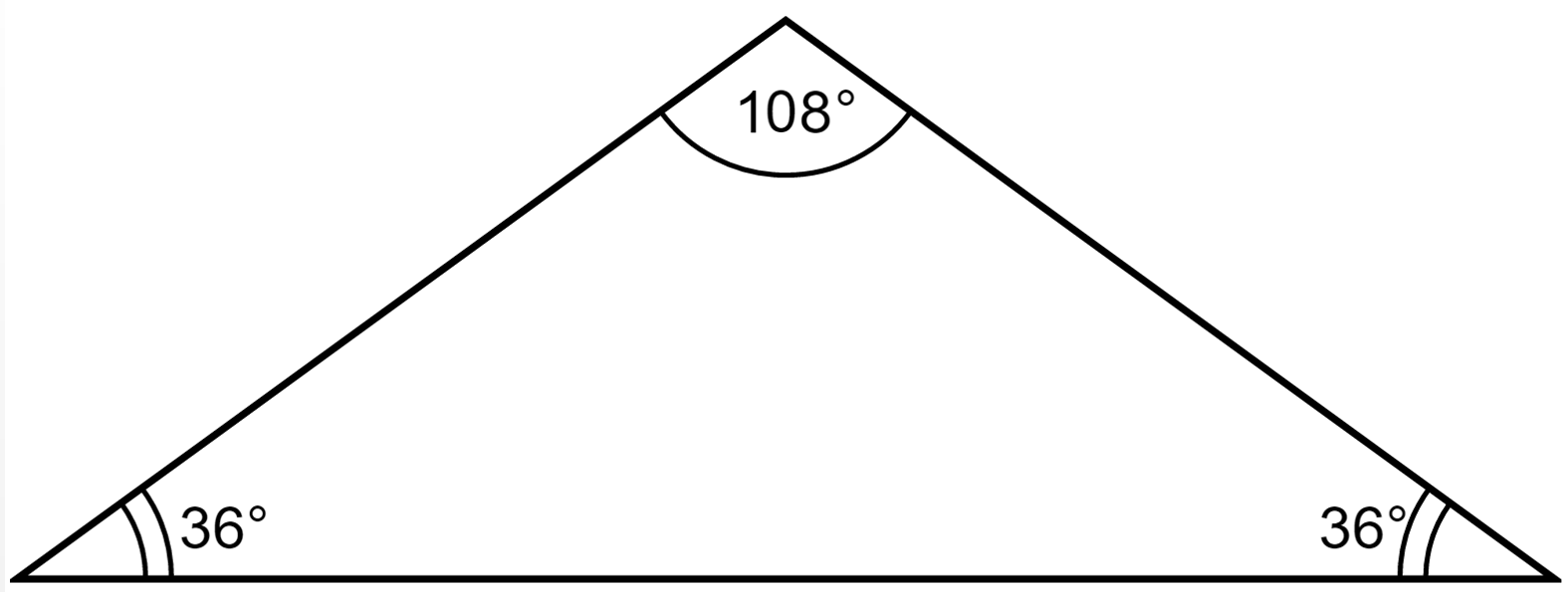
Closely related to the golden triangle is the golden gnomon, which is the isosceles triangle in which the ratio of the equal side lengths to the base length is the reciprocal \tfrac{1}{\varphi} of the golden ratio \varphi.
"The golden triangle has a ratio of base length to side length equal to the golden section φ, whereas the golden gnomon has the ratio of side length to base length equal to the golden section φ."
:{a' \over b'} = {1\over\varphi} = {{\sqrt5 - 1} \over 2} \approx 0.618~034.
Angles
(The distances AX and CX are both a′ = a = φ, and the distance AC is b′ = φ², as seen in the figure.)
- The apex angle AXC is: ::\theta' = 2 \arcsin{b' \over 2a'} = 2 \arcsin{\varphi^2 \over 2\varphi} = 2 \arcsin{1+\sqrt5 \over 4} = {3\pi \over 5}~\text{rad} = 108^\circ. :Hence, the golden gnomon is an obtuse (isosceles) triangle.
:Note: \theta' = \arccos\left(\frac{1-\sqrt5}{4}\right)\text{rad} = {3\pi \over 5}\text{rad} = 108^\circ.
- Since the angles of the triangle AXC sum to \pi radians, each of the base angles CAX and ACX is:
::\beta' = \theta = {\pi - {3\pi \over 5} \over 2}
\text{rad} = {\pi \over 5}\text{rad} = 36^\circ.
:Note: \beta' = \theta = \arccos\left(\frac{1+\sqrt5}{4}\right)\text{rad} = {\pi \over 5}\text{rad} = 36^\circ.
- The golden gnomon is the triangle having its three angles in the ratios 1 : 1 : 3 (namely 36°, 36°, 108°). Its base angles are 36° each, which is the same as the apex angle of the golden triangle.
Bisections
- By bisecting one of its base angles, a golden triangle can be subdivided into a golden triangle and a golden gnomon.
- By trisecting its apex angle, a golden gnomon can be subdivided into a golden triangle and a golden gnomon.
- A golden gnomon and a golden triangle with their equal sides matching each other in length, are also referred to as the obtuse and acute Robinson triangles.
Tilings
- A golden triangle and two golden gnomons tile a regular pentagon.
- These isosceles triangles can be used to produce Penrose tilings. Penrose tiles are made from kites and darts. Such a kite is made from two adjacent golden triangles, and such a dart is made from two adjacent golden gnomons.
References
tags--
References
- Weisstein, Eric W.. "Golden Triangle".
- Weisstein, Eric W.. "Golden Gnomon".
This article was imported from Wikipedia and is available under the Creative Commons Attribution-ShareAlike 4.0 License. Content has been adapted to SurfDoc format. Original contributors can be found on the article history page.
Ask Mako anything about Golden triangle (mathematics) — get instant answers, deeper analysis, and related topics.
Research with MakoFree with your Surf account
Create a free account to save articles, ask Mako questions, and organize your research.
Sign up freeThis content may have been generated or modified by AI. CloudSurf Software LLC is not responsible for the accuracy, completeness, or reliability of AI-generated content. Always verify important information from primary sources.
Report