From Surf Wiki (app.surf) — the open knowledge base
Golden rhombus
Rhombus with diagonals in the golden ratio
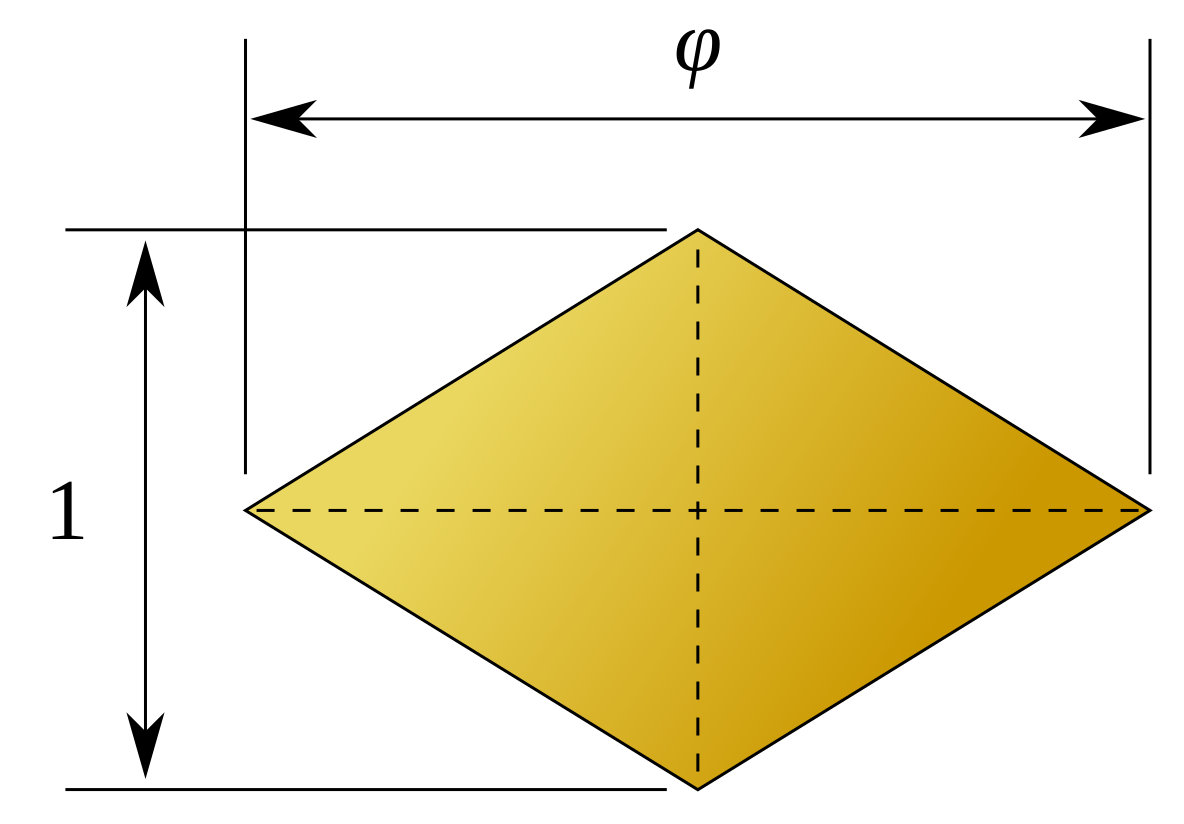
Rhombus with diagonals in the golden ratio
In geometry, a golden rhombus is a rhombus whose diagonals are in the golden ratio:{{citation | editor1-last = Davis | editor1-first = Chandler | editor2-last = Ellers | editor2-first = Erich W. :{D\over d} = \varphi = {{1+\sqrt5}\over2} \approx 1.618~034
Equivalently, it is the Varignon parallelogram formed from the edge midpoints of a golden rectangle. Rhombi with this shape form the faces of several notable polyhedra. The golden rhombus should be distinguished from the two rhombi of the Penrose tiling, which are both related in other ways to the golden ratio but have different shapes than the golden rhombus.For instance, an incorrect identification between the golden rhombus and one of the Penrose rhombi can be found in {{citation
Angles
(See the characterizations and the basic properties of the general rhombus for angle properties.)
The internal supplementary angles of the golden rhombus are:{{citation
- Acute angle: \alpha=2\arctan{1\over\varphi} ; :by using the arctangent addition formula (see inverse trigonometric functions): :\alpha=\arctan=\arctan=\arctan2\approx63.43495^\circ. :
- Obtuse angle: \beta=2\arctan\varphi=\pi-\arctan2\approx116.56505^\circ, :which is also the dihedral angle of the dodecahedron.{{citation :Note: an "anecdotal" equality: \pi- \arctan2=\arctan1+ \arctan3~. :
Edge and diagonals
By using the parallelogram law (see the basic properties of the general rhombus):
The edge length of the golden rhombus in terms of the diagonal length d is:
- a={1\over2}\sqrt{d^2+(\varphi d)^2}={1\over2}\sqrt{1+\varphi^2}~d=\over2}
d={1\over4}\sqrt{10+2\sqrt5}Hence: : The diagonal lengths of the golden rhombus in terms of the edge length a are:d\approx0.95106~d. - d={2a\over\sqrt{2+\varphi}}=2\sqrt~a\approx1.05146~a~. :
- D={2\varphi a\over\sqrt{2+\varphi}}=2\sqrt~a\approx1.70130~a~. :
Area
- By using the area formula of the general rhombus in terms of its diagonal lengths D and d :
:
:The area of the golden rhombus in terms of its diagonal length d is:
:A = {{(\varphi d)\cdot d}\over2} = {{\varphi}\over2}~d^2 = {{1+\sqrt5}\over4}
d^2 \approx 0.80902~d^2. A = (\sin\alpha)a^2 = (\sin(\arctan2))({1\over4}\sqrt{10+2\sqrt5}~d)^2 = {{1+\sqrt5}\over4}d^2. -- - By using the area formula of the general rhombus in terms of its edge length a :
:
:The area of the golden rhombus in terms of its edge length a is:
:A = (\sin(\arctan2))
a^2 = {2\over\sqrt5}(2\sqrt{{3-\varphi}\over5}a^2 \approx 0.89443~a^2. A = {{d\cdot D}\over2} = {1\over2}a)(2\sqrt{{2+\varphi}\over5}a) = {2\sqrt5\over5}. :a^2. -- : Note: \alpha+\beta = \pi , hence: \sin\alpha = \sin\beta
As the faces of polyhedra
Several notable polyhedra have golden rhombi as their faces. They include the two golden rhombohedra (with six faces each), the Bilinski dodecahedron (with 12 faces), the rhombic icosahedron (with 20 faces), the rhombic triacontahedron (with 30 faces), and the nonconvex rhombic hexecontahedron (with 60 faces). The first five of these are the only convex polyhedra with golden rhomb faces, but there exist infinitely many nonconvex polyhedra having this shape for all of their faces.{{citation |url-status = dead |hdl-access= free
File:Acute_golden_rhombohedron.png|Acute golden rhombohedron File:Flat_golden_rhombohedron.png|Obtuse golden rhombohedron File:Bilinski dodecahedron.png|Bilinski dodecahedron File:Rhombic icosahedron.svg|rhombic icosahedron File:Rhombictriacontahedron.svg|rhombic triacontahedron File:Rhombic hexecontahedron.png|rhombic hexecontahedron
References
References
- "Rhombus".
- "Golden Rhombus".
This article was imported from Wikipedia and is available under the Creative Commons Attribution-ShareAlike 4.0 License. Content has been adapted to SurfDoc format. Original contributors can be found on the article history page.
Ask Mako anything about Golden rhombus — get instant answers, deeper analysis, and related topics.
Research with MakoFree with your Surf account
Create a free account to save articles, ask Mako questions, and organize your research.
Sign up freeThis content may have been generated or modified by AI. CloudSurf Software LLC is not responsible for the accuracy, completeness, or reliability of AI-generated content. Always verify important information from primary sources.
Report