From Surf Wiki (app.surf) — the open knowledge base
Gogmagog (giant)
Giant in Welsh and English mythology

Giant in Welsh and English mythology
Gogmagog (also Goemagot, Goemagog, Goëmagot and Gogmagoc) was a legendary giant in the Matter of Britain. According to Geoffrey of Monmouth's Historia Regum Britanniae ("The History of The Kings of Britain", 12th century), he was a giant inhabitant of Cornwall, who was thrown off a cliff during a wrestling match with Corineus (the legendary namesake of Cornwall, and companion of Brutus of Troy).
Later tradition expanded on this story, with Gogmagog described as a descendant of Albina, and the chieftain and largest of the giants found by Brutus and his men inhabiting the land of Albion. The effigies of Gogmagog and Corineus, used in English pageantry and later instituted as guardian statues at Guildhall in London eventually earned the familiar names "Gog and Magog".
Etymology
The name "Gogmagog" is commonly derived from the biblical characters Gog and Magog; however, Peter Roberts, author of an 1811 English translation of the Welsh chronicle Brut Tysilio (itself a translation of Geoffrey of Monmouth's Historia Regum Britanniae), argued that it was a corruption of Cawr-Madog (), supported by Ponticus Virunnius' spelling of the name as Goermagog.
Geoffrey of Monmouth
-vs-giants.jpg)
]] Gogmagog ("Goemagot", "Goemagog") appears in the legend of the founding of Britain as written by Geoffrey of Monmouth in Historia Regum Britanniae (1136). The island of Albion was once inhabited by giants, but their numbers had dwindled and few remained. Gogmagog was one of these last giants, and was slain by Corineus, a member of the invading Trojan colonisers headed by Brutus. Corineus was subsequently granted a piece of land that was named "Cornwall" after him.
The Historia details the encounter as follows: Gogmagog, accompanied by twenty fellow giants, attacked the Trojan settlement and caused great slaughter. The Trojans rallied back and killed all giants, except for "one detestable monster named Gogmagog, in stature twelve cubits, and of such prodigious strength that at one shake he pulled up an oak as if it had been a hazel wand". He is captured so that Corineus can wrestle with him. The giant breaks three of Corineus's ribs, which so enrages him that he picks up the giant and carries him on his shoulders to the top of a high rock, from which he throws the giant down into the sea. The place where he fell was known as "Gogmagog's Leap" to posterity.
Archbishop Michael Joseph Curley suggests that Geoffrey of Monmouth may have been inspired by the giant Antaeus in Lucan's Pharsalia, who was defeated by Hercules in a wrestling match by lifting him from the earth, the source of his strength; both giants lived in caves and gave their names to a place.
Later versions
Gogmagog's combat with Corineus according to Geoffrey was repeated in Wace's Anglo-Norman Brut and Layamon's Middle-English Brut. Because Geoffrey's work was regarded as fact until the late 17th century, the story continued to appear in most early histories of Britain. Some expanded on the Historia, such as John of Hauville's Architrenius (), which describes how "the towering height of Gemagog's twelve cubits, rushing upon them, was enough to terrify the Trojans, until he was overthrown by the strong limbs of Corineus" and goes on to say that before the time of Brutus:
The tale of Gogmagog's ancestry was composed later in the 14th century. Known as the "Albina story" (or Des Grantz Geanz), it claimed Gogmagog to be a giant descended from Albina and her sisters, thirty daughters of the king of Greece exiled to the land later to be known as "Albion". This story was added as a prologue to later versions of Brut pseudo-history.
Thus according to the Middle English prose version of the Brut, known as the Chronicles of England, Albina was the daughter of Syrian king named Diodicias, from whom Gogmagog and Laugherigan and the other giants of Albion are descended. These giants lived in caves and hills until being conquered by Brutus' party arriving in "Tottenesse" (Totnes, Devon). A later chapter describes Gogmagog's combat with Corineus (Middle English: Coryn) "at Totttenes", more or less as according to Geoffrey. Gogmagog was the tallest of these giants; Coryn in comparison was at least the largest man from the waist upward among Brutus's crew. Caxton's printed edition, The Cronycles of Englond (1482), closely matches this content.Caxton (1482), The cronycles of Englond, Prolog and Chapter IV.
Raphael Holinshed also localises the event of the "leape of Gogmagog" at Dover, but William Camden in his 1586 work Brittannia locates it on Plymouth Hoe, perhaps following Richard Carew's Survey of Cornwall. Carew describes "the portraiture of two men, one bigger, the other lesser.. (whom they term "Gogmagog") which was cut upon the ground at the Hawe (i.e. The Hoe) in Plymouth...". These figures were first recorded in 1495 and were destroyed by the construction of the Royal Citadel in 1665.

Michael Drayton's Poly-Olbion preserves the tale as well:
Amongst the ragged Cleeves those monstrous giants sought:
Who (of their dreadful kind) t'appal the Trojans brought Great Gogmagog, an oake that by the roots could teare; So mighty were (that time) the men who lived there: But, for the use of armes he did not understand (Except some rock or tree, that coming next to land, He raised out of the earth to execute his rage), He challenge makes for strength, and offereth there his gage, Which Corin taketh up, to answer by and by, Upon this sonne of earth his utmost power to try.}}
Guardians of London

The Lord Mayor's account of Gogmagog says that the Roman Emperor Diocletian had thirty-three wicked daughters. He found thirty-three husbands for them to curb their wicked ways; they chafed at this, and under the leadership of the eldest sister, Alba, they murdered their husbands. For this crime they were set adrift at sea; they washed ashore on a windswept island, which they named "Albion"—after Alba. Here they coupled with demons and gave birth to a race of giants, whose descendants included Gog and Magog. The effigies of two giants were recorded in 1558 at the coronation of Elizabeth I and were described as "Gogmagot the Albion" and "Corineus the Britain". These, or similar figures, made of "wickerwork and pasteboard" made regular appearances in the Lord Mayor's Show thereafter, although they became known as Gog and Magog over the years. New figures were carved from pine in 1709 by Captain Richard Saunders and displayed in the Guildhall until 1940 when they were destroyed in an air-raid; they were replaced by David Evans in 1953.
Images of Gog and Magog (depicted as giants) are carried before Lord Mayors of the City of London in a traditional procession in the Lord Mayor's Show each year on the second Saturday of November.
In French literature
Under the influence of Geoffrey's Gogmagog (Goemagot), Gos et Magos, the French rendition of "Gog and Magog", were recast in the role of enemies defeated by the giant Gargantua, and taken prisoner to King Arthur who held court in London in Rabelais's Gargantua (1534). Gargantua's son Pantagruel also had an ancestor named Gemmagog, whose name was also a corruption of "Gog and Magog", influenced by the British legend.
In Irish folklore
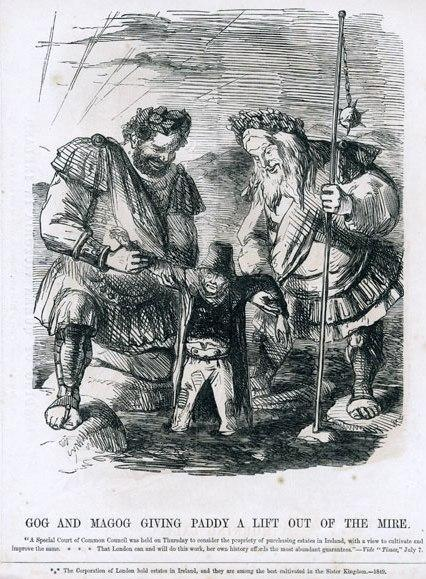
Works of Irish mythology, including the Lebor Gabála Érenn (the Book of Invasions), expand on Magog and make him the ancestor of Irish through Partholón, leader of the first group to colonise Ireland after the Deluge, and a descendant of Magog, as also were the Milesians, the people of the fifth invasion of Ireland. Magog was also the progenitor of the Scythians, as well as of numerous other races across Europe and Central Asia.
Explanatory notes
References
;Bibliography
References
- (1811). "The Chronicle of the Kings of Britain". E. Williams.
- Tysilio. (1862). "A history of the kings of ancient Britain, from Brutus to Cadwaladr". Simpkin, Marshall.
- Cooper, Wm R. (2002). "The Chronicle of the Early Britons - Brut y Bryttaniait - according to Jesus College MS LXI".
- {{Harvp. Geoffrey of Monmouth. Giles tr. 1842
- {{Harvp. Geoffrey of Monmouth. Giles tr. 1842
- {{Harvp. Geoffrey of Monmouth. Griscom tr. 1929
- Curley, Michael J.. (1994). "Geoffrey of Monmouth". Twayne Publishers.
- (1994). "Architrenius". Cambridge University Press.
- (1994). "Architrenius". Cambridge University Press.
- (2004). "Myths & Legends of the British Isles". Boydell Press.
- {{Harvp. Bernau. 2007
- {{harvp. Brie. 1906–1908
- {{harvp. Brie. 1906–1908
- (2013). "The Oxford Handbook of Holinshed's Chronicles". OUP Oxford.
- {{harvp. Harper. 1910
- {{harvp. Harper. 1910
- (1903). "The Giants: Corineus and Gogmagog". Popular Romances of the West of England.
- [http://www.lordmayorsshow.org/visitors/history/gogmagog Gog and Magog] at the Lord Mayor's Show: official website. Retrieved August 3, 2007.
- Ward-Jackson, Philip. (2003). "Public sculpture of the city of London". Liverpool University Press.
- Stephens, Walter. (1989). "Giants in Those Days: Folklore, Ancient History, and Nationalism". University of Nebraska Press.
- {{harvp. Rose. 2001
- {{harvp. Rose. 2001
- (1934). "Gargantua and Pantagruel". Oxford University Press.
- (1929). "All the extant works of Franc̜ois Rabelais: an American translation".
- (2003). "Daniel O'Connell, the British Press, and the Irish Famine". Ashgate.
- Heller, Jason. "Deeper Into Music With Glenn Danzig | Music | Interview". The A.V. Club.
This article was imported from Wikipedia and is available under the Creative Commons Attribution-ShareAlike 4.0 License. Content has been adapted to SurfDoc format. Original contributors can be found on the article history page.
Ask Mako anything about Gogmagog (giant) — get instant answers, deeper analysis, and related topics.
Research with MakoFree with your Surf account
Create a free account to save articles, ask Mako questions, and organize your research.
Sign up freeThis content may have been generated or modified by AI. CloudSurf Software LLC is not responsible for the accuracy, completeness, or reliability of AI-generated content. Always verify important information from primary sources.
Report