From Surf Wiki (app.surf) — the open knowledge base
Goethite
Iron(III) oxide-hydroxide named in honor to the poet Goethe
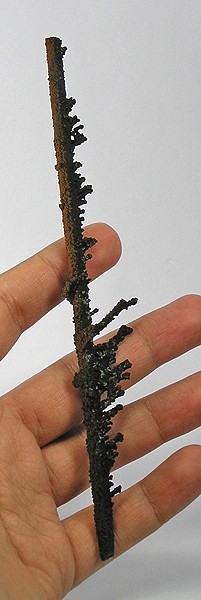
Iron(III) oxide-hydroxide named in honor to the poet Goethe
| Field | Value |
|---|---|
| name | Goethite |
| category | oxide minerals hydroxide subgroup |
| image | Goethite-169735.jpg |
| formula | α-FeO(OH) |
| IMAsymbol | Gth |
| strunz | 4.FD.10 |
| system | Orthorhombic |
| class | Dipyramidal (mmm) |
| H–M symbol: (2/m 2/m 2/m) | |
| symmetry | Pbnm |
| color | Yellowish to reddish to dark brown or black |
| habit | Radial acicular, mammillary, botryoidal, stalactitic, massive, as encrustation, as pseudomorph; may be banded or iridescent |
| cleavage | Perfect {010} |
| fracture | Uneven to splintery |
| mohs | 5.0–5.5 |
| luster | Adamantine to dull |
| refractive | Opaque to sub-translucent |
| streak | Brown, brownish yellow to orange yellow |
| gravity | 3.3–4.3 |
| fusibility | Fusible at 5–5.5 |
| solubility | HCl soluble |
| other | weakly magnetic |
| references |
H–M symbol: (2/m 2/m 2/m)
Goethite (, ) is a mineral of the diaspore group, consisting of iron(III) oxide-hydroxide, specifically the α-polymorph. It is found in soil and other low-temperature environments such as sediment. Goethite has been well known since ancient times for its use as a pigment (brown ochre). Evidence has been found of its use in paint pigment samples taken from the caves of Lascaux in France. It was first described in 1806 based on samples found in the Hollertszug Mine in Herdorf, Germany. The mineral was named after the German polymath and poet Johann Wolfgang von Goethe (1749–1832).
Composition
Goethite is an iron oxyhydroxide containing ferric iron. It is the main component of rust and bog iron ore. Goethite's hardness ranges from 5.0 to 5.5 on the Mohs Scale, and its specific gravity varies from 3.3 to 4.3. The mineral forms prismatic needle-like crystals ("needle ironstone") but is more typically massive.
Feroxyhyte and lepidocrocite are both polymorphs of the iron oxyhydroxide FeO(OH) which are stable at the pressure and temperature conditions of the Earth's surface. Although they have the same chemical formula as goethite, their different crystalline structures make them distinct minerals.
Additionally, goethite has several high-pressure and high-temperature polymorphs, which may be relevant to the conditions of the Earth's interior. These include ε-FeOOH, which has an orthorhombic crystal structure, a cubic pyrite-type polymorph with or without losing hydrogen and an ultradense hexagonal structure.
Goethite has the same crystal structure as diaspore, the analogous aluminium oxide-hydroxide mineral. Oxygen and hydroxide ions form a hexagonal close-packed structure, with iron ions filling octahedral sites between the anions. The sites filled by iron ions form paired chains running the length of the crystal, with the two chains in each pair joined by hydroxide ions.
File:Goethite c.png|The goethite crystal structure viewed along [001]. Red ions are iron, white are oxygen, and yellow are hydroxide. File:Goethite b.png|The goethite crystal structure viewed along [010]
Formation

Goethite often forms through the weathering of other iron-rich minerals, and thus is a common component of soils, concentrated in laterite soils. Nanoparticulate authigenic goethite is a common diagenetic iron oxyhydroxide in both marine and lake sediments. The formation of goethite is marked by the oxidation state change of Fe2+ (ferrous) to Fe3+ (ferric), which allows for goethite to exist at surface conditions. Because of this oxidation state change, goethite is commonly seen as a pseudomorph. As iron-bearing minerals are brought to the zone of oxidation within the soil, the iron turns from iron(II) to iron(III), while the original shape of the parent mineral is retained. Common goethite pseudomorphs include pyrite, siderite, and marcasite, though any iron(II)-bearing mineral could become a goethite pseudomorph if proper conditions are met. It may also be precipitated by groundwater or in other sedimentary conditions, or form as a primary mineral in hydrothermal deposits. Goethite has also been found to be produced by the excretion processes of certain bacteria types.
Distribution
Goethite is found all over the planet, usually in the form of concretions, stalactitic formations, oolites (a form consisting of tiny round grains cemented together),
Significant deposits of goethite are found in England; Cuba; and Minnesota, Missouri, Colorado, Alabama, Georgia, Virginia, and Tennessee, in the United States.
Deposits significant in location, if not in abundance, have been found in the Martian crater Gusev by NASA's Spirit rover, providing strong evidence for the presence of liquid water on the planet in an earlier stage of its evolution.
Limpets' teeth are composed of about 80% goethite fibres of only tens of nanometers in diameter, small enough to be flaw-insensitive, which accounts for their extreme tensile strength of 3.5–6.0 GPa and elastic modulus of .{{Cite journal |doi-access=free
Usage
Its main modern use is as an iron ore, being referred to as brown iron ore. and has been heat-treated for use as a red pigment since Paleolithic times. Iron-rich lateritic soils that have developed over serpentinite rocks in tropical climates are mined for their iron content, as well as other metals.
Fine goethite specimens are rare and therefore are valued collectibles.
In a royal tomb of the ancient kingdom of Phrygia, a body was found believed to be King Gordias, father of the legendary King Midas. The burial shroud had been colored with a dye containing goethite, which in its original un-faded state would have made the shroud look as though it were woven from gold. Historians speculate that the legend of King Midas' golden touch might have originated from Phrygian royalty wearing clothes made from such golden-colored textiles.
Gallery
File:Goethite-242608.jpg|Iridescent goethite, Filón Sur Mine, Tharsis, Huelva, Spain File:Goethite3.jpg|Goethite from Minas Gerais, Brazil File:Goethite-Calcite-Feldspar-Group-215498.jpg|A sharp, disc-shaped calcite has here been completely replaced by goethite, which preserved the original form perfectly File:PyOx.JPG|Goethite coating/replacing rusted pyrite cubes File:Goethite-162473.jpg|Finely crystallized specimen of goethite from Lake George, Park County, Colorado, US File:Harvard Museum of Natural History. Goethite. Negaunee, Marquette Co., MI (DerHexer) 2012-07-20.jpg|Goethite from Negaunee, Marquette County, Michigan
References
References
- Warr, L.N.. (2021). "IMA–CNMNC approved mineral symbols". Mineralogical Magazine.
- (1985). "Manual of Mineralogy". Wiley.
- (2012). "Goethite Mineral Data".
- "Goethite".
- (2005). "Goethite". Mineral Data Publishing.
- "goethite". [[Oxford University Press]].
- {{cite Merriam-Webster. goethite
- {{cite Dictionary.com. goethite
- {{cite American Heritage Dictionary. goethite
- (2010). "High-pressure X-ray diffraction study of ε-FeOOH". Physics and Chemistry of Minerals.
- (2016). "FeO2 and FeOOH under deep lower-mantle conditions and Earth's oxygen–hydrogen cycles". Nature.
- (2017). "The pyrite-type high-pressure form of ε-FeOOH". Nature.
- (2017). "Discovery of a hexagonal ultradense hydrous phase in (Fe,Al)OOH". Proceedings of the National Academy of Sciences of the United States of America.
- (2003). "Nanogoethite is the dominant reactive oxyhydroxide phase in lake and marine sediments". Geology.
- (2010). "Biomineralization of lepidocrocite and goethite by nitrate-reducing Fe(II)-oxidizing bacteria: Effect of pH, bicarbonate, phosphate, and humic acids". Geochimica et Cosmochimica Acta.
- (1964). "Mineralogy for amateurs.". Van Nostrand.
- (November 2005). "Mössbauer spectroscopy on Mars: goethite in the Columbia Hills at Gusev crater". Hyperfine Interactions.
- Webb, Jonathan. (18 February 2015). "Limpet teeth set new strength record". [[BBC]] News.
- (October 2018). "Heat Treatment of Mineral Pigment During the Upper Palaeolithic in North-East Italy: Heat treatment of mineral pigment during the Upper Palaeolithic". Archaeometry.
- (1 May 1941). "Origin of the Surigao iron ores". Economic Geology.
- (October 1968). "Notes on Rare and Unusual New England Gemstones". Rocks & Minerals.
- (2012). "The archaeology of Phrygian Gordion, royal city of Midas". University of Pennsylvania Museum of Archaeology and Anthropology.
- "Great Myths and Legends: The Golden Age of King Midas". Penn Museum.
This article was imported from Wikipedia and is available under the Creative Commons Attribution-ShareAlike 4.0 License. Content has been adapted to SurfDoc format. Original contributors can be found on the article history page.
Ask Mako anything about Goethite — get instant answers, deeper analysis, and related topics.
Research with MakoFree with your Surf account
Create a free account to save articles, ask Mako questions, and organize your research.
Sign up freeThis content may have been generated or modified by AI. CloudSurf Software LLC is not responsible for the accuracy, completeness, or reliability of AI-generated content. Always verify important information from primary sources.
Report