From Surf Wiki (app.surf) — the open knowledge base
Glovebox
Sealed container with gloves in the side for manipulating the objects inside
Sealed container with gloves in the side for manipulating the objects inside
| Field | Value |
|---|---|
| name | Glovebox |
| image | Glovebox.jpg |
| alt | |
| caption | An ordinary glovebox, showing the two gloves for manipulation, with airlock on the right |
| other_names | Isolator |
| uses | Inert atmosphere work |
| Hazardous materials work | |
| related | Desiccator |
| Schlenk line |
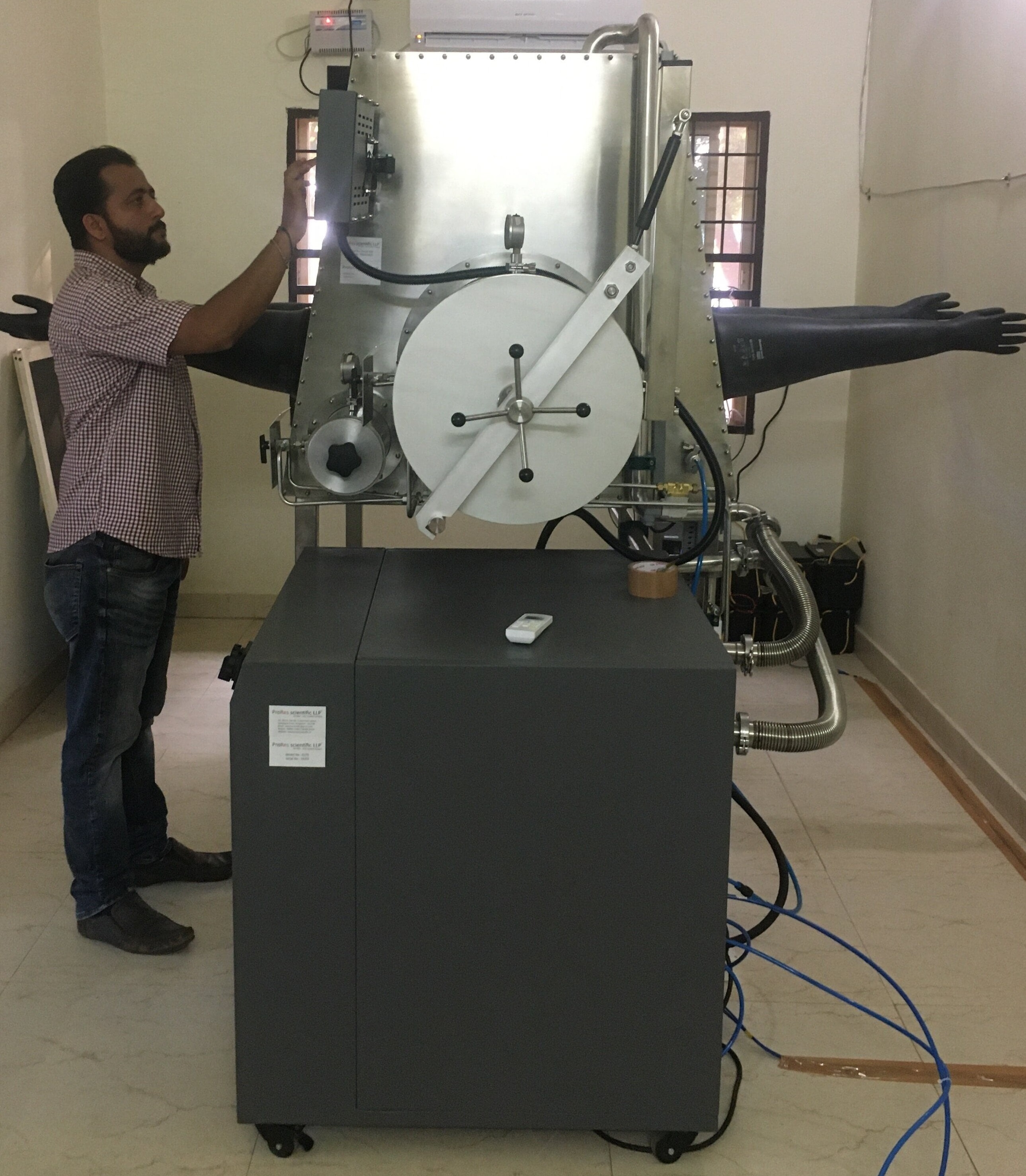
Hazardous materials work Schlenk line A glovebox (or glove box) is a sealed container that is designed to allow one to manipulate objects where a separate atmosphere is desired. Built into the sides of the glovebox are gloves arranged in such a way that the user can place their hands into the gloves and perform tasks inside the box without breaking containment. Part or all of the box is usually transparent to allow the user to see what is being manipulated. A smaller antechamber compartment is used to transport items into or out of the main chamber without compromising the internal environment. Antechambers are much smaller than the main chambers so they can be exposed to ambient conditions more often and achieve inert conditions quickly.
Two types of gloveboxes exist. The first allows a person to work with hazardous substances, such as radioactive materials or infectious disease agents, and the second allows manipulation of substances that must be contained within a very high purity inert atmosphere, such as argon or nitrogen. It is also possible to use a glovebox for manipulation of items in a vacuum chamber.
Inert atmosphere work
An inert gas glovebox is a system that allows users to work in inert atmospheres. The gas in a glovebox is either provided from a pure source or is pumped through a series of treatment devices which remove solvents, water and oxygen from the gas. Copper metal (or some other finely divided metal) is commonly used to remove oxygen, this oxygen removing column is normally regenerated by passing a hydrogen/nitrogen mixture through it while it is heated: the water formed is passed out of the box with the excess hydrogen and nitrogen. It is common to use molecular sieves to remove water by absorbing it in the molecular sieves' pores. Such a box is often used by organometallic chemists to transfer dry solids from one container to another container.
An alternative to using a glovebox for air sensitive work is to employ Schlenk methods using a Schlenk line. One disadvantage of working in a glovebox is that organic solvents will attack the plastic seals. As a result, the box will start to leak and water and oxygen can then enter the box. Another disadvantage of a glovebox is that oxygen and water can diffuse through the plastic gloves. Also, coordinating solvents, such as tetrahydrofuran and dichloromethane, can bind irreversibly to the copper catalyst, reducing its effectiveness. One way to prolong the lifespan of the glovebox and catalyst is to turn off circulation when using solvents, followed by purging when work involving solvents is finished.
Inert atmosphere gloveboxes are typically kept at a higher pressure than the surrounding air, so that any microscopic leaks are mostly leaking inert gas out of the box instead of letting air in. There are now open source hardware plans for medium performance inert gas glove boxes (e.g., able to reduce oxygen to
Hazardous materials work
At the now-deactivated Rocky Flats Plant, which manufactured plutonium triggers, also called "pits", production facilities consisted of linked stainless steel gloveboxes up to 64 feet, or 20 meters, in length, which contained the equipment which forged and machined the trigger parts. The gloves were lead-lined. Other materials used in the gloveboxes included acrylic viewing windows and Benelex shielding composed of wood fiber and plastic which shielded against neutron radiation. Manipulation of the lead-lined gloves was onerous work.
Some gloveboxes for radioactive work are under inert conditions, for instance, one nitrogen-filled box contains an argon-filled box. The argon box is fitted with a gas treatment system to keep the gas very pure to enable electrochemical experiments in molten salts.
Gloveboxes are also used in the biological sciences when dealing with anaerobes or high-biosafety level pathogens.
Gloveboxes used for hazardous materials are generally maintained at a lower pressure than the surrounding atmosphere, so that microscopic leaks result in air intake rather than hazard outflow. Gloveboxes used for hazardous materials generally incorporate HEPA filters into the exhaust, to keep the hazard contained.
Gallery
File:Vacuum Dry Box.jpg|Metal glovebox for handling dangerous substances in vacuum, with extra protection against explosions or implosions File:S Krikalev with miniglovebox.jpg|Sergei Krikalev working with a portable glovebox at the International Space Station File:Glovebox INL.jpg|Multiple-port glovebox allowing access by several operators from different sides File:Argonne's Tribology Lab - Hydrogen Tribometer.jpg|A glovebox-like shield built around an experimental setup File:NNSA-NSO-58.jpg|Large scale glovebox in the nuclear industry File:Scientist using a glovebox.jpg|A scientist in UCL Chemical Engineering uses a glovebox to manipulate a sample File:Glovebox at Gdansk University of Technology.jpg|Glovebox with microscope and airlock File:GB II glove box.jpg|Nano Material handling glove box File:ProRes PB II glovebox.jpg|Inert glovebox using for pharmaceutical application (hygroscopic samples weighing and packing) File:Maarja Paalo uses a glovebox.jpg|Supercapacitor test cell assembly in an argon dry chamber. Modern supercapacitors work with an organic electrolyte that must be protected from moisture. Therefore, the supercapacitor was filled with electrolyte in a dry chamber in high purity argon environment
References
References
- "Antechamber of a Glove Box".
- Maryam, Mottaghi. (December 2025). "Open source inert gas glove box". HardwareX.
- link. (2012-02-05 . jrc.ec.europa.eu)
This article was imported from Wikipedia and is available under the Creative Commons Attribution-ShareAlike 4.0 License. Content has been adapted to SurfDoc format. Original contributors can be found on the article history page.
Ask Mako anything about Glovebox — get instant answers, deeper analysis, and related topics.
Research with MakoFree with your Surf account
Create a free account to save articles, ask Mako questions, and organize your research.
Sign up freeThis content may have been generated or modified by AI. CloudSurf Software LLC is not responsible for the accuracy, completeness, or reliability of AI-generated content. Always verify important information from primary sources.
Report