From Surf Wiki (app.surf) — the open knowledge base
Glock
Series of pistols

Series of pistols
| Field | Value | |||||||
|---|---|---|---|---|---|---|---|---|
| name | Glock | |||||||
| image | Glock 17 (6825676904) без фона.jpg | |||||||
| image_size | 300 | |||||||
| caption | A first-generation Glock 17 adopted by the Norwegian Armed Forces under the P80 designation | |||||||
| origin | Austria | |||||||
| type | {{bulleted list | |||||||
| is_ranged | yes | |||||||
| service | 1982–present | |||||||
| used_by | See Users | |||||||
| wars | ||||||||
| * Kurdish–Turkish conflict<ref>{{cite news | last1 | Şafak | first1=Yeni | title=PKK'ya ait silahlar ele geçirildi | url=https://www.yenisafak.com/gundem/pkkya-ait-silahlar-ele-gecirildi-2540663 | access-date=24 June 2023 | work=Yeni Şafak | language=tr-TR}} |
| ** Russian invasion of Ukraine<ref>{{cite web | url | https://www.thedrive.com/the-war-zone/ukraine-situation-report-a-peak-into-prigozhins-bizarre-pad | title=Ukraine Situation Report: A Peek Into Prigozhin's Bizarre Pad | date=July 5, 2023 | author=Howard Altman | archiveurl=https://web.archive.org/web/20230708031739/https://www.thedrive.com/the-war-zone/ukraine-situation-report-a-peak-into-prigozhins-bizarre-pad | archive-date=July 8, 2023 | quote=According to Fontanka, two Saiga carbines, an Austrian Stey carbine, an Arka semi-automatic rifle, and several other rifles and pistols were among the items returned to Prighozin. The most revered of all those weapons, however, was a Glock pistol Prigozhin was awarded by Russian Defense Minister Sergei Shoigu, according to Fontanka.}} |
| * 2024 conflict in Ecuador<ref>{{cite tweet | user | war_noir | number=1744852566477783178 | title=#Ecuador 🇪🇨: A recent footage shows armed members of the criminal groups shooting at a Police car during the recent conflicts. The perpetrators are armed with various pistols including a Glock pistol (possibly Glock 19 Gen 3) with extended magazine}} | ||||
| designer | Gaston Glock | |||||||
| design_date | 1979–1982 | |||||||
| manufacturer | Glock GmbH | |||||||
| production_date | 1982–present | |||||||
| number | 20,000,000 as of 2020 | |||||||
| variants | See Variants | |||||||
| cartridge | {{plainlist | |||||||
| action | Short recoil, locked breech, tilting barrel (straight blowback for Glock 25, 28 and 44) | |||||||
| rate | 1,100–1,400 rounds/min (Glock 18) | |||||||
| velocity | 375 m/s (Glock 17, 17C, 18, 18C) | |||||||
| range | 50 m (Glock 17, 17C, 18, 18C) | |||||||
| feed | 6-, 10-, 13-, 15-, 17-, 19-, 24-, 25-, 31-, 33-, or 40-round detachable box magazine, or 50- or 100-round detachable drum magazine |
the semi-automatic pistol
Semi-automatic pistol |Machine pistol (Glock 18)}}
- Kurdish–Turkish conflict
- War in Afghanistan
- Iraq War
- Mexican drug war
- Syrian Civil War
- War in Iraq
- Russo-Ukrainian War
- Russian invasion of Ukraine
- 2024 conflict in Ecuador
- 9×19mm Parabellum
- 10mm Auto
- .22 LR
- .357 SIG
- .380 ACP
- .40 S&W
- .45 ACP
- .45 GAP
Glock (; stylized as GLOCK) is a brand of polymer-framed, short-recoil-operated, locked-breech semi-automatic pistols designed and produced by Austrian manufacturer Glock Ges.m.b.H.. The firearm, designed by company founder Gaston Glock (1929–2023), entered Austrian military and police service in 1982 as the P80 (later known commercially as the Glock 17) after outperforming established competitors in reliability and safety tests. Despite initial market resistance to its "plastic" construction, the Glock became the first commercially successful line of pistols with a polymer frame.
The weapon utilizes the company's proprietary "Safe Action" system, which consists of three internal independent safety mechanisms: the trigger safety, firing pin safety, and drop safety. These mechanisms prevent accidental discharge without the use of an external on-off switch. The pistols are also noted for their high magazine capacity relative to their weight and their resistance to corrosion, originally achieved through a ferritic nitrocarburizing surface treatment known as Tenifer.
Glock pistols have become the company's most profitable line of products. They are supplied to national armed forces, security agencies, and police forces in at least 48 countries, including the Federal Bureau of Investigation (FBI) and the majority of police agencies in the United States. The product line has evolved through five generations of design changes ("Gen 1" through "Gen 5") and is available in a wide variety of calibers, including 9×19mm Parabellum, .40 S&W, 10mm Auto, and .45 ACP, as well as various sizes ranging from the full-sized Glock 17 to the subcompact Glock 26 and "slimline" Glock 43.
The widespread adoption of the design has made the Glock rise in popularity and a subject of gun control debates. In the 2020s, the pistols faced scrutiny regarding the proliferation of "Glock switches," illegal aftermarket auto sears that convert the firearms into machine pistols. This led to lawsuits filed by the states of Minnesota and New Jersey in 2024, and legislation in California in 2025 (Assembly Bill 1127), aimed at forcing design changes to prevent such conversions. In October 2025, Glock announced a major "right-sizing" initiative, ceasing production of over thirty variants to streamline manufacturing and introduce redesigned components to mitigate full-auto conversion.
History
The company's founder and head engineer, Gaston Glock (1929–2023), had no experience with firearms design or manufacture at the time his first pistol, the Glock17, was being prototyped. Glock had extensive experience in advanced synthetic polymers, which was instrumental in the company's design of the first commercially successful line of pistols with a polymer frame. Glock introduced ferritic nitrocarburizing into the firearms industry as an anticorrosion surface treatment for metal gun parts.
Development
In 1980, the Austrian Armed Forces announced that it would seek tenders for a new, modern duty pistol to replace their World War II–era Walther P38 handguns. The Federal Ministry of Defence of Austria formulated a list of 17 criteria for the new generation service pistol, including requirements that it would be self loading; fire the NATO-standard 9×19mm Parabellum round; the magazines would not require any means of assistance for loading; not be subject to accidental discharge from shock, strike, and drop from a height of 2 m onto a steel plate. After firing 15,000 rounds of standard ammunition, the pistol was to be inspected for wear. The pistol was to then be used to fire an overpressure test cartridge generating 5000 bar. The normal maximum operating pressure (Pmax) for the 9 mm NATO is 2520 bar.
Glock became aware of the Austrian Army's planned procurement, and in 1982, assembled a team of Europe's leading handgun experts from military, police, and civilian sport-shooting circles to define the most desirable characteristics in a combat pistol. Within three months, Glock had developed a working prototype that combined proven mechanisms and traits from previous pistol designs. In addition, the plan was to make extensive use of synthetic materials and modern manufacturing technologies, which led to the Glock17 becoming a cost-effective candidate.
Several samples of the Glock17 (so named corresponding to its magazine capacity or because it was the 17th patent procured by the company) were submitted for assessment trials in early 1982, and after passing all of the exhaustive endurance and abuse tests, the Glock emerged as the winner. According to Friedrich Dechant, former head of the Austrian Armaments and Defence Technology Agency, the Glock P80 was clearly superior to other handguns in terms of performance, handling, charging capacity and price.
The handgun was adopted into service with the Austrian military and law enforcement in 1982 as the Pistole 80 (P80), with an initial order for 25,000 guns. The Glock17 outperformed eight different pistols from five other established manufacturers (Heckler & Koch of Germany offered their P7M8, P7M13, and P9S, SIG Sauer of Switzerland bid with their P220 and P226 models, Beretta of Italy submitted their model 92SB-F, FN Herstal of Belgium proposed an updated variant of the Browning Hi-Power, and the Austrian Steyr Mannlicher entered the competition with the GB).
The results of the Austrian trials sparked a wave of interest in Western Europe and overseas, particularly in the United States, where a similar effort to select a service-wide replacement for the M1911 had been going on since the late 1970s (known as the Joint Service Small Arms Program). In late 1983, the United States Department of Defense inquired about the Glock pistol and received four samples of the Glock17 for unofficial evaluation. Glock was then invited to participate in the XM9 Personal Defense Pistol Trials, but declined because the DOD specifications would require extensive retooling of production equipment and providing 35 test samples in an unrealistic time frame.
In 1985, after joint Norwegian and Swedish trials from 1983 to 1985, the Glock17 was accepted into service as the P80 in Norway, and in 1988 as the Pistol 88 in Sweden, where it surpassed all prior NATO durability standards. As a result, the Glock17 became a standard NATO-classified sidearm and was granted a NATO Stock Number (1005-25-133-6775). By 1992, some 350,000pistols had been sold in more than 45countries, including 250,000 in the United States alone.
Starting in 2013, the British Armed Forces began replacing the Browning Hi-Power pistol with the Glock17Gen4, due to concerns about weight and the external safety of the Hi-Power. The British preferred the Glock17Gen4 over the Beretta Px4 Storm, FN FNP, Heckler & Koch P30, SIG Sauer P226, Smith & Wesson M&P, and Steyr M9A1 of which 19 pistols each, all chambered in 9×19mmParabellum, were entered in the R9GSP trials.
The French Armed Forces (FAF) in 2020 began replacing their MAC Mle 1950 and, to a lesser extent, their PAMAS G1 pistols with Glock17Gen5 models specifically made for the FAF. The French preferred the Glock17Gen5 over the HS2000 and CZ P-10 offerings that also made it to the final selection phase.
Product evolution
Glock has updated its basic design several times throughout its production history.
First-generation models
The first-generation (Gen 1) Glock pistols are most notably recognized by their smoother "pebble finish" grip and finger groove-less frames. The Gen 1 frame pattern and design was used by Glock from 1982 through 1988 and pre-dates the checkered grip patterns used in the second generation of Glock pistols. The first Glock17s imported to the US were serialized with an alphanumeric (two-letter prefix followed by three numbers) stamped into the slide, barrel, and a small metal plate inserted into the bottom side of the polymer frame. The first documented Glock17s (by serial number) imported into the US were from the AF000series in January 1986, followed by AH000, AK000, and AL000. These early Glock(Gen 1) pistols (serial number prefixAF through AM) were also manufactured with a barrel that had a smaller overall diameter and thinner bore walls, later known as "pencil barrels". The barrels were later redesigned with thicker bore walls, and manufacturing continued to evolve and improve the design of Glock pistols.
Many of the first-generation Glocks were shipped and sold in the iconic "Tupperware" style plastic boxes. The earliest Glock boxes had ammunition storage compartments that allowed for 17 rounds of 9mm to be stored with the pistol. This box design was later changed by Glock to meet BATF import requirements, and the ammunition storage compartments were removed.
Second-generation models

A mid-life upgrade to the Glock pistols involved the addition of checkering on the front strap and trigger guard and checkering and serrations to the back strap. These versions, introduced in 1988, were informally referred to as "second-generation" or Gen2 models, though Glock did not mark the pistols Gen2. In 1991, an integrated recoil spring assembly replaced the original two-piece recoil spring and tube design. The magazine was slightly modified, changing the floorplate and fitting the follower spring with a resistance insert at its base.
Third-generation models

In 1998, the frame was further modified with an accessory rail (called the "Universal Glock rail") similar to a Picatinny rail to allow the mounting of laser sights, tactical lights, and other accessories. Thumb rests on both sides of the frame and finger grooves on the front strap were added. Glock pistols with these upgrades are informally referred to as (early) "third-generation" models. Later third-generation models additionally featured a modified extractor that serves as a loaded chamber indicator, and the locking block was enlarged, along with the addition of an extra cross pin to aid the distribution of bolt thrust forces exerted by the locking block. This cross pin is known as the locking block pin and is located above the trigger pin.
The polymer frames of third-generation models can be black, flat dark earth, or olive drab. Besides that, non-firing dummy pistols ("P"models) and non-firing dummy pistols with resetting triggers ("R"models) have a bright red frame, and Simunition-adapted practice pistols ("T"models) a bright blue frame for easy identification.
In 2009, the Glock22RTF2 (Rough Textured Frame 2) (chambered in .40 S&W) was introduced. This pistol featured a new checkering texture around the grip and new scalloped (fish gill-shaped) serrations at the rear of the sides of the slide. Many of the existing models became available in the RTF2version, including the 17, 31, 32, 23, 21, and 19. Some of those did not have the fish gills.
Fourth-generation models


At the 2010 SHOT Show, Glock presented the "fourth generation", now dubbed "Gen4" by Glock itself. Updates centered on ergonomics and the recoil spring assembly. The initial two fourth-generation models announced were the full-sized Glock 17 and Glock 22, chambered for the 9×19mm Parabellum and .40 S&W cartridges, respectively. The pistols were displayed with a modified rough-textured frame (RTF-4), front grip strap with finger grooves, interchangeable backstraps of different sizes, and an accessory rail. "Gen4" is on the slide next to the model number to identify the fourth-generation pistols.
The basic grip size of the fourth-generation Glock pistols is slightly smaller compared to the previous design. A punch is provided to remove the standard trigger housing pin and replace it with the longer cross pin needed to mount the medium or large backstrap that will increase the trigger distance by 2 mm or 4 mm. With the medium backstrap installed, the grip size is identical to the third-generation pistols. The magazine release catches are enlarged and reversible for left-handed use. To use the exchangeable magazine release feature, fourth-generation Glock magazines have a notch cut on both sides of the magazine body. Earlier versions of the magazines will not lock into the Gen4 pistols if the user has moved the magazine release button to be operated by a left-handed user. Gen4 magazines will work in older models.
Mechanically, fourth-generation Glock pistols are fitted with a dual recoil spring assembly to help reduce perceived recoil and increase service life expectancy. Earlier subcompact Glock models such as the Glock 26 and Glock 30 have already used a dual recoil spring assembly that was carried over to the fourth-generation versions of those models. The slide and barrel shelf have been resized, and the front portion of the polymer frame has been widened and internally enlarged, to accommodate the dual recoil spring assembly. The trigger mechanism housing has also been modified to fit into the smaller-sized grip space.
The introduction of fourth-generation Glock pistols continued in July 2010 when the Glock 19 and Glock 23, the reduced size "compact" versions of the Glock 17 and Glock 22, became available for retail. In late 2010, Glock continued the introduction of fourth-generation models with the Glock 26 and Glock 27 "subcompact" variants.
In January 2013, more fourth-generation Glock pistols were introduced commercially during the annual SHOT Show, including the Glock 20 Generation 4 along with other fourth-generation Glock models.
2011 recoil spring assembly exchange program
In September 2011, Glock announced a recoil spring exchange program in which the manufacturer voluntarily offers to exchange the recoil spring assemblies of its fourth-generation pistols (with the exception of the "subcompact" Glock 26 and Glock 27 models) sold before 22 July 2011 at no cost "to ensure our products perform up to GLOCK's stringent standards", according to the company.
M series
On 29 June 2016, the United States Federal Bureau of Investigation (FBI) awarded a contract to Glock to provide new 9×19mm Parabellum chambered duty pistols. The solicitation specifications deviated from the specifications of Glock fourth-generation models. Features found in the M series pistols evolved into what become Glock's Fifth Generation or Gen5 pistols.
In August 2016, the Indianapolis Metro Police Department (IMPD) started training with a batch of Glock 17M pistols. The most obvious difference with the Glock third- and fourth-generation models on published images is the omission of finger grooves on the grip. In October of that year, the IMPD issued a 17M voluntary recall following failures encountered while dry firing the pistols during training. According to Major Riddle with the IMPD, "Glock is working to correct the problem and we hope to begin issuing the new [17Ms] as soon as December."
Fifth-generation models

In August 2017, Glock presented the "fifth generation" or "Gen 5". The revisions centered on ergonomics and improving reliability. Many parts of fifth-generation Glock pistols cannot be interchanged with those of the previous generations. The two fifth-generation models announced were the Glock 17 and Glock 19, chambered for the 9×19mm Parabellum. Some conspicuous changes on the fifth-generation models are ambidextrous slide stop levers, DLC surface finish for barrel and slide, a barrel featuring a revised style of polygonal rifling (called the "Glock Marksman Barrel" by Glock), a deeper recessed barrel crown, omission of the finger grooves on the grip, a flared magazine well, and a reintroduction of a half-moon-shaped cutout on the bottom front of the grip. The locking block pin located above the trigger pin that was introduced in the third generation is omitted. Many internal parts were less conspicuously revised. "Gen 5" is on the slide next to the model number to identify the fifth-generation pistols. The "Gen 5" slide can feature front serrations (FS) to provide an additional tactile traction surface choice. The magazines were also revised for the fifth-generation models: the redesigned magazine floor plates feature a frontward protruding lip to offer grip for manual assisted extraction and the magazine follower became orange colored for easier visual identification.
Discontinuation of prior generations and launch of V-designation models
In October 2025, Glock announced that it would be ceasing production of more than thirty variants of its handguns. The decision was cited by Glock as a streamlining and "right-sizing" measure, but was also prompted by passage of legislation in the United States against pistols that can be easily converted to fully automatic fire (through the use of a Glock switch or other means). Only four models will remain in production, all of which are single-stack compact variants that are both popular sellers and do not suffer from the same convertibility concerns: models Glock 42, 43, 43X and 48. Glock plans to replace the discontinued models in December with "V" designations after the model numbers, which will feature redesigned trigger bars and rear plates designed to prevent the use of full-auto switches.
Design details
Operating mechanism
The Glock 17 is a short recoil–operated, locked-breech semi-automatic pistol that uses a modified Browning cam-lock system adapted from the Hi-Power pistol. The firearm's locking mechanism uses a linkless, vertically tilting barrel with a rectangular breech that locks into the ejection port cut-out in the slide (the SIG Sauer system). During the recoil stroke, the barrel moves rearward initially locked together with the slide about 3 mm until the bullet leaves the barrel and chamber pressure drops to a safe level. A ramped lug extension at the base of the barrel then interacts with a tapered locking block integrated into the frame, forcing the barrel down and unlocking it from the slide. This camming action terminates the barrel's movement while the slide continues back under recoil, extracting and ejecting the spent cartridge casing. The slide's uninterrupted rearward movement and counter-recoil cycle are characteristic of the Browning system.
Glock pistols incorporate a number of features intended to enhance reliability in adverse conditions, such as utilizing advanced metal coatings, "stub" slide guides instead of true frame rails, and an unusual cocking mechanism wherein the trigger is partially responsible for cocking the striker. By relying partially on force from the shooter's trigger finger to cock the striker, a Glock effectively reduces the load on the recoil spring as the slide moves forward into battery, whereas almost all other striker-fired pistols on the market rely fully on the recoil spring to cock the striker.
Features

The slide features a spring-loaded claw extractor, and the stamped sheet metal ejector is pinned to the trigger mechanism housing. Pistols after 2002 have a reshaped extractor that serves as a loaded chamber indicator. When a cartridge is present in the chamber, a tactile metal edge protrudes slightly out immediately behind the ejection port on the right side of the slide. The striker firing mechanism has a spring-loaded firing pin that is cocked in two stages that the firing pin spring powers. The factory-standard firing pin spring is rated at 24 N, but by using a modified firing pin spring, it can be increased to 28 N or to 31 N. When the pistol is charged, the firing pin is in the half-cock position. As the trigger is pulled, the firing pin is then fully cocked. At the end of its travel, the trigger bar is tilted downward by the connector, releasing the firing pin to fire the cartridge. The connector resets the trigger bar so that the firing pin will be captured in half-cock at the end of the firing cycle. This is known as a preset trigger mechanism, referred to as the "Safe action" trigger by the manufacturer. The connector ensures the pistol can only fire semiautomatically.
The factory-standard, two-stage trigger has a trigger travel of 12.5 mm and is rated at 25 N, but by using a modified connector, it can be increased to 35 N or lowered to 20 N. In response to a request made by American law enforcement agencies for a two-stage trigger with increased trigger pull, Glock introduced the NY1 (New York) trigger module, which features a flat spring in a plastic housing that replaces the trigger bar's standard coil spring. This trigger modification is available in two versions: NY1 and NY2 that are rated at 25 N to 40 N and 32 N to 50 N, respectively, which require about 20 N to 30 N of force to disengage the safeties and another 10 N to 20 N in the second stage to fire a shot.
The Glock's frame, magazine body, and several other components are made from a high-strength nylon-based polymer invented by Gaston Glock, called Polymer 2. This plastic was specially formulated to provide increased durability and is more resilient than carbon steel and most steel alloys. Polymer 2 is resistant to shock, caustic liquids, and temperature extremes where traditional steel/alloy frames would warp and become brittle. The injection-molded frame contains four hardened steel guide rails for the slide: two at the rear of the frame, and the remaining pair above and in front of the trigger guard. The trigger guard itself is squared off at the front and checkered. The grip has an angle of 109° and a nonslip, stippled surface on the sides and both the front and rear straps. The frame houses the locking block, which is an investment casting that engages a 45° camming surface on the barrel's lower camming lug. It is retained in the frame by a steel axis pin that holds the trigger and slide catch. The trigger housing is held to the frame by means of a polymer pin. A spring-loaded sheet-metal pressing serves as the slide catch, which is secured from unintentional manipulation by a raised guard molded into the frame. Because of its polymer construction, there were initially fears that Glock pistols would be invisible to airport X-ray machines, making them easy to illegally import into the United States. In actuality, 84% of the gun's weight is from steel, and Polymer 2 is visible to X-ray machines. The myth's prevalence is believed to be connected to a scene that perpetuated the myth in Die Hard 2, which released a few years after the Glock was invented. In 1988, the Undetectable Firearms Act was passed in the United States, banning the manufacture or import of any gun that could pass undetected through a metal detector.
The Glock pistol has a relatively low slide profile, which holds the barrel axis close to the shooter's hand and makes the pistol more comfortable to fire by reducing muzzle rise and allows for faster aim recovery in rapid firing sequences. The rectangular slide is milled from a single block of ordnance-grade steel using CNC machinery. The barrel and slide undergo two hardening processes prior to treatment with a proprietary nitriding process called Tenifer. The Tenifer treatment is applied in a 500 °C nitrate bath. The Tenifer finish is between 0.04 and in thickness, and is characterized by extreme resistance to wear and corrosion; it penetrates the metal, and treated parts have similar properties even below the surface to a certain depth.
The Tenifer process produces a matte gray-colored, nonglare surface with a 64 Rockwell C hardness rating and a 99% resistance to salt water corrosion (which meets or exceeds stainless steel specifications), making the Glock particularly suitable for individuals carrying the pistol concealed as the highly chloride-resistant finish allows the pistol to better endure the effects of perspiration. Glock steel parts using the Tenifer treatment are more corrosion resistant than analogous gun parts having other finishes or treatments, including Teflon, bluing, hard chrome plating, or phosphates. During 2010, Glock switched from the salt bath nitriding Tenifer process to a not exactly disclosed gas nitriding process. After applying the nitriding process, a black Parkerized decorative surface finish is applied. The underlying nitriding treatment will remain, protecting these parts even if the decorative surface finish were to wear off.
A fourth generation Glock 17 consists of 34 parts. For maintenance, the pistol disassembles into five main groups: the barrel, slide, frame, magazine, and recoil-spring assembly. The firearm is designed for the NATO-standard 9×19mm Parabellum cartridge, but can use high-power (increased pressure) +P ammunition with either full-metal-jacket or jacketed hollow-point projectiles.
Barrel
The hammer-forged barrel has a female type polygonal rifling with a right-hand twist. The stabilization of the round is not by conventional rifling, using lands and grooves, but rather through a polygonal profile consisting of a series of six or eight interconnected noncircular segments (only the .45 ACP and .45 GAP have octagonal polygonal rifling). Each depressed segment within the interior of the barrel is the equivalent of a groove in a conventional barrel. Thus, the interior of the barrel consists of smooth arcs of steel rather than sharply defined slots. Instead of using a traditional broaching machine to cut the rifling into the bore, the hammer forging process involves beating a slowly rotating mandrel through the bore to obtain the hexagonal or octagonal shape. As a result, the barrel's thickness in the area of each groove is not compromised as with conventional square-cut barrels. This has the advantage of providing a better gas seal behind the projectile as the bore has a slightly smaller diameter, which translates into more efficient use of the combustion gases trapped behind the bullet, slightly greater (consistency in) muzzle velocities, and increased accuracy and ease of maintenance.
The newer lines of Glock pistols—i.e. Gen5, G42/43—are equipped with the Glock Marksmanship Barrel, or GMB. While older barrels were somewhat difficult to identify a bullet as coming from a particular barrel with high enough reliability for evidentiary use, the newer GMB ones are designed differently. A study by Stephen Christen and Hans Rudolf Jordi, published by Forensic Science International in February 2019, shows that the new GMB barrels leave more identifiably unique markings on the fired projectile. These marks were more easily identified than previous pistol barrel markings, and were sufficient for reliably tying a bullet to a particular barrel. The study used a comparison microscope and an ABIS (Evofinder).
Safety
Glock pistols lack a traditional on-off safety lever, which Glock markets as an advantage, especially to police departments, as the user is able to fire immediately without separately manipulating a safety. Instead, the pistols are designed with three independent safety mechanisms to prevent accidental discharge. The system, designated "Safe Action" by Glock, consists of an external integrated trigger safety and two automatic internal safeties: a firing pin safety and a drop safety. The external safety is a small inner lever contained in the trigger. Pressing the lever activates the trigger bar and sheet metal connector. The firing pin safety is a solid hardened steel pin that, in the secured state, blocks the firing pin channel (disabling the firing pin in its longitudinal axis). It is pushed upward to release the firing pin for firing only when the trigger is actuated and the safety is pushed up through the backward movement of the trigger bar. The drop safety guides the trigger bar in a ramp that is released only when direct rearward pressure is applied to the trigger. The three safety mechanisms are automatically disengaged one after the other when the trigger is squeezed, and are automatically reactivated when the trigger is released.
In 2003, Glock announced the Internal Locking System (ILS) safety feature named Glock Safety Lock. The ILS is a manually activated lock located in the back of the pistol's grip. It is cylindrical in design and, according to Glock, each key is unique. When activated, the lock causes a tab to protrude from the rear of the grip, giving both a visual and tactile indication as to whether the lock is engaged or not. When activated, the ILS renders the Glock unfireable, as well as making it impossible to disassemble. When disengaged, the ILS adds no further safety mechanisms to the Glock pistol. The ILS is available as an option on most Glock pistols. Glock pistols cannot be retrofitted to accommodate the ILS. The lock must be factory-built in Austria and shipped as a special order.
Magazine

The Glock 17 feeds from staggered-column or double stack magazines that have a 17-round capacity (which can be extended to 19 with an optional floor plate) or optional 24 or 33-round high-capacity magazines. For jurisdictions which restrict magazine capacity to 10 rounds, Glock offers single-stack, 10-round magazines. The magazines are made of steel and are overmolded with plastic. A steel spring drives a plastic follower. After the last cartridge has been fired, the slide remains open on the slide stop. The slide stop release lever is located on the left side of the frame directly beneath the slide and can be manipulated by the thumb of the right-handed shooter.
Glock magazines are interchangeable between models of the same caliber, meaning that a compact or subcompact pistol will accept magazines designed for the larger pistols chambered for the same round. However, magazines designed for compact and subcompact models will not function in larger pistols because they are not tall enough to reach the slide and magazine release. For example, the subcompact Glock 26 will accept magazines from both the full-size Glock 17 and the compact Glock 19, but the Glock 17 will not accept magazines from the smaller Glock 19 or the Glock 26. The magazines for the Glock 36, the Glock 42, the Glock 43, and the Glock 44 are all unique; they cannot use magazines intended for another model, nor can their magazines be used in other models.
Sights

The first Glock pistols sent to the United States in 1985 failed to meet the BATF import "points" requirement, requiring Glock to quickly develop an adjustable rear sight which allowed for the pistols to be imported and sold commercially in 1986. It is believed that Glock designed and created this adjustable rear sight over a weekend in order to meet the ATF's importation requirements, and so it was dubbed the "weekend" sight. These first-generation adjustable rear sights extended past the slide and were susceptible to breaking. Even on later models, the front sight can easily become misshapen from friction against the holster, leading to replacements with metal sights, or tritium illuminated night sights.
More commonly today, the Glock 17 has a fixed polymer combat-type sighting arrangement that consists of a ramped front sight and a notched rear sight with white contrast elements painted on for increased acquisition speed – a white dot on the front post and a rectangular border on the rear notch. Some newer rear sights can be adjusted for windage (on certain models due to the windage sights not coming as factory default), as it has a degree of lateral movement in the dovetail it is mounted in. Three other factory rear sight configurations are available in addition to the standard 6.5 mm height sight: a lower impact 6.1 mm sight, and two higher impact versions – 6.9 mm and 7.3 mm.
Accessories
The Glock pistol accessories available from the factory include several devices for tactical illumination, such as a series of front rail-mounted "Glock tactical lights" featuring a white tactical light and an optional visible laser sight. An alternate version of the tactical light using an invisible infrared light and laser sight is available, designed to be used with an infrared night vision device. Another lighting accessory is an adapter to mount a flashlight onto the bottom of a magazine.
Polymer holsters in various configurations and matching magazine pouches are available. In addition, Glock produces optional triggers, recoil springs, slide stops, magazine release levers, and maritime spring cups. Maritime spring cups are designed to allow the pistol to be fired immediately after being submerged in water. They feature additional openings that allow liquids to flow and escape around them, offering enhanced reliability when water has penetrated into the firing pin assembly channel.
Magazine floor plates (or +2 baseplates), which expand the capacity of the standard magazines by two rounds, are available for models chambered for the 9×19mm Parabellum, .45 GAP, .40 S&W, .357 SIG, and .380 ACP cartridges. In addition to the standard nonadjustable polymer sight line, three alternative sight lines are offered by Glock. These consist of steel, adjustable, and self-illuminating tritium night rear sights and factory steel and self-illuminating tritium contrast pointer steel front sights.
The Glock 17 along with many variants can accept pistol conversion kits, with one such example being the FAB-Defense KPOS Scout. They can also accept special stocks like the Flux Defense Brace.
Glock switch
Main article: Glock switch
A Glock switch is an aftermarket accessory which depresses the firearm's sear, allowing fully automatic fire. Without the proper license, they are illegal in the United States.
Commemorative, anniversary, engraved, and other rare Glocks
Glock began producing limited edition and commemorative Glocks in 1991. Glock later produced a series of anniversary models to celebrate business milestones and in honor of 20, 25, and 30 years of US sales. Additionally, many law enforcement agencies had the department name, logo, or badges engraved on the slides of issued duty weapons.
Variants
Following the introduction of the Glock 17, numerous variants and versions have been offered. Variants that differ in caliber, frame, and slide length are identified by different model numbers with the exception of a few models with a letter suffix (the Glock 17L, 19X, 30S, and 43X).
The original double-stack "small frame" Glock pistols are made in five form factors, all modeled after the original full-sized Glock 17. "Standard" models are designed as full-sized duty firearms with a large magazine capacity. "Compact" models are slightly smaller with reduced magazine capacity and lighter weight while maintaining a usable grip length. "Subcompact" models are designed for easier carry and being lighter and shorter, are intended to be used with two fingers on the grip below the trigger guard and lack an accessory rail like the larger, after generation two, Glock models. The other two form factors use the full-size "standard" frame with longer slides that include a lower section to fill in the space between the frame's dust cover and the front of the slide. The first of these are the "long slide" models, which were too long for certain IPSC classes, necessitating the creation of the intermediate "competition" models. Currently, available chamberings for all five form-factors are 9mm Parabellum (9×21mm in certain countries) and .40 Smith & Wesson. Additionally, .357 SIG and .45 GAP chamberings are offered in "standard", "compact", and "subcompact" models, while .380 ACP is offered only in "compact" and "sub-compact" models. Recently, so-called "crossover" versions in 9mm Parabellum pair short (front to back) "compact" frames with longer "standard" grip lengths. This was initially to provide a longer-grip, higher capacity version of the Glock 19 (Glock 19X and Glock 45), but Glock developed the Glock 47 for US Customs and Border Patrol which used the G45 frame with a G17 length slide that included a front section to fill in the gap between the dust cover and the front of the slide, a design that fits the same overall dimensions as the Glock 17. Naturally, the next step was to couple this slide with the Glock 19 Frame, creating the Glock 49.
There are also the wider double-stack "large frame" Glock pistols for use with larger calibers, currently in 10mm Auto and .45 ACP. These models have bigger, wider slides and frames and are larger than the smaller-chambered pistols. These come in only "standard", "subcompact", "competition" (.45 ACP only), and "long slide" (10mm only). Additionally, Glock introduced the "subcompact" Glock 30S in .45 ACP adjusted to use the slimmer lighter slide of the Glock 36. Also, in 2007, Glock introduced a "short frame" version of these large frame weapons to provide a grip better suited to small hands. The short frame was originally designed to compete in the now cancelled U.S. military Joint Combat Pistol trials for a new .45 ACP pistol to replace the M9 pistol. Glock's entry featured an optional ambidextrous magazine release and MIL-STD-1913 rail along with a reduction in the size of the backstrap. The Glock 21SF was originally available in three versions: one with a Picatinny rail and ambidextrous magazine release and two with a Universal Glock rail available with or without the ambidextrous magazine release. However, the ambidextrous release and picatinny rail were soon dropped. As of January 2009, the Glock 20, 21, 29, and 30 were offered in short-framed variations. These models incorporate a 2.5 mm reduction in trigger reach, and full-sized models feature a 4 mm reduction in heel depth, which corresponds to an overall reduction in length for those models. The short frame models were not introduced for the Gen 4 and Gen 5 models, as the replaceable backstraps design makes a separate short frame version redundant.
Glock also produces single-stack "slimline" models, targeting the concealed carry market. The first was introduced with Gen 3 in .45 ACP as the Glock 36. More recently, after the introduction of Gen 5, came the Glock 42 in .380 ACP, followed by the Glock 43 in 9mm Parabellum. The most recent additions to the "slimline" series, the 43X and 48, were introduced together in 9mm Parabellum. These have longer grips that allow for a full three-finger hold and a 10-round capacity. The 43X is a long grip "crossover" 43, while the 48 has a longer slide to provide a "slimline" version of the "compact" Glock 19.
| Caliber | Subcompact (SC)/SC | Compact (C)/C | C/Standard (Std) | Std/C | Std/Std | Competition/Std | Long Slide/Std | 9×19mm | 10mm Auto | .45 ACP | .40 S&W | .380 Auto | .357 SIG | .45 G.A.P. | 22 LR |
|---|---|---|---|---|---|---|---|---|---|---|---|---|---|---|---|
| G26 | G19, G46 | G19X, G45 | G49 | G17, G18, G47, P80 | G34 | G17L | |||||||||
| G29 | G20 | G40 | |||||||||||||
| G30, G30S | G21 | G41 | |||||||||||||
| G27 | G23 | G22 | G35 | G24 | |||||||||||
| G28 | G25 | ||||||||||||||
| G33 | G32 | G31 | |||||||||||||
| G39 | G38 | G37 | |||||||||||||
| G44 |
| Caliber | Subcompact (SC)/SC | SC/Compact (C) | C/C | 9×19mm | .45 ACP | .380 Auto |
|---|---|---|---|---|---|---|
| G43 (slim) | G43X (slim) | G48 (slim) | ||||
| G36 (slim) | ||||||
| G42 (slim) |
9×19mm Parabellum
- Glock 17: The Glock 17Glock 17 is the original 9×19mm Parabellum model, with a standard magazine capacity of 17 rounds, introduced in 1982. Initial samples of the new civilian offering were marked Glock 82. But, it was decided not to use the year to designate civilian models, but to begin the model numbers at 17 and continue numerically from there. Glock also offers a version of the standard magazine which incorporates a longer "+2" base plate to provide a capacity of 19 rounds. Also, a 10-round version of the standard magazine was created for markets that restrict the magazine capacity of handguns. Glock also offers an extended 24-round (with flush base plate) magazine for the Glock 17. Finally, the Glock 17 can use the Glock 18's extended 33-round (with +2 base plate) magazine. The base plates for the extended magazines can be swapped out to create 26- and 31-round magazines as well. The longest serving of the Glocks, the Glock 17 can be had with numerous "options" such as a threaded barrel, or slides cut for the Modular Optic System (MOS). Some options, such as the universal Glock rail have become standard. In addition, some features have been given their own suffixed model designations creating entirely new models, all of which can use the same magazines as the Glock 17:
- Glock 17L: Introduced in 1988, the 17L incorporates a longer slide and extended barrel. Initially, the Glock 17L had three holes in the top of the barrel and a corresponding slot in the slide; however, later production pistols lack the holes in the barrel. The Glock 17L is manufactured in limited quantities.
- Glock 17C: Introduced in 1996, the 17C incorporates slots cut in the barrel and slide to compensate for recoil. Many other Glock pistols now come with this option, all with a "C" suffix on the slide.
- Glock 17MB: The 17MB is a version with ambidextrous magazine catch. This model, along with the other MB variants, was no longer available upon the introduction of the fourth-generation models, which have a reversible magazine catch.
- Glock 17M: Introduced in 2016, the 17M was created in response to an FBI solicitation for a new full-size 9mm pistol. Differences from the Generation 4 model include removal of the finger grooves, ambidextrous slide lock, rounded slide nose profile, flared magazine well with new magazine baseplates, and a tougher finish on metal components. The Glock 17M also abandons the polygonal rifling of previous models for conventional rifling. , the Federal Bureau of Investigation, the South Carolina Highway Patrol and the Ontario Provincial Police have adopted the pistol as standard.
- Glock P80: Introduced in 2020, the P80 was commissioned by United States firearms distributor Lipsey's to create an exclusive commemorative Glock model, the Pistole 80. The P80 is a throwback to the original Glock 17 Gen 1 type pistol chambered in 9×19mm with original Gen 1 frame and stippling and Gen 2 / Gen 3 internals [[File:MarineCorpsGlock18.jpg|thumb|Man firing a fully automatic 9×19mm Glock 18 machine pistol with a shoulder stock]]
- Glock 18: The Glock 18Glock 18 is a selective-fire variant of the Glock 17, developed at the request of the Austrian counter-terrorist unit EKO Cobra, and as a way to internally test Glock components under high strain conditions. Originally produced in 1986, this machine pistol–class firearm has a lever-type fire-control circular selector switch, installed on the serrated portion of the rear left side of the slide. With the selector lever in the bottom position, the pistol fires fully automatically at a cyclic rate of 1,100–1,400 RPM (rounds per minute), and with the selector lever in the top position, the pistol fires semi-automatically. The firearm is typically used with an extended 33-round-capacity magazine and may be fired with or without a shoulder stock, although other magazines from the Glock 17 can be used, with available capacities of 10, 17, 19 or 24 rounds. Unlike all Glock's other pistols, it is only offered to military, law enforcement, and government organizations. Early Glock 18 models were ported to reduce muzzle rise during automatic fire. A very early design introduced a longer ported barrel, which was soon discarded as it would not fit in a holster. Another compensated variant was produced, known as the Glock 18C. It has a keyhole opening cut into the forward portion of the slide, similar to the opening on the Glock long-slide models, although the Glock 18 has a standard-length slide. The keyhole opening provides an area to allow the four, progressively larger (from back to front) compensator cuts machined into the barrel to vent the propellant gases upwards, affording more control over the rapid-firing machine pistol.
- Glock 18C: The compensator cuts start about halfway back on the top of the barrel. The two rear cuts are narrower than the two front cuts. The slide is hollowed, or dished-out, in a rectangular pattern between the rear of the ejection port and the rear sight. The rate of fire in fully automatic mode is around 1,100–1,200 rounds per minute. Most of the other characteristics are equivalent to the Glock 17, although the slide, frame, and certain fire-control parts of the Glock 18 are not interchangeable with other Glock models.[[File:Glock 19 (9mm), Generation 3.jpg|thumb|Glock 19 Gen 3]]
- Glock 19: The Glock 19 Glock 19 is effectively a reduced-size Glock 17, called the "Compact" by the manufacturer. It was first produced in 1988, primarily for military and law enforcement. The Glock 19's barrel and pistol grip are shorter by about 12 mm than the Glock 17, and it uses a magazine with a standard capacity of 15 rounds. A 10-round version of this magazine is also made for markets that restrict the magazine capacity of handguns. And, a "+2" base plate can make the standard magazine into a longer 17-round magazine. The pistol is also compatible with any magazines designed for the Glock 17 and Glock 18, providing factory magazine capacities of 17, 19, 24 and 33. Changing out base plates adds capacities of 26 or 31. To preserve the operational reliability of the short recoil system, the mass of the slide remains the same as in the Glock 17 from which it is derived. With the exception of the slide, frame, barrel, locking block, recoil spring, guide rod, and slide lock spring, all of the other components are interchangeable between the models 17 and 19. The Glock 19 Gen 4 MOS (Modular Optic System) has also been used by Special Operations Forces as the Mk 27 MOD 2. One of the oldest of the Glock pistols, options like threaded barrel and MOS slide cuts are available, and suffixed model designations have been created for some features, all of which excepting the G19X can use any magazine the G19 can:[[File:Glock 19X.svg|thumb|Glock 19X proposed by [[Glock GmbH]] for [[XM17 Modular Handgun System competition]]]]
- Glock 19X: The 19X is the civilian version of Glock's entry to the XM17 Modular Handgun System competition for the United States Armed Forces. It features a Glock 19 slide with a Glock 17-like frame in coyote color instead of the regular Glock black color. The frame includes a lanyard loop and a front lip in the magazine which purpose is to make changing magazines with gloves on easier, but this means the new Gen 5 17-round magazines cannot be used in the Glock 19X because the front lip will block the extended magazine floor plates from locking into the 19X's magazine well. This can be remedied by switching to a Gen 4–style magazine floor plate or with a factory +2 extension. The G19X can use any factory G17 magazine for Gen 4 and prior. It is only the Gen 5 17- and 19-round magazines that it cannot accept. The 19X comes standard with night sights and includes one 17-round magazine and two 19-round magazines, all in coyote color. The Glock 19X has proven to be one of Glock's best selling pistols, with over 100,000 sold within 6 months of the 19X first being released.
- Glock 19M:Glock 19M Introduced in 2016, the 19M was created in response to an FBI solicitation for a new compact 9mm pistol. Differences from the Generation 4 model include removal of the finger grooves, ambidextrous slide stop, rounded slide nose profile, flared magazine well with new magazine baseplates, and a tougher finish on metal components. The Glock 19M also abandons the polygonal rifling of previous models for conventional rifling. The US Marine Corps fielded the Glock 19M, designated as the M007, to CID (Criminal Investigation Division) and Marine One personnel.
- Glock 19 Canadian: The limit for Restricted Class firearms in Canada is a 105mm barrel, so, due to its 102mm barrel, the standard Glock 19 is too short to be legal. Starting in 2017, a market specific Glock 19 has been sold in Canada with a 106mm barrel and a distinctive laser-engraved hollow maple leaf on the right side of the slide.[[File:Glock 26 (6971790359).jpg|thumb|The subcompact Glock 26 with factory adjustable sights in 9×19mm Parabellum]]
- Glock 26: The Glock 26 Glock 26 is a 9×19mm "subcompact" variant designed for concealed carry and was introduced in 1995, mainly for the civilian market. It has also been acquired by the US military and designated Mk 26. It features a smaller frame compared to the Glock 19, with a pistol grip that supports only two fingers, a shorter barrel and slide, and a double-stack magazine with a standard capacity of 10 rounds. A factory magazine with a +2 extension gives a capacity of 12 rounds. In addition, the Glock 26 can use factory magazines from the Glock 17, Glock 18, and Glock 19, and one can swap out base plates to give it capacities of 15, 17, 19, 24, 26, 31 and 33 rounds. More than simply a "shortened" Glock 19, design of the subcompact Glock 26 required extensive rework of the frame, locking block, and spring assembly that features a dual recoil spring. MOS options are available, but so far the Glock universal rail is not offered. There is also:
- Glock 26 for U.S. Customs and Border Protection (CBP): This Glock is a Generation 5 Glock for the CBP that incorporates a flared magazine well with an extended, longer grip than that of the usual Gen 5 Glock 26. Moreover, the magazine well is flat across and has no bump as the Glock 25 Gen 5 or the G19X. In addition, it offers a longer 11-round magazine.
- Glock 34: The Glock 34 Glock 34 is a competition version of the Glock 17. It is similar to its predecessor, the Glock 17L, but with a slightly shorter slide and barrel, to meet the maximum size requirements for many sanctioned action pistol sporting events. It was developed and produced in 1998, and compared to the Glock 17, features a 21 mm longer barrel and slide. It has an extended magazine release, extended slide stop lever, 20 N trigger pull, and an adjustable rear sight. The sides at the front of the slide are slanted instead of squared. Further, the top of the slide and parts of its inside are milled out, creating a conspicuous hole at the top designed to reduce front-end muzzle weight to better balance the pistol and reduce the overall weight of the slide. The Glock 34 can accept any magazine the Glock 17 can accept.
- Glock 43: The Glock 43Glock 43 is a "slimline" version of the subcompact Glock 26 that features an ultracompact slide and frame. The Glock 43 is the first Glock pistol to be manufactured with a single-stack 9×19mm Parabellum magazine, having a standard capacity of six rounds and being unique to the model. Unlike other subcompact Glock pistols, the Glock 43 cannot use factory magazines from its larger relatives due to its single-stack magazine design. It also does not allow the removal of the backplate grip as is possible on the 4th gen Glocks. The magazine is thinner than the Glock 43X, and the Glock 43 cannot accept magazines for the Glock 43X.
- Glock 43X: The 43X is similar to the 43 except it has a longer and thicker grip for an increased magazine capacity of 10 rounds. The grip of the Glock 43X is comparable to the 48 and can be interchanged. Glock 43X magazines do not fit into the Glock 43, or vice versa. The 43X also features front slide serrations, a built-in extended beaver tail, a reversible magazine catch (similar to Gen 5 models), GMB rifling (again similar to Gen 5 models), and a two-tone finish (silver slide/black receiver). In the EU the 43X comes with a rail. At least three aftermarket sources manufacture 15-round flush-fit magazines for the Glock 43X and Glock 48, which make the Glock 43X and Glock 48 match the standard capacity of the Glock 19 in a narrower pistol.[[File:Glock45custom.pga.jpg|thumb|Glock 45 MOS]]
- Glock 45: The Glock 45 Glock 45, similar to the Glock 19X, incorporates Gen5 features catered for police use. The Glock 45 frame features a Glock 17 full size grip length with a shorter Glock 19 length dust cover and is fitted with a Glock 19 slide with front slide serrations. Unlike the Glock 19X, the Glock 45 features a flared magazine well and can accommodate Gen 5 magazines, because unlike the 19X, the Glock 45 does not have the front lip that blocks the Gen 5 magazine's extended floor plate. The Glock 45 also deletes the lanyard loop found at the back of the grip on the 19X and comes standard with plastic sights instead of the night sights standard on the 19X.
- Glock 46: The Glock 46 Glock 46 is a "compact" version like the Glock 19. This model has a rotating barrel breech lock system. It had been designed as option to bid for a service pistol, with law enforcement agencies in Germany at state and federal level in mind. The differing breech lock system makes it possible to disassemble the firearm without the need to press the trigger, but only with no projectile chambered. Also, enhanced drop-safety is a must – the model complies with the specifications in the German technical guideline (Technische Richtlinie "Pistole") for service pistols. Police in Saxony-Anhalt chose the Glock 46 TR among three competitors and are to receive up to 8,600 new pistols until 2021 for over 6,400 officers, replacing their ageing Pistole 6 (P6), a SIG Sauer P225 variant. The state of Saxony-Anhalt is the first introducing a pistol made by Glock as standard-issue sidearm into its force.
- Glock 47: The Glock 47 Glock 47 is a full-sized handgun created for the U.S. Customs and Border Protection, who wanted a version of the Glock 17 that has full parts compatibility with a Glock 19, saving for the slide and barrel. This means that the G47 slide and barrel can be put on a G19 frame to give the G19 a longer slide, barrel, and sight radius (the equivalent of a Glock 49), and the G19 slide and barrel can be put on a G47 frame to create a pistol that functions like a Glock 45. The G47 recoil spring assembly is the same as for the G19. The G47 frame is the same as for the G45 with a shorter dust cover, and the G17-length slide is modified to fill in the gap in a similar manner to the G34. The G47 also comes with MOS cuts and magazines that have the Gen 5 extended base plate. In short, G47 and G19 Gen5/MOS/MOD1/FS have modularity between both pistols. Reportedly, the US Secret Service is also using this model, and the G47 Gen 5 MOS is now available to the public.
- Glock 48: The Glock 48 Glock 48 is a "slimline" version similar to the subcompact Glock 43 and 43X. All components of the Glock 48 are identical to the Glock 43X except the slide and barrel which are longer. The slides for the Glock 43, Glock 43X, and Glock 48 are functional on any of those three frames. The G48 features a 4.17-inch-long barrel, front slide serrations, a built-in extended beaver tail, a reversible magazine catch (similar to Gen 5 models), GMB rifling (again similar to Gen 5 models), a two-tone finish (silver slide/black receiver), and a magazine capacity of 10 rounds. In the EU, Glock offers the 48 and the 43X with a rail. At least three aftermarket sources manufacture 15-round flush-fit magazines for the Glock 43X and Glock 48, which make the Glock 43X and Glock 48 match the standard capacity of the Glock 19 in a narrower pistol.
- Glock 49: In November 2023, American firearms distributor TALO Distributors announced the introduction of the Glock 49. It used the full-length Glock 47 slide and the Glock 19 frame. The slide is cut for the MOS optics option. The model is sold exclusively through TALO Distributors, and Glock does not offer to sell it directly. The new model is essentially a crossover similar to the Glock 45, but in reverse. Instead of a compact slide mated to a full-grip frame, it is a full-length slide mated to a compact frame.
9×21mm
.jpg)
- The 9×21mm pistol cartridge was adopted and commercialized by Israel Military Industries for those markets (such as in France, Italy, and Mexico) where military service cartridges like the 9×19mm Parabellum are banned for civilian use. Glock produces 9×21mm-chambered versions of the Model 17, and other 9mm Parabellum models, for these markets. These alternative caliber versions are marked with the same model number as the 9mm Parabellum version only differing in the barrel and caliber marking. Glock does not export or produce the 9×21mm pistols for the United States commercial market. This makes any 9×21mm Glock model a unique and highly desirable item for US firearm collectors. A limited number of 9×21mm Glocks have found their way into the US and are mostly held by collectors and gun enthusiasts.
10mm Auto

Glock 20
- Glock 20: [[File:1991_Glock_20_10mm.jpg|thumb|1991 Production Gen 2 Glock 20 10mm Pistol]]The Glock 20, introduced in 1991, was developed for the then-growing law enforcement and security forces market for the 10mm Auto. The pistol handles both full-power and reduced "FBI" loads that have reduced muzzle velocity. Due to the longer cartridge and higher pressures, the pistol is slightly larger than the Glock 17, having a roughly 2.5 mm greater width and 7 mm greater length. Though many small parts interchange with the Glock 17, with a close to 50% parts commonality, the major assemblies are scaled-up and do not interchange. The standard magazine capacity of the Glock 20 is 15 rounds, and there are no other factory magazine offerings. In 2009, Glock announced they would offer a 152 mm barrel as a drop-in option.
- Glock 20SF: The 20SF is a version of the Glock 20 that uses the Short Frame (SF) which is based on the standard G20 frame (same width), but reduces the trigger reach from the back of the grip by 2.5 mm and the heel of the pistol is shortened by 4 mm so the trigger can be reached and operated better by users with relatively small hands. Glock 29
- Glock 29: The Glock 29 is a 10mm Auto equivalent of the subcompact Glock 26 introduced in 1997 along with the Glock 30 (.45 ACP). The pistol features a 96 mm barrel and a standard magazine capacity of 10 rounds. Like other subcompact Glock pistols, the Glock 29 functions with the factory magazines from its related full-size model, giving an optional capacity of 15 rounds.
- Glock 29SF: The 29SF version of the Glock 29 uses the SF which is based on the standard G29 frame (same width), but reduces the trigger reach from the back of the grip by 2.5 mm. Glock 40
- Glock 40: The Glock 40, introduced in 2015, is a 10mm Auto equivalent of the long-slide Glock 17L. The Glock 40 is only made with the "Gen4" frame and "MOS" (Modular Optic System) configuration. The Glock 40 uses the same magazine as the Glock 20.
.45 ACP

Glock pistols chambered for the .45 ACP (and the .45 GAP) feature octagonal polygonal rifling rather than the hexagonal-shaped bores used for models in most other chamberings. Octagonal rifling provides a better gas seal in relatively large diameter rifled bores, since an octagon resembles a circle more closely than a hexagon.
- Glock 21: The Glock 21 Glock 21 is a .45 ACP version of the Glock 20 designed primarily for the American market. Compared to the Glock 20 chambered in 10mm Auto, the slide of the Glock 21 is lighter to compensate for the lower-energy .45 ACP cartridge. The standard Glock 21 magazine is of the single-position-feed, staggered-column type with a capacity of 13 rounds. While there is no other factory magazine, a "+1" base plate is available to make the magazine 14-round. The .45 ACP Glock 21 is capable of firing .45 Super ammunition.
- Glock 21SF: The 21SF is a version of the Glock 21 that uses a Short Frame lower which is based on the standard G21 frame (same width), but reduces trigger reach from the back of the grip by 2.5 mm, and the heel of the pistol is shortened by 4 mm so the trigger can be reached and operated better by users with smaller hands.
- Glock 30: The Glock 30 Glock 30 is a .45 ACP version of the subcompact Glock 29, with a standard magazine capacity of 10 rounds. The standard magazine includes a "+1" base plate, and can be made into a 9-round magazine by swapping in a flush base plate. The factory magazine from the Glock 21, with a capacity of 13 rounds (14 rounds with the +1 base plate), will function in the Glock 30.
- Glock 30SF: The 30SF is a version of the Glock 30 that uses a Short Frame lower which is based on the standard G30 frame (same width), but reduces trigger reach from the back of the grip by 2.5 mm. The G30SF accepts the same double-stack .45ACP magazines as the G30 and G21.
- Glock 30S: The 30S is a version of the Glock 30 that features a thin slide (same slide as the G36), a Short Frame lower, and the same double stack magazines as the Glock 30 and 21. Like the G30, G30S magazines holds 10 rounds.
- Glock 36: The Glock 36 Glock 36 is a "slimline" version of the subcompact Glock 30 that features an ultracompact slide and frame and is chambered for the .45 ACP cartridge. The Glock 36 is the first Glock pistol to be manufactured with a single-stack magazine, having a standard capacity of six rounds and being unique to the model. The Glock 36 cannot use factory magazines from its larger relatives due to its single-stack magazine design.
- Glock 41: The Glock 41 Glock 41 is a competition version of the Glock 21, much like what the G34 is in relation to the G17; it features a 5.3-inch barrel and an elongated slide. The Glock 41 is only made with the "Gen4" frame.
.40 S&W
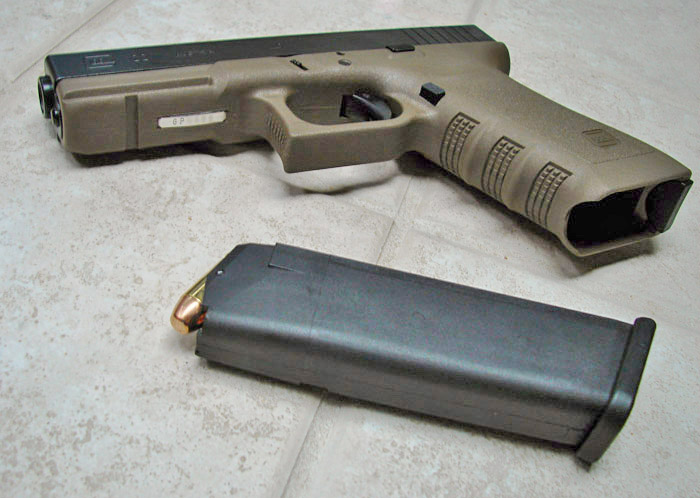

In 1990, Smith & Wesson and Winchester developed the .40 Smith & Wesson by shortening the 10mm case. This created a round that was more powerful than the 9mm Parabellum but with more manageable recoil. The round was also still operable in the smaller frame size used for Glock 9mm models. As is typical of many pistols chambered in .40 S&W, each of the standard Glock models (22, 23, and 27) may be easily converted to the corresponding .357 SIG chambering (Glock 31, 32, and 33, respectively) simply by replacing the barrel. No other parts need to be replaced, as the .40 S&W magazines will feed the .357 SIG rounds.
- Glock 22: The Glock 22 Glock 22 is a .40 S&W version of the full-sized Glock 17 introduced in 1990. The pistol uses a modified slide, frame, and barrel to account for the differences in size and power of the .40 S&W cartridge. The standard magazine capacity is 15 rounds. A 10-round version of this magazine is also offered for those markets where the magazine capacity for handguns is restricted. Additionally, the standard magazine is available with a "+1" base plate to make it a 16-round magazine. And, there is a Glock factory 22-round extended magazine offered. One can also swap in the +1 base plate to make that a 23-round magazine. The Glock Model 22 is favored and used by multiple law enforcement agencies around the world, including the Baltimore Police Department, Los Angeles Police Department, Miami Police Department, Maryland State Police, Cumberland County Sheriff's Department (NJ), Overland Park Police Department, Kansas City Police Department, Missouri State Highway Patrol, and Alaska State Troopers in the United States; the NSW Police Force, Queensland Police Service and the Northern Territory Police Force in Australia; the Edmonton Police Service, Calgary Police Service, Alberta Sheriffs Branch, Winnipeg Police Service, Toronto Police Service, Ottawa Police Service, and British Columbia Sheriff Service in Canada; and the National Bureau of Investigation (Philippines).
- Glock 23: The Glock 23 Glock 23 is a .40 S&W version of the compact Glock 19. It is dimensionally identical to the Glock 19, but is slightly heavier and uses a modified slide, frame, .40 S&W barrel, and a standard magazine capacity of 13 rounds. For jurisdictions limiting the magazine capacity of handguns, Glock offers a 10-round version of the standard magazine as well. There is also a factory 14-round version of the standard magazine using the +1 base plate. Finally, any magazine made for the Glock 22 will work in the Glock 23.
- Glock 23C: Introduced in 1998 as part of the Generation 3 production series. This Glock 23 variant comes from the factory with two ports cut in the barrel, and corresponding slide cuts. This allows gasses to be ported upwards on firing, providing downward force on the muzzle. They were not as popular with law enforcement agencies as the standard 23C, but were utilised by the Fulton County Sheriffs Department, of Georgia, United States.
- Glock 24: The Glock 24 Glock 24 is a .40 S&W long-slide variant of the Glock 22, similar in concept to the Glock 17L. Additionally, a compensated, ported-barrel version designated the 24C was also produced. The Glock 24 was introduced in 1994 and officially dropped from the company's regular product lineup upon the release of the Glock 34 and 35. The Glock 24 can use any magazine made for the Glock 22.
- Glock 27: The Glock 27 Glock 27 is a .40 S&W version of the subcompact Glock 26, with a standard magazine capacity of 9 rounds. Glock also offers a 10-round version of this magazine with the +1 base plate. The factory magazines from the larger Glock 22 and 23 will function in the Glock 27, increasing capacity to 13, 14, 15, 16 or 22 rounds. Spacers are available that fit on these larger-capacity magazines themselves; they have the effect of "extending" the magazine well of the pistol, thereby improving the ergonomic feel of the pistol when the longer magazines are inserted.
- Glock 35: The Glock 35 Glock 35 is a .40 S&W version of the competition Glock 34. The Glock Model 35 was the service pistol for the Kentucky State Police, but by the summer of 2017, they had reverted from the Glock 35 back to 9mm weapons because of penetration improvements in the 9mm bullets, noting some officers had never been able to make the switch from 9mm to .40 S&W in the first place due to their struggles in mastering the higher caliber. The Glock 35 can use any magazine made for the Glock 22.
.380 ACP

The first two .380 ACP models (Glock 25 and 28) were released in 1995 to provide a less powerful alternative to the 9mm Parabellum and 9×21mm, primarily intended for markets such as Brazil that prohibit civilian ownership of firearms chambered in more powerful calibers. Made in Austria, import restrictions ban civilian importation into the United States, but a limited Glock 28 run was manufactured in Glock's US plant for US sale. The Glock 25 and 28 are banned in Canada as they do not meet minimum handgun barrel length requirements.
Due to the relatively low bolt thrust of the .380 ACP cartridge, the locked-breech design of the Glock 19 and Glock 26 was minimally modified for the Glock 25 and Glock 28 to implement unlocked breech operation. It operates via straight blowback of the slide. This required modification of the locking surfaces on the barrel, as well as a redesign of the former locking block. Unusual for a blowback design, the barrel is not fixed to the frame. It moves rearward in recoil until it is tilted below the slide, similar to the standard locked-breech system. The reduced size and mass of the Glock 42 allowed the return to the Glock-standard locked-breech design.
- Glock 25: The Glock 25 Glock 25, introduced in 1995, is a blowback derivative of the compact (102 mm barrel) Glock 19. The magazine capacity is 15 rounds. Standard fixed sight elevation is 6.9 mm, unlike the 6.5 mm elevation used for the 9×19mm models.
- Glock 28: The Glock 28 Glock 28, introduced in 1997, is a blowback derivative of the subcompact (87 mm barrel) Glock 26. The standard magazine capacity is 10 rounds, but the 15-round Glock 25 magazine will function in the Glock28. Standard fixed-sight elevation is 6.9 mm, unlike the 6.5 mm elevation used for the 9×19mm Parabellum models.
- Glock 42: The Glock 42 Glock 42, introduced in 2014, is a locked-breech "slimline" (83 mm barrel) design, the smallest model Glock made. The single-stack magazine has a capacity of six rounds. US-manufactured Glock 42s may be sold for US civilian use.
.357 SIG
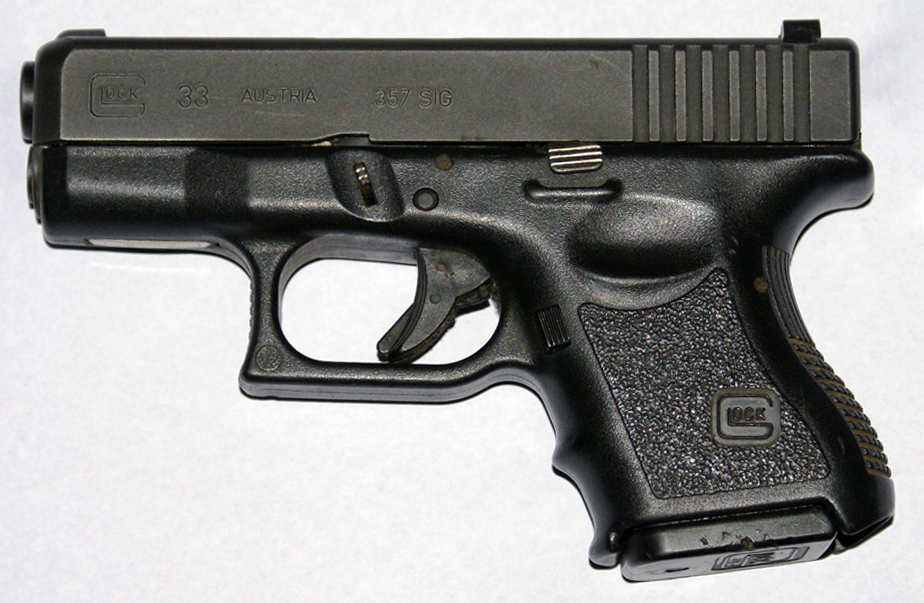
In 1994, SIG and Federal developed the .357 SIG to match the ballistics of typical .357 Magnum loads. This was done by necking down a shortened 10mm case to .357, so it was easy for Glock to alter their .40 Smith & Wesson models to the new caliber. As is typical of pistols chambered in .357 SIG, each of the standard Glock models (31, 32, and 33) may be easily converted to the corresponding .40 S&W chambering (Glock 22, 23, and 27, respectively) simply by replacing the barrel. The .357 SIG magazines differ from the .40 S&W counterpart, with the addition of an internal rib on each side of the magazine body including cutouts for the follower. This guides the bottlenecked cartridges through the feeding process. While it is possible to load .40 S&W into these magazines, the friction causes the larger rounds to lock up inside the magazine body and will induce malfunctions. .40 S&W magazines do not have this feature and can load both .357 SIG and .40 S&W respectively.
- Glock 31: The Glock 31 Glock 31 is a .357 SIG variant of the full-sized Glock 22. The standard magazine capacity of the Glock 31 is 15 rounds. It can accept magazines intended for the Glock 22 as well.
- Glock 32: The Glock 32 Glock 32 is a .357 SIG variant of the compact Glock 23. The standard magazine capacity of the Glock 32 is 13 rounds. It can accept magazines intended for the Glock 31, Glock 22, or Glock 23 as well.
- Glock 33: The Glock 33 Glock 33 is a .357 SIG variant of the subcompact Glock 27. The standard magazine capacity of the Glock 33 is 9 rounds. It can also accept magazines intended for the Glock 32, Glock 31, Glock 22, Glock 23, and Glock 27.
.45 GAP
Glock pistols chambered for the .45 GAP (and the .45 ACP) feature octagonal polygonal rifling rather than the hexagonal-shaped bores used for models in most other chamberings. Octagonal rifling provides a better gas seal in relatively large diameter rifled bores, since an octagon will have shorter sides and shallower angles than a hexagon.
- Glock 37: The Glock 37 Glock 37 is a .45 GAP version of the Glock 17. It uses a wider, beveled slide, larger barrel, and different magazine, but is otherwise similar to the Glock 17. The Glock 37 first appeared in 2003. It was designed to offer ballistic performance comparable with the .45 ACP in the frame size of the Glock 17. The concern with the size of the Glock 20/21 has been addressed by the Glock 36, 21SF, and 30SF, all of which featured reduced-size frames. The standard magazine capacity of the Glock 37 is 10 rounds.
- Glock 38: The Glock 38 Glock 38 is a .45 GAP version of the compact Glock 19. The standard magazine capacity of the Glock 38 is 8 rounds, but it can use the 10-round magazines of the Glock 37.
- Glock 39: The Glock 39 Glock 39 is a .45 GAP version of the subcompact Glock 26. The standard magazine capacity of the Glock 39 is 6 rounds, but it can use the 8- and 10-round magazines of the Glock 37 and Glock 38.
.22 Long Rifle
- Glock 44: The Glock 44Glock 44 is a .22 Long Rifle rimfire model based on the Glock 19. While the Glock 44 is similar in size as the Glock 19, the Glock 44 has a magazine capacity of 10 rounds and uses a simple blowback mechanism instead of the locked breech mechanism used on nearly all other Glock pistols. The Glock 44 is lighter than the G19 at 12 ounces, and it retains Glock's polygonal rifling, which has been tested by Glock to work with lead .22 bullets. It uses a steel/polymer composite slide due to the lower slide mass required to function with the less powerful cartridge. The 44 uses the company's proprietary "Safe Action" trigger, and of a footprint such that holsters made for the 19 or 23 are interchangeable with the 44.
Production in other countries

- Russia: Russian firms such as Skat, ORSIS, and Izhmash assemble three models of Glock pistols locally: the Glock 17, 34, and 35.
- Uruguay: As of 2015, there were plans to assemble Glock 17 pistols at army workshops in Uruguay to fulfill the needs of the national military services and law enforcement organizations.
- United States: Glock pistols are manufactured by the Glock Inc. subsidiary division located in the United States. Those batches are identical to the Austrian-made ones, but they are marked as "USA", instead of "AUSTRIA", on the slide.
Clones
Third-party frames and slides for Glock pistols began to appear in the early 2000s. This has led to "Glock" becoming a generic term including pistols not made by Glock GmbH, especially as expiring patents allowed complete Glock clones to be made. Many American companies produce Glock clones.
- China: In 2017, it was reported that Norinco was able to make a clone of the Glock 17 known as the NP-7 (or ). The pistol was subcontracted to Hunan Ordnance Industry Group through the Hunan Ordnance and Light Weapons Research Institute. Its features appear to be influenced by the fourth-generation Glock 17. The is marketed for export.
- Iran: Three unlicensed clones of Glock pistols made by Iranian DIO's Shahid Kaveh Industry Complex are named Ra'ad (with a safety selector, possibly an unlicensed copy of Glock 17), Glock 19 and Kaveh-17 (probably an improved Ra'ad, a variant of Glock 17S). It is not known if they could be adopted by the Iranian military to replace Browning Hi-Power, M1911 and SIG P226 pistols, and they were possibly prototypes that did not proceed to mass production.
- Myanmar: The Tatmadaw have adopted a clone of the Glock 17 known as the MA5 MK II, first reported in 2018. As of 2019 they were being manufactured for Myanmar's special forces units. The pistol has a rounded trigger guard and the Tatmadaw emblem on the grip, which has rectangular spacing instead of the smaller dot-like spacing.
- Pakistan: Unlicensed Glock clones are made in Pakistan's Khyber region, which were first reported in 2018.
- Taiwan: The 205th Arsenal in Taiwan produces a copy of the Glock 19, named the T97 pistol. The Taiwan-made Glocks were made to replace the Smith & Wesson Model 5906 used by the Taiwan police, but it ultimately did not enter service.
- Turkey: Akdal Arms produces a pistol named the Ghost TR01, which is heavily influenced by Glock pistols in its design.
- United States: Ruger produces the RXM, a Gen 3 clone that uses a fire control unit.
- Vietnam: At the Vietnam Defence Expo 2024 in December 2024, Z111 Factory unveiled a new series of Glock clone pistols known as the SN19 (Glock 17 Gen 5), the SN19-T (Steel Frame version) and the SN7VN-M24 chambered in 7.62x25 Tokarev.
Users

| Country | Organization | Model | |||||||||||||||
|---|---|---|---|---|---|---|---|---|---|---|---|---|---|---|---|---|---|
| Argentina | Agrupacion de Fuerzas de Operaciones Especiales Argentine Army | 17, 19X | |||||||||||||||
| date=2016-11-24 | title=wiw_sa_argentina - worldinventory | url=https://sites.google.com/site/worldinventory/wiw_sa_argentina | archive-url=https://web.archive.org/web/20161124203421/https://sites.google.com/site/worldinventory/wiw_sa_argentina | url-status=dead | archive-date=2016-11-24 | access-date=2023-02-28 }} | 17, 18 | ||||||||||
| Argentine National Gendarmerie, Argentine Federal Police, Buenos Aires province police | 17 | ||||||||||||||||
| Armenia | National Police of Armenia | 17, 18 | |||||||||||||||
| Australia | url=http://www.contactairlandandsea.com/adf_weapons_pt1.pdf | title=ADF Weapons Part 1 | first=Brian | last=Hartigan | access-date=5 June 2019 | magazine=Contact Air Land & Sea | url-status=live | archive-url=https://web.archive.org/web/20170610191607/http://www.contactairlandandsea.com/adf_weapons_pt1.pdf | archive-date=10 June 2017}} | 19, 26 | |||||||
| Australian Federal Police, Australian Border Force, New South Wales Police Force, Queensland Police Service, Western Australia Police Force, Northern Territory Police Force, Tasmania Police | 17, 19, 22, 23, 26, 27 | ||||||||||||||||
| Austria | Austrian Armed Forces (incl. Militärpolizei) | 17 (Pistole 80), 18C, 26, 21 | |||||||||||||||
| Bundespolizei, EKO Cobra also G18 (Min. of Interior); Justizwache (Min. of Justice) | 17, 18, 19 | ||||||||||||||||
| Azerbaijan | For use with Special Military Services, 160 Glock pistols purchased in 2013. | 19 | |||||||||||||||
| Bangladesh | Ordered by Bangladesh Army | 26 | |||||||||||||||
| Used by SWAT of Bangladesh Police | 17 | ||||||||||||||||
| Brazil | Polícia Federal - Federal Police | 17, 19, 26 | |||||||||||||||
| Polícia Rodoviária Federal – Federal Highway Police | 17, 17 MOS, 26 | ||||||||||||||||
| Polícia Militar do Estado de São Paulo - Military Police of São Paulo State | 22 | ||||||||||||||||
| Polícia Civil do Estado de São Paulo - Civil Police of São Paulo State | 22 | ||||||||||||||||
| Polícia Militar do Estado do Rio de Janeiro - Military Police of Rio de Janeiro State | 23 | ||||||||||||||||
| Polícia Militar do Estado do Espírito Santo - Military Police of Espírito Santo State | 17, 22 | ||||||||||||||||
| Polícia Militar do Estado da Bahia - Military Police of Bahia State | 22 | ||||||||||||||||
| 1º Batalhão de Forças Especiais | 17, 21 | ||||||||||||||||
| Canada | Kasler | 1992 | p=79}} Winnipeg Police Service Tactical Support Team | 17, 17M, 19, 26, 35 | |||||||||||||
| China | SWAT units | 17, 19, 26 | |||||||||||||||
| Czech Republic | 601st Special Forces Group; nonstandard sidearm issued on international deployments | 17 | |||||||||||||||
| Police of the Czech Republic, mainly special units | 17 | ||||||||||||||||
| Denmark | Sirius Dog Sled Patrol, Greenland | 20 | |||||||||||||||
| East Timor | Timor-Leste Defence Force | 23 | |||||||||||||||
| National Police of Timor-Leste | 19 | ||||||||||||||||
| Ecuador | National Police, Various special police units such as the GOE and GIR | 17 | |||||||||||||||
| Estonia | Police and Border Guard Board | 19 | |||||||||||||||
| Estonian Special Operations Force | 19 | ||||||||||||||||
| Finland | url=http://www.mil.fi/ruotuvaki/?action=read_page&pid=132&aid=2176 | title=Puolustusvoimille uusia pistooleja | trans-title=New pistols for the defense forces | first=Viljami | last=Hanhenoja | date=12 February 2009 | magazine=Ruotuväki | publisher=Finnish Defence Forces | language=fi | access-date=16 August 2009 | url-status=dead | archive-url=https://web.archive.org/web/20090909035958/http://www.mil.fi/ruotuvaki/?action=read_page&pid=132&aid=2176 | archive-date=9 September 2009}} | 17 (as 9.00 PIST 2008) | |||
| Finnish Police, primary service firearm; Border Guard (Ministry of Interior) | 17, 19, 26 | ||||||||||||||||
| Criminal Sanctions Agency, Dept. of Corrections (Vankeinhoitolaitos) (Ministry of Justice) | — | ||||||||||||||||
| France | French Armed Forces | 17, 17 MOS, 19, 26, 34 | |||||||||||||||
| Georgia | Mainly used by GSOF and some MIA units. Became standard issue for Georgian Ministry of Internal Affairs forces in October 2021. | 17, 21, 26 | |||||||||||||||
| Germany | Kampfschwimmer of the Bundeswehr, G17 issued under designation P9. | 17 | |||||||||||||||
| Federal and State Police, tactical units (GSG 9, SEKs); Customs (ZUZ) - G17, G19, G26. | 17, 19, 26 | ||||||||||||||||
| State Police in Saxony-Anhalt - about 8,600 G46 TR, standard-issue firearm. | 46 | ||||||||||||||||
| Greece | Ειδική Κατασταλτική Αντιτρομοκρατική Μονάδα (EKAM) unit of the Hellenic Police | 21 | |||||||||||||||
| Hong Kong | Hong Kong Police Force (incl. special units SDU, CTRU, ASU, SBDIV), ICAC, C&E Dept. | 17, 19 | |||||||||||||||
| Iceland | Iceland Crisis Response Unit (Ministry of Foreign Affairs) | — | |||||||||||||||
| url=http://www.logreglukonur.is/greinasafn.php?subaction=showfull&id=1175185763&archive=&start_from=&ucat=2& | title=Tengslanet lögreglukvenna: Lögreglukonur í skotfimi | trans-title=Policewomen's network: Policewomen in shooting | date=29 March 2007 | website=Lögreglukonur | language=is | access-date=24 July 2009 | url-status=dead | archive-url=https://web.archive.org/web/20090908213209/http://www.logreglukonur.is/greinasafn.php?subaction=showfull&id=1175185763&archive=&start_from=&ucat=2& | archive-date=8 September 2009}} Víkingasveitin units (Ministry of Interiour) | — | |||||||
| India | Standard Issue side arm for special forces Para (SF) (Army), MARCOS (Navy), National Security Guard (Min. of Home Aff.). | 17, 26 | |||||||||||||||
| Andhra Pradesh Police | 19X | ||||||||||||||||
| Indonesia | Indonesian National Armed Forces (Army, Navy, Air Force) | 17, 18, 19, 23, 26, 27, 34, 42 | |||||||||||||||
| Indonesian National Police | 17 | ||||||||||||||||
| Iraq | Iraqi security forces - military and law enforcement forces (purchased 125,163 pistols) | 19 | |||||||||||||||
| Israel | Israeli Defense Forces, Israel Police | 17, 19 | |||||||||||||||
| Japan | Security Police of Tokyo Metropolitan Police Department | ||||||||||||||||
| Special Assault Team | 17, 19 | ||||||||||||||||
| Jordan | Royal Guard | — | |||||||||||||||
| Kosovo | url=http://www.smallarmssurvey.org/files/portal/spotlight/country/eu_pdf/europe-kosovo-2006.pdf | title=SALW survey of Kosovo | website=Small Arms Survey | access-date=11 February 2010 | url-status=dead | archive-url=https://web.archive.org/web/20100705043746/http://www.smallarmssurvey.org/files/portal/spotlight/country/eu_pdf/europe-kosovo-2006.pdf | archive-date=5 July 2010}} | 19, 17 | |||||||||
| Latvia | Latvian Military, standard-issue pistols with Land Forces. | 17, 19, 21, 26 | |||||||||||||||
| Lithuania | Lithuanian Armed Forces | 17 | |||||||||||||||
| Lithuanian Police | 17, 19, 26 | ||||||||||||||||
| Luxembourg | Luxembourg Army | 17 | |||||||||||||||
| Unité Spéciale de la Police of the Grand Ducal Police | 17, 26 | ||||||||||||||||
| Malaysia | url=http://www.tactical-life.com/online/special-weapons/malaysian-special-forces | title=Malaysian Special Forces | last=Thompson | first=Leroy | date=December 2008 | website=Tactical Life | access-date=29 November 2009 | url-status=live | archive-url=https://web.archive.org/web/20120402013858/http://www.tactical-life.com/online/special-weapons/malaysian-special-forces/ | archive-date=2 April 2012}} | 17, 19, 34 | ||||||
| Malaysia Coast Guard (MMEA); Royal Malaysia Police (Ministry of Home Affairs) | 17, 18, 19, 26, 34 | ||||||||||||||||
| Royal Malaysian Customs (Ministry of Finance) | 17, 19, 26, 43 | ||||||||||||||||
| Mexico | Armada de México (Navy) | 17 | |||||||||||||||
| Moldova | Fulger Battalion | 17 | |||||||||||||||
| Monaco | Compagnie des Carabiniers du Prince | 17 | |||||||||||||||
| Montenegro | Armed Forces of Montenegro, standard military sidearm. | 17 | |||||||||||||||
| Myanmar | editor-last1=Jones | editor-first1=Richard D. | editor-last2=Ness | editor-first2=Leland S. | title=Jane's Infantry Weapons 2009/2010 | edition=35th | date=27 January 2009 | location=Coulsdon | publisher=Jane's Information Group | isbn=978-0-7106-2869-5}} and the Myanmar Police Special Task Force. Manufactured locally as MA-1 MK-II. | MA5 MK II | ||||||
| Netherlands | Military of the Netherlands; Royal Marechaussee (Min. of Defence) BSB sections Persoonsbeveiliging (PB), Observatie Team (OT) and Sky Marshals also use Glock 26. | 17, 18, 26 | |||||||||||||||
| Dutch Police, standard-issue firearm of the Dienst Speciale Interventies. | 17 | ||||||||||||||||
| New Zealand | New Zealand Defence Force{{Cite web | url=http://www.scoop.co.nz/stories/AK1511/S00624/nzdf-to-get-new-glock-pistols.htm | title=NZDF To Get New Glock Pistols | website=Scoop News | access-date=25 November 2015 | url-status=live | archive-url=https://web.archive.org/web/20151126073035/http://www.scoop.co.nz/stories/AK1511/S00624/nzdf-to-get-new-glock-pistols.htm | archive-date=26 November 2015 | 17 | ||||||||
| New Zealand Police (an "unarmed service", but are trained to use firearms) | 17 | ||||||||||||||||
| Norway | Norwegian Armed Forces | 17 (P-80, P-80NM1, P-80NM2) | |||||||||||||||
| Pakistan | url=http://articles.janes.com/articles/Janes-Defence-Weekly-2006/IDEAS-2006-Pakistan-selects-Sig-Sauer-pistols-for-special-forces.html | title=IDEAS 2006: Pakistan selects SIG Sauer pistols for Special Forces | last=White | first=Andrew | date=November 27, 2006 | website=Janes Defence Weekly | access-date=7 May 2017 | url-status=dead | archive-url=https://archive.today/20130216073615/http://articles.janes.com/articles/Janes-Defence-Weekly-2006/IDEAS-2006-Pakistan-selects-Sig-Sauer-pistols-for-special-forces.html | archive-date=16 February 2013}} | 17, 19 | ||||||
| Philippines | url=http://www.tactical-life.com/news/glock-17-gen4-philippines-armed-forces/#glock-17-gen4-2 | title=Glock 17 Gen4 Wins Philippines Armed Forces Solicitation | date=26 September 2017 | website=Tactical Life | url-status=live | archive-url=https://web.archive.org/web/20170930040236/http://www.tactical-life.com/news/glock-17-gen4-philippines-armed-forces/#glock-17-gen4-2 | archive-date=30 September 2017}} Philippine Army, Philippine Marine Corps MARSOG, Presidential Security Group (joint service unit) | 17, 21 | |||||||||
| National Intelligence Coordinating Agency, Philippine Drug Enforcement Agency (Office of President) | — | ||||||||||||||||
| National Bureau of Investigation (Dept. of Justice); Philippine National Police (DILG) | 17 | ||||||||||||||||
| Peru | Peruvian Air Force, Peruvian Army, Peruvian Navy, Dirección Nacional Antidrogas. | 17 | |||||||||||||||
| Poland | Polish Armed Forces | 17 | |||||||||||||||
| Border Guard; Polish Police (Ministry of Interior and Admin.) | 17, 19, 26 | ||||||||||||||||
| Portugal | Portuguese Army; Portuguese Marine Corps; Maritime Police; Military Judiciary Police; (Ministry of National Defence) | 17 | |||||||||||||||
| Guarda Nacional Republicana; Polícia de Segurança Pública; Foreigners and Borders Service; Municipal Police; (Ministry of Internal Administration) | 19, 19X | ||||||||||||||||
| Judiciary Police; Prison Guard; (Ministry of Justice) | 19, 26 | ||||||||||||||||
| Romania | Romanian Armed Forces | 17, 17L, 19 | |||||||||||||||
| Russia | Special Operations Forces | 17, 26 | |||||||||||||||
| Federal Security Service (FSB); Ministry of Internal Affairs (MVD), special forces | 17, 19 | ||||||||||||||||
| Serbia | Police of Serbia | 17, 19, 21, 35 | |||||||||||||||
| Singapore | Singapore Police Force; Prison Service (Ministry of Home Affairs) | 19 | |||||||||||||||
| Slovakia | 5th Special Operations Regiment (Slovakia) | 17 | |||||||||||||||
| Slovak Police Force | |||||||||||||||||
| Spain | Unidad Especial de Intervención (UEI) group of Spanish Civil Guard, | 17, 19, 43 | |||||||||||||||
| Sweden | url=http://www.mil.se/sv/Materiel-och-teknik/Vapen/Pistol-88/ | title=Pistol 88 | website=Försvarsmakten | language=sv | access-date=8 September 2008 | url-status=dead | archive-url=https://web.archive.org/web/20081010174257/http://www.mil.se/sv/Materiel-och-teknik/Vapen/Pistol-88/ | archive-date=10 October 2008}} | 17 (Pistol 88, 88C, 88C2), 19 (Pistol 88B, 88D) | ||||||||
| Swedish Police Authority | 45 | ||||||||||||||||
| Switzerland | Swiss Armed Forces: Military Police, Swiss Grenadiers, ARD 10, FSK-17 | 17, 26 | |||||||||||||||
| Police (Gendarmerie) Cantonal of Geneva | 19 | ||||||||||||||||
| Taiwan | Various criminal investigation bureaus outside major cities | 19 | |||||||||||||||
| Thailand | Royal Thai Police at least 2,238 G19, G17 used by Arintharat 26, Naresuan 261 units. G17 and G19 used by Royal Thai Army | 17, 19 | |||||||||||||||
| Timor Leste | url=http://www.smallarmssurvey.org/fileadmin/docs/C-Special-reports/SAS-SR12-Timor-Leste-Armed-Violence-Assessment-Final-Rep.pdf | editor1-last=Muggah | editor1-first=Robert | editor2-last=LeBrun | editor2-first=Emile | name-list-style=amp | title=Timor-Leste Armed Violence Assessment Final Report | date=October 2010 | publisher=Small Arms Survey | isbn=978-2-940415-43-4 | series=Special Report No. 12 | page=17 | access-date=30 August 2018 | archive-url=https://web.archive.org/web/20170505060031/http://www.smallarmssurvey.org/fileadmin/docs/C-Special-reports/SAS-SR12-Timor-Leste-Armed-Violence-Assessment-Final-Rep.pdf | archive-date=5 May 2017 | url-status=dead}} | 19 |
| Tunisia | Unité Spéciale – Garde Nationale | 17, 34 | |||||||||||||||
| Used by Special Forces Command. | 17, 19 | ||||||||||||||||
| Ukraine | Ukrainian Armed Forces | 17 | |||||||||||||||
| Department of Security Police in the Kyiv region | 17, 19 | ||||||||||||||||
| United Kingdom | British Armed Forces | 17 (L131A1), 17T (L132A1), 19 (L137A1) | |||||||||||||||
| Specialist Firearms Command of the Metropolitan Police | 17, 17M, 19, 19M, 26 | ||||||||||||||||
| Police Scotland | 17 | ||||||||||||||||
| Police Service of Northern Ireland | 17, 19 | ||||||||||||||||
| United States | url=http://kitup.military.com/2015/02/marines-operators-choose-glocks.html | title=Marines Allow Operators to Choose Glocks over MARSOC .45s | date=19 February 2015 | website=Military.com | url-status=live | archive-url=https://web.archive.org/web/20150222201224/http://kitup.military.com/2015/02/marines-operators-choose-glocks.html | archive-date=22 February 2015}} United States Navy SEALs | 19, 19M, 26 | |||||||||
| U.S. Customs and Border Protection; United States Coast Guard (Dept. of Homeland Security) | 19, 26, 47; 19 | ||||||||||||||||
| Federal Bureau of Investigation; Bureau of Alcohol, Tobacco, Firearms and Explosives; Drug Enforcement Administration (Dept. of Justice) | 17M, 19, 19M, 22, 23, 27 | ||||||||||||||||
| Alaska State Troopers | 22 | ||||||||||||||||
| Baltimore City Police Department{{cite web | url = https://baltimorepolicemuseum.com/en/component/content/article/482-bpd-weapons | title = Baltimore Police Weapons | last = Driscoll | first = Kenny | date = 29 December 2022 | access-date = 27 January 2024}} | 17, 22 | ||||||||||
| Colorado State University Police Department | 17, 19 | ||||||||||||||||
| Kansas Highway Patrol | 17 | ||||||||||||||||
| Kentucky State Police SRT | 27, 35 | ||||||||||||||||
| New York City Police Department; New York State Police; New York State University Police | 17, 19, 21, 22, 23, 27 | ||||||||||||||||
| New Jersey State Police; Port Authority Police Department | 19 | ||||||||||||||||
| South Carolina Highway Patrol | 17M | ||||||||||||||||
| url=https://abc13.com/hpd-rookies-buy-own-guns-glock-17-houston-police-department-why-forces-officers-to/12372371/ | title=HPD officers have to spend $2K to buy own guns, bullets, handcuffs | first=Brooke | last=Taylor | date=October 25, 2022 | website=ABC-13}} | 17, 19, 45 | |||||||||||
| Douglas County Sheriff's Department, Douglas County Oregon | 18 | ||||||||||||||||
| Houston Police Department | 17 | ||||||||||||||||
| Uruguay | Uruguayan National Army | 17 | |||||||||||||||
| Vatican City | Swiss Guard | 19 | |||||||||||||||
| Gendarmerie of Vatican City | 17 | ||||||||||||||||
| Venezuela | Venezuelan Armed Forces | 17 | |||||||||||||||
| Vietnam | Mobile Police | 19 | |||||||||||||||
| Yemen | Military of Yemen | 19 |
Criminal use
Glock pistols have been used in mass shootings in the United States, including the 1991 Luby's shooting, the 1996 Murder of Tupac Shakur, the 2007 Virginia Tech shooting, the 2011 Tucson shooting, the 2012 Aurora shooting, the 2012 Sandy Hook Elementary School shooting, the 2015 Charleston church shooting, the 2016 Orlando nightclub shooting, the Pittsburgh synagogue shooting, and the 2022 New York City Subway attack. In April 2022, Ilene Steur, a survivor of the 2022 NYC subway attack, sued Glock and its Austrian parent company for compensation for her physical injuries and emotional pain. Glock pistols have also been used in mass shootings elsewhere in the world, including the 2001 Nepalese royal massacre, the 2002 Erfurt massacre, the 2002 Nanterre massacre, the killings committed by Viktor Kalivoda in 2005, the 2011 Norway attacks, the 2012 Bucharest hair salon shooting, the 2016 Munich shooting, the 2023 Rotterdam shootings, the 2023 Prague shootings and the 2025 Graz school shooting.
A 2014 report by the Chicago Police Department found that Glock pistols were the third most traced handgun, coming after those from Smith & Wesson and Sturm, Ruger & Co. Experts on gun control, mass shootings, and defense training have cited factors such as reliability, ease of use, and commonness for why Glock pistols are so often involved in mass shootings and other criminal acts. The criminal use of handguns including Glocks has led to calls for increased gun control in the United States. This common usage, however, has been described by Paul M. Barrett to be a result of Glock's overall popularity and market presence in the US and that "this level of violence isn't necessarily tied to a particular[,] to a brand".
Glock pistols were singled out for restriction by some jurisdictions and were branded the "hijacker's special" based on the false assumption that they could bypass airport metal detectors because of their polymer frame. This was refuted in Congressional hearings by the ATF, FAA, and other organizations responsible for airline security, which proved embarrassing for the ban's advocates and provided significant publicity for Glock.
In December 2024, the states of Minnesota and New Jersey sued Glock over the design of the 9-millimeter semiautomatic pistol, claiming that the company had failed to make changes to prevent the easy conversion of the pistol into an illegal and much more dangerous machine gun. The conversion is done using a small, illegal device known as a Glock switch.
On October 10, 2025, California Governor Gavin Newsom signed Assembly Bill 1127 into law, prohibiting the retail sale of new semi-automatic handguns that can be readily converted to fully automatic fire using Glock switches. The law primarily affects Glock pistols and similar designs featuring a cruciform trigger bar, and has been described as a "Glock ban." The law aims to address a perceived design flaw allowing illegal modifications, with proponents hoping to pressure manufacturers like Glock to redesign their firearms in the interest of public safety. The National Rifle Association and other gun advocacy groups filed a federal lawsuit challenging the statute soon after.
References
Bibliography
References
- "PKK'ya ait silahlar ele geçirildi". Yeni Şafak.
- Howard Altman. (July 5, 2023). "Ukraine Situation Report: A Peek Into Prigozhin's Bizarre Pad".
- (March 5, 2023). "Ukrainian Kraken Regiment show their small arms and revolver grenade launchers". Ukrainska Pravda.
- (January 2025). "#Ecuador 🇪🇨: A recent footage shows armed members of the criminal groups shooting at a Police car during the recent conflicts. The perpetrators are armed with various pistols including a Glock pistol (possibly Glock 19 Gen 3) with extended magazine}}{{better source needed".
- Molinari, Piergiorgio. (14 September 2021). "New GLOCK Watch Chrono: it's time to celebrate the 40th anniversary of the GLOCK pistol".
- Dockery, Kevin. (2007). "Future Weapons". Penguin.
- "ETS 40 round (9mm) mag, fits Glock 17, 18, 19, 26, 34".
- "BETA MAG Magazine 9MM Glock Clear".
- McFadden, Robert D.. (27 December 2023). "Gaston Glock, Inventor of the Gun That Bears His Name, Dies at 94". [[The New York Times]].
- (24 January 2012). "How The Glock Became America's Weapon Of Choice".
- "Safe Action System". Glock.
- "Glock Gen 5: Differences, Features and How It Compares".
- (2019-04-09). "Glock Awarded $85M Contract to Arm Customs and Border Protection". HSToday.
- (12 December 2024). "New Jersey, Minnesota sue Glock over switch that allows pistols to fire like machine gun". [[Associated Press]].
- Khaled, Fatma. (13 December 2024). "Minnesota and New Jersey sue Glock for selling handguns as easily convertible machine guns". [[Jurist (website).
- Sabalow, Ryan. (2025-07-28). "Newsom just got a new gun. Will he ban selling new Glocks like the one Kamala Harris owns?". CalMatters.
- Horan, Daniel. (17 January 2012). "Pistol-Packing By the Millions". [[The Wall Street Journal]].
- (7 August 2010). "Metal Treatments: Ferritic Nitrocarburizing/Melonite/Tenifer".
- (20 May 2005). "Defence Standard 05–101 Part 1: Proof of Ordnance, Munitions, Armour and Explosives".
- "GLOCK P80 Anniversary".
- (2013). "Die Weiterentwicklung der Selbstladepistole I". Mötz & Schuy.
- Sweeney, Patrick. (June 2024). "The Gun Digest Book of the Glock". Krause Publications.
- Kokalis, Peter G.. (October 1984). "Plastic Perfection: SOF Expert Gives Glock-17 Great Grades".
- Kinard, Jeff. (2003). "Pistol". ABC-CLIO.
- (2023-01-13). "La società austriaca produttrice delle pistole Glock compie 40 anni".
- "Vapen: Pistol 88".
- Janson, O.. (5 August 2012). "Swedish Military Pistols and Revolvers 1863-1988".
- (11 January 2013). "British armed forces get first new pistol since World War II".
- (10 November 2018). "Letter FOI 2018/15464".
- (12 December 2018). "Letter FOI 2018/15730".
- Kotlarski, Amael. (7 January 2019). "France awards pistol and sniper rifle contracts".
- (9 January 2020). "PSA : GLOCK 17 Gen 5, un bon choix pour remplacer MAC 50 et PAMAS?".
- (2006). "The Complete Glock Reference Guide". Ptooma Productions.
- Sadowski, Robert. (2018). "Book of Glock, A Comprehensive Guide to Americas Most Popular Handgun". Skyhorse Publishing.
- Sadowski, Robert. (2023). "Book of Glock". [[Skyhorse Publishing]].
- Lunde, Ken. (26 January 2010). "Assorted Glocks (Page 1 of 3)".
- Lunde, Ken. (30 November 2009). "Ken Lunde's 2009 SHOT Show Photos & Report".
- Jacobellis, Nick. (18 September 2009). "Glock G22 RTF2 Duty Pistol".
- (10 December 2011). "Glock G17 RTF2 9mm review".
- "SHOT Show 2010: Glock Introduces Gen4 Pistols".
- Cristofani, Giuliano. (10 September 2014). "Glock pistols Gen3 VS Gen4. What is the difference between the Generations?".
- (30 January 2010). "Ken Lunde's 2010 SHOT Show Photos & Report".
- (20 January 2010). "More Gen 4 Glock Photos".
- (19 January 2010). "SHOT Show 2010: GLOCK brings pistols into the next generation".
- "Gen 4 Glock Review: Evolution, not Revolution".
- Miller, Payton. (9 February 2011). "Glock 17 Gen4".
- (April 29, 2010). "Glock Gen4 G19 and G23 Will Arrive This Summer".
- "Recoil Spring Exchange Program".
- Smith, Aaron. (30 June 2016). "Glock wins $85 million FBI contract".
- "9mm Luger Pistols / Replacement Parts".
- Roberts, Patrick. (16 August 2016). "Breaking: Photo Of The New FBI Glock 17M Leaked".
- Roberts, Patrick. (6 September 2016). "Glock 17M Recall Update".
- "17m Archives".
- (25 August 2017). "OFFICIAL: The New GLOCK Gen5 Has Arrived".
- (25 August 2017). "TFB First Look: The New Gen5 GLOCK 17 And Gen5 GLOCK 19".
- (25 August 2017). "GLOCK Gen 5 Safe Action Pistols, First Look at New GLOCK 17 & 19".
- (24 August 2017). "Here's the Full Reveal of the New Glock Gen5 Pistol".
- "High Performance DLC Coatings Give You the Diamond Edge".
- Zimmerman, Dan. (2025-10-21). "GLOCK Discontinues Dozens of Popular Handgun Models".
- "GLOCK Streamlines Firearm Offerings to Make Room for Future Innovation".
- Sweeney, Patrick. (30 May 2008). "The Gun Digest Book of the Glock". Gun Digest Books.
- (2019). "Glock 17 Gen 4 Review and Dirt Test".
- Armstrong, Brian. (2022-10-14). "The Mechanics of a Striker vs. a Hammer-Fired Pistol".
- "Auto-loading firearm with selectable live fire and training modes".
- ''Glock Armorer Manual'', 2012, p.52.
- "Glock 17 Holsters".
- "GLOCK Gen4 "Safe Action"® Pistols and Accessories Brochure".
- "Safe Action System".
- Sagi, Guy J.. (January 13, 2011). "Steyr M40-A1".
- Suciu, Peter. (13 April 2020). "Glock 7: The Gun You Have Nothing to Fear From (But Glock Hates It)".
- (2004). "Barrels".
- (February 2019). "Individuality testing of new Glock pistol barrels 'Marksman Barrel'". Forensic Science International.
- (9 September 2009). "Glock Pistol Used by Police Raised Safety Issues".
- "Safe-action system".
- (10 September 2009). "Glock Pistol Used by Police Raised Safety Issues".
- "Glock Safety Lock".
- "Trigger safety lock for pistols and trigger assembly".
- "Glock magazines".
- Gurwitch, Jeff. "Improving your Glock for under $100 Part II: Connectors, Sights and Magpul Magwell!".
- Gao, Charlie. (23 February 2019). "Shootout: 5 Ways to Make a Glock Even Deadlier".
- "GLOCK Inc. {{!}} GLOCK Pistols {{!}} Buy Guns Online".
- "KPOS Scout - New Pistol Conversion Kit for Glock 17/19".
- (10 December 2020). "Stock attachments: Glock". Firearms News.
- (24 March 2022). "Tiny 'Glock Switches' Have Quietly Flooded the US With Deadly Machine Guns".
- (January 15, 2009). "New Product Announcements for Glock, Inc. at 2009 SHOT Show".
- (February 2, 2008). "Glock, Inc. Introduces New Glock 30 SF .45 Auto Short Frame Pistol at SHOT Show in Las Vegas".
- "GLOCK, Inc. Announces New .45 Semiautomatic Short Frame Pistol with New Features".
- (30 March 2017). "Glock 17M: The 'Inside' Scoop (Photo Documentary)".
- (12 June 2017). "Ontario Provincial Police Replaces its Current Pistols with GLOCK Pistols". U.S. Headquarters, Glock.
- (17 August 2017). "TFB TV Glock 18 Machine Pistol Mini-Documentary".
- (7 August 2017). "Hands-on with Glock 18: The elusive machine pistol (VIDEO)".
- (2008). "Glock 18 selective-fire automatic pistol (Austria), Pistols".
- "Glock 18".
- "Pistol, 9 Millimeter, Semi-Automatic".
- Felts, Kevin. (8 January 2018). "Glock 19X Magazine Compatibility Issues".
- (10 July 2018). "GLOCK 19X Reaches Sales Milestone in Less than 6 Months". Glock Inc..
- (10 November 2017). "USMC Fielding New Concealable Glock 19M 'M007' Pistol".
- (17 September 2017). "Glock 19 Canadian Version Coming With Special Barrel, Maple Leaf".
- Firearms Outlet Canada. (4 May 2018). "What does a Canadian Glock 19 look like? | Unboxing the Glock 19 Gen 4 Canadian Edition".
- "National Stock Number NSN 1005-01-658-7261, 1005016587261".
- "National Defense Industrial Association: Equipping the SOF Ground Combatant".
- (20 June 2020). "The Guns of Delta Force".
- (11 April 2019). "TFB EXCLUSIVE: New CBP GLOCK G47, G19 MOS And G26".
- Ayoob, Massad. (September 1999). "The Glock 34". The Modern Survivalist.
- (4 January 2019). "The Skinny on the New "Slimline" G43X and G48". Glock Collectors Association.
- (2024-03-18). "Glock 43X Review: Best Concealed Carry Gun? - CAT Outdoors".
- Roberts, Patrick. (23 September 2018). "A Black 19x? The Glock 45 & Glock 17 MOS Gen5 Leaked".
- (24 September 2017). "Brand New & Shiny: Glock 46".
- "GLOCK 46 TR für Polizei in Sachsen-Anhalt". Polizeipraxis.
- (18 September 2019). "Glock 46: Das sind die neuen Pistolen der Polizei in Sachsen-Anhalt". MDR.
- (11 April 2019). "New CBP GLOCK G47, G19 MOS and G26".
- (31 May 2019). "The new G47 for U.S. Customs and Border Protection". Glock Collectors Association.
- (26 July 2019). "It's A European Thing". Glock Collectors Association.
- (8 November 2023). "TALO introduces the Glock 49".
- (3 March 2016). "HIT Show: Glock 43 in 9x21 mm".
- Roberts, Patrick. (3 January 2019). "Imported 9x21 Glock 17 For Sale On Gunbroker".
- Manning, Robb. (10 June 2015). "Glock Reference Guide". F+W Media.
- "Guide".
- Dougherty, Martin J.. (2005). "Small Arms from the Civil War to the Present Day". Amber Books Ltd.
- McNab, Chris. (22 December 2015). "Glock: The World's Handgun". Amber Books Ltd.
- Johnson, Steve. (January 8, 2013). "The New Glock 30S".
- White, Phil. (14 January 2013). "SHOT Show Sets the Stage for Unveiling of Latest Offering from Glock".
- (6 January 2014). "Glock G41 Gen 4".
- "Boxed Glock 23C .40 S&W - Fulton County Sheriff's Office".
- "Glock Model Info: "Have any models been discontinued?"".
- Moore, Michael. (July 2017). "Better Bullets".
- (8 December 1996). "ATF Form 4590".
- (16 December 2013). "The Unobtainable Glock 25 and Glock 28—NGOA Buyers Club".
- James, Frank W.. "The Glock Model 38".
- (10 December 2019). "GLOCK's Big Reveal: G44 .22 LR". Glock Collectors Association.
- (10 December 2019). "Glock 44: Austrian Company Moves into Rimfire Market". Gun Digest.
- Johnston, Jeff. (2020-07-01). "Glock 44 .22 Semi-Automatic Handgun Review".
- (5 March 2012). "Skat GM-100 Glock Clone in 9mm and .22LR".
- "Пистолет спортивный GM-100".
- (17 July 2012). "Glock – собранно в России".
- (13 September 2013). "Kalashnikov To Produce Steyr Rifles, Glock Pistols".
- (14 May 2015). "Glock Plans to Open Pistol Production Plant in Uruguay".
- "Facts About GLOCK".
- (15 June 2019). "Glock Guns Made in the USA? Yes, This is Happening".
- (July 31, 2021). "The History Behind Glock Clone Pistols".
- Roberts, Patrick. (21 January 2019). "SHOT 2019, Attack Of The Glock Clones?".
- (22 December 2017). "Chinese Norinco Glock Clone".
- "中国版格洛克手枪现身 既然能国产为何我军却不装备".
- (2018-11-15). "湖南兵器的'十八般武器'". Hunan Provincial People's Government Portal.
- (2019-08-06). "国产格洛克手枪, 性能优异却不内销-军事-初默网".
- (2018). "国产GLOCK?9mm狙击枪?GearKr带你看2018北京国际警博会的武器枪械".
- (27 October 2014). "Iran stands among 10 polymeric weapons manufacturers".
- (1 November 2008). "گلاک؛ قاتل دیروز دانشمند ایرانی که تبدیل به دستاورد جدید دفاعی شد".
- (23 July 2018). "MA5 MK II: The Burmese Tatmadaw's Production Glock Handgun".
- "MA-5 Mk.2 - Semi-automatic pistol".
- "CAT-UXO - Ma 5 mk 2 pistol".
- (5 April 2018). "The Glock Revolution Comes to Peshawar in Select-Fire".
- "Glock 17 Copy Made in Pakistan".
- Gao, Charlie. (5 July 2020). "Pro Tip: Don't Buy a 'See Through' Glock from Pakistan".
- (22 August 2011). "XT98 Semi-Automatic Sniper Rifle (M14 style rifle) and XT97 Pistol".
- (22 October 2010). "Akdal Ghost". Modern Firearms.
- Patrick, Sweeney. (April 2025). "Is Ruger's RXM Pistol the Best Ever Made?". [[Firearms News]].
- (26 December 2024). "Vietnam Defence Expo 2024: New Handguns".
- Moss, Matthew. (12 February 2021). "New Glock Pistols and B&T Submachine Guns for Argentina's Special Forces".
- (2016-11-24). "wiw_sa_argentina - worldinventory".
- (4 February 2022). "Վարժախաղ՝ պարեկների մասնակցությամբ".
- Hartigan, Brian. "ADF Weapons Part 1".
- (26 September 2017). "Then and Now: Firearms".
- "The GLOCK 22 Pistol".
- (March 6, 2016). "WA Police need semi-automatic rifles to combat active shooters, police union tells Commissioner".
- (2016-03-05). "Cops need firepower for shooting attacks".
- "Glock".
- Newell, Deanne. (2020-06-19). "Glock pistols are for police officers' safety".
- Valpolini, Paolo. (June 2009). "There are Two Types of Men in this World...".
- "Pistolenbewaffnung des Bundesheeres - 1955 bis heute".
- (2009). "Verhältnismäßiges Einschreiten: Die Bundespolizei verfügt über eine Reihe von Dienstwaffen". [[Ministry of the Interior (Austria).
- [[Ministry of Justice (Austria). (5 June 2008). "Anfragebeantwortung: "Entwaffnung von Justizwachebeamten"".
- (20 December 2013). "Azerbaijan purchases 160 Glock pistols from Austria".
- (18 February 2021). "Tender Notice P.4 SEC".
- Hassan, Kamrul. (20 December 2008). "জঙ্গি-সন্ত্রাস দমনে র্যাব-পুলিশকে অস্ত্র ও প্রশিক্ষণ দিচ্ছে যুক্তরাষ্ট্র". [[Prothom Alo]].
- "DPF define Glock 9×19mm como armamento padrão da Polícia Federal – A previsão é que sejam adquiridas mais de 7 mil armas ainda este ano".
- Passos, Anny. (23 July 2018). "Polícia Rodoviária Federal (PRF) – Teste, Aprovação e Aquisição das Pistolas Glock".
- (2019-08-22). "Glock vence licitação e venderá 40 mil pistolas para a PM de SP".
- (6 February 2021). "Polícia Civil recebe mais de 4 mil pistolas semiautomáticas".
- "Entrega de pistolas Glock .40".
- (5 June 2019). "Polícia Militar recebe 2.905 pistolas Glock".
- Nascimento, Silvânia. "SSP assina contrato para aquisição de mais de 10 mil pistolas Glocks".
- "Batalhão de Forças Especiais (BFEsp) - Brasil".
- (18 August 2017). "3 arteries severed after gun 'spontaneously discharges' on Winnipeg police officer".
- "Pistol Glock 17".
- (18 April 2007). "Ruční Zbraně AČR". Ministry of Defence & Armed Forces of the Czech Republic.
- "Veřejná zakázka - nákup zbraní Glock - Policie České republiky".
- Knupp, Jeremiah. (18 July 2018). "Nine Lives of the 10 mm Auto".
- (29 September 2025). "Government Hands Over Military Weapons to F-FDTL {{!}} The Dili Weekly".
- (2010). "Timor-Leste Armed Violence Assessment: final report". Small Arms Survey.
- (8 August 2017). "Politsei vahetab välja alles mõni aasta tagasi soetatud püstolid".
- Andres, Einmann. (10 February 2021). "Erioperatsioonide väejuhatus võtab kasutusele uued relvad". [[Postimees]].
- Hanhenoja, Viljami. (12 February 2009). "Puolustusvoimille uusia pistooleja". [[Finnish Defence Forces]].
- (12 December 2007). "Poliisi hankkii uusia virka-aseita". [[Helsingin Sanomat]].
- (7 January 2019). "France orders 75,000 Glock 17 semi-automatic pistols".
- (13 January 2019). "More on the New French Army Glocks, FN SCARs".
- (7 January 2020). "France awards pistol and sniper rifle contracts". Jane's 360.
- (21 October 2021). "Rearmament Underway at the Ministry of Internal Affairs".
- (25 August 2014). "Taucher-Glock: Deutsche Marine beschafft P9A1".
- (22 January 2019). "Glock 46 wird neue Dienstpistolen–Generation in Sachsen-Anhalt".
- Ziros, Prokopius. (April 2005). "Specialized Weaponry & Equipment of Ekam".
- (29 March 2007). "Tengslanet lögreglukvenna: Lögreglukonur í skotfimi".
- "Ríkislögreglustjórinn: Rekstur embættis ríkislögreglustjórans árið 1999".
- (29 January 2005). "Íslenskur her: Hugmyndir um stofnun íslensks hers í 400 ár". [[Morgunblaðið]].
- (12 July 2020). "Modern weapons for Andhra Pradesh police". The Times of India.
- Rizall (MG), Ashar Saifur. (25 March 2018). "Kopaska Pamer Alutsista Jelang Hari Jadi ke-56 - TIMES Indonesia".
- Sugiri Sukani, Penerangan Lanud. (30 Sep 2022). "Jarak 25 Meter Menembak Pistol, Harus Dikuasai Oleh Personel Lanud Sugiri Sukani.".
- (2022-08-10). "Perwira Lanud Dumatubun Latihan Menembak Pistol {{!}} MalukuTerkini.com".
- Sultan Iskandar Muda, Penerangan Lanud. (27 March 2018). "Lomba Menembak Eksklusif Ajang Bergengsi di Lanud Sim".
- Sutan Sjahrir. (2023-03-08). "Gelar Latihan Menembak Di Lanud Sut".
- Indonesia, C. N. N.. "Spesifikasi Glock 17, Diduga Pistol Bharada E dalam Penembakan Polisi".
- (2009). "Jane's Infantry Weapons 2009–2010". Jane's Information Group.
- Turk Takano. (September 2015). "警視庁の特殊拳銃". ホビージャパン.
- "SALW survey of Kosovo".
- (22 August 2016). "Këta janë militantët tjerë të Vetëvendosjes të punësuar nga Shpend Ahmeti në Komunë".
- (28 July 2005). "Par ieroču modeļu noteikšanu un iepirkumu Nacionālo bruņoto spēku vajadzībām".
- (2008). "Faktu lapa "Nacionālie bruņotie spēki"".
- (12 July 2018). "AM sagatavojusi jaunus armijas ieroču standartus".
- "Pistoletas Glock 17".
- (2006-11-21). "Lithuanian cops get new guns".
- "Armement".
- "Unofficial Pistols Page, Equipment".
- (March 2006). "L'Unite d'Intervention de la Police Luxembourgeoise".
- Thompson, Leroy. (December 2008). "Malaysian Special Forces".
- Kamal, Mohd Husaini. (24 June 2011). "Kursus Pengendalian Senjata Kecil di WILSAR".
- "Lapang Sasar".
- (6 May 2025). "Exerciții militare în nordul R. Moldova. La poligonul din Bălți vor avea loc trageri de luptă". ziar.md - Tot ce merită să știi.
- Giletta, Jacques. (2005). "Les Gardes Personnelles des Princes de Monaco". Taurus Editions.
- ((Biker06)). (18 July 2012). "La Releve de la Garde sur "The Rock"".
- Danilović, Mihailo. (19 October 2009). "Nova oprema i stanovi". Partner.
- (27 January 2009). "Jane's Infantry Weapons 2009/2010". Jane's Information Group.
- (20 July 2018). "MA5 MK II: The Burmese Tatmadaw's Production Glock Handgun".
- "Glock 17, pistool 9 mm".
- (2009). "Jane's Infantry Weapons 2009–2010". Jane's Information Group.
- Timmer, Jaap. (2005). "Politiegeweld: geweldgebruik van en tegen de politie in Nederland". Kluwer.
- (2007). "Glock 17 pistool bij de Arrestatieteams".
- "Het nieuwe politie pistool, deel 1".
- "Het nieuwe politie pistool, deel 2".
- (13 January 1985). "Glock 17".
- White, Andrew. (November 27, 2006). "IDEAS 2006: Pakistan selects SIG Sauer pistols for Special Forces".
- (26 September 2017). "Glock 17 Gen4 Wins Philippines Armed Forces Solicitation".
- (2 June 2017). "PMC to get new anti-terror equipment from US gov't". [[Philippine News Agency]].
- (3 July 2013). "Cops now fully armed: Amulets, prayers, Glocks".
- (2 July 2013). "PNoy distributes brand new pistols to PNP officers".
- (11 March 2005). "Kolejny przetarg na pistolety dla Policji i SG".
- (August 24, 2007). "Policjanci będą strzelać z glocków".
- Ferreira, Bryan. (11 October 2019). "Portuguese Army Adopts Glock 17 Gen5 Coyote".
- Beleza, Hugo. (5 September 2008). "PSP e GNR recebem dez mil pistolas Glock".
- (21 April 2007). "Agentes da PM equipados com novas pistolas Glock". [[Correio da Manhã (Portugal).
- "Polícia Judiciária Militar".
- Machado, Miguel. (October 8, 2019). "GIOE/GNR – 2019: Novo Equipamento de Protecção Individual e Armamento".
- Curado, Miguel. (October 16, 2018). "PSP e SEF recebem mais 1150 armas". Correio da Manhã.
- Coelho, Rute. (17 May 2016). "Polícia Municipal reforçada a pensar em obras e turismo". [[Diário de Notícias]].
- Gualtieri, Fernando. (11 March 2017). "Menina de Ponte de Lima resgatada: "Polícia Judiciária só actuou quando havia condições de segurança", diz director da PJ/Braga".
- (30 April 2008). "Portugal: Grupo de intervenção prisional comemora aniversário com simulações de motins e fogo cruzado".
- (19 October 2016). "Special Operations Forces: Analysis of the Situation at the Senezh Special Operations Center".
- Galeotti, Mark. (2015). "Spetsnaz: Russia's Special Forces". Osprey Publishing.
- "Спецподразделения МВД России вооружают пистолетом Glock-17".
- (11 December 2009). "Оружие: Спецподразделения МВД вооружатся австрийскими пистолетами".
- "Special Anti-Terrorist Unit-SAU".
- "Gendarmerie of the Republic of Serbia".
- (2 April 2019). "Breaking: Glock to Supply 6,000 Glock 19 Gen 5 Pistols to the Singapore Police Force".
- "Security Officer & Institution Chief Armourer". Singapore Prison Service.
- Kolesar, Samuel. (12 July 2016). "NÁZOR: Jak Slovensko nakoupilo pistole CZ-75 a Glock 17".
- (3 December 2019). "Česká zbrojovka will arm policemen in Slovakia".
- "UEI: Unidad Especial de Intervención".
- Díez Cámara, Octavio. (12 February 2020). "Pistolas Glock, recamaradas para el 9×19mm Parabellum, para la Infantería de Marina española".
- Díez Cámara, Octavio. (5 November 2020). "Glock G43, la nueva pistola del Ejército de Tierra español".
- "Pistol 88".
- Svensk, Henrik. (5 January 2007). "Pistol 88 / Glock 17/19".
- Stark, Pontus. (2023-04-20). "Polisen byter pistoler – Region mitt först ut". SVT Nyheter.
- (3 May 2011). "Swiss Army Selects GLOCK As New Service Pistol".
- "Gendarmerie : Groupe de Policiers Rollers Inline".
- (9 November 2015). "淘汰20年骨董槍 警用手槍5年內全面換新".
- "อาวุธประจำกาย และอาวุธธประจำกายทหารราบ".
- (October 2010). "Timor-Leste Armed Violence Assessment Final Report". [[Small Arms Survey]].
- (18 March 2016). "International Glocks: Fighting Terror in Tunisia".
- (6 October 2012). "Bordo Bereliler: The difficult we do immediately, the impossible takes a little longer".
- (6 May 2022). "Canadian military support to Ukraine".
- "Поліція охорони Київщини озброїлась пістолетами Глок майже на мільйон".
- (11 January 2013). "Glock 17 9mm pistols replace Browning for UK forces".
- "Royal Air Force Aircraft and Weapons: Glock - L131A1".
- "Tactical Hearing Protection System (THPS) User Information".
- "Central Operations, Specialist Firearms unit (CO19)".
- (September 2024). "The Times".
- (May 2016). "2004 Annual Report".
- (25 October 2002). "New guns to be issued to PSNI".
- (23 March 2003). "Cops get pistol power!". [[Belfast Telegraph]].
- (19 February 2015). "Marines Allow Operators to Choose Glocks over MARSOC .45s".
- (6 January 2016). "U.S. Navy SEALS Switch to Glock 19!".
- . (9 April 2019). ["CBP Awards Contract for Duty Handguns"](https://www.cbp.gov/newsroom/national-media-release/cbp-awards-contract-duty-handguns). *U.S. Customs and Border Protection*.
- D'Costa, Ian. (12 April 2019). "Shhh... Glock just released a new Glock without really saying anything (G47)". Sightline Media Group.
- (2020-09-30). "Coast Guard fields new Glock pistols".
- Ayoob, Massad. (1 July 2008). "The Glock 22: America's best-selling police pistol". Guns Magazine.
- (8 September 2010). "ATF Gives Agents Choice of .40-Caliber Glocks".
- Ayoob, Massad. (December 2004). "9mm Dead?".
- (May 9, 2013). "Alaska Troopers Get Gen4 Glock Pistols".
- "Colorado State University Police Department Policy Manual, Policy 305".
- "2018 Annual Report".
- (3 July 2014). "Kentucky State Police SRT GLOCKs".
- (30 November 2017). "NYPD Set to Retire Last of its Revolvers".
- "Annual Report 2018".
- "General Order 1 Law Enforcement Role and Authority".
- Alexander, Dan. (19 May 2017). "State Police sue gun maker over faulty pistols".
- (24 February 2017). "Reliable Nine: Examining the Popularity of the Glock 19".
- (26 April 2013). "Bridging the .45 GAP".
- Taylor, Brooke. (October 25, 2022). "HPD officers have to spend $2K to buy own guns, bullets, handcuffs".
- Comus, Steve. (1993). "The Gun Digest Book of 9mm Handguns". DBI Books, Inc..
- Samfelt, Patricia. (28 April 2013). "Uruguay to produce Glock pistols".
- Rogoway, Tyler. (28 September 2015). "The Pope Has A Small But Deadly Army Of Elite Warriors Protecting Him".
- or ''17''
- McNab, Chris. (2015). "Glock: The World's Handgun". Amber Books Ltd.
- (2022-06-01). "New York subway shooting survivor sues gun manufacturer Glock". [[Reuters]].
- Smith, Lee. (2016-01-07). "Graphic: The Most Popular Crime Guns in Chicago, Ranked".
- Horwitz, Sari. (20 July 2012). "Glock semiautomatic pistol links recent mass shootings". [[The Washington Post]].
- Alvatado, Francisco. (21 June 2016). "Glock pistols are the overlooked weapon in American mass shootings".
- Byrd, Caitlin. (14 February 2019). "A year after the Parkland shooting, a new push to close the 'Charleston loophole'". The Post and Courier.
- (September 21, 2012). "Happiness Is a Warm Glock: Paul Barrett on America's Gun".
- Thrush, Glenn. (December 12, 2024). "Minnesota and New Jersey Sue Glock Over Lethal Add-On for Guns".
- (August 12, 2023). "Inexpensive Add-on Spawns a New Era of Machine Guns".
- Santucci, Jeanine. "A controversial handgun crackdown is coming in California".
- (2025-10-15). "NRA sues California after Newsom signs ban on semiautomatic pistol 'switches'".
This article was imported from Wikipedia and is available under the Creative Commons Attribution-ShareAlike 4.0 License. Content has been adapted to SurfDoc format. Original contributors can be found on the article history page.
Ask Mako anything about Glock — get instant answers, deeper analysis, and related topics.
Research with MakoFree with your Surf account
Create a free account to save articles, ask Mako questions, and organize your research.
Sign up freeThis content may have been generated or modified by AI. CloudSurf Software LLC is not responsible for the accuracy, completeness, or reliability of AI-generated content. Always verify important information from primary sources.
Report