From Surf Wiki (app.surf) — the open knowledge base
Global Women's Strike
International feminist campaign
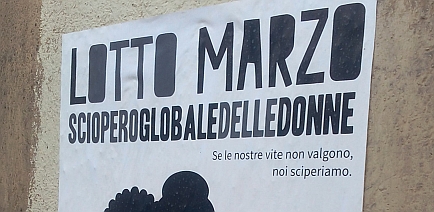
International feminist campaign
The Global Women's Strike is a movement that seeks to value all women's work and all women's lives around the world. Many countries (including Guyana, Haiti, the United States, the United Kingdom, India, Italy, Peru, Luxembourg and Ireland) actively participate in this campaign in an effort to grant women justice for their unacknowledged contribution in the labor force.
Background
Women and girls perform nearly two-thirds of the work in most given households. This work includes physical labor such as washing dishes, doing laundry, vacuuming, etc. but also emotional labor such as sending out birthday cards, organizing family vacations, preparing for holidays, etc. Much of this work in the household, while at times is referred to as a "second shift," remains unpaid. It is also not included in a country's gross national product or gross domestic product, although women's unpaid labor is estimated at nearly $11 trillion. Many of the women engaged in this campaign argue that a large portion of this problem can be traced back to the military-industrial complex. Over $1 trillion a year is spent on the military worldwide, owing a large portion of this spending to the United States. If 10% of this money was circulated back into the community, it could be used to provide essentials for living: water, basic health care, sanitation, nutrition programs, literacy programs, minimum wage. The Global Women's Strike, which is a result of the International Wages for Housework Campaign started by Selma James in 1972, seeks the recognition and payment for all caring work and the return of military spending to the community through a policy of "Invest in Caring, Not Killing".
Goals
The goals of the global campaign are:
- the payment of caring work of any kind, in money or in terms of other resources;
- obtaining more investments in welfare, possibly cutting military expenses;
- wages equity for women and men all around the global market;
- money, benefits and breaks for maternity and breastfeeding;
- Third World debt abolition;
- better accessibility to clean water, decent housing, healthcare, public transports and literacy.
- less working hours thanks to the use of technology;
- protection against violence and persecution of any kind and, where necessary, asylum;
- freedom of travel and movement.The No-nonsense Guide to Women's Rights, p. 127; Nikki van der Gaag, Verso, 2004.
References
Examples around the World
- Luxembourg Women's strike Fraestreik
References
- "8 marzo, sarà sciopero 'globale': donne in marcia in 40 Paesi del mondo", article by Maria Novella Deluca on the 8-3-2107 issue of ''[[La Repubblica]]'', see [http://www.repubblica.it/cronaca/2017/03/01/news/8_marzo_sara_sciopero_globale_donne_in_marcia_in_40_paesi_del_mondo-159523140/ www.repubblica.it]
- ''100 Women: Should mothers get living wage?'', 23 October 2013 article on [https://www.bbc.co.uk/news/av/world-24672374 www.bbc.co.uk]
- [https://www.theguardian.com/world/2000/mar/07/gender "Stop the world and change it: the global women's strike"], ''[[The Guardian]]'', 7 March 2000.
This article was imported from Wikipedia and is available under the Creative Commons Attribution-ShareAlike 4.0 License. Content has been adapted to SurfDoc format. Original contributors can be found on the article history page.
Ask Mako anything about Global Women's Strike — get instant answers, deeper analysis, and related topics.
Research with MakoFree with your Surf account
Create a free account to save articles, ask Mako questions, and organize your research.
Sign up freeThis content may have been generated or modified by AI. CloudSurf Software LLC is not responsible for the accuracy, completeness, or reliability of AI-generated content. Always verify important information from primary sources.
Report