From Surf Wiki (app.surf) — the open knowledge base
Gliese 436 b
Hot Neptune exoplanet orbiting Gliese 436

Hot Neptune exoplanet orbiting Gliese 436
| Field | Value |
|---|---|
| name | Gliese 436 b / Awohali |
| image | Exoplanet Comparison Gliese 436 b.png |
| caption | Size comparison of Awohali with Neptune |
| discovery_ref | |
| discoverer | Butler, Vogt, |
| Marcy et al. | |
| discovery_site | California, USA |
| discovered | August 31, 2004 |
| discovery_method | Radial velocity, Transit |
| alt_names | Awohali |
| apsis | astron |
| semimajor | |
| eccentricity | |
| period | |
| inclination | |
| time_periastron | |
| arg_peri | |
| semi-amplitude | |
| star | Gliese 436 |
| mean_radius | |
| mass | |
| density | |
| surface_grav | 1.27 g |
| albedo | ≤0.66 (Bond) |
| single_temperature | (662.8 K, dayside) |
Marcy et al. | semi-amplitude = Gliese 436 b (sometimes called GJ 436 b, formally named Awohali) is a Neptune-sized exoplanet orbiting the red dwarf Gliese 436 (Noquisi), the only known planet in its system. It was the first hot Neptune discovered with certainty (in 2007) and was among the smallest-known transiting planets in mass and radius, until the much smaller Kepler exoplanet discoveries began circa 2010.
In December 2013, NASA reported that clouds may have been detected in the atmosphere of GJ 436 b.
Discovery
Gliese 436 b was discovered in August 2004 by R. Paul Butler and Geoffrey Marcy of the Carnegie Institute of Washington and University of California, Berkeley, respectively, using the radial velocity method. Together with 55 Cancri e, it was the first of a new class of planets with a minimum mass (M sini) similar to Neptune.
The planet was recorded to transit its star by an automatic process at NMSU on January 11, 2005, but this event went unheeded at the time. In 2007, Michael Gillon from Geneva University in Switzerland led a team that observed the transit, grazing the stellar disc relative to Earth. Transit observations led to the determination of its exact mass and radius, both of which are very similar to that of Neptune, making Gliese 436 b at that time the smallest known transiting extrasolar planet. The planet is about four thousand kilometers larger in diameter than Uranus and five thousand kilometers larger than Neptune and slightly more massive. Gliese 436 b orbits at a distance of four million kilometers or one-fifteenth the average distance of Mercury from the Sun.
Naming
In August 2022, this planet and its host star were included among 20 systems to be named by the third NameExoWorlds project. The approved names, proposed by a team from the United States, were announced in June 2023. Gliese 436 b is named Awohali and its host star is named Noquisi, after the Cherokee words for "eagle" and "star". As stated in the IAU naming citation, the name refers to a Cherokee legend, alluding to the planet's evaporating atmosphere:
Physical characteristics
The planet's surface temperature is estimated from measurements taken as it passes behind the star to be 712 K. This temperature is significantly higher than would be expected if the planet were only heated by radiation from its star, which was prior to this measurement, estimated at 520 K. Whatever energy tidal effects deliver to the planet, it does not affect its temperature significantly. A greenhouse effect would result in a much greater temperature than the predicted 520–620 K.
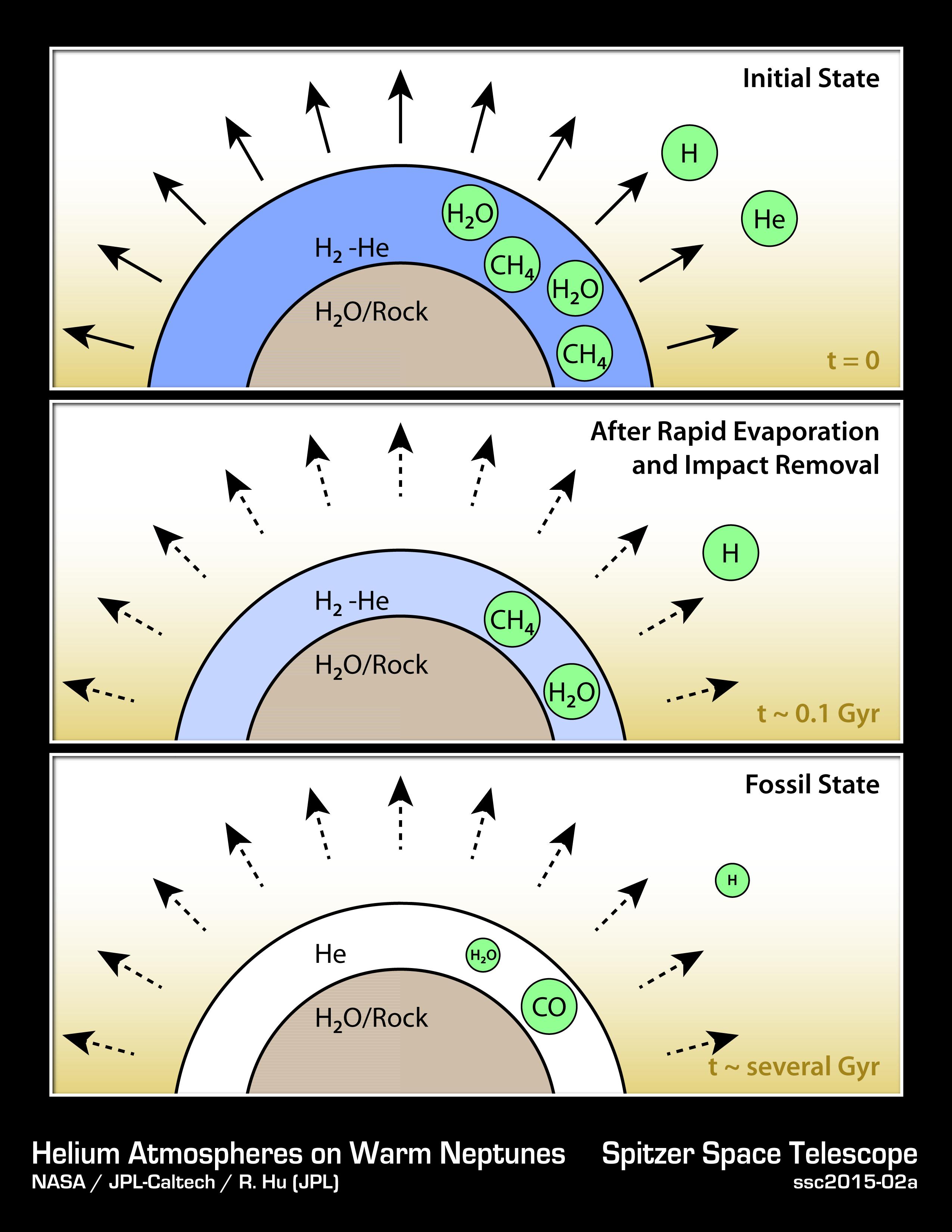
Its main constituent was initially predicted to be hot "ice" in various exotic high-pressure forms, which would remain solid despite the high temperatures, because of the planet's gravity. The planet could have formed further from its current position, as a gas giant, and migrated inwards with the other gas giants. As it approached its present position, radiation from the star would have blown off the planet's hydrogen layer via coronal mass ejection.
However, when the radius became better known, ice alone was not enough to account for the observed size. An outer layer of hydrogen and helium, accounting for up to ten percent of the mass, was needed on top of the ice to account for the observed planetary radius. This obviates the need for an ice core. Alternatively, the planet may consist of a dense rocky core surrounded by a lesser amount of hydrogen.
Observations of the planet's brightness temperature with the Spitzer Space Telescope suggest a possible thermochemical disequilibrium in the atmosphere of this exoplanet. Results published in Nature suggest that Awohali’s dayside atmosphere is abundant in CO and deficient in methane (CH4) by a factor of ~7,000. This result is unexpected because, based on current models at its temperature, atmospheric carbon should prefer CH4 over CO. In part for this reason, it has also been hypothesized to be a possible helium planet.
In June 2015, scientists reported that the atmosphere of Awohali was evaporating, resulting in a giant cloud around the planet and, due to radiation from the host star, a long trailing tail 9 e6mi long.
Orbital characteristics
One orbit around the star takes only about two days, 15.5 hours. Awohali orbit is likely misaligned with its star's rotation. The eccentricity of Awohali’s orbit is inconsistent with models of planetary system evolution. To have maintained its eccentricity over time requires that it be accompanied by another planet.
A study published in Nature found that the orbit of Awohali is nearly perpendicular (inclined by 103.2 degrees) to the stellar equator of Noquisi and suggests that the eccentricity and misalignment of the orbit could have resulted from interactions with a yet undetected companion. The inward migration caused by this interaction could have triggered the atmospheric escape that sustains its giant exosphere.
References
Selected media articles
- How Do Artists Portray Exoplanets They've Never Seen? 4/9, Scientific American October 2, 2007.
- Astronomers Detect Shadow Of Water World In Front Of Nearby Star (from Science Daily).
References
- (December 31, 2013). "Release 13-383 - NASA's Hubble Sees Cloudy Super-Worlds With Chance for More Clouds". [[NASA]].
- Moses, Julianne. (January 1, 2014). "Extrasolar planets: Cloudy with a chance of dustballs". [[Nature (journal).
- Knutson, Heather. (January 1, 2014). "A featureless transmission spectrum for the Neptune-mass exoplanet GJ 436b". [[Nature (journal).
- Kreidberg, Laura. (January 1, 2014). "Clouds in the atmosphere of the super-Earth exoplanet GJ 1214b". [[Nature (journal).
- (2008). "New observations and a possible detection of parameter variations in the transits of Gliese 436b". The Astrophysical Journal.
- (8 August 2022). "List of ExoWorlds 2022". [[International Astronomical Union.
- (2007). "Spitzer Transit and Secondary Eclipse Photometry of GJ 436b". The Astrophysical Journal.
- (2008). "Tidal Heating of Extra-Solar Planets". The Astrophysical Journal.
- Shiga, David. (6 May 2007). "Strange alien world made of "hot ice"". New Scientist.
- Fox, Maggie. (May 16, 2007). "Hot "ice" may cover recently discovered planet". Scientific American.com.
- H. Lammer. (2007). "The impact of nonthermal loss processes on planet masses from Neptunes to Jupiters". Geophysical Research Abstracts.
- Bean, J.L.. (2008). "A Hubble Space Telescope transit light curve for GJ 436b". Astronomy & Astrophysics.
- (February 2008). "Ocean Planet or Thick Atmosphere: On the Mass-Radius Relationship for Solid Exoplanets with Massive Atmospheres". [[The Astrophysical Journal]].
- (22 April 2010). "Possible thermochemical disequilibrium in the atmosphere of the exoplanet GJ 436b". Nature.
- [http://planets.ucf.edu/research/exoplanets/GJ436b-Wheres-the-methane GJ436b - Where's the methane?] {{webarchive. link. (2010-05-14 Planetary Sciences Group at the University of Central Florida, Orlando)
- (2011). "A ''Spitzer'' Transmission Spectrum for the Exoplanet GJ 436b". Astrophysical Journal.
- (2011). "Thermochemical and Photochemical Kinetics in Cooler Hydrogen Dominated Extrasolar Planets". Astrophysical Journal.
- (16 June 2015). "Helium-Shrouded Planets May Be Common in Our Galaxy". SpaceDaily.
- (25 June 2015). "A Giant Comet-like Cloud of Hydrogen Escaping from the warm Neptune-mass Exoplanet GJ 436b". [[Nature (journal).
- Bhanoo, Sindya N.. (25 June 2015). "A Planet with a Tail Nine Million Miles Long". [[New York Times]].
- "Hubble sees atmosphere being stripped from Neptune-sized exoplanet".
- (2008). "Observational Consequences of the Recently Proposed Super-Earth Orbiting GJ436". Astronomy & Astrophysics.
- (2022). "The polar orbit of the warm Neptune GJ 436b seen with VLT/ESPRESSO". Astronomy & Astrophysics.
- (2018). "Orbital misalignment of the Neptune-mass exoplanet GJ 436b with the spin of its cool star". Nature.
- (2004). "A Neptune-Mass Planet Orbiting the Nearby M Dwarf GJ 436". The Astrophysical Journal.
- M. Gillon. (2007). "Detection of transits of the nearby hot Neptune GJ 436 b". Astronomy and Astrophysics.
- Beust, Hervé. (August 1, 2012). "Dynamical evolution of the Gliese 436 planetary system - Kozai migration as a potential source for Gliese 436b's eccentricity". Astronomy.
- (2014). "A global analysis of Spitzer and new HARPS data confirms the loneliness and metal-richness of GJ 436 b". Astronomy and Astrophysics.
- (2018). "The CARMENES search for exoplanets around M dwarfs. First visual-channel radial-velocity measurements and orbital parameter updates of seven M-dwarf planetary systems". Astronomy and Astrophysics.
- "2022 Approved Names". [[International Astronomical Union.
- (April 2025). "A JWST Panchromatic Thermal Emission Spectrum of the Warm Neptune Archetype GJ 436b". [[The Astrophysical Journal Letters]].
This article was imported from Wikipedia and is available under the Creative Commons Attribution-ShareAlike 4.0 License. Content has been adapted to SurfDoc format. Original contributors can be found on the article history page.
Ask Mako anything about Gliese 436 b — get instant answers, deeper analysis, and related topics.
Research with MakoFree with your Surf account
Create a free account to save articles, ask Mako questions, and organize your research.
Sign up freeThis content may have been generated or modified by AI. CloudSurf Software LLC is not responsible for the accuracy, completeness, or reliability of AI-generated content. Always verify important information from primary sources.
Report