From Surf Wiki (app.surf) — the open knowledge base
Glenn Research Center
NASA research center in Ohio, US

NASA research center in Ohio, US
| Field | Value |
|---|---|
| agency_name | NASA John H. Glenn Research Center at Lewis Field |
| logo | NASA logo.svg |
| logo_width | 100px |
| seal_width | 140px |
| picture | Aerial View of Glenn Research Center at Lewis Field - GPN-2000-002008.jpg |
| picture_width | 220px |
| picture_caption | Aerial view of Glenn Research Center at Lewis Field |
| formed | 1942 |
| preceding1 | Aircraft Engine Research Laboratory |
| preceding2 | NASA Lewis Research Center |
| jurisdiction | Federal government of the United States |
| headquarters | Brook Park, Ohio, U.S. |
| coordinates | |
| chief1_name | James A. Kenyon |
| chief1_position | director |
| parent_agency | NASA |
| child1_agency | Neil A. Armstrong Test Facility |
| website |
NASA John H. Glenn Research Center at Lewis Field is a NASA center within the cities of Brook Park and Cleveland between Cleveland Hopkins International Airport and the Rocky River Reservation of Cleveland Metroparks, with a subsidiary facility in Sandusky, Ohio. Its director is James A. Kenyon. Glenn Research Center is one of ten major NASA facilities, whose primary mission is to develop science and technology for use in aeronautics and space. , it employed about 1,650 civil servants and 1,850 support contractors on or near its site.
In 2010, the formerly on-site NASA Visitors Center moved to the Great Lakes Science Center in the North Coast Harbor area of downtown Cleveland.
History
The installation was established in 1942 as part of the National Advisory Committee for Aeronautics (NACA) and was later incorporated into the National Aeronautics and Space Administration as a laboratory for aircraft engine research.
It was first named the Aircraft Engine Research Laboratory after funding was approved in June 1940. It was renamed the Flight Propulsion Research Laboratory in 1947, the Lewis Flight Propulsion Laboratory (LFPL) in 1948 (after George W. Lewis, the head of NACA from 1919 to 1947), and the NASA Lewis Research Center in 1958.
On March 1, 1999, the center was officially renamed the NASA John H. Glenn Research Center at Lewis Field, in honor of John Glenn, who was a fighter pilot, astronaut (the first American to orbit the Earth) and a politician.
As early as 1951, researchers at the LFPL were studying the combustion processes in liquid rocket engines.
Facilities
Neil A. Armstrong Test Facility

The 6400 acre NASA John H. Glenn Research Center at the Neil A. Armstrong Test Facility or just Neil A. Armstrong Test Facility, formerly the NASA John H. Glenn Research Center at Plum Brook Station or just Plum Brook Station, in southern Erie County, Ohio, near Sandusky, is also part of Glenn (). It is located about 50 mi from the main campus. It specializes in very large scale tests that would be hazardous on the main campus.
As of 2025, the station consists of five major facilities:
- Space Environments Complex
- In-Space Propulsion Facility
- Combined Effects Chamber
- Hypersonic Tunnel Facility
- NASA Electric Aircraft Testbed
The Plum Brook Reactor was decontaminated and decommissioned under a 2008 cost-plus-fee contract valued at more than $33.5 million.
In 2019 the U.S. senators from Ohio, Rob Portman and Sherrod Brown, proposed to rename Plum Brook Station after Neil Armstrong. The legislation was signed into law on December 30, 2020, and Plum Brook Station was renamed the Neil A. Armstrong Test Facility.
B-2 Spacecraft Propulsion Research Facility
Spacecraft Propulsion Facility Main article: Space Power Facility
The B-2 Spacecraft Propulsion Research Facility is the world's only facility capable of testing full-scale, upper-stage launch vehicles and rocket engines under simulated high-altitude conditions. The Space Power Facility houses the world's largest space environment vacuum chamber.
Icing Research Tunnel
The icing Research Tunnel is a wind tunnel capable of simulating atmospheric icing condition to test the effect of ice accretion on aircraft wings and body as well as to test anti-icing systems for aircraft.
Zero Gravity Research Facility
Main article: Zero Gravity Research Facility
The Zero Gravity Research Facility is a vertical vacuum chamber used for dropping experiment payloads for testing in microgravity. It enables the investigation of the behavior of components, systems, liquids, gases, and combustion when dropped in vacuum.
The facility consists of a concrete-lined shaft, 28 ft in diameter, that extends 510 ft below ground level. An aluminum vacuum chamber, 20 ft in diameter and 470 ft high, is contained within the concrete shaft. The pressure in this vacuum chamber is reduced to 13.3 newtons per square meter (1.3atm) before use.
The facility also includes a smaller drop tower with a free fall time of 2.2 seconds and a much lower cost per drop. It is used for the Dropping in a Microgravity Environment (DIME) and What if No Gravity (WING) educational programs.
The facility was designated a National Historic Landmark in 1985. It has been the world's largest microgravity facility since the 2003 closing of the Japan Microgravity Centre.
Developments
Aeronautics science and technology
NASA Glenn does research and technology development on jet engines, producing designs that reduce energy consumption, pollution, and noise. The chevrons it developed for noise reduction appear on many commercial jet engines today, including those used on the Boeing 787 Dreamliner.
Space science and technology
The Glenn Research Center, along with companies it has hired, are credited with the following:
- The liquid hydrogen rocket engine, which Wernher von Braun called the critical technology that allowed the Apollo Moon landings.
- The Centaur upper-stage rocket
- The gridded ion thruster, a high-efficiency engine for spaceflight. A Glenn-derived ion engine was used on the NASA probe Deep Space 1.
- The Electrical Power System for Space Station Freedom. A slightly modified version is used on the International Space Station.
- The Universal Stage Adapter for the planned Block 1B iteration of the Space Launch System (SLS).
Contributions
NASA Glenn's core competencies are:
- Air-breathing propulsion
- Communications technology and development
- Space propulsion and cryogenic fluids management
- Power, energy storage, and conversion
- Materials and structures for extreme environments
Education
The Glenn Research Center is home to the Lewis' Educational and Research Collaborative Internship Program (LERCIP). It provides internships for high school and college students and high school teachers. The high school program is an eight-week internship for sophomores and juniors with interests in science, technology, engineering, math, or professional administration. The college level consists of a 10-week internship and is open to college students at all levels. Only residents of the Cleveland area are eligible for high school LERCIP, but college LERCIP is open to students nationwide. Interns work closely with their NASA mentors and are involved in the daily activities of the center. They are expected to be available to work 40 hours a week for the duration of the internship. The LERCIP Teacher program is a 10-week internship for educators in STEM fields.
Other
The Dropping In Microgravity Environment is an annual contest held yearly by the center. Teams of high school students write proposals for experiments to be performed in the Drop Tower. The winners travel to the center, perform their experiments, and submit a research report to NASA.
Future
After 2004, NASA had been shifting its focus towards space exploration as mandated by the Vision for Space Exploration. Because of this, it was perceived by some that regional NASA centers like Glenn, which focus on research and technology, were becoming more and more marginalized in terms of resources and relevance. However, on May 13, 2006, it was announced that NASA Glenn Research Center had secured management of the Crew Exploration Vehicle's service module, which promised to generate billions of dollars and hundreds of jobs for the center. This work secured the center's future in the near term, and signalled a shift in priority for the center from aeronautical research to space exploration, aligning itself closer with NASA's new mission.
Another change of direction created uncertainty in 2010, however, when President Obama and Congress declared the end of the Vision for Space Exploration and sought to chart a new course for human space flight and NASA. However, the 2015 budget for NASA made substantial increases to projects in which the Research Center participates, such as aeronautics research, planetary science and space technology, and some of that funding was expected to flow down to the center.
Center directors
These people served as the director of the Glenn Research Center:
| No. | Image | Director | Start | End | Notes | |
|---|---|---|---|---|---|---|
| 1 | [[File:Edward R. Sharp.jpg | 70px]] | Edward R. Sharp | May 1942 | June 1947 | Manager, NACA Aircraft Engine Research Laboratory |
| June 1947 | September 1948 | Director, NACA Aircraft Engine Research Laboratory, | ||||
| September 1948 | September 1958 | NACA Lewis Flight Propulsion Laboratory | ||||
| October 1, 1958 | December 31, 1960 | Director NASA LeRC | ||||
| Acting | [[File:Eugene Manganiello.jpg | 70px]] | Eugene J. Manganiello | January 1, 1961 | October 31, 1961 | |
| 2 | [[File:Abe Silverstein.jpg | 70px]] | Abe Silverstein | November 1, 1961 | October 31, 1969 | |
| 3 | [[File:Bruce T. Lundin official portrait.webp | 70px]] | Bruce T. Lundin | November 1, 1969 | August 26, 1977 | |
| Acting | [[File:Bernard Lubarsky.jpg | 70px]] | Bernard Lubarsky | August 27, 1977 | September 30, 1978 | |
| 4 | [[File:John F. McCarthy Jr.jpg | 70px]] | John F. McCarthy Jr. | October 1, 1978 | June 21, 1982 | |
| 5 | [[File:Andrew J. Stofan.jpg | 70px]] | Andrew J. Stofan | June 22, 1982 | June 29, 1986 | |
| Acting | [[File:Director at the Glenn Research Center and Goddard Space Flight Center John M. Klineberg.jpg | 70px]] | John M. Klineberg | June 30, 1986 | May 28, 1987 | |
| 6 | May 29, 1987 | June 30, 1990 | ||||
| 7 | [[File:Lawrence J. Ross.jpg | 70px]] | Lawrence J. Ross | July 1, 1990 | February 28, 1994 | |
| 8 | [[File:Donald J. Campbell.webp | 70px]] | Donald J. Campbell | March 1, 1994 | September 30, 2003 | |
| 9 | [[File:Dr Julian Manly Earls.jpg | 70px]] | Julian M. Earls | October 1, 2003 | December 25, 2005 | |
| 10 | [[File:Whitlow Woodrow.jpg | 70px]] | Woodrow Whitlow Jr. | December 25, 2005 | February 2010 | |
| Acting | [[File:Ramon Lugo III.jpg | 70px]] | Ramon Lugo III | March 1, 2010 | July 17, 2010 | |
| 11 | July 18, 2010 | January 3, 2013 | ||||
| 12 | [[File:NASA Associate Administrator Jim Free Official Portrait (NHQ202411220001).jpg | 70px]] | James M. Free | January 4, 2013 | March 13, 2016 | |
| 13 | [[File:JanetLKavandi-NASA.jpg | 70px]] | Janet L. Kavandi | March 14, 2016 | September 31, 2019 | |
| Acting | [[File:Marla E. Pérez-Davis official portrait (cropped).jpg | 70px]] | Marla E. Perez-Davis | October 1, 2019 | January 23, 2020 | |
| 14 | January 24, 2020 | June 17, 2022 | ||||
| Acting | [[File:James A. Kenyon official portrait.webp | 70px]] | James A. Kenyon | June 17, 2022 | November 6, 2022 | |
| 15 | November 7, 2022 | present |
NASA Glenn Visitor Center
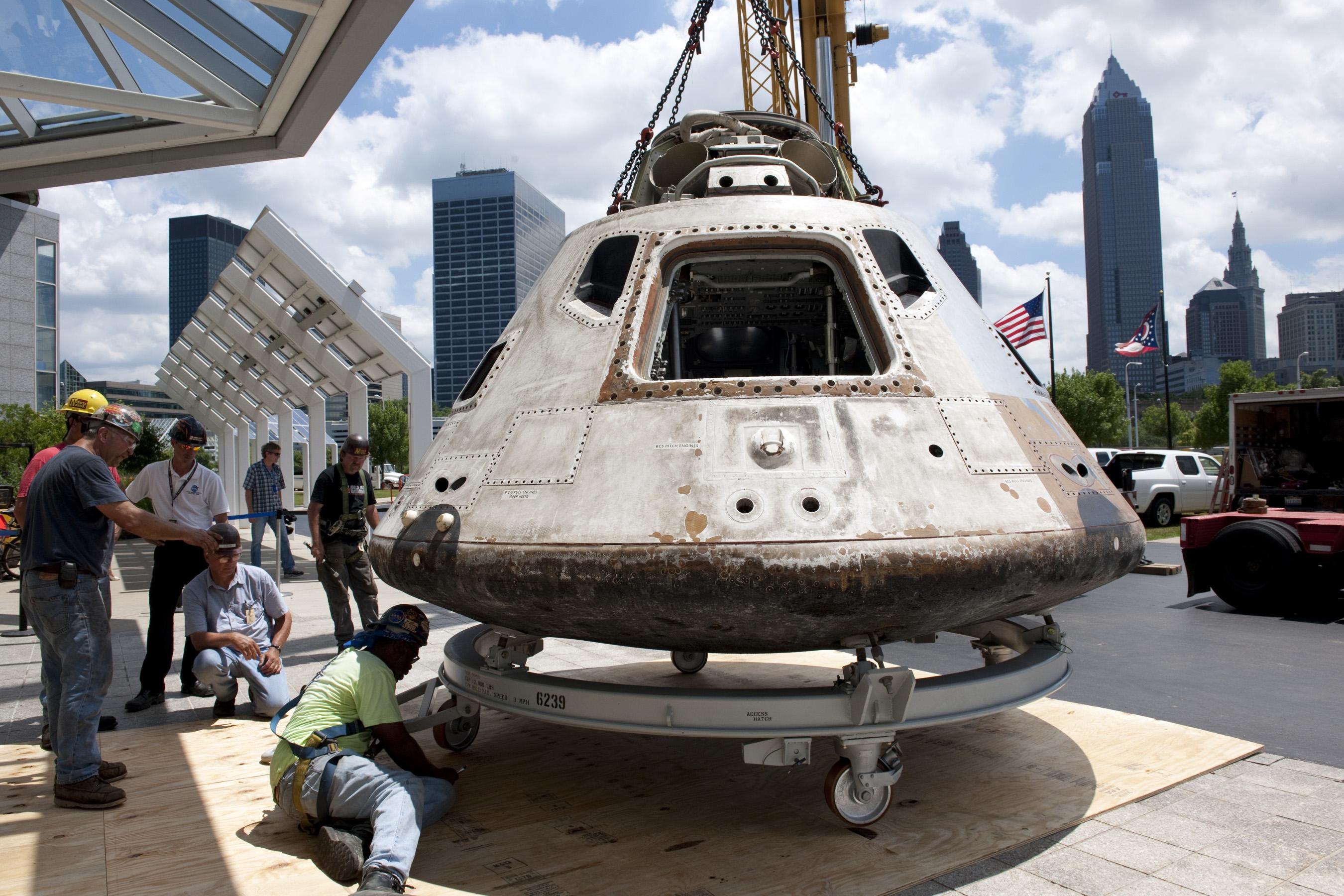
In September 2009, the Glenn Research Center closed its Visitor Center and sent many of its displays to the Great Lakes Science Center. The move was intended to reduce the public-relations budget; provide easier access to the general public, especially the under-served community; and bring the NASA Glenn facility more public exposure by putting the displays at the much more visited science center in Cleveland. Compared to the 60,000 visitors per year at its former site, the new Glenn Visitor Center section of the Great Lakes Science Center drew 330,000 visitors in its first year.
The NASA Glenn Research Center offers public tours of its research facilities on the first Saturday of each month. Reservations must be made in advance.
References
References
- (2019-11-22). "NASA's Glenn Research Center to make special public presentation at Great Lakes Science Center on Orion spacecraft!".
- "NACA TN-2349, Fluctuations in a spray formed by two impinging jets". [[National Advisory Committee for Aeronautics]].
- (17 March 2015). "NASA's Neil A. Armstrong Test Facility".
- "NASA Glenn Test Facilities". [[National Aeronautics and Space Administration]].
- "Neil Armstrong Test Facility - NASA".
- (May 29, 2008). "NASA Awards Reactor Decontamination and Decommission Contract". [[NASA]].
- [https://www.dispatch.com/news/20190721/sherrod-brown-rob-portman-want-to-rename-ohio-nasa-facility-after-neil-Armstrong Sherrod Brown, Rob Portman want to rename Ohio NASA facility after Neil Armstrong] {{Webarchive. link. (2021-03-06 Retrieved July 21, 2019)
- {{USBill. 116. s. 2472
- Portman, Rob. (December 30, 2020). "Portman, Brown Announce Bipartisan Legislation to Rename NASA's Plum Brook Station Test Facility After Neil Armstrong Signed Into Law".
- "Plum Brook Station". NASA.
- (January 6, 2015). "NASA Contribution: Chevrons". NASA.
- [http://www.hq.nasa.gov/office/pao/History/SP-4404/cover.htm] {{webarchive. link. (October 29, 2006)
- (September 27, 2013). "Glenn Ion Propulsion Research Tames the Challenges of 21st Century Space Travel". NASA.
- "Universal Stage Adapter (USA)".
- (15 July 2015). "Shaping the World of Tomorrow". NASA.
- (September 29, 2013). "USA.gov". NASA.
- (2011-01-04). "Student Drop Tower Competitions: Dropping In a Microgravity Environment (DIME) and What If No Gravity? (WING)". American Institute of Aeronautics and Astronautics.
- "Northeast Ohio". [[Cleveland.com]].
- (January 11, 2015). "Beefed-up budget is big development for NASA Glenn".
- "Personnel". NASA.
- "Edward R. Sharp". NASA.
- "Abe Silverstein". NASA.
- "Bruce T. Lundin". NASA.
- "John F. McCarthy". NASA.
- "Andrew J. Stofan". NASA.
- "John M. Klineberg". NASA.
- "Lawrence J. Ross". NASA.
- "Donald J. Campbell". NASA.
- "Julian M. Earls". NASA.
- "Woodrow Whitlow, Jr.". NASA.
- "Ramon Lugo III". NASA.
- "James Free". NASA.
- "Janet L. Kavandi". NASA.
- "Marla Perez-Davis". NASA.
- "Dr. James A. Kenyon". NASA.
- "Cleveland Plain Dealer | Cleveland, Ohio Newspaper". cleveland.com.
- (2009-07-15). "NASA Glenn visitors center offers its exhibits to Great Lakes Science Center". cleveland.com.
This article was imported from Wikipedia and is available under the Creative Commons Attribution-ShareAlike 4.0 License. Content has been adapted to SurfDoc format. Original contributors can be found on the article history page.
Ask Mako anything about Glenn Research Center — get instant answers, deeper analysis, and related topics.
Research with MakoFree with your Surf account
Create a free account to save articles, ask Mako questions, and organize your research.
Sign up freeThis content may have been generated or modified by AI. CloudSurf Software LLC is not responsible for the accuracy, completeness, or reliability of AI-generated content. Always verify important information from primary sources.
Report