From Surf Wiki (app.surf) — the open knowledge base
Glenelg, South Australia
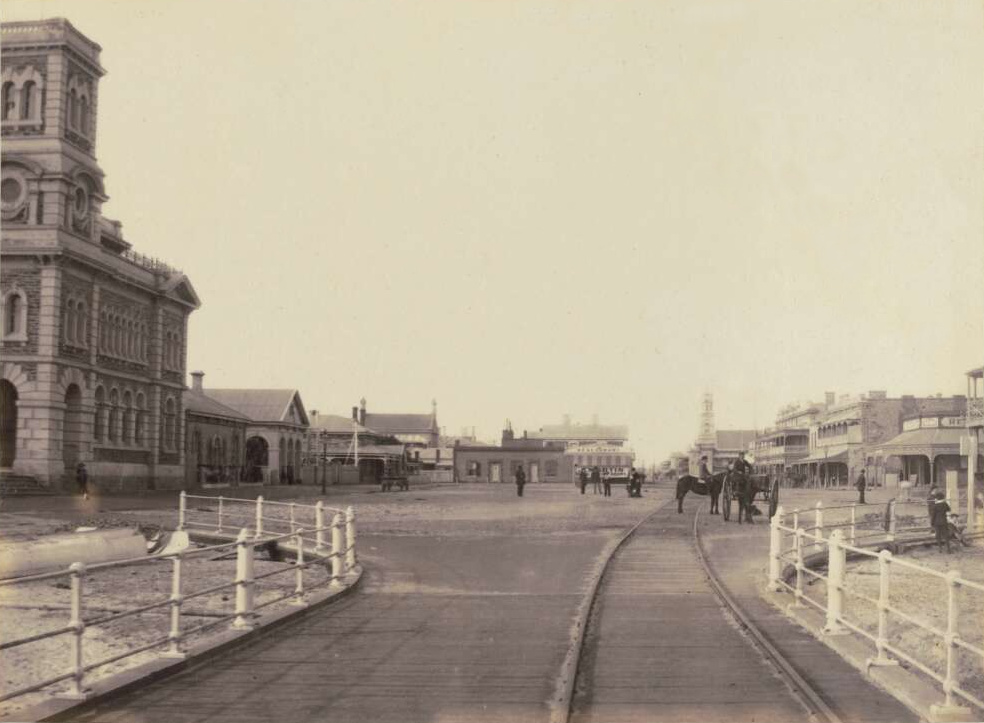
| Field | Value | |
|---|---|---|
| type | suburb | |
| name | Glenelg | |
| city | Adelaide | |
| state | sa | |
| image | Glenelg Town Hall 2015.jpg | |
| caption | Glenelg Town Hall and Moseley Square | |
| alternative_location_map | Australia SA inner Adelaide | |
| pushpin_map_caption | Location in greater metropolitan Adelaide | |
| coordinates | ||
| local_map | yes | |
| zoom | 13 | |
| local_map_id | Q3108740 | |
| pop | ||
| established | 1836 | |
| postcode | 5045 | |
| area | 0.88 | |
| area_footnotes | ||
| location1 | Adelaide CBD | dist1 = 9 |
| location2 | Port Adelaide | dist2 = 15 |
| location3 | Adelaide Airport | dist3=5 |
| lga | City of Holdfast Bay | |
| stategov | Morphett | |
| fedgov | Boothby | |
| near-n | Glenelg North | |
| near-ne | Glenelg North | |
| near-e | Glenelg East | |
| near-se | Glenelg East | |
| near-s | Glenelg South | |
| near-w | Gulf St Vincent | |
| footnotes | Adjoining suburbs |
| timezone-dst = | utc-dst = | near-n = Glenelg North | near-ne = Glenelg North | near-e = Glenelg East | near-se = Glenelg East | near-s = Glenelg South | near-sw = | near-w = Gulf St Vincent | near-nw = Glenelg is a beach-side suburb of the South Australian capital of Adelaide. Located on the shore of Holdfast Bay in Gulf St Vincent, it has become a tourist destination due to its beach and many attractions, home to several hotels and dozens of restaurants.
Established in 1836, it is the oldest European settlement on mainland South Australia. It was named after Lord Glenelg, a member of British Cabinet and Secretary of State for War and the Colonies. Through Lord Glenelg the name derives from Glenelg, Highland, Scotland.
History


Prior to the 1836 British colonisation of South Australia, Glenelg and the rest of the Adelaide Plains was home to the Kaurna group of Aboriginal Australians. They knew the area as "Pattawilya" and the local river as "Pattawilyangga", now named the Patawalonga River.
Prior to European settlement huge oyster reefs of Australian flat oysters (Ostrea angasi, also known as the Southern mud oyster) existed off the coast of Glenelg. Oysters were of huge importance as a food source for Indigenous Australians at many locations around Australia, but the extensive reefs were decimated after colonisation; it is estimated that in South Australia alone, at least 1500 km of coastal reefs were destroyed by the 21st century. Oyster fishing was practised by the early settlers, and much of the damage was caused by using dredging to collect the oysters, which led to the reefs being damaged.
Settlement
The first British settlers set sail for South Australia in 1836. Several locations for the settlement were considered, including Kangaroo Island, Port Lincoln and Encounter Bay. The Adelaide plains were chosen by Colonel William Light, and Governor John Hindmarsh proclaimed the province of South Australia at the site of The Old Gum Tree in Glenelg North on 28 December 1836.
The first post office in Glenelg opened on 5 December 1849; the first postmaster was John McDonald of the St Leonard's Inn. A telegraph office was opened in September 1859 and the two offices amalgamated in 1868. The present post office building on Moseley Square was built in 1912.
The sale of the surveyed lots that constitute the Town of Glenelg was remarkable: the right to purchase, at £1 per "town acre", was allocated by means of a ballot held in February 1839. The "winner" was a syndicate of six led by William Finke, with Osmond Gilles, his nephew John Jackson Oakden and H. R. Wigley (father of W. R. Wigley) notable members.
Among the town's earliest public buildings were the Independent (Congregational) church, opened 7 March 1848, St Peter's (Anglican) church, opened 28 March 1852 and the Pier Hotel, opened Christmas Day 1856, all the work of Henry J. Moseley, for whom Moseley Street and Moseley Square were named. No trace of the original structures remains.
The Corporate Town of Glenelg was proclaimed in 1855, separating local governance of the township of Glenelg from that of the West Torrens and Brighton district councils. Construction of the Glenelg Institute, which is now the Glenelg Town Hall, started in December 1875. The institute opened in 1877, with lecture rooms, a concert hall and a library. The classical structure was designed by Edmund Wright, whose works include the Adelaide Town Hall and Adelaide General Post Office on King William Street. The hall sits on Moseley Square, just off the beach. The Holdfast Bay city council acquired the hall in 1887. Today it houses a museum, tourist information centre and restaurants.
Jetty
Construction of Glenelg's first jetty commenced in August 1857. It was opened on 25 April 1859. The structure was 381 metres (1,250 ft) long and cost over £31,000 to build. It served fishermen and maritime traders, including a mail service operated by P&O, until Port Adelaide replaced it as Adelaide's main port. Passengers were also able travel from the Glenelg jetty to Kangaroo Island by steamer.
Various additions to the jetty were made, none of which stand today. A lighthouse was built in 1872 at the jetty's end, but a year later it caught fire and was cast into the sea to save the rest of the structure. A replacement lighthouse was built in 1874, and was 12.1 metres (40 ft) tall. Other additions included public baths, an aquarium, a police shed and a three-story kiosk with tea rooms.
The jetty kiosk was wrecked in a storm in 1943, and the jetty was severely damaged by a freak cyclone in 1948. Most of the structure washed away and the remaining structure was deemed unsafe. Just two weeks later, the local council began drafting plans for a new jetty and construction was completed in 1969. The new structure was just 215 metres (705 ft) long, less than two-thirds of the length of the original jetty. The second jetty continues to stand today, at the end of Jetty Road.
On 1 January 2016, two boys were drowned after falling into the water from rocks to north of the jetty.
The Glenelg Blocks
An ill-fated breakwater construction project was conceived in the early 1900s, intended to create an artificial harbour for the protection of yachts and the local fishing fleet. Parliamentary approval was granted in 1905. In 1909 and 1910, work was dogged by losses of machinery to rough seas and concrete piles that shattered when driven. Pile-driving for seabed study had some success in 1913. By mid-1916 the project remained incomplete and its future was uncertain. In 1918, the contractors took legal action against the Government seeking damages of £80,000. By 1919, the project had become an embarrassment and an "eye sore" without providing a safe harbour as originally intended. Today, the structures are heavily eroded and are colonised with marine life. The site is an artificial reef known to divers and snorkelers as "The Blocks" or "The Glenelg Blocks".
Amusement parks
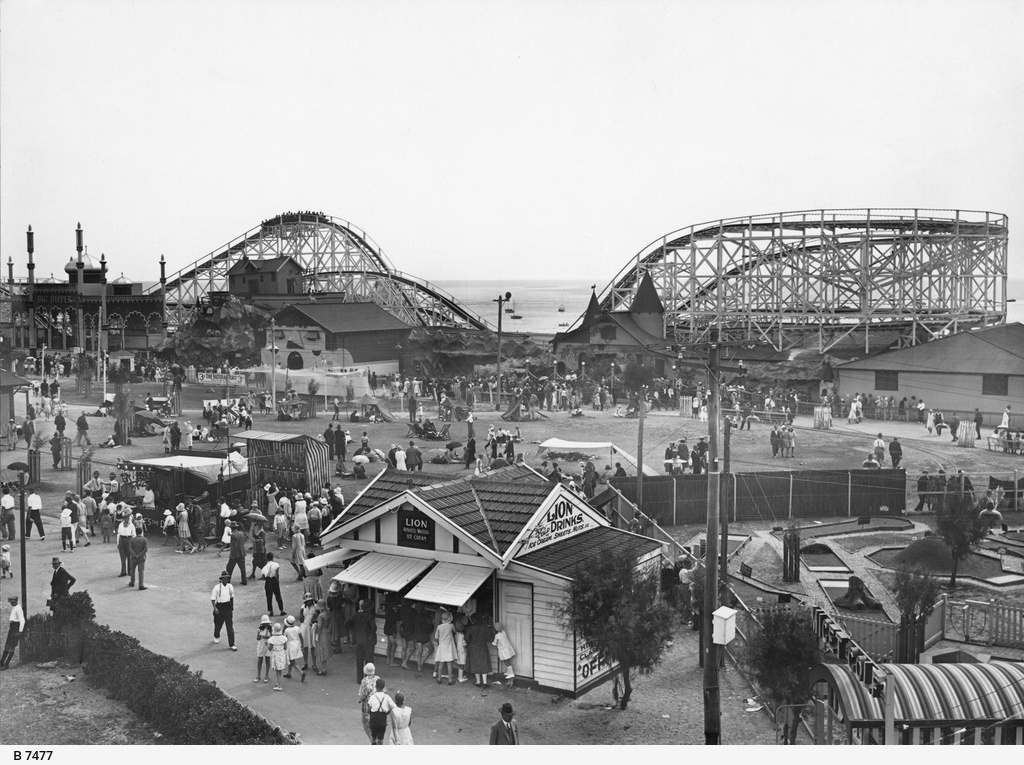
Glenelg has been a popular spot for recreation and leisure for much of its history. Following the success of Luna Park, Melbourne, a similar amusement park was constructed on Glenelg's foreshore in 1930. Luna Park Glenelg was placed in voluntary liquidation in 1934, and all the rides (excluding a single carousel) were disassembled, purchased by the directors, and transported to Sydney, where they were used in the construction of Luna Park Sydney. The park's managers claimed that the reasons for the closure were the inability to make money from the park as it was, and opposition to changes from Council and residents, who were afraid that "undesirables" would be attracted to the area.
Built near the former Luna Park site was Magic Mountain, which first opened in 1982. It featured water slides, mini-golf, bumper boats, dodgem cars and many other amusements and was popular with many Adelaide residents. It was also extensively criticised, called an eyesore and likened to a "giant dog dropping" in the media; despite this it was very popular with young children and teenagers. As part of the Holdfast Shores development, Magic Mountain was finally demolished in 2004 and replaced with The Beachouse, a 5-storey modern centre with a more conservative design which still incorporates the historic carousel; it opened in mid-2006. Since its opening, The Beachouse has been a widely popular attraction of the Glenelg area, appealing to both adults and children. A 25-metre single-arm Ferris wheel was a prominent feature of the area until its closure.
Wastewater treatment plant
South Australia's second largest wastewater treatment plants is located in Glenelg. It was first established in 1933, and was upgraded in 1945, 1962, 1973 and most recently in 2002. A pipeline pumps 2.8 gigalitres of treated wastewater to Adelaide where it is used to irrigate green spaces, such as parks and ovals. The facility also conducts tours for school groups and visitors to learn about water supply and treatment. The plant also returns treated wastewater to the ocean. The most significant pollutants discharged to the sea (by mass) in 2018/19 were: nitrogen (180 tonnes), phosphorus (78 tonnes), chlorine (32 tonnes), ammonia (14 tonnes), fluoride (14 tonnes) and zinc (1 tonne).
High-rise development

Atlantic Tower was built in the late 1970s and was Adelaide's tallest residential building at the time. The fourteen-story tower featured a revolving restaurant on its top floor, and was part of a larger development plan that never eventuated. Many other high-rise buildings exist in Glenelg, including the fifteen-story Stamford Grand hotel on Moseley Square, built in 1990, and the twelve-story Liberty Towers, built in 2004.
The Holdfast Shores development, starting in the late 1990s, included the construction of the Marina Pier apartment building with its own private marina in Glenelg North, and the Pier Hotel, founded 2001, and unrelated to the historic Pier Hotel on Moseley Square. The development was met with strong opposition, from both local residents and the City of Holdfast Bay, fearing overdevelopment would ruin the area. Parts of the plan were scaled back, with the Platinum Apartment building scaled down from fifteen stories to nine, and the cinema complex cancelled.
Demographics
|2001|2865 |2006|3125 |2011|3448 |2016|3349}} The 2016 Census by the Australian Bureau of Statistics counted 3,349 persons in Glenelg on the night of the census. The majority of residents are of Northern European descent, and almost two-thirds of residents are at least second generation Australian. Glenelg is a predominantly Christian community, with common affiliations, in descending order, Catholic, Anglican, no religion and Uniting.
The age distribution of Glenelg residents is skewed upwards more so than that of the Australian population. 26.4% of persons were 65 years or older in 2001, compared to the Australian average of 12.6%. 20.4% of persons were younger than 25 years, compared to the Australian average of 34.5%.
Transport


The suburb is bordered by Anzac Highway, (the road link to the Adelaide city centre), to the north, Brighton Road to the west and Pier Street to the south. Jetty Road is the main shopping strip in the suburb, and runs down the middle. Adelaide Metro operates several bus services from Glenelg to various destinations including the central business district and Adelaide Airport. The local council operates a free loop bus service in the area.
Glenelg is the terminus of the Glenelg tram line, which runs from Moseley Square, along Jetty Road through Glenelg, to the Adelaide Entertainment Centre. The route dates back to 1873.
Features and attractions


The wide beach is popular with visitors and locals alike, and tourists to Adelaide often visit Glenelg. To the north is the mouth of the Patawalonga River, which has been dammed to create an artificial lake which is used as a boat harbour, with a lock down to the sea. This is a popular spot for recreational boating.
A replica of was constructed in 1980 on the shore of the Patawalonga, with the appearance of being moored in the artificial lake, with a restaurant operating on it. It was demolished in 2019, after its popularity declined and it was no longer viable as a business.
Jetty Road is a long ribbon of shops, entertainment facilities and other commercial activities and is the main shopping precinct in Glenelg.
There is an annual celebration of the Epiphany for the Orthodox faithful of Adelaide, accompanied by the Greek festival of the Theophany.
A shark museum owned and operated by conservationist and shark attack survivor Rodney Fox once operated in Glenelg. Many of its former exhibits were leased to the South Australian Whale Centre, Victor Harbor, in 2008.
Sport
Glenelg is home to a team in the South Australian National Football League (SANFL), the Glenelg Tigers, and the Glenelg Seahorses in the South Australian Grade Cricket League
Reef restoration
In late 2020, The Nature Conservancy used a large barge to scatter several hundred tonnes of stone across the sea floor about 1 km offshore, to create 2 ha of substrate for a new oyster reef for the native angasi oyster, which had been nearly eliminated in Australian waters by over-harvesting and dredging during the 19th and early 20th centuries. Oyster reefs and seagrass beds help to protect coastlines from the effects of storm events and climate change, as well as offering the benefits of greater biodiversity, which helps to protect fish stocks, and protection from extremes of temperatures, which can threaten vulnerable species.
Politics
| Family First | 3.0% |
|---|
| Family First | 1.4% |
|---|
| Bob Patton | Mikki Bouchée |
|---|
Since 1985 Glenelg has been located in the Electoral district of Morphett for the South Australian House of Assembly. It was previously in the seat of Glenelg. The current sitting member is Stephen Patterson of the Liberal Party of Australia, who has held the seat since 2018. Federally, Glenelg is in the Division of Boothby and has been held by Louise Miller-Frost of the Australian Labor Party since the 2022 election.
Notable residents
- Tom Jay Williams – singer and songwriter, former resident
- Rhea Ripley – WWE wrestler, former resident
References
References
- "Search results for 'Glenelg, SUB' with the following datasets selected - 'Suburbs and localities', 'Counties', 'Local Government Areas', 'SA Government Regions' and 'Gazetteer'". South Australian Government.
- (3 January 1911). "Buffalo Row". [[The Daily Telegraph (Launceston).
- [http://www.slsa.sa.gov.au/manning/pn/g/glenelg4.htm The Manning Index of South Australian History > Place Names of South Australia > Glenelg] State Library of South Australia. Retrieved 15 November 2018.
- Allen, Yvonne. (2001). "''Footprints in the sand. Kaurna life in the Holdfast Bay Area''". Aboriginal Research Unit, University of South Australia.
- Bradley, James. (February 2021). "A reef history of time".
- City of Holdfast Bay. "Heritage and History".
- Walker, Martin (2004) ''The Post, Telegraph and Telephone Offices of South Australia and the Northern Territory'', Torrensville, South Australia: published by the author, p. 127 {{ISBN. 0-9757019-0-8
- eguide Pty Ltd. "Glenelg". Adelaide eguide.
- (9 February 1839). "Choice of the Township of Glenelg and the new Port Section". [[South Australian Register.
- (7 July 1894). "Death of Mr. H. J. Moseley". [[The Advertiser (Adelaide)]].
- City of Holdfast Bay, [https://www.holdfast.sa.gov.au/assets/general-downloads/Discover/Historic-Walk-Glenelg-DL.pdf Historic Glenelg: A Self-Guided Walk], O1: Glenelg Town Hall, accessed on 16 September 2024
- (2006). "Bay Discovery Centre". City of Holdfast Bay.
- "The Glenelg Town Hall and Bay Discovery Centre". NWS 9 Adelaide.
- Reynolds, Steve. (2002). "The Glenelg Jetty". Marine Life Society of South Australia, Inc..
- (12 February 1910). "KANGAROO ISLAND.". Observer.
- (2002). "Glenelg Jetty Exhibit: In the Adelaide Coast region of South Australia". NWS 9 Adelaide.
- Rogers, Tony; (2009), ''South Australia’s Extreme Weather: Its Human Impact'', Australian Metrological Association Incorporated, Kent Town SA, pages 113-123. ({{ISBN. 978 0 646 51841 1)
- Reynolds, Steve. (2002). "The Glenelg Jetty (Part 2)". [[Marine Life Society of South Australia]], Inc..
- "Attractions Within Holdfast". City of Holdfast Bay.
- "Two children killed in Glenelg seaside tragedy". The Advertiser.
- (1912-05-20). "GLENELG BREAKWATER.". Express and Telegraph.
- (1909-06-15). "GLENELG BREAKWATER.". Register.
- (1910-02-21). "GLENELG BREAKWATER.". Register.
- (1913-05-09). "GLENELG BREAKWATER.". Register.
- (1916-07-20). "GLENELG BREAKWATER.". Register.
- (1918-02-01). "GLENELG BREAKWATER.". Register.
- (1919-12-30). "GLENELG BREAKWATER.". Register.
- Ron. "15 Dec: Shore Dive @ Glenelg Jetty & Blocks".
- Marshall, Sam. (2005). "''Luna Park - Just for fun''". Luna Park Sydney Pty Ltd.
- Ashley Walsh, ABC Adelaide. (2004). "Farewell Magic Mountain".
- (10 June 2007). "Ferris wheel for Bay". News Limited.
- "Glenelg WWTP".
- "2018/2019 report for SOUTH AUSTRALIAN WATER CORPORATION, Glenelg Wastewater Treatment Plant - Glenelg North, SA".
- (2006). "Atlantic Tower". Emporis Buildings.
- (2006). "Stamford Grand". Emporis Buildings.
- City of Holdfast Bay. (2004). "Profound Regret and Disappointment, Apartments to go ahead on Glenelg foreshore".
- {{Census 2011 AUS
- [https://www.adelaidemetro.com.au/content/download/959215/5013292/file/Adelaide_Trams_routemap_03-11-19[2].pdf Adelaide trams map] {{Webarchive. link. (11 March 2020 Adelaide Metro)
- [https://www.trammuseumadelaide.com/the-western-lines The Western Lines] [[Tramway Museum, St Kilda]]
- Boisvert, Eugene. (30 January 2019). "City of Adelaide ship deadline approaches, Buffalo replica to be demolished".
- (7 May 2019). "HMS Buffalo Australia".
- [https://www.victor.sa.gov.au/__data/assets/pdf_file/0033/289572/2007-08-ANNUAL-REPORT.pdf 2007-08 Annual Report - City of Victor Harbor] Retrieved 28 February 2021.
- [http://www.abc.net.au/news/2015-02-20/researchers-rediscover-lost-oyster-reefs/6160464 Adelaide University researchers have discovered the loss of oyster reefs believed to have disappeared over 70 years ago due to dredging in South Australia] ''ABC News'', 23 February 2015. Retrieved 1 March 2021.
- [https://indaily.com.au/eat-drink-explore/features/2017/06/28/restored-sa-reef-seeks-to-turn-the-tide-for-oysters/ Restored SA reef seeks to turn the tide for oysters] ''InDaily'', 28 June 2017. Retrieved 1 March 2021.
- [https://www.abc.net.au/news/2021-02-12/native-flat-oyster-revival-underway-in-south-australia/13143908 Reef revival at full steam off Glenelg as 'eco-engineering' oysters create marine hubs] ''ABC News'', 12 February 2021. Retrieved 1 March 2021.
- State Electoral Office, South Australia. (December 2019). "District of Morphett - Polling Booth Results".
- Australian Electoral Commission. (2007). "Polling Place Results - Glenelg Central".
- Local Government Association of South Australia. (2006). "Election Results".
- The Poll Bludger. (2006). "South Australian House of Assembly Election 2006. Morphett".
- "Morphett - ECSA".
This article was imported from Wikipedia and is available under the Creative Commons Attribution-ShareAlike 4.0 License. Content has been adapted to SurfDoc format. Original contributors can be found on the article history page.
Ask Mako anything about Glenelg, South Australia — get instant answers, deeper analysis, and related topics.
Research with MakoFree with your Surf account
Create a free account to save articles, ask Mako questions, and organize your research.
Sign up freeThis content may have been generated or modified by AI. CloudSurf Software LLC is not responsible for the accuracy, completeness, or reliability of AI-generated content. Always verify important information from primary sources.
Report