From Surf Wiki (app.surf) — the open knowledge base
Glacial period
Geological Era
Geological Era
A glacial period (alternatively glacial or glaciation) is an interval of time (thousands of years) within an ice age that is marked by colder temperatures and glacier advances. Interglacials, on the other hand, are periods of warmer climate between glacial periods. The Last Glacial Period ended about 15,000 years ago. name="Severinghaus1999" The Holocene is the current interglacial. A time with no glaciers on Earth is considered a greenhouse climate state.{{Cite journal
Quaternary Period
Main article: Quaternary glaciation, timeline of glaciation
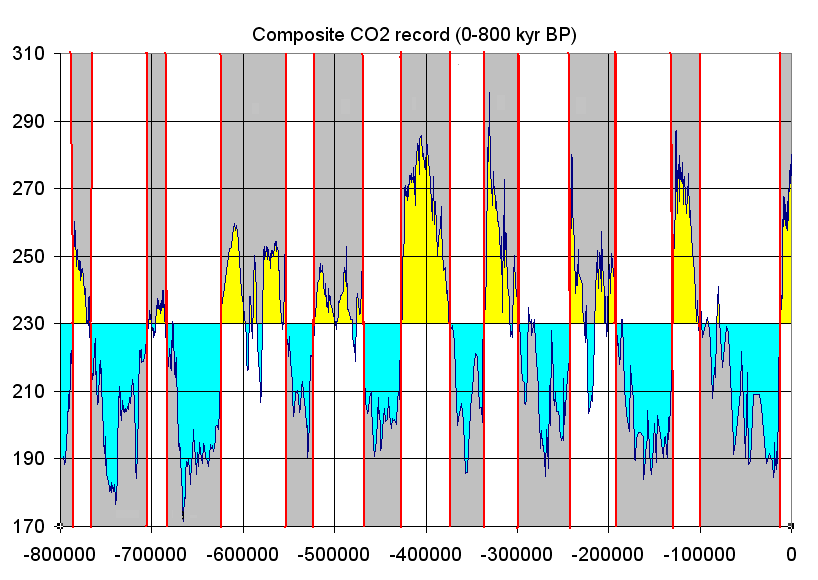
Within the Quaternary, which started about 2.6 million years before present, there have been a number of glacials and interglacials. At least eight glacial cycles have occurred in the last 740,000 years alone.{{Cite journal
Penultimate Glacial Period
Main article: Penultimate Glacial Period
The Penultimate Glacial Period (PGP) is the glacial period that occurred before the Last Glacial Period. It began about 194,000 years ago and ended 135,000 years ago, with the beginning of the Eemian interglacial.
Last Glacial Period
Main article: Last Glacial Period
The last glacial period was the most recent glacial period within the Quaternary glaciation at the end of the Pleistocene, and began about 110,000 years ago and ended about 11,700 years ago. The glaciations that occurred during the glacial period covered many areas of the Northern Hemisphere and have different names, depending on their geographic distributions: Wisconsin (in North America), Devensian (in Great Britain), Midlandian (in Ireland), Würm (in the Alps), Weichsel (in northern Central Europe), Dali (in East China), Beiye (in North China), Taibai (in Shaanxi) Luoji Shan (in southwest Sichuan), Zagunao (in northwest Sichuan), Tianchi (in the Tian Shan) Jomolungma (in the Himalayas), and Llanquihue (in Chile). The glacial advance reached the Last Glacial Maximum about 26,500 BP. In Europe, the ice sheet reached Northern Germany. Over the last 650,000 years, there have been on average seven cycles of glacial advance and retreat.
Next glacial period
Since orbital variations are predictable, computer models that relate orbital variations to climate can predict future climate possibilities. Work by Berger and Loutre suggests that the current warm climate may last another 50,000 years. The amount of heat trapping (greenhouse) gases being emitted into the Earth's oceans and its atmosphere may delay the next glacial period by an additional 50,000 years.
References
References
- (1999). "Abrupt Climate Change at the End of the Last Glacial Period Inferred from Trapped Air in Polar Ice". Science.
- (2006). "Leg 198 Synthesis : A Remarkable 120-m.y. Record of Climate and Oceanography from Shatsky Rise, Northwest Pacific Ocean". Proceedings of the Ocean drilling program..
- (2004). "A Geologic Time Scale 2004". Cambridge University Press.
- (2025). "Greenhouse gas effects on Quaternary climates". Elsevier.
- (2024). "CO2 in Earth's Ice Age Cycles". Oxford University Press.
- (July 2018). "Climate Dynamics During the Penultimate Glacial Period Recorded in a Speleothem from Kanaan Cave, Lebanon (central Levant)". Quaternary Research.
- (2003). "Successive Refinements in Long-Term Integrations of Planetary Orbits". The Astrophysical Journal.
- (2002). "Climate: An exceptionally long interglacial ahead?". Science.
- (16 November 2007). "Calcium Carbonate Cycling in Future Oceans and its Influence on Future Climates". Journal of Plankton Research.
- (14 January 2016). "Critical Insolation–CO2 Relation for Diagnosing Past and Future Glacial Inception". Nature.
This article was imported from Wikipedia and is available under the Creative Commons Attribution-ShareAlike 4.0 License. Content has been adapted to SurfDoc format. Original contributors can be found on the article history page.
Ask Mako anything about Glacial period — get instant answers, deeper analysis, and related topics.
Research with MakoFree with your Surf account
Create a free account to save articles, ask Mako questions, and organize your research.
Sign up freeThis content may have been generated or modified by AI. CloudSurf Software LLC is not responsible for the accuracy, completeness, or reliability of AI-generated content. Always verify important information from primary sources.
Report