From Surf Wiki (app.surf) — the open knowledge base
Girl group
Pop music act featuring young women
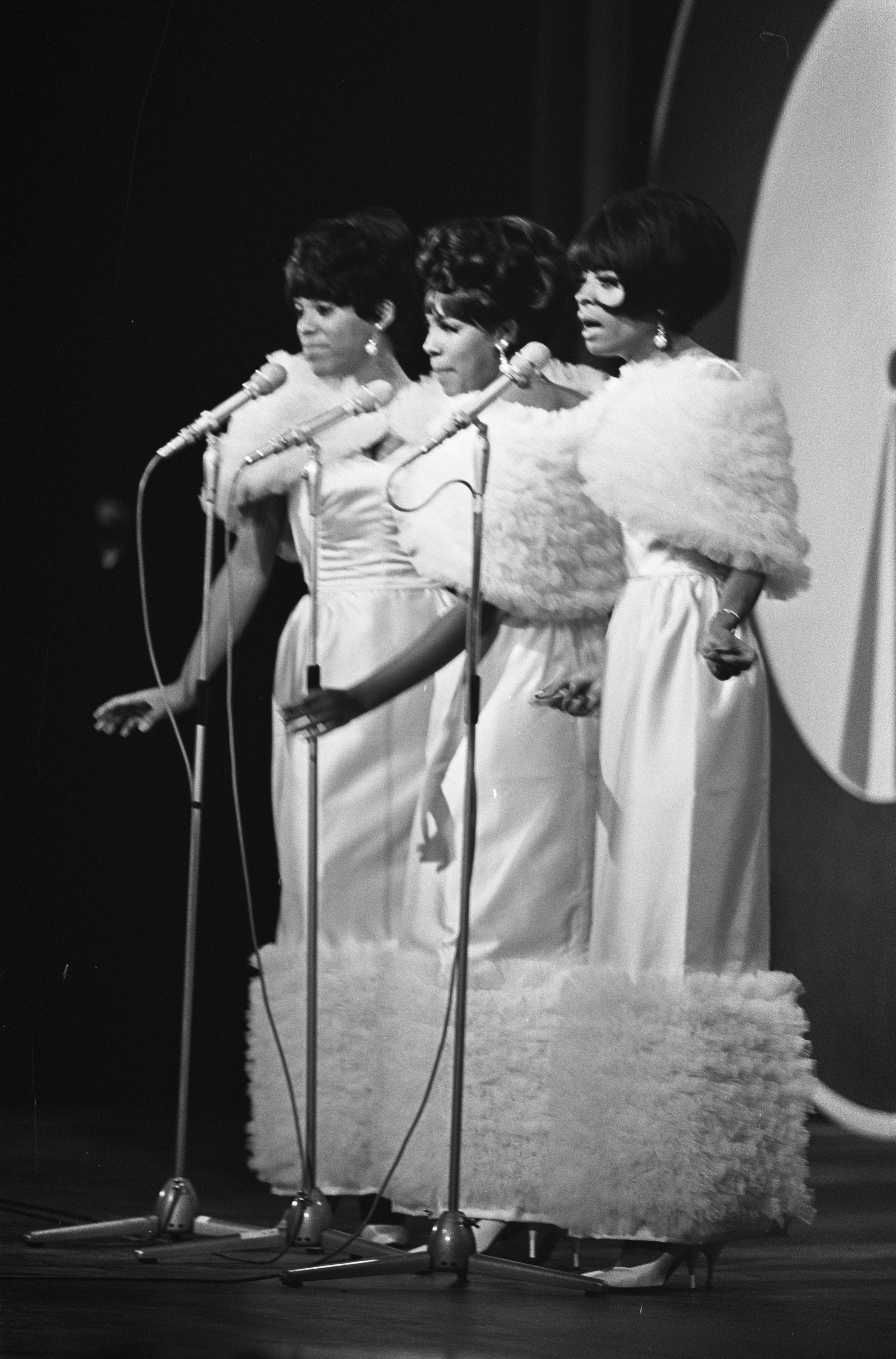
Pop music act featuring young women
A girl group is a music act featuring three or more female singers who generally harmonize together. The term "girl group" is also used in a narrower sense in the United States to denote the wave of American female pop music singing groups that flourished in the late 1950s and early 1960s between the decline of early rock and roll and start of the British Invasion, many of whom were influenced by doo-wop. All-female bands, in which members also play instruments, are usually considered a separate phenomenon. These groups are sometimes called "girl bands" to differentiate, although this terminology is not universally followed.
With the advent of the music industry and radio broadcasting, a number of girl groups emerged, such as the Andrews Sisters. The late 1950s saw the emergence of all-female singing groups as a major force, with 750 distinct girl groups releasing songs that reached US and UK music charts from 1960 to 1966. The Supremes alone held 12 number-one singles on the Billboard Hot 100 during the height of the wave and throughout most of the British Invasion rivaled the Beatles in popularity.{{cite book | url-access= registration | author-link= Joel Whitburn
In later eras, the girl group template would be applied to disco, contemporary R&B, and country-based formats, as well as pop. A more globalized music industry gave rise to the popularity of dance-oriented pop music led by major record labels. This emergence, led by the US, UK, South Korea and Japan, produced popular acts, with eight groups debuting after 1990 having sold more than 15 million physical copies of their albums. With the Spice Girls, the 1990s also saw the target market for girl groups shift from a male audience to an increasingly female one.
History
Vaudeville and close harmonies
One of the first major all-female groups was the Hamilton Sisters and Fordyce, an American trio who successfully toured England and parts of Europe in 1927, recorded and appeared on BBC radio they toured the US variety and big-time theaters extensively, and later changed their stage name to the Three X Sisters. The band was together from 1923 until the early 1940s, and known for their close harmonies, as well as barbershop style or novelty tunes, and utilized their 1930s radio success. The Three X Sisters were also especially a notable addition to the music scene, and predicted later girl group success by maintaining their popularity throughout the Great Depression. The Boswell Sisters, who became one of the most popular singing groups from 1930 to 1936, had over twenty hits. The Andrews Sisters started in 1937 as a Boswell tribute band and continued recording and performing through the 1940s into the late-1960s, achieving more record sales, more Billboard hits, more million-sellers, and more movie appearances than any other girl group to date. The Andrews Sisters had musical hits across multiple genres, which contributed to the prevalence and popularity of the girl group form.
1955–1970: The golden age of girl groups
As the rock era began, close harmony acts like the Chordettes, the Fontane Sisters, the McGuire Sisters and the DeCastro Sisters remained popular, with the first three acts topping the pop charts and the last reaching number two, at the end of 1954 to the beginning of 1955.{{cite book
However, it was the Chantels' 1958 song "Maybe" that became "arguably, the first true glimmering of the girl group sound". The "mixture of black doo-wop, rock and roll, and white pop" was appealing to a teenage audience and grew from scandals involving payola and the perceived social effects of rock music. However, early groups such as the Chantels started developing their groups' musical capacities traditionally, through mediums like Latin and choir music. The success of the Chantels and others was followed by an enormous rise in girl groups with varying skills and experience, with the music industry's typical racially segregated genre labels of R&B and pop slowly breaking apart. This rise also allowed a semblance of class mobility to groups of people who often could not otherwise gain such success, and "forming vocal groups together and cutting records gave them access to other opportunities toward professional advancement and personal growth, expanding the idea of girlhood as an identity across race and class lines." The group often considered to have achieved the first sustained success in girl group genre is the Shirelles, who first reached the Top 40 with "Tonight's the Night", and in 1961, became the first girl group to reach number one on the Hot 100 with "Will You Love Me Tomorrow", written by songwriters Gerry Goffin and Carole King at 1650 Broadway.{{cite encyclopedia

Other songwriters and producers in the US and UK quickly recognized the potential of this new approach and recruited existing acts (or, in some cases, created new ones) to record their songs in a girl group style. Phil Spector recruited the Crystals, the Blossoms, and the Ronettes, while Goffin and King penned two hit songs for the Cookies. Phil Spector made a huge impact on the ubiquity of the girl group, as well as bringing fame and notoriety to new heights for many girl groups. Phil Spector's so-called Wall of Sound, which used layers of instruments to create a more potent sound allowed girl groups to sing powerfully and in different styles than earlier generations. Jerry Leiber and Mike Stoller would likewise foster the Exciters, the Dixie Cups, and the Shangri-Las. The Shangri-Las' hit single, "Leader of the Pack", exemplified the "'death disc' genre" adopted by some girl groups. These songs usually told the story of teenage love cut short by the death of one of the young lovers.
The Paris Sisters had success from 1961 to 1964, especially with "I Love How You Love Me". The Chiffons, the Angels, and the Orlons were also prominent in the early 1960s. In early fall 1963 one-hit wonder the Jaynetts' "Sally Go 'Round the Roses" achieved a mysterious sound quite unlike that of any other girl group. In 1964, the one-hit wonder group the Murmaids took David Gates' "Popsicles and Icicles" to the top 3 in January, the Carefrees' "We Love You Beatles" scraped the top 40 in April, and the Jewels' "Opportunity" was a small hit in December.
Over 750 girl groups were able to chart a song between 1960 and 1966 in the US and UK, although the genre's reach was not as strongly felt in the music industries of other regions. As the youth culture of western Continental Europe was deeply immersed in Yé-yé, recording artists of East Asia mostly varied from traditional singers, government-sponsored chorus, or multi-cultural soloists and bands, while bossa nova was trendy in Latin America. Beat music's global influence eventually pushed out girl groups as a genre and, except for a small number of the foregoing groups and possibly the Toys and the Sweet Inspirations, the only girl groups with any significant chart presence from the beginning of the British Invasion through 1970 were Motown girl groups with the Supremes being the only girl group to score number one hits.{{cite book
1966–1989: Changes in formats and genres
.jpg)
Entering the 1970s, the Supremes had continued success with top 10 hits "Up the Ladder to the Roof" and "Stoned Love" along with six other singles charting on Billboard's top 40. Only two other girl groups made top 10 chartings through 1974 with "Want Ads" by Honey Cone and "When Will I See You Again" by the Three Degrees{{cite book
In Latin America, there were a number of dance-oriented popular girl groups during the era, including the Flans, Pandora and Fandango.
In Japan, all-female idol groups Candies and Pink Lady made a series of hits during the 1970s and 1980s as well. The Japanese music program Music Station listed Candies and Pink Lady in their Top 50 Idols of All Time (compiled in 2011), placing them at number 32 and number 15, with sales exceeding 5 and 13 million in Japan, respectively. With the single "Kiss in the Dark", Pink Lady was also one of only two Japanese artists to have reached the Billboard Top 40.
1990–2019: Dance pop girl group era
American R&B and pop

With their 1990 eponymous debut album, the trio Wilson Phillips sold over 5 million copies worldwide and reached five major US hit singles, four of which cracked the Top 10, with three peaking at number one on the Billboard Hot 100. After the rise of new jack swing, contemporary R&B and hip hop, American girl groups such as En Vogue, Exposé and Sweet Sensation all had singles which hit number one on the charts. Groups in these genres, such as SWV, Xscape, 702, Total, Zhane, Blaque, and 3LW, managed to have songs chart on both the U.S. Hot 100 and the U.S. R&B charts. However, TLC achieved the most success for a girl group in an era where contemporary R&B would become global mainstream acceptance. TLC remains the best-selling American girl group with 65 million records sold, and their second studio album, CrazySexyCool (1994), remains the best-selling album by a girl group in the United States (Diamond certification), while selling over 14 million copies worldwide. Destiny's Child emerged in the late 1990s and sold more than 60 million records.
In the mid-to-late-2000s, there was a revival of girl groups. American girl group and dance ensemble the Pussycat Dolls achieved worldwide success with their singles. Danity Kane also became the first girl group in Billboard history to have two consecutive number-one albums, as their self-titled debut album (2006) and their second album Welcome to the Dollhouse (2008) both topped the U.S. Billboard 200.
Girl groups continued their success in the 2010s. Girl group Fifth Harmony formed in 2012 on The X Factor USA. They reached international success with their debut album Reflection, which featured the hit "Worth It". "Work from Home", the lead single from their second studio album, became the first top-five single in the U.S by a girl group in a decade, following the September 2006 peak of "Buttons" by The Pussycat Dolls at number three. "Worth It" and "Work from Home" remain the most-viewed girl group music videos on YouTube. Indie rock group Haim have also had success since the 2010s.
The Second British Invasion and Europe
In the early 1990s, the British music scene was dominated by boy bands. The only girl group making an impact on the UK charts at the time was Eternal, but even they "remained largely faceless". Amidst the American domination of the girl group format, the Second British Invasion saw the UK's Spice Girls turn the tide in the mid-1990s, achieving ten number 1 singles in the UK and US. With sold-out concerts, advertisements, merchandise, 86 million worldwide record sales, the best-selling album of all time by a female group, and a film, the Spice Girls became the most commercially successful British group since the Beatles. Unlike their predecessors who were marketed at male record buyers, the Spice Girls redefined the girl group concept by going after a young female fanbase instead.
The cultural movement started by the Spice Girls produced a glut of other similar acts, which include the British-Canadian outfit All Saints, Irish girl group B*Witched, Atomic Kitten and the Honeyz, who all achieved varying levels of success during the decade. Throughout the 2000s, girl groups from the UK remained popular, with Girls Aloud's "Sound of the Underground" and Sugababes' "Round Round" having been called "two huge groundbreaking hits" credited with reshaping British pop music for the 2000s. Despite her being a solo artist, Amy Winehouse's 2006 album Back to Black contained heavy influence from 1960s girl groups and garnered Winehouse comparisons to the Ronettes. UK girl groups continued to have success in the 2000s and early 2010s, with acts such as Mis-Teeq, the Saturdays, Stooshe, Neon Jungle, Four of Diamonds and Little Mix, one of the most successful acts to come from the British version of The X Factor. Little Mix went on to become the major girl group of the 2010s, noted as the one British group that survived the "girl group apocalypse" that the late 2010s suffered.
Emergence of East Asian dance-pop girl groups
Although the emergence of dance-pop focused acts in Asia paralleled their British counterparts in the 1990s, girl groups in Asia sustained as a successful format through the 2010s. Japan has the music industry's second largest market overall and the largest physical music market in the world, with the physical sales Oricon Singles Chart being dominated by J-pop idol girl groups. In the late 1990s, vocal/dance girl bands Speed and Max gained prominence in Asia, and paved the way for succeeding Japanese girl groups, such as Morning Musume, AKB48, Perfume, and Momoiro Clover Z. Speed sold a total of 20 million copies in Japan within three years, with Variety calling them "Japan's top girl group", while Max still hold the record for girl group with the second most consecutive top 10 singles in Japan. Throughout the 2010s, AKB48 sister groups have been launched or will be launched in other Asian countries, including Indonesia, China, Thailand, Taiwan, the Philippines, and Vietnam. Several new Japanese idol groups appeared in the 2010s and created a fiercely competitive situation in the music industry, which has been referred to as the "Idol sengoku jidai" (アイドル戦国時代; lit. Age of the Idol Warring States).
From 2009, Hallyu (Korean wave) and K-pop became increasingly significant in the entertainment industry. Its influence spread to Japan and many other Asian, European and North American markets. At the beginning, girl groups such as Girls' Generation, 2NE1 and Wonder Girls were among the leaders of this "Hallyu" wave.
From the second half of the 2010s, new generations of Korean girl groups emerged and enjoyed great success as the Korean wave's globalisation accelerated. Popular South Korean girl groups of the era include Blackpink, Twice and Red Velvet, amongst others.{{Cite web |date=2023-06-27 |title=Top 15 Most Popular K-Pop Girl Groups (2023)
2020–present: Current era
The early 2020s saw a lack of prominent girl groups in Western culture, with The Guardian writing that girl band culture was "in crisis" following the hiatus announcement of Little Mix in 2022. Following a period of the UK having no major girl groups, various girl groups began to emerge into the public domain in the early 2020s. These include: R&B trio Flo, American pop group Boys World, British trio Say Now, who were credited with "bringing back the chaotic energy of iconic UK girl groups", American supergroup Boygenius, British pop group XO, American Building the Band winners 3Quency, British-Venezuelan trio Deja Vu and British-Norwegian quartet Girl Group.
On the other hand, East Asian girl groups continued to dominate globally, with Blackpink, Twice and Red Velvet enjoying continued success. This led to the creation of numerous East Asian girl groups throughout the early 2020s, including Ive, NewJeans, Aespa and Le Sserafim. The popularity of the music style led to the creation of Katseye, a global girl group inspired by Korean girl groups. 2025 also saw a phenomenon for fictional group Huntrix from the Netflix film KPop Demon Hunters; their song "Golden" became the first number one on the Billboard Hot 100 for a Korean girl group, as well as the first girl group to hit number one since Destiny's Child's "Bootylicious" in 2001.
Themes
Girl groups have a wide array of subject matter in their songs, depending on time and place and who was producing. Songs also had a penchant for reflecting the political and cultural climate around them. For instance, songs with abusive undertones were somewhat common during the 1950s–1970s. One notable example was the song "He Hit Me (And It Felt Like a Kiss)" by the Crystals. During the "golden age of girl groups", lyrics were disparate, ranging from songs about mean dogs to underage pregnancy. However, common sentiments were also found in ideas like new love, pining after a crush or lover, and heartache. Some songs sounded upbeat or cheerful and sang about falling in love, whereas others took a decidedly more melancholic turn. Groups like the Shangri-Las, with the song "I Can Never Go Home Anymore" sang about the darker side of being in love.
Adolescence
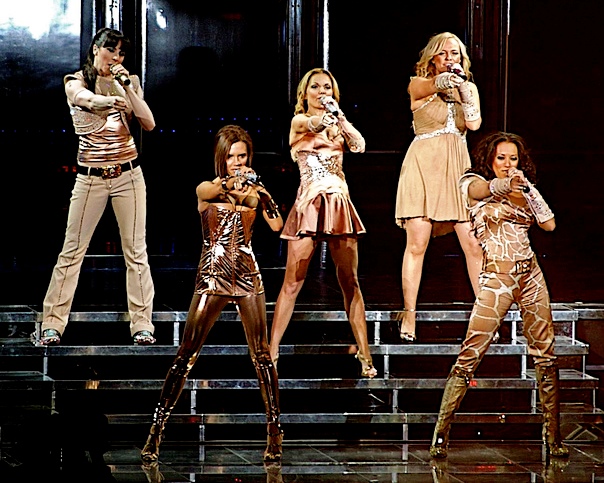
An especially prevalent theme was adolescence. Since most of the girl groups were composed of young singers, often still in high school, songs mentioned parents in many cases. Adolescence was also a popular subject because of an emerging audience of young girls listening to and buying records. Adolescence was also reinforced by girl groups in cultivation of a youthful image, since "an unprecedented instance of teenage girls occupying center stage of mainstream commercial culture". An example of this youth branding might be Baby Spice from the Spice Girls. This was shown through flourishes like typically matching outfits for mid-century girl groups and youthful content in songs. Girl groups of the 1950s era would also give advice to other girls, or sing about the advice their mothers gave to them, which was a similarity to some male musical groups of the time (for example, the Miracles' "Shop Around").
Adolescence was also important (especially starting in the 1950s) from the other end: the consumers were "teenagers [with] disposable income, ready access to automobiles, and consolidated high schools that exposed them to large numbers of other teens. Mass teen culture was born."
Feminism
As the girl group structure persisted through further generations, popular cultural sentiments were incorporated into the music. The appearance of "girl power" and feminism was also added, even though beginning groups were very structured in their femininity. It would be simplistic to imply that girl groups only sang about being in love; on the contrary, many groups expressed complex sentiments in their songs. There were songs of support, songs that were gossipy, etc.; like any other musical movement, there was much variation in what was being sung. A prominent theme was often teaching "what it meant to be a woman". Girl groups would exhibit what womanhood looked like from the clothes they were wearing to the actual lyrics in their songs. Of course this changed over the years (what the Supremes were wearing was different from the Spice Girls), but girl groups still served as beacons and examples of certain types of identities to their audiences through the years.
In the 1990s through the present, with the prevalence of such groups as the Spice Girls, there has been a strong emphasis on women's independence and a sort of feminism. At the very least, the music is more assertive lyrically and relies less on innuendo. This more recent wave of girl groups is more sexually provocative as well, which makes sense within pop music within this time frame as well.
References
References
- Rutledge-Borger, Meredith E.. (15 April 2013). "The Fabulous Girl Groups". [[The Rock and Roll Hall of Fame and Museum]].
- "Girl Groups - A Short History". History-of-rock.com.
- (2008). "Girl Culture: An Encyclopedia". Greenwood Press.
- "Girl Groups". Girl Groups.
- As evidence of the popularity of the Supremes, during and after the British Invasion, on 21 May 1977 edition of ''[[American Top 40]]'', [[Casey Kasem]] noted that the Supremes, more than any other act, dethroned the Beatles from the Hot 100's summit three times.
- Held, David. (1999). "Global Transformations: Politics, Economics and Culture". Stanford University Press.
- Aniftos, Rania. (May 27, 2022). "Billboard Explains: The Evolution of Girl Groups".
- "Reading Eagle - Google News Archive Search".
- "Three X Sisters".
- Sforza, John. (2000). "Swing It! The Andrews Sisters Story". University Press of Kentucky.
- "The Andrews Sisters: The Official Site".
- Lipshutz, Jason. (7 November 2017). "Top 10 Girl Groups Of All Time".
- Alan Betrock ''Girl groups: the story of a sound'' 1982 p.148
- Dave Thompson. "Maybe - The Chantels | Listen, Appearances, Song Review". AllMusic.
- "History, Travel, Arts, Science, People, Places | Smithsonian". Smithsonianmag.com.
- O'Brien, Lucy M.. (16 April 2024). "girl groups (music)".
- "The Girl Groups With the exception of the teen idols, girl group". Shsu.edu.
- "The Chantels".
- (8 November 2009). "Girl Groups, Girl Culture: Popular Music and Identity in the 1960s by Jacqueline Warwick".
- (3 December 2010). "100 Greatest Artists: The Shirelles". Rolling Stone.
- "From The Rock & Roll Hall Of Fame". The Shirelles.
- "The Brill Building and the Girl Group Era | Rock and Roll: An American Story". Teachrock.org.
- "History, Travel, Arts, Science, People, Places | Smithsonian". Smithsonianmag.com.
- (26 December 1939). "Phil Spector Biography". Rolling Stone.
- "Phil Spector - The Producer".
- "Jerry Leiber and Mike Stoller Biography | The Rock and Roll Hall of Fame and Museum". Rockhall.com.
- Larkin, Colin. (4 July 2006). "Shangri-Las". Oxford University Press.
- Stewart Mason. "Cruisin 1963 - Various Artists". AllMusic.
- Whitburn, Joel. (1990). "The Billboard Hot 100 Charts: The Sixties (5 December 1964)". Record Research, Inc..
- "Mass and Propaganda Music | Cultural Exchange China - The Netherlands". Culturalexchange-cn.nl.
- [[:Category:Maoist China propaganda songs]]. ''English Wikipedia''.
- "60's & 70's Asian Pop Record Covers Photo Gallery by david greenfield at". Pbase.com.
- (17 March 2011). "The Garland Handbook of Southeast Asian Music - Google Books". Routledge.
- Carr, Sue. (21 June 2010). "Bananarama to headline Hyde's Splendid Festival". Manchester Evening News.
- (29 October 2008). "New England's largest GLBT newspaper". Bay Windows.
- DeLuca, Dan. (10 November 2008). "Patti LaBelle joins some old friends". San Diego Union-Tribune.
- "Music Station announces their Top 50 Idols of All-Time".
- (16 June 1979). "Billboard magazine, June 1979".
- [{{BillboardURLbyName
- Ibanga, Imaeyen. (19 June 2008). "Not 'The End of the Road' for '90s R&B - ABC News". Abcnews.go.com.
- Battersby, Matilda. (5 November 2012). "TLC plan first album since Lisa 'Left Eye' Lopes' death - News - Music". The Independent.
- Waxman, Olivia B.. (11 January 2013). "Beyoncé and Destiny's Child to Release Original Track for First Time in Eight Years".
- ''[[Making the Band]]''/''The Rise and Fall of Danity Kane'', ''[[MTV]]'' (30 April 2009). Retrieved on 2009-04-30.
- "Fifth Harmony's 'Worth It' Video Reaches 2 Billion Views".
- Savage, Mark. (6 October 2023). "Haim look back at their first decade: 'No-one wanted to sign us!'". [[BBC News]].
- Myers, Justin. (February 27, 2002). "Girlbands vs Boybands – their biggest songs of the century revealed". [[Official Charts Company]].
- Golden, Anna Louise. (1997). "The Spice Girls: The Uncensored Story Behind Pop's Biggest Phenomenon". [[Ballantine Books]].
- [http://www.thespicegirls.com/facts/timeline Facts - Timeline] {{Webarchive. link. (21 October 2007 Spice Girls)
- (2007-06-28). "Timeline: Spice Girls".
- Golden, Anna Louise. (1997). "The Spice Girls: The Uncensored Story Behind Pop's Biggest Phenomenon". [[Ballantine Books]].
- (28 June 2007). "In pictures: Spice Girls through the years". BBC News.
- "The Official Top 20 biggest selling groups of all time revealed!". Officialcharts.com.
- Harlow, John. (27 October 1996). "Wannabe like me?". [[The Sunday Times]].
- Smith, Andrew. (22 August 1999). "Girls on top. After Spice, all-girl groups are dominating the charts. They're successful, but who's got the power?". [[The Observer]].
- Sullivan, Caroline. (5 July 2000). "No more girl power". [[The Guardian]].
- Neil McCormick. (13 August 2009). "Xenomania: how to write a hit song". The Daily Telegraph.
- Emily MacKay. (November 2009). "End of Decade: Sound of the Overground". [[IPC Media]].
- (2019-09-13). "Why the best album of the 21st century is Amy Winehouse's Back to Black".
- "New girlband Neon Jungle have a smashing time as they make video for debut single Trouble". [[Daily Record (Scotland).
- "How Little Mix & Girls' Generation Survived The 2010s Girl Group Apocalypse". Affinity.
- Williamson, Lucy. (14 June 2011). "BBC News - The dark side of South Korean pop music". Bbc.com.
- (22 April 2015). "The International Federation of the Phonographic Industry Releases Its 2014 Data on the World Music Market". aramajapan.com.
- (15 December 2013). "Oricon 2013 Yearly Charts : Singles". 6Theory Media, LLC..
- Herskovitz, Jon. (11 October 1999). "Top Japanese girl group Speed coming to a halt". [[Variety (magazine).
- "女性グループのシングル1位獲得数で単独1位に! モーニング娘。の偉業を検証".
- "JKT48 website".
- SNH48 Project. "SNH48 Website". AKS.
- (27 March 2016). "AKB48 to form sister groups based in Taiwan, Philippines and Thailand". 6Theory Media, LLC.
- (23 April 2010). "デビュー続々! 2010年アイドル戦国時代 生き残るのはどのグループ!?".
- St. Michel, Patrick. (September 13, 2011). "How Korean Pop Conquered Japan".
- (18 October 2012). "K-Pop takes America: how South Korea's music machine is conquering the world". The Verge.
- (31 August 2011). "K-POP Hits the Europe". The UOS Times.
- Herman, Tamar. (December 7, 2017). "10 Best K-Pop Girl Groups of the Past Decade: Critic's Picks".
- Daly, Rhian. (August 18, 2022). "New generations: SNSD, NewJeans and the evolution of K-pop girl groups".
- "Girl bands made British pop great – so where have all the good ones gone?". [[The Guardian]].
- "Girl Group Boys World Breaks Up After Five Years".
- "Say Now are bringing back the chaotic energy of iconic UK girl groups". [[NME]].
- Duran, Anagricel. (17 March 2025). "Boygenius 'ended at the perfect time', says Lucy Dacus: 'It immediately outpaced our expectations'". [[NME]].
- "XO share fierce new single 'Real Friends', co-written by Charli XCX". [[NME]].
- "'Building the Band' Winner 3Quency Signs With Records and Columbia Records (Exclusive)". [[The Hollywood Reporter]].
- Rawlings, Amber. (24 April 2025). "Deja Vu are doing it differently". [[Hunger (magazine).
- ""Yay! Saturday" sees Girl Group drag the audience along for a messy, joyful girls' night out". [[The Line of Best Fit]].
- "12 Rising Girl Groups To Know Now: FLO, KISS OF LIFE, BINI, Citizen Queen & More". [[Grammy Awards]].
- "Get To Know KATSEYE: The Global Girl Group Styled After K-Pop Superstars". [[Grammy Awards]].
- "A History of Girl Groups at No. 1 on the Billboard Hot 100".
- Jonze, Tim. (23 July 2014). "60s girl groups: 10 of the best".
- Buckingham, Kathryn. (26 December 2014). "The Evolving Presence of Feminism and Women in Rock and Roll".
- (7 April 2016). "Sisters With Voices: A Brief History of Girl Groups".
- Cyrus, Cynthia J.. (May 2003). "Selling an Image: Girl Groups of the 1960s". Cambridge University Press.
- Warwick, Jacqueline. (20 February 2007). "Girl Groups, Girl Culture: Popular Music and Identity in the 1960s". Routledge.
This article was imported from Wikipedia and is available under the Creative Commons Attribution-ShareAlike 4.0 License. Content has been adapted to SurfDoc format. Original contributors can be found on the article history page.
Ask Mako anything about Girl group — get instant answers, deeper analysis, and related topics.
Research with MakoFree with your Surf account
Create a free account to save articles, ask Mako questions, and organize your research.
Sign up freeThis content may have been generated or modified by AI. CloudSurf Software LLC is not responsible for the accuracy, completeness, or reliability of AI-generated content. Always verify important information from primary sources.
Report