From Surf Wiki (app.surf) — the open knowledge base
Gimmal ring
Ring with two or three links that fit together
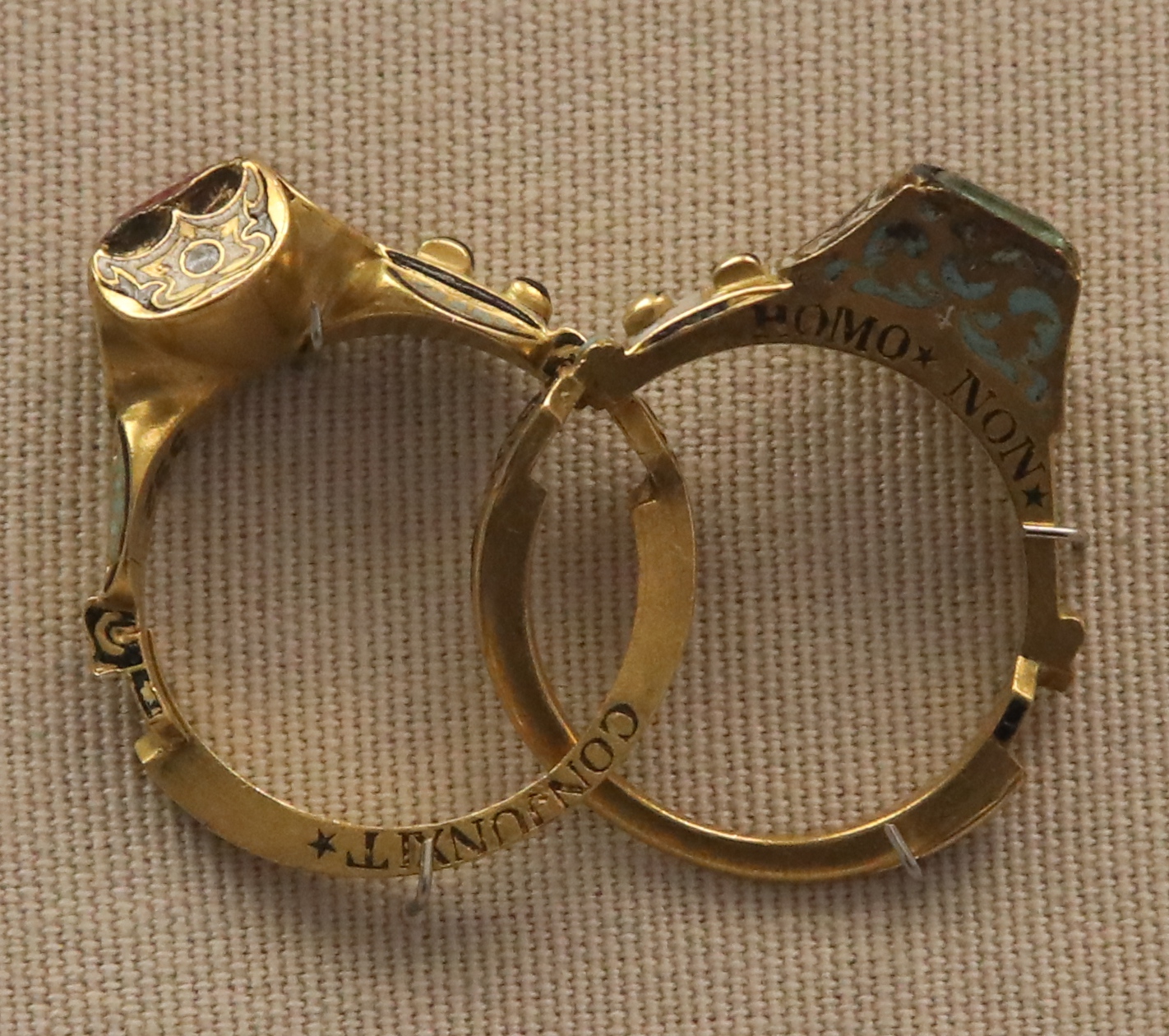
Ring with two or three links that fit together
A gimmal ring, or gimmel ring, is a ring with two or three hoops or links that fit together to form one complete ring. The name gimmal comes from Latin gemellus, twin, via Old French. They were known as joint rings in Elizabethan England.
In the 16th and 17th centuries, such rings were fashionable in England, Germany, and other countries, and were often used as betrothal rings. The engaged couple would wear one hoop each and rejoin them to use as a wedding ring. With triple link rings, a third person could witness the couple's vows and hold the third part of the ring until the marriage.
An early gimmal band, consisting of two interlocked rings sculpted to form a single ring, is to be found in the Victoria and Albert Museum, dated to 1350. Henry III of England met the Count of Gynes in 1202 and gave him a gimmal ring set with a ruby and two emeralds. Martin Luther wed Catherine Bora in 1525 with a gimmal ring inscribed "Whom God has joined together, Let no man put asunder".
Around 1600, the gimmal ring began to sometimes incorporate the clasped hands of the fede ring and a third symbol, a heart, was added, sometimes with a third shank. Designs involving clasped hands, and sometimes a heart, remained popular after the Renaissance. Similar imagery is found on other love rings, including claddagh rings.
The Benjamin Zucker collection in the Walters Museum in Baltimore contains two elaborate gimmal rings incorporating small hidden enameled sculptural details visible only when the bands are separated. By the late 18th century, multiple shanks of five or more were made, sometimes collected at the back by a pivot, so they hinged like a fan.
Cultural references
There are several references to gimmal rings in Shakespeare's plays, including a joint-ring mentioned in Othello. Robert Herrick's poem The Jimmall Ring or True-Love Knot (1648) is founded on a gimmal (jimmall) ring.
A gimmal ring is important to characters in Dryden's Don Sebastian (1690), which includes the passage:
A curious artist wrought 'em, With joynts so close as not to be perceiv'd; Yet are they both each other's counterpart.
References
Sources
- Diana Scarisbrick, Takayuki Toyama, Kanji Hashimoto, Historic Rings: Four Thousand Years of Craftsmanship (2004)
- Gimmel ring
References
- "gimmal, n.". Oxford University Press..
- (2010). "Fede rings from Rokštejn castle". Zaměřeno na středověk. Zdeňkovi Měřínskému.
- (1993). "Victoria and Albert Museum Catalogue of Rings 1930". Anglia Publishing.
- Scarisbrick, Diana, ''Rings, Symbols of Wealth Power and Affection'', 1993, Abrams, NY
- The Power of Love, Levi, Karen editor,1988, Diamond Information Centre, London
This article was imported from Wikipedia and is available under the Creative Commons Attribution-ShareAlike 4.0 License. Content has been adapted to SurfDoc format. Original contributors can be found on the article history page.
Ask Mako anything about Gimmal ring — get instant answers, deeper analysis, and related topics.
Research with MakoFree with your Surf account
Create a free account to save articles, ask Mako questions, and organize your research.
Sign up freeThis content may have been generated or modified by AI. CloudSurf Software LLC is not responsible for the accuracy, completeness, or reliability of AI-generated content. Always verify important information from primary sources.
Report