From Surf Wiki (app.surf) — the open knowledge base
Gilgit Scouts
1913–1975 paramilitary in Gilgit Agency, Jammu and Kashmir
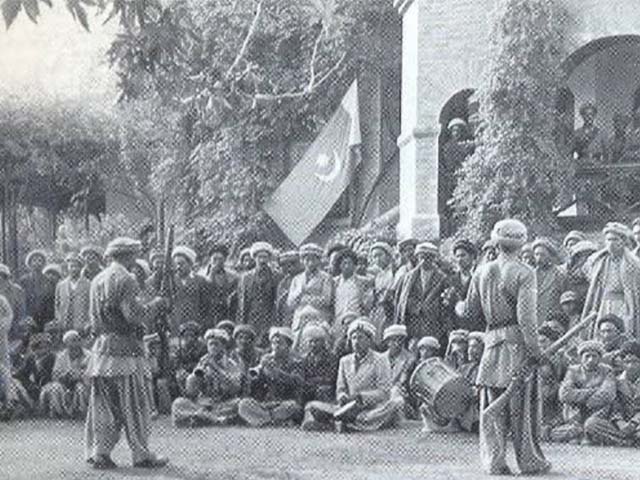
1913–1975 paramilitary in Gilgit Agency, Jammu and Kashmir
| Field | Value | |
|---|---|---|
| unit_name | Gilgit Scouts | |
| image | Gilgit_Scouts_logo.jpg | |
| caption | Insignia of the Gilgit Scouts | |
| start_date | 1913 | |
| disbanded | 1975 | |
| end_date | 1975 | |
| allegiance | {{plainlist | |
| branch | Army | |
| type | Paramilitary | |
| role | ||
| nickname | Northern Battalion | |
| colors | ||
| colors_label | ||
| battles | ||
| battle_honours | ||
| notable_commanders | Major William Brown | |
| Brigadier Aslam Khan |
- Flag of Jammu and Kashmir (1936-1953).svg Jammu and Kashmir (1913–1947)
- Flag of Pakistan.svg Dominion of Pakistan (1947–1956)
- Flag of Pakistan.svg Islamic Republic of Pakistan (1956–1975)
- First Kashmir War
- 1947 Gilgit Rebellion
- Battle of Jaglote
- Bunji Action
- Action at Tsari
- Battle of Thorgo
- Siege of Skardu Brigadier Aslam Khan
The Gilgit Scouts was a paramilitary force within the Gilgit-Baltistan region in northern Pakistan. They were raised by the British Raj in 1913, to assist the Gilgit-based British Political Agent in managing Gilgit Agency which formed the northern frontier of British India. The force had a strength of almost 600 composed of local men recruited by British commanders.
Not only Gilgit Tehsil, which had been leased to the British Raj for 60 years starting in 1935 by Hari Singh the ruler of Jammu & Kashmir but the whole of Gilgit Agency which was under British control was ceded to Hari Singh on 1st July 1947.
Following Jammu & Kashmir's accession to India on 26th October 1947, the Gilgit Scouts under the command of Major William Brown, staged a rebellion and overthrew the Governor of Gilgit. In a matter of days the 6th Battalion of Jammu & Kashmir in Bunji was routed by a Gilgit Scouts force under command Captain Mathieson the deputy commandant and Assistant Political Agent operating out of Chilas. The Muslim element of the State Forces based at Bunji joined the Gilgit Scouts in their war of liberation.
After Major Brown and Captain Mathieson left Gilgit, Major Aslam Khan (who took on the nom de guerre of Colonel Pasha) was given command of the Gilgit Scouts. Men from 6th J&K were amalgamated into Gilgit Scouts.in early January 1948. Major Aslam who had intimate knowledge of the area having served earlier in Rattu and Bunji as part of Jammu & Kashmir forces, organised the enlarged Gilgit Scouts now numbering around 1600 into three groups, namely Ibex, Tiger and Eskimo forces.
The Gilgit Scouts combined force conquered all of Baltistan, and had taken Kargil, Dras in early May 1948 and Zojila in July 1948 and were threatening Leh under command Lieutenant Colonel Mian Ghulam Jilani after Major Aslam Khan had been posted to GHQ. General Thimayya recaptured Zojila on 1st November 1948 using Stuart light tanks and in a matter of weeks the Indian Army linked up with Leh also gaining control of Kargil. The territories retained by Gilgit Scouts as of 31 December 1948 gave rise to the present day Gilgit-Baltistan.
The force was continued by Pakistan till 1975 when it was integrated into the Northern Light Infantry of the Pakistan Army.
History
Antecedents
When the Gilgit Agency was established in 1889, it was controlled using the Imperial Service Troops provided by the Maharaja of Jammu and Kashmir and placed under the command of the British Political Agent. A few contingents of British Indian troops and 14 British officers were added in 1891. Levies from Punial were also present earlier. After the Hunza–Nagar Campaign in 1891, and the pacification of Chilas and Chitral, the British Indian troops were gradually reduced, and replaced by new levies from Hunza, Nagar and Punial.
Formation of scouts
In 1913, the local levies were replaced by a permanent body of troops on a company basis, under the name "Gilgit Scouts". The force was paid for by the state of Jammu and Kashmir, but commanded by British officers under the control of the British Political Agent at Gilgit. The initial strength of Gilgit Scouts was 656 men. They were organised into 8 companies of 80 men each. Each company had two native officers, a Subedar and a Jamadar.
The force had no connection to the Jammu and Kashmir State Forces, but became part of the Frontier Corps, along with Chitral Scouts, Kurram Militia and other local forces. The recruits were from all areas of the Gilgit Agency and had the advantage of local knowledge. They were also acclimatised to local climate and the harsh mountain terrain. They were responsible for maintaining local order as well as monitoring foreign activity along the northern borders.
The recruitment in the Gilgit scouts was based on the recommendation of Mirs and Rajas of the area. Close relatives of Mirs and Rajas were given direct Viceroy commissions in Gilgit scouts.
First Kashmir War (1947)
After the Independence of Pakistan, the Gilgit Scouts rebelled against the authority of Jammu and Kashmir and participated in the First Kashmir War. According to Major William Brown, its commanding officer, there was a secret plan among a few members of Gilgit Scouts to set up a "Republic of Gilgit-Astor(e)" when they ousted the governor of Gilgit representing the Maharaja's government on 1 November 1947. Historian Ahmad Hasan Dani, a member of the Shina community which is the majority ethno-linguistic group of the Gilgit Baltistan region of Pakistan, mentions that although there was lack of public participation in the rebellion, pro-Pakistan sentiments were intense in the civilian population and their anti-Kashmiri sentiments were also clear. On 2 November, the Pakistani flag was raised on the old tower in the Gilgit Scout Lines, under the command of Major Brown.
On 12 January 1948, the command was handed over to Colonel Aslam Khan the first local commander of the Gilgit Scouts, under the authority of the Azad Jammu and Kashmir provisional government.
Inside Pakistan
After the conclusion of the First Kashmir War, the Gilgit Scouts operated as a paramilitary force in the Northern Areas (now called Gilgit-Baltistan). In 1975, the force was amalgamated into the Northern Light Infantry Regiment of the Pakistan Army, where the Gilgit Scouts became the 1st and 2nd Battalions of the regiment.
Gilgit Baltistan Scouts
Main article: Gilgit-Baltistan Scouts
The force was re-raised in 2003 as the Northern Area Scouts under command of Brigadier Inayat Wali. It quickly progressed and took over the responsibilities of Law and Order in Gilgit Baltistan. In 2011, the force was renamed Gilgit Baltistan Scouts, a federal paramilitary force.
References
Bibliography
References
- (2014). "Gilgit Rebelion: The Major Who Mutinied Over Partition of India". Pen and Sword.
- {{harvnb. Schofield, Kashmir in Conflict. 2003. Snedden, Understanding Kashmir and Kashmiris. 2015
- (2008). "The 'Great Game' in the Pamirs and the Hindu-Kush: The British Conquest of Hunza and Nagar". Modern Asian Studies.
- Bajwa, Kuldip Singh. (1 January 2004). "Jammu and Kashmir War: 1947 & 1948". Har Anand Publications.
- "Anthropology of Gilgit-Baltistan". Social Science Open Access Repository.
- "Northern Light Infantry".
- [http://www.gilgitbaltistanscouts.gov.pk/index.htm Gilgit Baltistan Scouts] {{Webarchive. link. (2014-08-09 (official web page))
This article was imported from Wikipedia and is available under the Creative Commons Attribution-ShareAlike 4.0 License. Content has been adapted to SurfDoc format. Original contributors can be found on the article history page.
Ask Mako anything about Gilgit Scouts — get instant answers, deeper analysis, and related topics.
Research with MakoFree with your Surf account
Create a free account to save articles, ask Mako questions, and organize your research.
Sign up freeThis content may have been generated or modified by AI. CloudSurf Software LLC is not responsible for the accuracy, completeness, or reliability of AI-generated content. Always verify important information from primary sources.
Report