From Surf Wiki (app.surf) — the open knowledge base
GIGN
French National Gendarmerie unit

French National Gendarmerie unit
| Field | Value | |||
|---|---|---|---|---|
| unit_name | National Gendarmerie Intervention Group | |||
| native_name | Groupe d'intervention de la Gendarmerie nationale | |||
| native_namea | ||||
| native_namer | ||||
| image | Écusson région gendarmerie GIGN.svg | |||
| caption | Official insignia (2021) | |||
| dates | 1973–present | |||
| country | France | |||
| agency | National Gendarmerie | |||
| type | Police tactical unit | |||
| role | ||||
| ops_juris | {{Plainlist | |||
| headquarters_label | Headquarters | |||
| headquarters | Satory, Yvelines, France | |||
| coordinates | ||||
| motto | S'engager pour la vie | |||
| motto_translated | ()S'engager in French can mean to commit (to do something) but also to enlist (in the army) | |||
| abbreviation | GIGN | |||
| <!-- Structure --> | sworn_type_label | Operators | ||
| sworn | (400 in Satory)New organization for GIGN with full integration of Regional Branches - L'Essor de la Gendarmerie nationale: Nouvelle organisation pour le GIGN avec le rattachement intégral des antennes https://lessor.org/vie-des-personnels/nouvelle-organisation-pour-le-gign-avec-le-rattachement-des-antennes-gign | |||
| stations | ||||
| current_commander | général de brigade | |||
| Benoît Villeminoz | ||||
| notable_commanders | ||||
| <!-- Notables --> | programs | |||
| significant_operations | {{Collapsible list | |||
| title | See list: | |||
| awards | [[File:Croix de la Valeur Militaire ribbon.svg | 30px | alt= | link=]] Croix de la Valeur Militaire |
| animals |
- National
- International Benoît Villeminoz | Loyada hostage crisis (1976) | Grand Mosque seizure (1979) | Ouvéa hostage crisis (1988) | Air France Flight 8969 hijacking (1994) | Île-de-France attacks (2015)
The GIGN ( ; ) is the elite tactical unit of the French National Gendarmerie. Among its missions are counterterrorism, hostage rescue, surveillance of national threats, protection of government officials, critical site protection (such as French embassies in war-torn countries), and targeting organized crime.
Established in 1973 and becoming operational in 1974, the GIGN was initially created as a relatively small tactical unit specialized in sensitive hostage situations, but has since grown into a larger force with expanded responsibilities and capabilities. It is now composed of nearly 1,000 operators. The main unit comprises around 400 operators based in Satory, near Versailles in the Paris Region. Approximately 600 additional operators make up fourteen regional GIGN branches called AGIGNs (), seven of which are also located in metropolitan France and the remaining seven, in French overseas territories. The unit shares jurisdiction of French sovereign territory with the special response units of the National Police,Each of the two French National Police forces, the National Police and the National Gendarmerie, has primary responsibility for a part of the territory: large cities and urban areas for the National Police, smaller cities and rural areas for the National Gendarmerie. There are two National Police units specialised in counter-terrorism and hostage rescue: the Paris BRI and RAID. If needed, they can form a joint task force called National Police Intervention Force (). GIGN and FIPN (or its components) can be engaged together – or in the other force's area of responsibility – in an emergency. and its training centre is located in Beynes.
Although most of its operations take place in France, the GIGN (as a component of the French Armed Forces) can operate anywhere in the world. Many of its missions are secret, and GIGN operators are not allowed to be publicly photographed. Since its formation, the GIGN has been involved in over 1,800 missions and has also rescued more than 600 hostages, making it one of the most experienced counter-terrorism units in the world.
In December 1994, the GIGN rose to worldwide prominence after its operatives successfully stormed and rescued the passengers of Air France Flight 8969, which had been hijacked by the Armed Islamic Group of Algeria, at Marseille Provence Airport.
History
GIGN was formed in Maisons-Alfort, near Paris, in 1973, shortly after the Munich massacre at the 1972 Summer Olympics and other less-known incidents in France exposed a need for dedicated counterterrorist units.
Initially named ECRI (), it became operational in March 1974, under the command of then-lieutenant Christian Prouteau, and executed its first mission ten days later.
Another unit, named GIGN, was created simultaneously within the Mobile Gendarmerie parachute squadron in Mont-de-Marsan in southwest France, but the two units were merged under Prouteau's command in 1976, and adopted the GIGN designation.
GIGNs initial complement was 15, later increased to 32 in 1976, 78 by 1986, and 120 by 2005. GIGN moved to Versailles-Satory in 1982.
In 1984, it became a part of a larger organisation called GSIGN (),In the French Gendarmerie, a groupement (grouping) is typically a battalion- or regiment-size unit but while infantry regiments in the French Army share a common format (ie same number of companies) this is not mandatory for a Gendarmerie groupement together with EPIGN (),A French escadron is equivalent to a British squadron and to either a troop or a company in the US armed forces. GSPR (), the Presidential Security group and GISA (), a specialized training center.
On 1 September 2007, a major reorganization took place. GSIGN was disbanded and replaced by a new unit also named GIGN. The former GSIGN components (the original GIGN, EPIGN, GSPR and GISA) became "forces" of the new GIGN which now reached a total complement of 380 operators.The reorganization was conducted by general Denis Favier, who had personally led the Marignane assault in 1994 as GIGN's commander and assumed command of the "new" GIGN in 2007. He later became Director-general of the Gendarmerie Nationale (DGGN) from 2013 to 2016.
The change from GSIGN to the new GIGN, an organization reporting directly to the Director-general of the Gendarmerie, was not a simple name swap. It was done in order to reinforce command and control functions; provide better integration through common selection, common training and stronger support; and improve the unit's capability to handle complex situations such as mass hostage-takings similar to the Beslan school siege.
In 2009, the Gendarmerie, while remaining part of the French Armed Forces, was attached to the Ministry of the Interior, which already supervised the National Police. The respective areas of responsibility of each force did not change however, as the Police already had primary responsibility for major cities and large urban areas, while the Gendarmerie was in charge of smaller towns and rural areas (in addition to its specific military missions). Under the new command structure, GIGN gendarmes can still be engaged in operations outside of France due to their military status.
In January 2015, GIGN was engaged for the very first time simultaneously with RAID, the National Police tactical unit, during the January 2015 Île-de-France attacks.The two actions were distinct but coordinated
On 1 August 2021, the 14 regional GIGN branches were fully integrated in the group's organization as part of a new Force Antennes. Prior to this reorganization, these regional branches, established in 2004, had been administratively attached to the seven domestic "Zonal Gendarmerie Regions" for seven of them and to the Overseas Gendarmerie Command () for the remaining seven but they were independent units that only came under GIGN operational control when a crisis occurred. Sometimes referred to as "GIGN 3.0",The new GIGN which replaced GSIGN in 2007 was often dubbed GIGN 2.0 the new organization also emphasizes the group's role in training and in operational support.
A new common insignia was adopted as a result of the 2021 reorganization. Shaped as a shield, it worn on the left sleeve by every GIGN gendarme. A circular badge is worn on the right sleeve: the traditional round GIGN patch for Satory-based operators and a different patch for members of the AGIGNs. The AGIGN patch replaces the parachute with a thunderbolt, as AGIGNs are not parachute units.
Since its creation, the group has taken part in over 1,800 operations, rescued over 600 hostages and arrested over 1,500 suspects, losing four members killed in action and ten in training.Two of the four fatalities involved AGIGN members, the first one occurred in May 2016 at a time when AGIGN's were not yet fully integrated into GIGN which explains why some publications mention "only" three operators killed in action. Three of the four fatalities in action were sustained when dealing with armed deranged persons. The fourth one occurred during an operation against illegal gold-mining in French Guiana in March 2023.
Structure


GIGN is currently organized in four "forces", a "détachement", an Engineering and Support division, a National Training Center for Specialized InterventionIntervention Spécialisée is the top tier of the Intervention spectrum. The first tier is "operational intervention" (also called basic intervention) and is taught to every gendarme. The next tier, "intermediate intervention" is for special "Surveillance and intervention" or "Intervention" platoons called "PSIG Sabre" in the Departmental Gendarmerie), PIGM in the Mobile Gendarmerie and PIGR in the Republican Guard. and a Human Resources bureau, under two headquarters (administrative and operational):
Intervention Force
Also known as the original GIGN, the Intervention Force () has approximately 100 operators, serving as GIGN's main assault unit. It is divided into four platoons (), two of which are on alert at all times. These sections are further divided into individual teams of operators. Two of the intervention sections specialize in high altitude jumps; the other two specialize in diving.
Observation & Search Force
Approximately 40 operators, the Observation & Search Force () specialises in reconnaissance in relation with judiciary police work, and counterterrorism. Formed from the EPIGN.
Security & Protection Force
Approximately 65 operators, the Security & Protection Force () specialises in executive and sensitive site protection. Formed from the EPIGN.
Regional Branches Force
The Regional Branches Force () serves as the headquarters for the fourteen regional GIGN branches.
Gendarmerie Detachment of the GSPR Presidential Security Group
The Gendarmerie Detachment of the GSPR Presidential Security Group () is tasked with protecting the President of France. Originally a Gendarmerie unit, the GSPR is now jointly operated by the Gendarmerie and the National Police.
Engineering and Support Division
The Engineering and Support Division () is a support force with cells specializing in long-range sniping, breaching, assault engineering, special devices, and other specializations.
National Training Center for Specialized Intervention
The National Training Center for Specialized Intervention () is tasked with selection, training and retraining (called recycling) not only of GIGN operators, but also of selected Gendarmerie or foreign personnel.
Regional and overseas branches
Although GIGN, as part of the French military, has been deployed to external combat zones, it is primarily centered in France, engaging in peacetime operations as a special police force.
The fourteen regional GIGN branches, initially known as PI2Gs () for the domestic units and GPIs () for the overseas units, were respectively redesignated as GIGN branches in April and July 2016 and fully integrated into GIGN in 2021.
As of 2021, the seven metropolitan GIGN branches are located in Caen, Dijon, Nantes, Orange, Reims, Toulouse and Tours, while the seven overseas branches are based in Guadeloupe, Martinique, French Guiana, Réunion, Mayotte, French Polynesia and New Caledonia.
The twenty nuclear protection units, called PSPGs (), located on site at each one of the French nuclear power plants, are not a part of GIGN, but operate under its operational control.
Operations
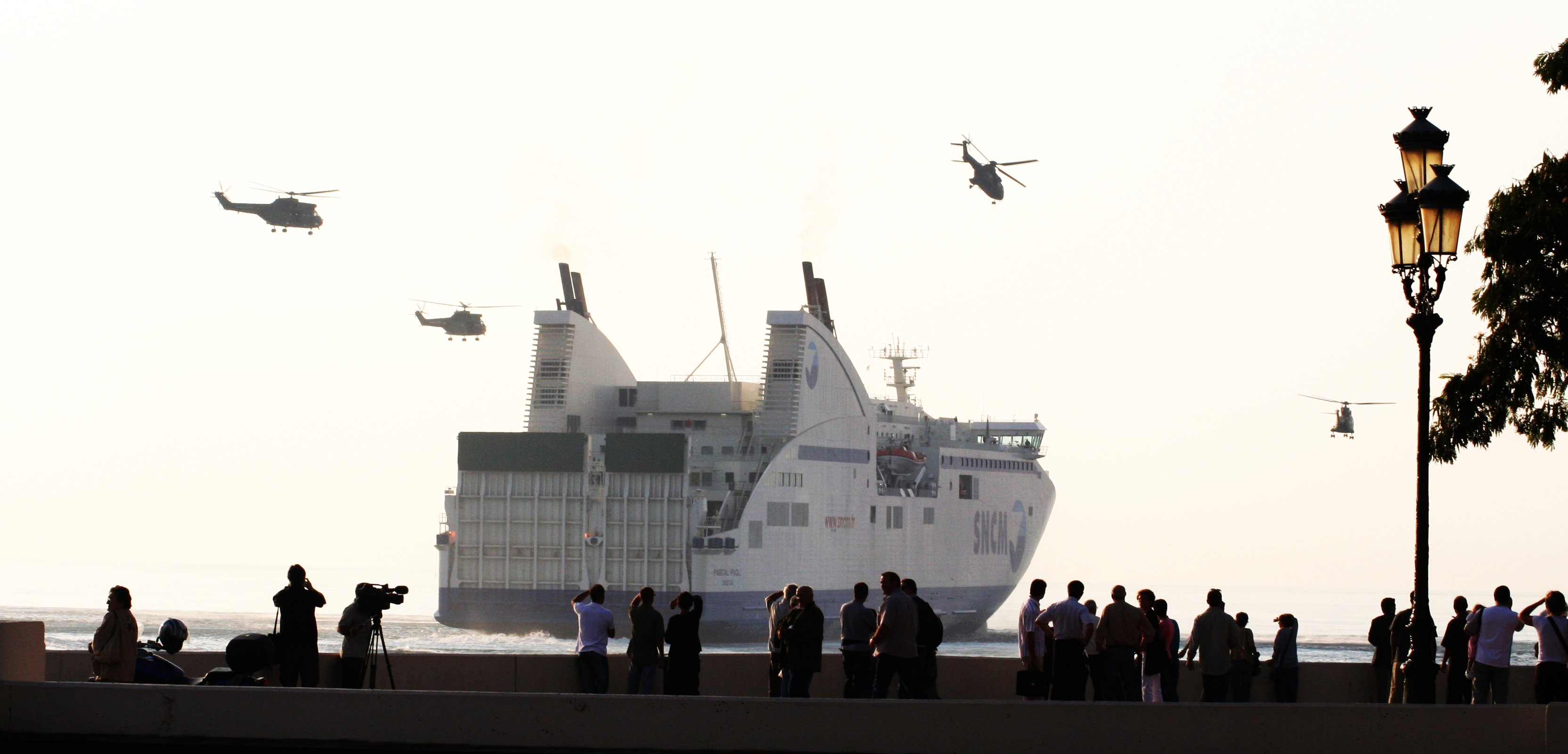

GIGN reports directly to the Director General of the Gendarmerie Nationale (DGGN), i.e., the chief of staff of the Gendarmerie, who in turn reports directly to the Ministry of the Interior.
The DGGN or his Deputy for Operations can take charge in a major crisis; however, most of the day-to-day missions are conducted in support of local units of the Departmental Gendarmerie. GIGN is also a member of the European ATLAS Network, an informal association consisting of the special police units of the 27 states of the European Union.
Known operations
Known GIGN operations include:
- Rescue of 30 French pupils from a school bus captured by the Front de Libération de la Côte des Somalis in Loyada, Djibouti in 1976. GIGN snipers and French Foreign Legion troops killed the hostage-takers in an operation that was only partially successful, as two children were killed.
- Planning the rescue of diplomats from the French Embassy in San Salvador in 1979; the hostage-takers surrendered before the assault was conducted.
- Advising Saudi authorities during the Grand Mosque Seizure in Mecca, Saudi Arabia, in November and December 1979.
- Arrest of several Corsican terrorists of the National Liberation Front of Corsica at the Fesch Hostel in 1980.
- Arrest of suspected Irish terrorists in the Irish of Vincennes affair, in August 1982.
- Rescue of hostages during the Ouvéa cave hostage taking in Ouvea, New Caledonia in May 1988.
- Protection of the 1992 Olympic Winter Games in Albertville.
- Rescue of 229 passengers and crew from Air France Flight 8969 in Marseille in December 1994. Nine GIGN operators were wounded during the operation, but all four hijackers were killed. The mission was broadcast live by news channels, increasing awareness of GIGN's existence.
- Arrest of the mercenary Bob Denard and his group during a coup attempt in 1995 in Comoros (Operation Azalee).
- Operations in Bosnia to arrest persons indicted for war crimes.
- Capture of 6 Somali pirates, and recovery of part of the ransom, after ensuring that Le Ponant luxury yacht hostages were freed off the coast of Puntland, Somalia in the Gulf of Aden, in conjunction with French Commandos Marine in April 2008.
- Deployment of tactical teams in Afghanistan in support of French Gendarmerie POMLT (Police Operational Mentoring Liaison Team) detachments from 2009 to 2011.
- Deployment in Libya during Operation Harmattan in 2011.
- Neutralization of the two terrorists involved in the Paris Charlie Hebdo shooting on 7 January 2015.
- Deployment to the 2015 Bamako hotel attack, although the situation had already been taken care of by local police, with assistance from American and French special forces, by the time the GIGN team arrived.
- Neutralization of the terrorist responsible for the Carcassonne and Trèbes attack in March 2018 (a former EPIGN officer, Arnaud Beltrame, voluntarily swapped places with a hostage and was killed trying to disarm the terrorist). This operation was conducted by an AGIGN unit based in Toulouse under GIGN supervision, while operatives sent from Satory were still underway.
- Several deployments in Ukraine in 2022 to protect various French or International missions during the Russian invasion.
- Deployment to counter unrest in New Caledonia in 2024 GIGN was selected by the International Civil Aviation Organisation (ICAO) to organise hostage-rescue exercises aboard planes for the special forces of the other member states.
Coordination with RAID
Coordination between GIGN and RAID, the National Police's tactical unit, is handled by a joint organization called Ucofi ().
A "leader/follower" protocol has been established for use when both units need to be engaged jointly,As was the case following the 7 January 2015 Charlie Hebdo assassinations. leadership belonging to the unit operating in its primary areas of responsibility.
Selection and training


Candidates undertake a one-week pre-selection screening followed by, for those accepted, a fourteen-month training program. Mental ability and self-control are important, in addition to physical strength.
Similar to most special forces, the training is stressful with a high rate of failure, especially in the initial phase; only 7–8% of the volunteers complete the training process. AGIGN candidates undertake a one-week pre-selection screening followed by an eight-week training program.
GIGN training consists of:
- Weapon handling
- Combat shooting and marksmanship training
- Airborne courses, such as HALO or HAHO jumps, paragliding, and heliborne insertions
- Underwater combat, swimming, diving, and naval boarding
- Hand-to-hand combat training
- Undercover surveillance and stalking (investigative cases support)
- Infiltration and escape techniques
- Explosive ordnance disposal
- Chemical, biological, radiological, and nuclear device neutralization
- Survival and warfare in tropical, arctic, mountain and desert environments
- Diplomacy and negotiation skills

There are several tactical specialties in the group, including: long-range sniping, breaching, observation and reconnaissance, executive protection, freefall parachuting with HALO/HAHO jumps, diving, etc.
The GIGN trains alongside other counterterrorist units from NATO countries, including the American FBI HRT, British SAS, Australian SPS, German GSG 9, and Irish Garda ERU.
Weapons and equipment
GIGN uses a wide range of firearms and equipment, including:
Firearms
| Name | Origin | Type | Notes |
|---|---|---|---|
| Taser X26 | United States | Less lethal | Since 2003 |
| Manurhin MR 73 | France | Revolver | Not used operationally |
| Glock 17 | Austria | Pistol | |
| Glock 19 | |||
| Glock 26 | |||
| FN Five-seveN | Belgium | ||
| Heckler & Koch MP5 | Germany | Submachine gun | A3, A5, SD and K-PDW variants |
| Heckler & Koch UMP | |||
| SIG MPX | United States | ||
| Heckler & Koch MP7 | Germany | Personal defense weapon | |
| FN P90 | Belgium | ||
| Remington 870 | United States | Shotgun | |
| Mossberg 590 | |||
| Benelli M3 | Italy | ||
| Benelli M4 | |||
| Heckler & Koch HK416 | Germany | Assault rifle | |
| FN SCAR | Belgium | L and H variants | |
| Colt M4 | United States | ||
| SIG MCX | MCX Rattler variant | ||
| SIG SG 550 | Switzerland | 551, 552, 553 variants | |
| CZ BREN 2 | Czech Republic | Chambered in 7.62x39mm | |
| Heckler & Koch HK417 | Germany | Sniper rifle | |
| Accuracy International Arctic Warfare | United Kingdom | .308 and .338 variants | |
| Accuracy International AXSR | |||
| Tikka T3 | Finland | ||
| Colt Canada C20 DMR | Canada | 16 in. barrels variant. | |
| PGM 338 | France | ||
| PGM Hécate II | 12.7x99mm variant | ||
| FN Minimi | Belgium | Machine gun | |
| Heckler & Koch HK69 | Germany | Grenade launcher | |
| B&T GL-06 | Switzerland | ||
| Milkor MGL | South Africa |
Individual equipment
- Grenades
- Ballistic shields
- Ballistic helmets with mounted visors
- Plate carrier
- Balaclava
- Tactical gloves
- NVGs (Night Vision Goggles)
Vehicles
Various types of armored vehicles, both civilian-style SUVs and dedicated armoured personnel carriers, some with assault ladders installed on the roof of the vehicle
Helicopter support is provided by Gendarmerie helicopters and, for tactical deployment of large groups, by GIH (), a joint Army/Air Force special operations flight equipped with SA330 PUMA helicopters, based in nearby Villacoublay Air Base. GIH was established in 2006, and has also been tasked to support the National Police's RAID unit since 2008.
Motto and values
| Date | French | English | Reference |
|---|---|---|---|
| Until 2014 | Sauver des vies au mépris de la sienne | To save lives without regard to one's own | |
| Since 2014 | S'engager pour la vie | A commitment for life |
Respect for human life, combined with fire discipline, has always been taught to group members since its inception. Each new member is traditionally issued a six-shot revolver as a reminder of these values.
GIGN leaders
- Chef d'escadron Christian Prouteau: 1973–1982
- Capitaine Paul Barril: 1982–1983 (Interim)
- Capitaine Philippe Masselin: 1983–1985
- Chef d'escadron Philippe Legorjus: 1985–1989
- Chef d'escadron Lionel Chesneau: 1989–1992
- Chef d'escadron Denis Favier: 1992–1997
- Chef d'escadron Eric Gerard: 1997–2002
- Lieutenant Colonel Frédéric Gallois: 2002-2007
- Général de Brigade Denis Favier: 2007–2011
- Général de Brigade Thierry Orosco: 2011–2014
- Général de Brigade Hubert Bonneau: 2014–2017
- Général de Brigade Laurent Phélip: 2017–2020
- Général de Division Ghislain Réty: August 2020 - October 2025
- General de brigade Benoît Villeminoz since November 2025
Awards
On 9 December 2011, French Defense MinisterThe title was changed in 2017 to Ministre des Armées ('Minister of the Armies') Gérard Longuet, awarded the Cross for Military Valour to GIGN for its participation in operation Harmattan in Libya. On 31 July 2013, GIGN was awarded a second Cross for Military Valour for its participation in the War in Afghanistan.
On 15 June 2015, the unit received the Medal for internal security. As GIGN was awarded the Cross for Military Valour twice, members of the group are officially allowed to wear the fourragère.
In popular culture
The subject of this article has appeared in popular cultural contexts such as films, video games, novels, strip cartoons, and the like. These are mostly trivial mentions, and listing them adds no value to the encyclopedic treatment of the subject.
Before adding items to this section, please read Wikipedia:WikiProject Military history/Content guide#Popular culture and refer to earlier discussions in this article's talk page. Additions that appear to be insignificant and/or are not attributed to a reliable source WILL be removed.
If an item you have added has been removed and you wish to contest its removal, please start a discussion on this article's talk page proposing that it be restored.
-->
GIGN has been featured in dozens of media works, including films, television shows, novels, video games, and strip cartoons, typically working alongside other international counterterrorist units. They have also been the focus of several works, including:
- L'Assaut, a 2010 French film about the Air France Flight 8969 hijacking. It was done with the collaboration and the advice of GIGN. There are a few fictional personal stories intertwined with the operation, but otherwise, the film is accurate to reports of the operation.
- L'Ordre et la Morale (Rebellion), a 2011 film depicting the controversial 1988 Ouvéa cave hostage taking in New Caledonia, from the perspective of then-GIGN leader Philippe Legorjus. Even though he played a major role in the negotiations, and participated in the first part of the assault, Legorjus' leadership during and after the operation was contested, and he left GIGN a few months later.
- L'intervention (15 Minutes of War), a 2019 French-Belgian war film very loosely based on GIGN's 1976 hostage rescue of school children in Djibouti.
References
- ''Gend'info'' magazine (Official Gendarmerie information magazine in French). GIGN's 40th anniversary issue. December 2014.
- Journal officiel de la République française (JORF) Décret du 10 décembre 2025 portant promotions et nominations dans la 1re section des officiers généraux et nominations dans la 2e section des officiers généraux - NOR : INTJ2533809D - JORF n°0290 du 11 décembre 2025 - Texte n° 42 https://www.legifrance.gouv.fr/jorf/id/JORFTEXT000053010835
- French national gendarmerie site : ''Le colonel Benoît Villeminoz prend le commandement du GIGN'' https://www.gendarmerie.interieur.gouv.fr/gendinfo/actualites/2025/le-colonel-benoit-villeminoz-prend-le-commandement-du-gign. Retrieved on 1 November 2025
- (9 January 2015). "Who are GIGN? Elite police force formed after 1972 Olympics attack on Israelis". The Independent.
- "40 ans, la naissance".
- "Special Training for a SWAT Team: The French Curriculum {{!}} Office of Justice Programs".
- Aleksander Olech, French and Polish fight against terrorism, Poznan 2022, p. 102; https://www.researchgate.net/publication/359135918_French_and_Polish_fight_against_terrorism
- Atlamazoglou, Stavros. "An elite French counterterrorism unit gained worldwide fame for a daring raid on a hijacked plane 28 years ago".
- From 1974 to 1976, the {{lang. fr. Maisons-Alfort. fr. Mont-de-Marsan. fr. ''Histoire de la gendarmerie mobile d'Ile-de-France'', 3 volumes, Éditions SPE-Barthelemy, Paris, 2007, {{ISBN. 2-912838-31-2 — tome III p 160
- {{lang. fr. ''Encyclopédie de la Gendarmerie Nationale'', tome III p 160-166
- Société nationale de L'Histoire et du Patrimoine de la Gendarmerie / Société des amis du musée de la gendarmerie https://www.force-publique.net/2007/09/01/1er-septembre-2007-creation-du-gign-2-0/ {{Webarchive. link. (10 June 2023)
- Ministerial decree of 26 July 2021. Arrêté du 26 juillet 2021 relatif aux attributions et à l'organisation du groupe d'intervention de la gendarmerie nationale NOR : INTJ2120405A https://media.interieur.gouv.fr/bomi/BOMI2021-8-2/textes/I40_20210726_INTJ2120405A.pdf
- GIGN 3.0 ''Gend'Info'' (Official Gendarmerie information magazine in French), Issue 417 1st Semester 2022
- Elite French gendarme shot dead in Guiana operation https://www.france24.com/en/europe/20230325-elite-french-gendarme-shot-dead-in-guiana-operation
- (4 February 2021). "Normandie. Le GIGN officialise son arrivée à Caen".
- Gendarmerie memorandum 61050 dated 26 July 2016.
- "La croix de la Valeur militaire pour le GIGN".
- Colonel Bonneau interview, {{lang. fr. ''L’Essor de la Gendarmerie nationale'' n°478
- (17 December 2018). "France's Elite GIGN Counter Terror Unit Still Has A Cult-Like Affinity For The Revolver". The Drive.
- Promotion to brigadier general on August, 1st 2018 - https://www.legifrance.gouv.fr/affichTexte.do;jsessionid=287069C58D39A0AEA6A9AEE966E3AC8D.tplgfr21s_3?cidTexte=JORFTEXT000037257874&dateTexte=&oldAction=rechJO&categorieLien=id&idJO=JORFCONT000037257534
- Official Journal of the French Republic November 2022 https://www.legifrance.gouv.fr/jorf/id/JORFTEXT000046591812
- Journal officiel de la République française (JORF) Décret du 10 décembre 2025 portant promotions et nominations dans la 1re section des officiers généraux et nominations dans la 2e section des officiers généraux - NOR : INTJ2533809D - JORF n°0290 du 11 décembre 2025 - Texte n° 42 https://www.legifrance.gouv.fr/jorf/id/JORFTEXT000053010835
- nationale, Gendarmerie. "Remise de la seconde Croix de la Valeur militaire au GIGN".
- nationale, Gendarmerie. "Le drapeau du GIGN reçoit la fourragère et la médaille de la sécurité intérieure".
- "1976 Loyada Hostage Rescue Mission". French Foreign Legion Information.
- "15 minutes de guerre (2017)".
- "L'Intervention". AlloCiné.
This article was imported from Wikipedia and is available under the Creative Commons Attribution-ShareAlike 4.0 License. Content has been adapted to SurfDoc format. Original contributors can be found on the article history page.
Ask Mako anything about GIGN — get instant answers, deeper analysis, and related topics.
Research with MakoFree with your Surf account
Create a free account to save articles, ask Mako questions, and organize your research.
Sign up freeThis content may have been generated or modified by AI. CloudSurf Software LLC is not responsible for the accuracy, completeness, or reliability of AI-generated content. Always verify important information from primary sources.
Report