From Surf Wiki (app.surf) — the open knowledge base
Giant squid
Deep-ocean dwelling squid in the family Architeuthidae
Deep-ocean dwelling squid in the family Architeuthidae
- Dinoteuthis More, 1875
- Dubioteuthis Joubin, 1900
- Megaloteuthis Kent, 1874
- Megateuthis Hilgendorf in Carus, 1880
- Megateuthus Hilgendorf, 1880
- Mouchezis Vélain, 1877
- Plectoteuthis Owen, 1881
- Steenstrupia Kirk, 1882
The giant squid (Architeuthis dux) is a species of deep-ocean dwelling squid in the family Architeuthidae. It can grow to a tremendous size, offering an example of abyssal gigantism; recent estimates put the maximum body size at around 5 m for females, with males slightly shorter, but substantially lighter, as it is less robust and its arms make up much of the length. The mantle of the giant squid is about 2 m long (longer for females, shorter for males), and the feeding tentacles of the giant squid, concealed in life, are 10 m.
The number of different giant squid species has been debated, but genetic research suggests that only one species exists.
In 2004, a Japanese research team obtained the first images of a living specimen in its habitat.
Taxonomy
The closest relatives of the giant squid are thought to be the four obscure species of "neosquid" in the family Neoteuthidae, each of which belongs to its own monotypic genus, as with the giant squid. Together, both families comprise the superfamily Architeuthoidea.
Range and habitat
The giant squid is widespread, occurring in all of the world's oceans. It is usually found near continental and island slopes from the North Atlantic Ocean, especially Newfoundland, Norway, the northern British Isles, Spain, and the oceanic islands of the Azores and Madeira, to the South Atlantic around southern Africa, the North Pacific around Japan, and the southwestern Pacific around New Zealand and Australia. Specimens are rare in tropical and polar latitudes.
The vertical distribution of giant squid is incompletely known, but data from trawled specimens and sperm whale diving behavior suggest it spans a large range of depths, possibly 300 -.
Morphology and anatomy
Like all squid, a giant squid has a mantle (torso), eight arms, and two longer tentacles (the longest known tentacles of any cephalopod). The arms and tentacles account for much of the squid's great length, making it much lighter than its chief predator, the sperm whale. Scientifically documented specimens have masses of hundreds, rather than thousands, of kilograms.
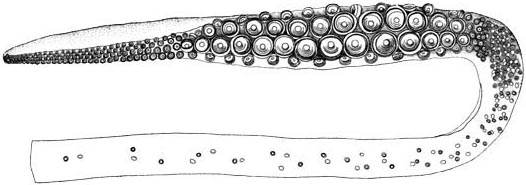
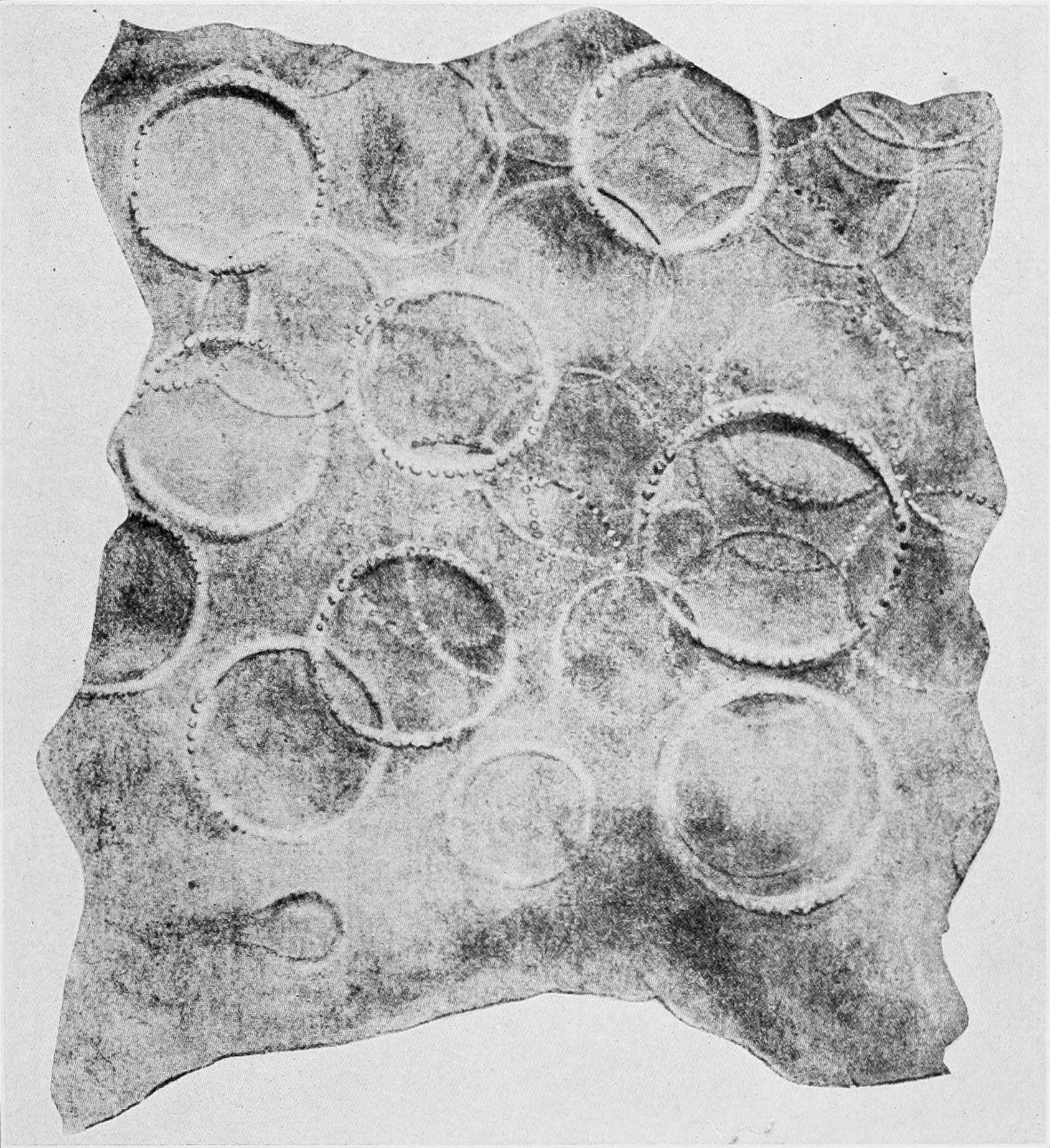
The inside surfaces of the arms and tentacles are lined with hundreds of subspherical suction cups, 2 to in diameter, each mounted on a stalk. The circumference of these suckers is lined with sharp, finely serrated rings of chitin. The perforation of these teeth and the suction of the cups serve to attach the squid to its prey. It is common to find circular scars from the suckers on or close to the head of sperm whales that have attacked giant squid.
Each tentacular club is divided into three regions—the carpus ("wrist"), manus ("hand") and dactylus ("finger"). The carpus has a dense cluster of cups, in six or seven irregular, transverse rows. The manus is broader closer to the end of the club, and has enlarged suckers in two medial rows. The dactylus is the tip. The bases of all the arms and tentacles are arranged in a circle surrounding the animal's single, parrot-like beak, as in other cephalopods.
Giant squid have small fins at the rear of their mantles used for locomotion. Like other cephalopods, they move through jet propulsion—by pulling water into the mantle cavity, and pushing it through the siphon, in gentle, rhythmic pulses. They can also move quickly by expanding the cavity to fill it with water, then contracting muscles to jet water through the siphon. Giant squid breathe using two large gills inside the mantle cavity. The circulatory system is closed, which is a distinct characteristic of cephalopods. Like other squid, they contain dark ink.
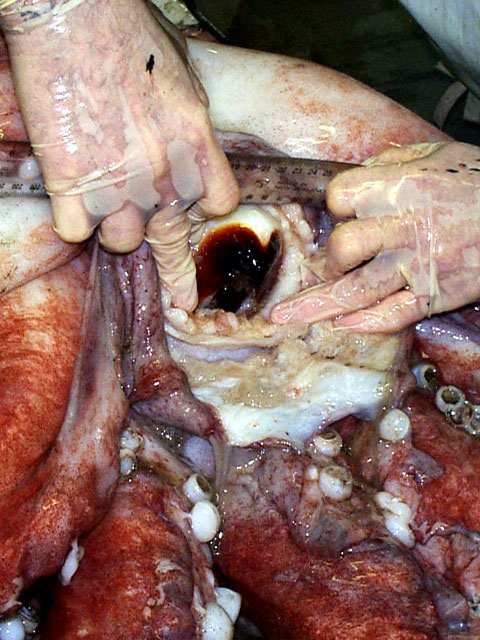
The giant squid has a sophisticated nervous system and complex brain, attracting great interest from scientists. It also has the largest eyes of any living creature except perhaps the colossal squid—up to at least 27 cm in diameter, with a 9 cm pupil (only the extinct ichthyosaurs are known to have had larger eyes). Large eyes can better detect light (including bioluminescent light), which is scarce in deep water. The giant squid probably cannot see color, but it can probably discern small differences in tone, which is important in the low-light conditions of the deep ocean.
Giant squid and some other large squid species maintain neutral buoyancy in seawater through an ammonium chloride solution which is found throughout their bodies and is lighter than seawater. This differs from the method of flotation used by most fish, which involves a gas-filled swim bladder. The solution tastes somewhat like salty liquorice/salmiak and makes giant squid unattractive for general human consumption.
Like all cephalopods, giant squid use organs called statocysts to sense their orientation and motion in water. The age of a giant squid can be determined by "growth rings" in the statocyst's statolith, similar to determining the age of a tree by counting its rings. Much of what is known about giant squid age is based on estimates of the growth rings and from undigested beaks found in the stomachs of sperm whales.
Size
The giant squid is the second-largest mollusc and one of the largest of all extant invertebrates. It is exceeded only by the colossal squid, Mesonychoteuthis hamiltoni, which may have a mantle nearly twice as long. Several extinct cephalopods, such as the Cretaceous coleoids Yezoteuthis and Haboroteuthis, and the Ordovician nautiloid Endoceras may have grown even larger. Although the Cretaceous Tusoteuthis, with its 2 m long mantle, was once considered to grow to a size close to that of the giant squid (over 10 m including arms), this genus is likely doubtful. The largest specimen probably belonged to the genus Enchoteuthis, estimated to have short arms, with a total length of only 3 m.
Giant squid size, particularly total length, has often been exaggerated. Reports of specimens reaching and even exceeding 20 m are widespread, but no specimens approaching this size have been scientifically documented. According to giant squid expert Steve O'Shea, such lengths were likely achieved by greatly stretching the two tentacles like elastic bands.
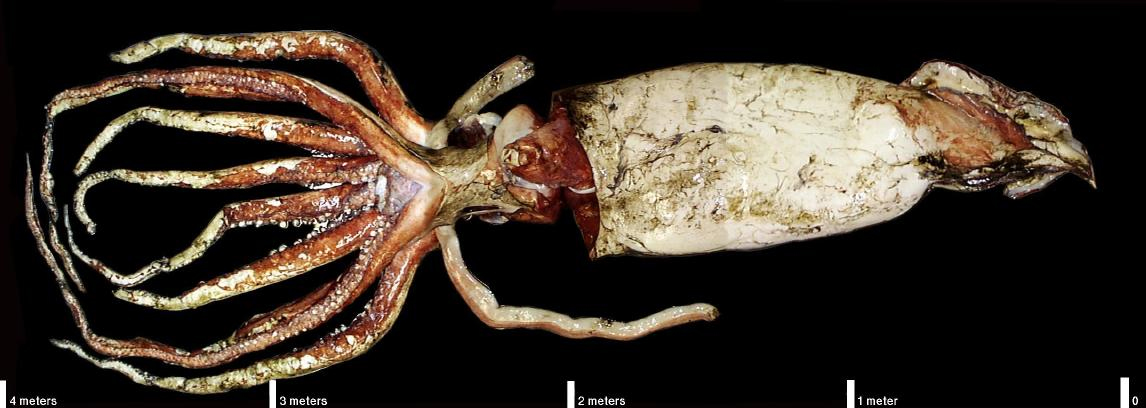
Based on the examination of 130 specimens and of beaks found inside sperm whales, giant squids' mantles are not known to exceed 2.25 m.
Giant squid exhibit sexual dimorphism. Maximum weight is estimated at 275 kg for females and 150 kg for males.
Reproductive cycle
Little is known about the reproductive cycle of giant squid. They are thought to reach sexual maturity at about three years old; males reach sexual maturity at a smaller size than females. Females produce large quantities of eggs, sometimes more than 5 kg, that average 0.5 to long and 0.3 to wide. Females have a single median ovary in the rear end of the mantle cavity and paired, convoluted oviducts, where mature eggs pass, exiting through the oviducal glands, then through the nidamental glands. As in other squid, these glands produce a gelatinous material used to keep the eggs together once they are laid.
In males, as with most other cephalopods, the single, posterior testis produces sperm that move into a complex system of glands that manufacture the spermatophores. These are stored in the elongate sac, or Needham's sac, that terminates in the penis from which they are expelled during mating. The penis is prehensile, over 90 cm long, and extends from inside the mantle. The two ventral arms on a male giant squid are hectocotylized, which means they are specialized to facilitate the fertilization of the female's eggs.
How the sperm is transferred to the egg mass is much debated, as giant squid lack the hectocotylus used for reproduction in many other cephalopods. It may be transferred in sacs of spermatophores, called spermatangia, which the male injects into the female's arms. This is suggested by a female specimen recently found in Tasmania, having a small subsidiary tendril attached to the base of each arm.
Post-larval juveniles have been discovered in surface waters off New Zealand, with plans to capture more and maintain them in an aquarium. Young giant squid specimens were found off the coast of southern Japan in 2013 and confirmed through genetic analysis.
Another juvenile, approximately 3.7 m long, was encountered and filmed alive in the harbour in the Japanese city of Toyama on 24 December 2015; after being filmed and viewed by a large number of spectators, including a diver who entered the water to film the squid up close, it was guided out of the harbour into Toyama Bay by the diver.
Genetics
Analysis of the mitochondrial DNA of giant squid individuals from all over the world has found that there is little variation between individuals across the globe (just 181 differing genetic base pairs out of 20,331). This suggests that there is only a single species of giant squid in the world. Squid larvae may be dispersed by ocean currents across vast distances.
Ecology
Feeding
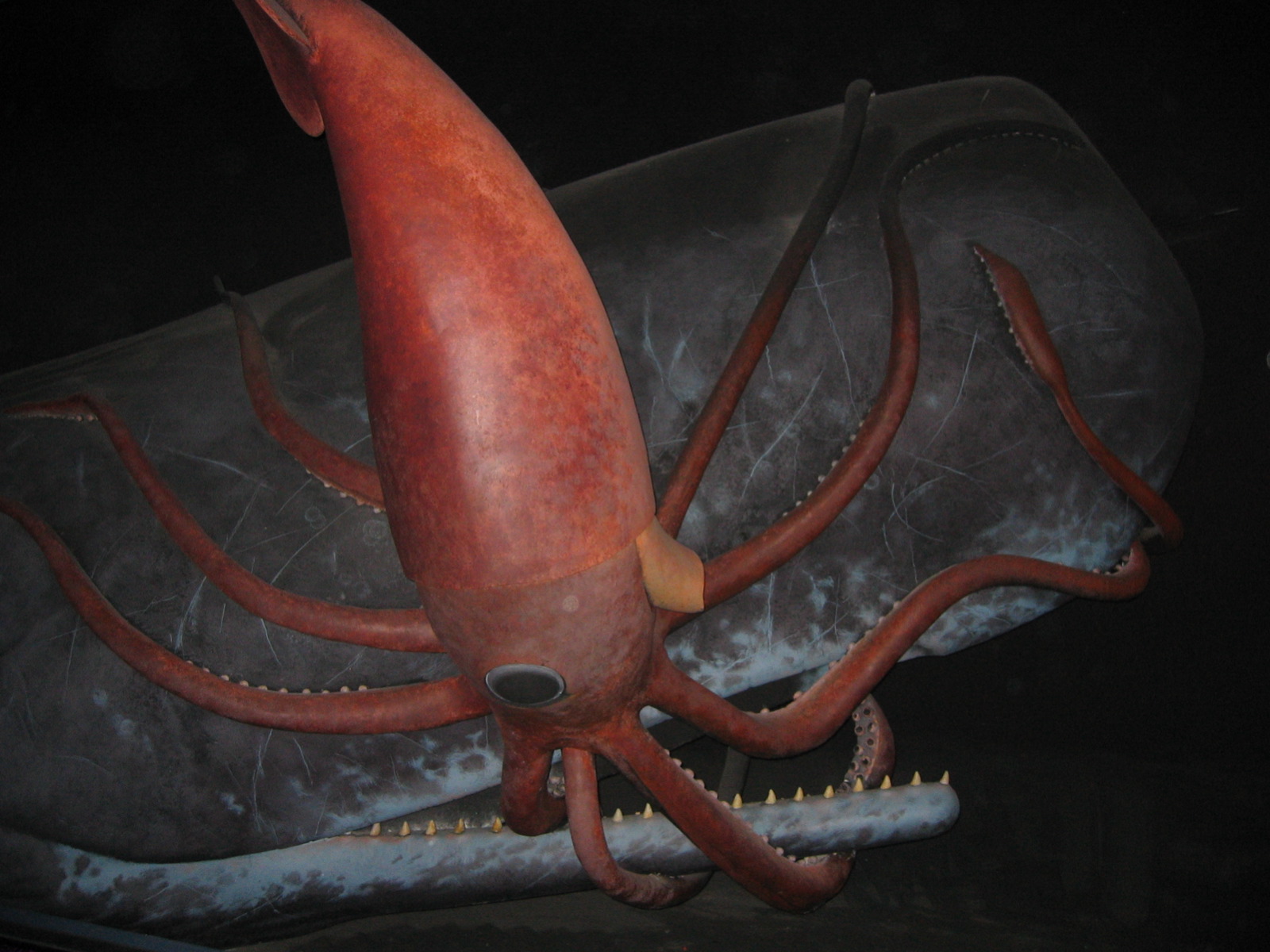
Recent studies have shown giant squid feed on deep-sea fish, such as the orange roughy (Hoplostethus atlanticus), and other squid species. They catch prey using the two tentacles, gripping it with serrated sucker rings on the ends. Then they bring it toward the powerful beak, and shred it with the radula (tongue with small, file-like teeth) before it reaches the esophagus. They are believed to be solitary hunters, as only individual giant squid have been caught in fishing nets. Although the majority of giant squid caught by trawl in New Zealand waters have been associated with the local hoki (Macruronus novaezelandiae) fishery, hoki do not feature in the squid's diet. This suggests giant squid and hoki prey on the same animals.
Predators and potential cannibalism
The known predators of adult giant squid include sperm whales, pilot whales, southern sleeper sharks,{{cite journal |author1=Cherel, Yves |author2=Duhamel, Guy |title=Antarctic jaws: Cephalopod prey of sharks in Kerguelen waters
Population

Scientists have been unable to determine the worldwide population of giant squid to any degree of accuracy. Estimates have been put together based on the number of giant squid beaks found in the stomachs of deceased sperm whales, a known predator of the giant squid, and the better-known population of sperm whales. Based on such observations, it has been estimated that sperm whales consume between 4.3 and 131 million giant squid annually, implying that the giant squid population is likewise well into the millions, but more precise estimates have been elusive.
Species

The taxonomy of the giant squid, as with many cephalopod genera, has long been debated. Lumpers and splitters may propose as many as seventeen species or as few as one. The broadest list is:
- Architeuthis dux, Atlantic giant squid
- Architeuthis (Loligo) hartingii
- Architeuthis japonica
- Architeuthis kirkii
- Architeuthis (Megateuthis) martensii, North Pacific giant squid
- Architeuthis physeteris
- Architeuthis sanctipauli, southern giant squid
- Architeuthis (Steenstrupia) stockii
- Architeuthis (Loligo) bouyeri
- Architeuthis clarkei
- Architeuthis (Plectoteuthis) grandis
- Architeuthis (Megaloteuthis) harveyi
- Architeuthis longimanus
- Architeuthis monachus?
- Architeuthis nawaji
- Architeuthis princeps
- Architeuthis (Dubioteuthis) physeteris
- Architeuthis titan
- Architeuthis verrilli It is unclear if these are distinct species, as no genetic or physical basis for distinguishing between them has yet been proposed.
In the 1984 FAO Species Catalogue of the Cephalopods of the World, Roper, et al. wrote:
In Cephalopods: A World Guide (2000), Mark Norman writes:
In March 2013, researchers at the University of Copenhagen suggested that, based on DNA research, there is only one species:
Timeline
Main article: List of giant squid specimens and sightings

Aristotle, who lived in the fourth century BC, described a large squid, which he called teuthus, distinguishing it from the smaller squid, the teuthis. He mentions, "of the calamaries, the so-called teuthus is much bigger than the teuthis; for teuthi [plural of teuthus] have been found as much as five ells [] long".
Pliny the Elder, living in the first century AD, also described a gigantic squid in his Natural History, with the head "as big as a cask", arms 30 ft long, and carcass weighing 700 lb.
Tales of giant squid have been common among mariners since ancient times, and may have led to the Norse legend of the kraken, a tentacled sea monster as large as an island capable of engulfing and sinking any ship. Japetus Steenstrup, the describer of Architeuthis, suggested a giant squid was the species described as a sea monk to the Danish king Christian III circa 1550. The Lusca of the Caribbean and Scylla in Greek mythology may also derive from giant squid sightings. Eyewitness accounts of other sea monsters like the sea serpent are also thought to be mistaken interpretations of giant squid. Nevertheless, the historian , who has studied the past interactions between humans and giant squid, has pointed out that many old stories about sea monsters were not associated with giant squid until the late 19th century. Latva has proposed that the giant squid was monsterized in the 19th century by natural historians and other writers. Regarding seafarers' relationship with giant squid, he explains it as being pragmatic: they did not perceive giant squid as monsters, but as sea animals that could be utilized in various ways.
Steenstrup wrote a number of papers on giant squid in the 1850s. He first used the term "Architeuthus" (this was the spelling he chose) in a paper in 1857. A portion of a giant squid was secured by the French corvette Alecton in 1861, leading to wider recognition of the genus in the scientific community. From 1870 to 1880, many squid were stranded on the shores of Newfoundland. For example, a specimen washed ashore in Thimble Tickle Bay, Newfoundland, on 2 November 1878; its mantle was reported to be 6.1 m long, with one tentacle 10.7 m long, and it was estimated as weighing 1 ST. Many of these specimens were not preserved, often being processed into manure or animal feed. In 1873, a squid "attacked" a minister and a young boy in a dory near Bell Island, Newfoundland. Many strandings also occurred in New Zealand during the late 19th century.

Although strandings continue to occur sporadically throughout the world, none have been as frequent as those at Newfoundland and New Zealand in the 19th century. It is not known why giant squid become stranded on shore, but it may be because the distribution of deep, cold water where squid live is temporarily altered. Many scientists who have studied squid mass strandings believe they are cyclical and predictable. The length of time between strandings is not known, but was proposed to be 90 years by Architeuthis specialist Frederick Aldrich. Aldrich used this value to correctly predict a relatively small stranding that occurred between 1961 and 1968.
In 2004, another giant squid, later named "Archie", was caught off the coast of the Falkland Islands by a fishing trawler. It was 8.62 m long and was sent to the Natural History Museum in London to be studied and preserved. It was put on display on 1 March 2006 at the Darwin Centre. The find of such a large, complete specimen is very rare, as most specimens are in a poor condition, having washed up dead on beaches or been retrieved from the stomachs of dead sperm whales.
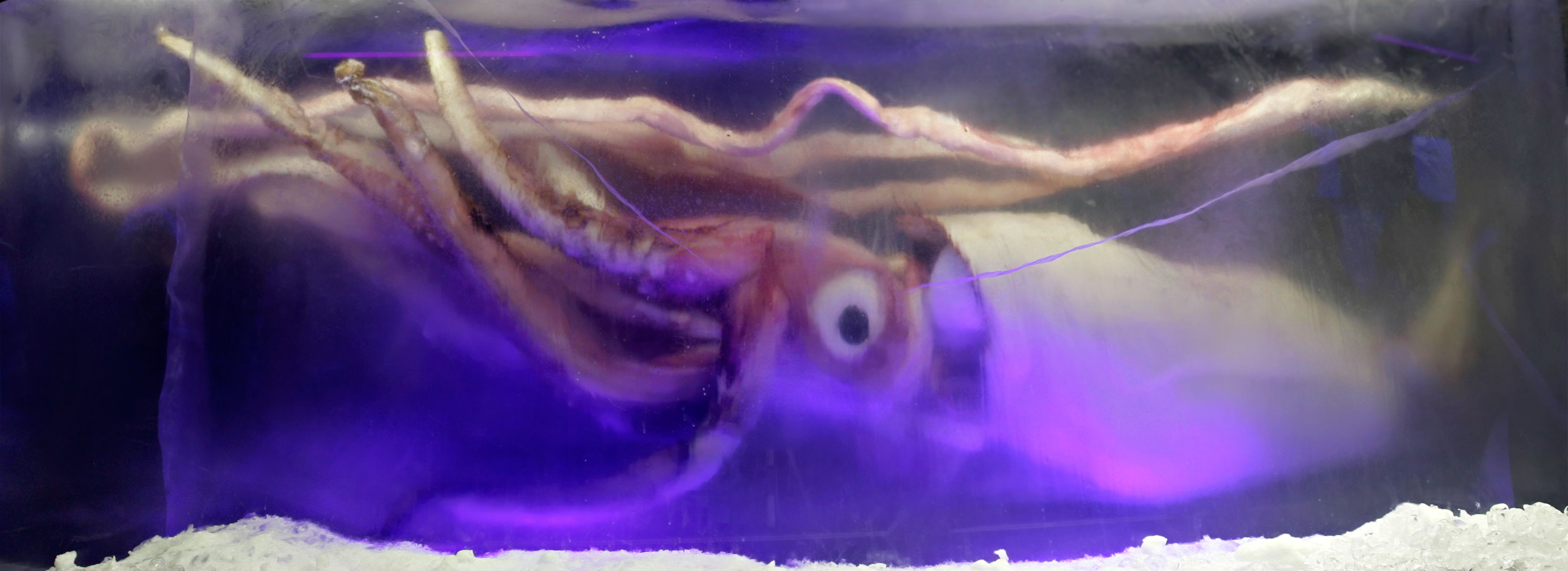
Researchers undertook a painstaking process to preserve the body. It was transported to England on ice aboard a trawler, then defrosted, which took about four days. The major difficulty was that thawing the thick mantle took much longer than the tentacles. To prevent the tentacles from rotting, scientists covered them in ice packs, and bathed the mantle in water. Then they injected the squid with a formol-saline solution to prevent rotting. It is now on show in a 9 m glass tank at the Darwin Centre of the Natural History Museum.
_replica_in_Muséum_national_d'histoire_naturelle_(France).jpg)
In December 2005, the Melbourne Aquarium in Australia paid A$100,000 for the intact body of a 7 m giant squid, preserved in a giant block of ice, which had been caught by fishermen off the coast of New Zealand's South Island that year.
The number of known giant squid specimens was close to 700 in 2011, and new ones are reported each year. Around 30 of these specimens are exhibited at museums and aquaria worldwide. The Museo del Calamar Gigante in Luarca, Spain, had by far the largest collection on public display, but many of the museum's specimens were destroyed during a storm in February 2014.
The search for a live Architeuthis specimen includes attempts to find live young, including larvae. The larvae closely resemble those of Nototodarus and Onykia, but are distinguished by the shape of the mantle attachment to the head, the tentacle suckers, and the beaks.
Images and video of live animals
Main article: List of giant squid specimens and sightings (2001–2014)#Quest for a live animal
By the turn of the 21st century, the giant squid remained one of the few extant megafauna to have never been photographed alive, either in the wild or in captivity. Marine biologist and author Richard Ellis described it as "the most elusive image in natural history". However, the animal in this photograph was a sick or dying Onykia robusta, not a giant squid.
First images of live adult

The first image of a live mature giant squid was taken on 15 January 2002, on Goshiki beach, Amino Cho, Kyoto Prefecture, Japan. The animal, which measured about 2 m in mantle length and 4 m in total length, The specimen was identified by Koutarou Tsuchiya of the Tokyo University of Fisheries. It is on display at the National Science Museum of Japan.
First observations in the wild
The first photographs of a live giant squid in its natural habitat were taken on 30 September 2004, by Tsunemi Kubodera (National Science Museum of Japan) and Kyoichi Mori (Ogasawara Whale Watching Association). Their teams had worked together for nearly two years to accomplish this. They used a five-ton fishing boat and only two crew members. The images were created on their third trip to a known sperm whale hunting ground 970 km south of Tokyo, where they had dropped a 900 m line baited with squid and shrimp. The line also held a camera and a flash. After over twenty tries that day, an 8 m giant squid attacked the lure and snagged its tentacle. The camera took over 500 photos before the squid managed to break free after four hours. The squid's 5.5 m tentacle remained attached to the lure. Later DNA tests confirmed the animal as a giant squid.

On 27 September 2005, Kubodera and Mori released the photographs to the world. The photo sequence, taken at a depth of 900 m off Japan's Ogasawara Islands, shows the squid homing in on the baited line and enveloping it in "a ball of tentacles". The researchers were able to locate the likely general location of giant squid by closely tailing the movements of sperm whales. According to Kubodera, "we knew that they fed on the squid, and we knew when and how deep they dived, so we used them to lead us to the squid". Kubodera and Mori reported their observations in the journal Proceedings of the Royal Society.
Among other things, the observations demonstrate actual hunting behaviors of adult Architeuthis, a subject on which there had been much speculation. The photographs showed an aggressive hunting pattern by the baited squid, leading to it impaling a tentacle on the bait ball's hooks. This may disprove the theory that the giant squid is a drifter which eats whatever floats by, rarely moving so as to conserve energy. The observations suggest that the species has a much more aggressive feeding technique.
First video of live adult in natural habitat =====
In November 2006, American explorer and diver Scott Cassell led an expedition to the Gulf of California with the aim of filming a giant squid in its natural habitat. The team employed a novel filming method: using a Humboldt squid carrying a specially designed camera clipped to its fin. The camera-bearing squid caught on film what was claimed to be a giant squid, with an estimated length of 40 ft, engaging in predatory behavior. The footage aired a year later on a History Channel program, MonsterQuest: Giant Squid Found. Cassell subsequently distanced himself from this documentary, claiming that it contained multiple factual and scientific errors.
In July 2012, a crew from television networks NHK and Discovery Channel captured what was described as "the first-ever footage of a live giant squid in its natural habitat". The footage was revealed on a on 13 January 2013, and was shown on Discovery Channel's show Monster Squid: The Giant Is Real on 27 January 2013, and on Giant Squid: Filming the Impossible – Natural World Special on BBC Two. To capture the footage the team aboard OceanX's vessel MV Alucia traveled to the Ogasawara Islands, south of Tokyo and utilized the ship's crewed submersibles. The squid was about 3 m long and was missing its feeding tentacles, likely from a failed attack by a sperm whale. It was drawn into viewing range by both artificial bioluminescence created to mimic panicking Atolla jellyfish and by using a Thysanoteuthis rhombus (diamond squid) as bait. The giant squid was filmed feeding for about 23 minutes by Tsunemi Kubodera until it departed. The technique of using unobtrusive viewing and bioluminescence luring of the squid with quiet unobtrusive platforms was described by Edith Widder, a member of the expedition.
Second video of giant squid in natural habitat
On 19 June 2019, in an expedition run by the National Oceanic & Atmospheric Association (NOAA), known as the Journey into Midnight, biologists Nathan J. Robinson and Edith Widder captured a video of a juvenile giant squid at a depth of 759 m in the Gulf of Mexico. Michael Vecchione, a NOAA Fisheries zoologist, confirmed that the captured footage was that of the genus Architeuthis, and that the individual filmed measured at somewhere between 10 and.
Other sightings
Main article: List of giant squid specimens and sightings (2001–2014)#Quest for a live animal, List of giant squid specimens and sightings (2015–present)
Videos of live giant squids have been occasionally captured near the surface since the 2012 sighting, with one of these aforementioned individuals being guided back into the open ocean after appearing in Toyama Harbor on 24 December 2015. The majority of these sightings were of sick or dying individuals that had come up to the surface.
Aquarium keeping
The giant squid cannot be kept in aquariums due to its hard-to-reach habitat, body size, and special needs. In 2022, a live specimen was found off the coast of Japan, and an attempt was made to transport it to the Echizen Matsushima Aquarium in the city of Sakai. The squid died and was placed on display in the aquarium.
Cultural depictions
Main article: Giant squid in popular culture, Kraken in popular culture

Representations of the giant squid have been known from early legends of the kraken through books such as Moby-Dick and Jules Verne's 1870 novel Twenty Thousand Leagues Under the Seas on to other novels such as Ian Fleming's Dr. No, Peter Benchley's Beast (adapted as a film called The Beast), and Michael Crichton Sphere (adapted as a film).
In particular, the image of a giant squid locked in battle with a sperm whale is a common one, although the squid is the whale's prey and not an equal combatant.
References
References
- Allcock, L.. (2014). "''Architeuthis dux''".
- (2010 <!--). "Cephalopods of the world. An annotated and illustrated catalogue of species known to date". FAO.
- Atkinson, Kent. (1 May 2008). "Size matters on 'squid row' (+photos, video)". [[The New Zealand Herald]].
- Yukhov, V. L. (2014). [http://dspace.nbuv.gov.ua/bitstream/handle/123456789/129663/24-Yukhov.pdf Гигантские кальмары рода ''Architeuthis'' в Южном океане / Giant calmaries ''Architeuthis'' in the Southern ocean] {{Webarchive. link. (9 March 2024 . [Gigantskiye kalmary roda ''Architeuthis'' v Yuzhnom okeane.] ''Ukrainian Antarctic Journal'' no. 13: 242–253. {{in lang). ru
- (2005). "First-ever observations of a live giant squid in the wild". [[Proceedings of the Royal Society B: Biological Sciences]].
- "WoRMS – World Register of Marine Species – Architeuthoidea Pfeffer, 1900".
- (2006). "Enigmas de la Ciencia: El Calamar Gigante". Coordinadora para el Estudio y la Protección de las Especies Marinas (CEPESMA).
- (1998). "Architeuthidae [Pfeffer 1900]".
- Roeleveld, M.A.C.. (2002). "Tentacle morphology of the giant squid ''Architeuthis'' from the North Atlantic and Pacific Oceans". Bulletin of Marine Science.
- "Giant Squid Sucker Marks {{!}} Smithsonian Ocean".
- (2001). "Tentacular club variation in cephalopods".
- (2000). "Cephalopod tentacle terminology".
- (2012). "A unique advantage for giant eyes in Giant Squid". Current Biology.
- Piper, R.. (2007). "Extraordinary Animals: An encyclopedia of curious and unusual animals". Greenwood Press.
- (2022-05-01). "Everything you need to know about giant squids".
- (2006). "Two coleoid jaws from the Upper Cretaceous of Hokkaido, Japan". Journal of Paleontology.
- (2015). "Late Cretaceous record of large soft-bodied coleoids based on lower jaw remains from Hokkaido, Japan". Acta Palaeontologica Polonica.
- (2015). "Normal giants? Temporal and latitudinal shifts of Palaeozoic marine invertebrate gigantism and global change". Lethaia.
- (2020). "The Muensterelloidea: phylogeny and character evolution of Mesozoic stem octopods". Papers in Palaeontology.
- (2008). "Giant squid and colossal squid fact sheet".
- (2015). "Sizing ocean giants: Patterns of intraspecific size variation in marine megafauna". PeerJ.
- (1982). "The Giant Squid". W. H. Freeman and Company.
- Roper, Clyde. (1982). "The Giant Squid". Scientific American.
- (2009). "A new record of giant squid Architeuthis sp. (Cephalopoda: Oegopsida) in Brazilian waters". Zoologia (Curitiba).
- Runck, Allison. "Southern Giant Squid".
- Schrope, M.. (27 February 2002). "Giant Squid babies captured".
- (2015). "First records of small-sized young giant squid Architeuthis dux from the coasts of Kyushu Island and the south-western Sea of Japan". Marine Biodiversity Records.
- (28 December 2015). "Giant squid surfaces in Japanese harbor". CNN.
- Fessenden, Marissa. "A Giant Squid Visits a Japanese Harbor".
- Marshall, Michael. (20 March 2013). "World's giant squid are one big happy family".
- (2004). "Gut contents of a giant squid ''Architeuthis dux'' (Cephalopoda: Oegopsida) from New Zealand waters". New Zealand Journal of Zoology.
- "Architeuthis dux".
- (2008). "Cheetahs of the deep sea: Deep foraging sprints in short-finned pilot whales off Tenerife (Canary Islands)". Journal of Animal Ecology.
- (14 May 2008). "Whales are 'cheetahs of the deep'". BBC News.
- (2021). "Killer Whales take down Giant Squid".
- "The bloody pirate life of one of the ocean's most elusive creatures".
- "Washed-up giant squid shows signs of fierce deep-sea fight". Earth Touch News Network.
- (2013). "Unanswered questions about the giant squid ''Architeuthis'' (Architeuthidae) illustrate our incomplete knowledge of coleoid cephalopods". American Malacological Society.
- (1984). "Cephalopods of the World". Food and Agriculture Organization.
- Norman, M.D.. (2000). "Cephalopods: A world guide". ConchBooks.
- (20 March 2013). "Monster from the deep hits the surface". University of Copenhagen.
- Aristotle. "Historia Animalium".
- Ellis, R.. (1998). "[[The Search for the Giant Squid]]". Lyons Press.
- Pliny. "Naturalis Historia".
- "The search for the Giant Squid: Chapter One". [[The New York Times]].
- (2014). "The Kraken: When myth encounters science". História, Ciências, Saúde-Manguinhos.
- "Sea Monks, Sea Bishops, and the Mysterious Umibōzu of Japan".
- Lee, Henry. (1883). ""The Great Sea Serpent", Sea Monsters Unmasked, The Fisheries Exhibition Literature 3". William Clowes and Sons.
- Latva, Otto. (2023-05-11). "The Giant Squid in Transatlantic Culture: The Monsterization of Molluscs". Routledge.
- Verrill, Addison Emery. (1882). "Report on the cephalopods of the northeastern coast of America".
- Jha, Alok. (1 March 2006). "Giant sea creature goes on display". The Guardian.
- Holroyd, Jane. (21 December 2005). "New squid on the (ice) block". The Age.
- (28 February 2006). "Giant Squid goes on display". Natural History Museum.
- (2011). "The giant squid ''Architeuthis'': An emblematic invertebrate that can represent concern for the conservation of marine biodiversity". Biological Conservation.
- (4 February 2014). "El calamar gigante de Gandia se salva del temporal del Cantábrico".
- "Elusive Giant Squid Captured on Film for the First Time".
- (1993). "European Seashells". Hemmen.
- (28 February 2002). "Chasing giants: On the trail of the Giant Squid".
- O'Shea, S.. (4 October 2003). "Re: Living ''Architeuthis'' photo".
- O'Shea, S.. (4 October 2003). "Re: Living ''Architeuthis'' photo".
- link. (13 December 2006)
- link. (January 2008)
- was found near the water's surface. It was captured and tied to a [[Wharf. (2002-02-01). "". link. (2002-02-01). link
- (2010). "Board of Directors". Undersea Voyager Project.
- "Scott Cassell". Explore Green.
- Cassell, Scott. (20 November 2007). "Monster Quest: The Giant Squid – found". ScubaBoard.com.
- (7 January 2013). "Giant squid filmed in Pacific depths: Japan scientists".
- "Giant Creature". [[NHK]].
- (6 January 2013). Oricon. link
- Robey, Jason. (12 October 2012). "Giant Squid Captured on Video for First Time". Discovery.
- [https://www.bbc.co.uk/programmes/b0377t15 ''Giant Squid: Filming the Impossible – Natural World Special''] . BBC.
- (2018-05-12). "Search for the Giant Squid".
- ''Monster Squid: The Giant Is Real''. Discovery Channel.
- (5 March 2013). "Transcript of "How we found the giant squid"".
- "NOAA-funded expedition captures rare footage of Giant Squid in the Gulf of Mexico".
- Jarvis, Brooke. (2019-06-21). "Giant Squid, phantom of the deep, reappears on video". [[The New York Times]].
- (22 December 2006). "Giant squid caught on video by Japanese scientists". Reuters.
- (9 January 2013). "The Giant Squid, captured on camera in its natural habitat for the first time ever! Revealed on NHK and the Discovery Channel". NHK.
- "Giant Squid visits harbor in Japan".
- (29 December 2015). "Rare Giant Squid caught on film in Japan". Yahoo! Travel.
- (29 April 2022). "Ultra-rare live giant squid washes ashore in Japan".
- Hoare, Philip. (3 June 2013). "Professor Malcolm Clarke, acclaimed authority on the sperm whale and giant squid".
This article was imported from Wikipedia and is available under the Creative Commons Attribution-ShareAlike 4.0 License. Content has been adapted to SurfDoc format. Original contributors can be found on the article history page.
Ask Mako anything about Giant squid — get instant answers, deeper analysis, and related topics.
Research with MakoFree with your Surf account
Create a free account to save articles, ask Mako questions, and organize your research.
Sign up freeThis content may have been generated or modified by AI. CloudSurf Software LLC is not responsible for the accuracy, completeness, or reliability of AI-generated content. Always verify important information from primary sources.
Report