From Surf Wiki (app.surf) — the open knowledge base
Giacomo Serpotta
Italian sculptor

Italian sculptor
Giacomo Serpotta (10 March 1656 – 27 February 1732) was an Italian sculptor, active in a Rococo style and mainly working in stucco.
Biography
Serpotta was born and died in Palermo; and may have never left Sicily. His skill and facility with stucco sculpture appears to have arisen without mentorship or direct exposures to the mainstream of Italian Baroque. Rudolf Wittkower describes him as an aberrancy in an otherwise provincial scene, a "meteor in the Sicilian sky".
In 1677, along with Procopio de Ferrari, he decorated the small church of the Madonna dell’Itria in Monreale. His first independent work appears to be in 1682 in connection with an equestrian statue cast of Charles II of Spain and Sicily, which was cast in bronze by Gaspare Romano.
The Serpotta family, including his brother Giuseppe (1653–1719) and his son Procopio (1679–1755), was immensely prolific in Palermo, decorating churches and oratories. In style, he has a florid elegance that often recalls Antonio Raggi, a slightly older artist who was adept at stucco decoration and active in Rome.
For example, decorating the Oratory of San Lorenzo (1690/98–1706) with such a profusion of statuary, teeming with putti, that the walls appear to quiver with the movement of a crowd. He completed work also for the Oratory of Santa Cita; the Oratory of Rosario di San Domenico (1710–17); the Oratory of San Mercurio; the Oratory of Santa Caterina, adjacent to the church of the Olivella; and the chapel dell'Oratorio dei Santi Pietro e Paolo dell'Ospedale dei Sacerdoti. His work at the oratory of the Compagna della Carità di San Bartolomeo degli Incurabili in Palermo has been lost.
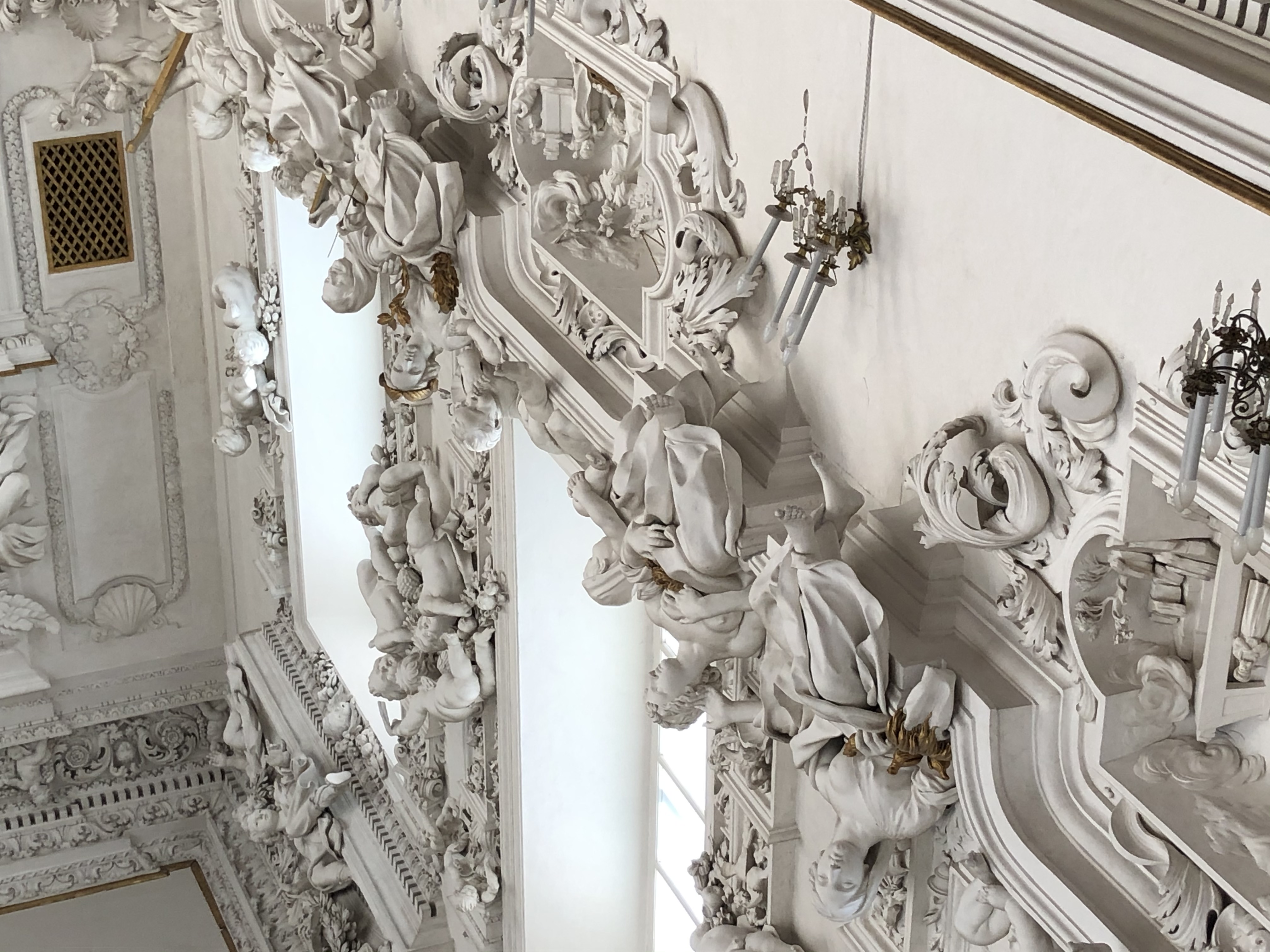

His stucco work for the oratories follows a general formula, but each elaboration is its individual tour de force. Two of the oratories are dedicated to the rosary, and the wall is divided into a series of tableaux or dioramas, each matching a Mystery of the Rosary, above these are allegorical figures or a fecundity of cherubs in playful frolic. The tableaux develops a program of prayer images, like a via crucis for contemplative prayer. The Santa Cita oratory is remarkable for its dioramas, coupled with almost genre like figures calling our attention from the moldings on which they perch. Between the doors entering the oratory is a remarkably detailed depiction of a naval battle, referencing the Battle of Lepanto. In the frames above and below are a trophy of arms, including helmets and body armor, and a Hapsburg eagle spreads its wings.
He also decorated the Archbishop's Palace in Santa Chiara; the Badia Nuova; and the Saints Cosmas and Damian's Church in Alcamo.
| Five Oratories in Palermo decorated by Serpotta | |
|---|---|
| [[File:Oratorio di Santa Cita.JPG | 140px]] |
| Santa Cita | |
Gallery
Statue di Giacomo Serpotta Oratorio di San Domenico.jpg|Oratorio di San Domenico, c.1600. La Giustizia di Giacomo Serpotta (Alcamo).jpg|Justice, (one of four cardinal virtues) stucco, dated 1722 (Saints Cosmas and Damian's Church in Alcamo) Mansuetudine di Giacomo Serpotta, Alcamo.jpg|Prudence, stucco, dated 1724 Badia Nuova in Alcamo San Pietro di Giacomo Serpotta, Alcamo.jpg|Saint Peter, Badia Nuova in Alcamo
References
Sources
- Web Gallery of Art Biography
- Donald Garstang: Giacomo Serpotta and the Stuccatori of Palermo 1560-1790 (London, 1984)
References
- [https://web.archive.org/web/20131112091911/http://www.siciliantimes.com/2012/03/oratorio-santa-cita-oratory-santa-cita.html Oratory of Santa Cita (1668–1718)].
This article was imported from Wikipedia and is available under the Creative Commons Attribution-ShareAlike 4.0 License. Content has been adapted to SurfDoc format. Original contributors can be found on the article history page.
Ask Mako anything about Giacomo Serpotta — get instant answers, deeper analysis, and related topics.
Research with MakoFree with your Surf account
Create a free account to save articles, ask Mako questions, and organize your research.
Sign up freeThis content may have been generated or modified by AI. CloudSurf Software LLC is not responsible for the accuracy, completeness, or reliability of AI-generated content. Always verify important information from primary sources.
Report