From Surf Wiki (app.surf) — the open knowledge base
Ghumdan Palace
Historical site in the Old City of Sana'a
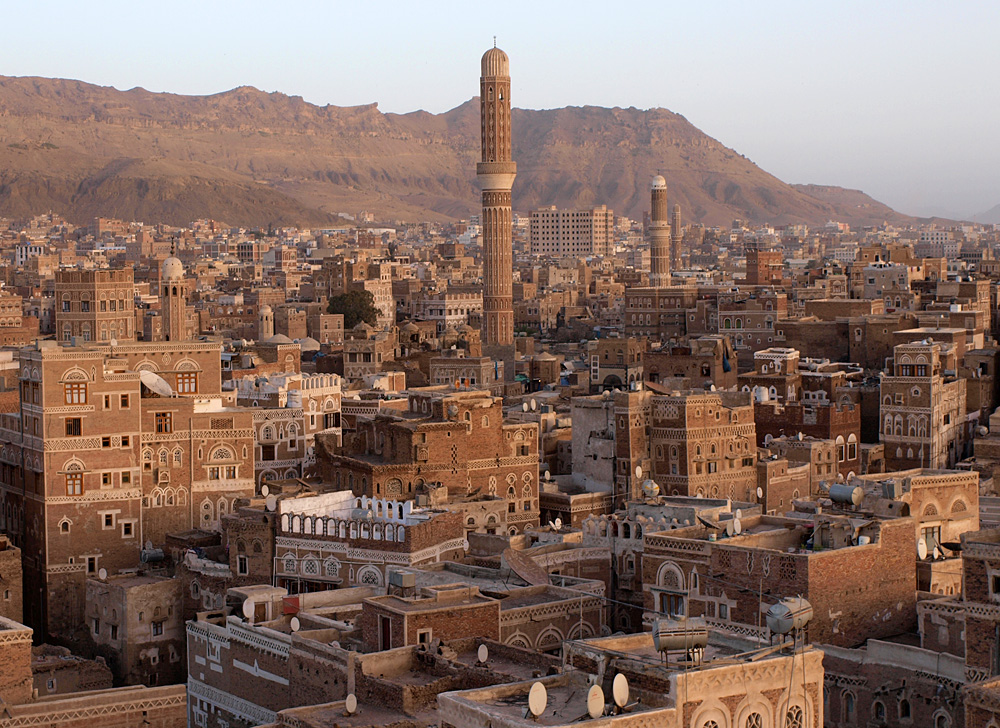
Historical site in the Old City of Sana'a
| Field | Value |
|---|---|
| name | Ghumdan Palace |
| caption | One of the doors of the Ghumdan Palace that has Sabean inscriptions. Currently in the Great Mosque of Sana’a |
| map_type | Yemen |
| coordinates | |
| relief | 1 |
| location_town | Sana'a |
| location_country | Yemen |
| completion_date | Mid third century AD (?) |
| style | Architecture |
Ghumdan Palace, also Qasir Ghumdan or Ghamdan Palace, is an ancient fortified palace in Sana'a, Yemen, going back to the ancient Kingdom of Saba. All that remains of the ancient site (Ar. khadd) of Ghumdan is a field of tangled ruins opposite the first and second of the eastern doors of the Jami‘ Al Kabeer Mosque (Great Mosque of Sana'a). This part of Sana'a forms an eminence which is known to contain the debris of ancient times. The place is located on the extreme southeastern end of Sanaa's old walled city, al-Qaṣr, just west of where the Great Mosque of Sana'a was later built, and is part of the UNESCO World Heritage Site of the Old City of Sana'a. It is sometimes referred to as Ghumdan Tower.
According to Arab geographer and historian, Al-Hamdani (c. 893-945), the foundation stones of Ghumdan Palace were laid by Shem, the son of Noah, and finished by the Sabaean monarch Ilī-Sharḥa Yaḥḍib (ca. 8th century BCE), the father of Bilqis. Others say that it was built by Sha'r Awtar who walled the city of Sana'a, while yet others suggest that it may date to pre-Islamic times, constructed by the Sabaeans during the reign of the last great Sabaean King El Sharih Yahdhib (ca. 60-20 BCE). Some historians date it to the beginning of the 2nd century or the 1st century. The palace was destroyed by Caliph Uthman, or even earlier, by Kaleb. Restored several times, the palace history is represented in numerous legends and tales. It is mentioned in many pieces of Arabic poetry, the poets singing about its beauty. Ghumdan Palace tower, a 20-storey high-rise building, is believed by some to have been the world's earliest skyscraper.
History
Though the former palace is now in ruins, its style, a towered, multi-floor structure, has provided the prototype for the tower-type houses built in Sana’a. It expressed the "exquisite architecture of the old city".
The palace was used by the last Himyarite kings, who had ruled Yemen from Ghumdan and was once the residence of Abhalah. It was reportedly destroyed by Caliph Uthman in the 7th century because he feared it could be used as a stronghold for a rebellion. Some of its materials were re-used to build the Great Mosque.
The palace was reconstructed some time later but deteriorated over time. The ruins of the palace tower are now in the form of a mound that extends from the east of the Great Mosque to the north of Bab Al-Yemen.
Architecture
The palace tower or citadel was built at the top of a hill. Historians such as Al-Hamdani, Mohammed Al-Qazwani and Dr. Adnan Tarsis dispute the height of the original palace. Given its grandeur, its height was exaggerated in historic accounts. Most claims are between six and ten storeys. In the early 9th century, it was reported to have been "seven storeys tall with the highest room being of polychrome marble, and its roof a single slab of green marble." Al-Hamdani writing in the tenth-century in the eighth book of his celebrated geography of the antiquities of the Yemen, Al-Iklīl (الإكليل) provides this description:
Built over a square layout, the top floor of the tower contained the Bilqis Hall, also described by al-Hamdani (two volumes, preserved in the British Museum), featured a ceiling affixed with eight-piece transparent marble fanlights. Openings at the four corners of the hall provided a clear view of the moon, worshipped by kings in ancient Yemen. A gate, known as the “Qasr Al-Selah”, is said to be the last vestige of the palace tower.
In pre-Islamic poetry
The Ghumdan Palace is mentioned in pre-Islamic poetry with the poets singing about its beauty. Legend states that when birds flew over the palace, their shadows could be seen on the ceiling.
Dhu Jadan al-Himyari (fl. 6th - 7th century) wrote:
:You have heard of Ghumdan's towers: :From the mountain top it lowers :Well carpentered, with stones for stay, :Plastered with clean, damp, slippery clay; :Oil lamps within it show :At even like the lightening's glow. :This once-new castle is ashes today :The flames have eaten its beauty away.
The poet Adiy b. Zayd al-Hiri wrote:
:What is there after San'a in which once lived :Rulers of a kingdom whose gifts were lavish? :Its builder raised it to the flying clouds, :Its lofty chambers gave forth musk. :Protected by mountains against the attacks of enemies, :Its lofty heights unscalable. :Pleasant was the voice of the night-owl there, :Answered at even by a flute player.
Long after its destruction, the 10th century geographer al Hamdani (c. 893-945) quoted verses reflecting the legend of the tower of Ghumdan: :Twenty stories high the palace stood, :Flirting with the stars and the clouds. :If Paradise lies over the skies, :Ghumdan borders on Paradise.
Notes
References
References
- McLaughlin, Daniel. (12 February 2008). "Yemen: the Bradt travel guide". Bradt Travel Guides.
- R. Serjeant & R. Lewcock, ''San'a'; An Arabian Islamic City'', London 1983
- Al-Hamdāni, al-Ḥasan ibn Aḥmad, ''The Antiquities of South Arabia - The Eighth Book of Al-Iklīl'', Oxford University Press 1938, pp. 8-9; 18–21
- Aithe, p.30.
- (2001). "Yemen: jewel of Arabia". Stacey International.
- Han, Carolyn. (2005). "From the land of Sheba: Yemení folk tales". Interlink Books.
- Al-Alaya, Zaid. (1 October 2005). "The Ancient & Mysterious Palace of Ghamdan". Yemen Observer.
- (1966). "Encyclopedia Americana". Americana Corp..
- (1 January 1994). "New Arabian studies". University of Exeter Press.
- Bronze lion figures at each corner of the [[alabaster]] ceilings were said to make a roaring sound when the wind passed through them. However, the most extraordinary feature of the palace was said to have been the [[Clepsydra (clock). clepsydra]], an ancient time-telling device, which was built therein.Al-Hamdāni, al-Ḥasan ibn Aḥmad, ''The Antiquities of South Arabia - The Eighth Book of Al-Iklīl'', Oxford University Press 1938, p. 15
- "Citadels of High Yemen". CPA Media.
- Houtsma, M. Th.. (1993). "First encyclopaedia of Islam".
- Grabar, Oleg. (1987). "The Formation of Islamic Art". Yale University Press.
This article was imported from Wikipedia and is available under the Creative Commons Attribution-ShareAlike 4.0 License. Content has been adapted to SurfDoc format. Original contributors can be found on the article history page.
Ask Mako anything about Ghumdan Palace — get instant answers, deeper analysis, and related topics.
Research with MakoFree with your Surf account
Create a free account to save articles, ask Mako questions, and organize your research.
Sign up freeThis content may have been generated or modified by AI. CloudSurf Software LLC is not responsible for the accuracy, completeness, or reliability of AI-generated content. Always verify important information from primary sources.
Report