From Surf Wiki (app.surf) — the open knowledge base
Ghost Festival
Traditional Buddhist and Taoist festival

Traditional Buddhist and Taoist festival
| Field | Value | |
|---|---|---|
| holiday_name | Ghost Festival | |
| image | HK ShatinYuLanFestival KingOfGhost.JPG | |
| caption | A paper effigy of the Guanyin in Shatin, Hong Kong. | |
| official_name | ||
| nickname | Spirit Festival | |
| observedby | Buddhists | |
| Taoists | ||
| significance | To commemorate the opening of the gates of Hell and Heaven, and spiritual realm permitting all spirits and souls to receive sustenance, money, and other offerings. | |
| date | 15th day of the 7th Chinese lunisolar month | |
| date | ||
| date | ||
| date | ||
| date | ||
| observances | Ancestor worship, offering food, burning joss paper, chanting of scriptures | |
| relatedto | {{Plain list |
the Chinese festival and its related traditions
Taoists
- Obon (in Japan)
- Baekjung (in Korea)
- Vu Lan (in Vietnam)
- Pchum Ben (observed by Khmer people) and Sen Kbal tek, សែនក្បាលទឹក (observed by Chinese-Cambodians) (in Cambodia)
- Boun Khao Padap Din (in Laos)
- Mataka dānēs (in Sri Lanka)
- Sat Thai (in Thailand) The Ghost Festival or Hungry Ghost Festival, also known as the Zhongyuan Festival in Taoism and the Yulanpen Festival in Buddhism, is a traditional festival held in certain East and Southeast Asian countries. According to the traditional Chinese lunisolar calendar, the Ghost Festival is on the 15th night of the seventh month (14th in parts of southern China).
In Chinese culture, the fifteenth day of the seventh month in the traditional Chinese calendar is called Ghost Day or (especially in Taiwan) Pudu () and the seventh month is generally regarded as the Ghost Month, in which ghosts and spirits, including those of deceased ancestors, come out from the lower realm (Diyu or Preta). Distinct from both the Qingming Festival (or Tomb Sweeping Day, in spring) and Double Ninth Festival (in autumn) in which living descendants pay homage to their deceased ancestors, during Ghost Festival, the deceased are believed to visit the living.
On the fifteenth day the realms of Heaven and Hell and the realm of the living are open, and both Taoists and Buddhists would perform rituals to transmute and absolve the sufferings of the deceased. Intrinsic to the Ghost Month is veneration of the dead, where traditionally the filial piety of descendants extends to their ancestors even after their deaths. Activities during the month would include preparing ritualistic food offerings, burning incense contain Styrax benzoin , and burning joss paper, a papier-mâché form of material items such as clothes, gold, and other fine goods for the visiting spirits of the ancestors. Elaborate meals (often vegetarian) would be served with empty seats for each of the deceased in the family, treating the deceased as if they are still living. Ancestor worship is what distinguishes Qingming Festival from Ghost Festival, because the latter includes paying respects to all deceased, including the same and younger generations, while the former only includes older generations. Other festivities may include buying and releasing miniature paper boats and lanterns on water, which signifies giving directions to the lost ghosts and spirits of the ancestors and other deities.
Origins
Main article: Hungry ghost, Petavatthu, Yulanpen Sutra, Mulian Rescues His Mother
The name relates to the concept of the hungry ghost, the Chinese translation of the term preta in Buddhism. It plays a role in Chinese Buddhism and Taoism as well as in Chinese folk religion, and represents beings who were originally living people, who have died, and who are driven by intense emotional needs in an animalistic way.
As a Taoist festival: Taoism has the "Three Yuan" theory (representing the Three Great Emperor-Officials), which the name "Zhong Yuan" comes from. The festival flourished during the Tang dynasty, whose rulers were partial to Taoism; and "Zhongyuan" became well established as the holiday's name.
As a Buddhist festival: The origin story of the modern Ghost Festival, ultimately originated from ancient India, deriving from the Mahayana scripture known as the Yulanpen or Ullambana Sutra.{{refn|group=note|Karashima: On p. 302 'Although this sutra has often been regarded as apocryphal [Japanese version has in recent times], the contents and ideas in it are well rooted in India as we have seen above. In addition to that, the vocabulary and usage of Chinese words are more archaic, compared with Kumārajīva's corpus (401-413 CE), while they resemble greatly the translations by Dharmarakṣa (fl. 265?-311 CE). Moreover, the transliteration 鉢和羅 (EH pat γwa la MC pwât γwâ lâ} of Skt. pravāra (ṇā), which only occurs in this sutra and its adaptation, i.e. the Baoen Fengpen jing 報恩奉盆經 (T. 16, no. 686, 780a20), indicates clearly that this sutra is not apocryphal but a genuine translation, because only somebody who knew the original Indian form was able to transliterate it thus correctly into Chinese. In conclusion, I assume that
The [Theravadan forms of the festival in South and Southeast Asia (including Cambodia's Pchum Ben) are much older, deriving from the Petavatthu, a scripture in the Pali Canon that probably dates to the 3rdcenturyBC. The Petavatthu account is broadly similar to that later recorded in the Yulanpen Sutra, although it concerns the disciple Sāriputta and his family rather than Moggallāna.
Observance

The Ghost Festival is held during the seventh month of the Chinese calendar. It also falls at the same time as a full moon, the new season, the fall harvest, the peak of Buddhist monastic asceticism, the rebirth of ancestors, and the assembly of the local community. During this month, the gates of hell are opened up and ghosts are free to roam the earth where they seek food and entertainment. These ghosts are believed to be spirits of those without descendants (or, traditionally, without descendants in the male line) or whose descendants did not pay tribute to them after they died. They are desperately hungry, thirsty, and restless as a result. Family members offer food and drink to the ghosts and burn hell bank notes and other forms of joss paper. Joss paper items are believed to have value in the afterlife, considered to be very similar in some aspects to the material world. Families pay tribute to wandering ghosts of strangers so that these homeless souls do not intrude on their lives and bring misfortune. A large feast is held for the ghosts on the day of the ghost festival or thereabouts, when people bring samples of food and place them on an altar or outside a temple or house, to please the ghosts and ward off bad luck. Lotus-shaped lanterns are lit and set afloat in rivers to symbolically guide lost souls to the afterlife.
In some East Asian countries today, live performances are held and everyone is invited to attend. The first row of seats are always empty as this is where the ghosts sit. The shows are always put on at night and at high volumes as the sound is believed to attract and please the ghosts. Some shows include Chinese opera, dramas, and in some areas, even burlesque shows. Traditionally Chinese opera was the main source of entertainment but the newer shows, concerts, dramas, wars, and so forth are referred to as Getai. These acts are better known as "Merry-making".
For rituals, Chinese Buddhists and Taoists hold ceremonies to relieve ghosts from suffering, many of them holding ceremonies in the afternoon or at night (as it is believed that the ghosts are released from hell when the sun sets). Altars are built for the deceased and priests and monks alike perform rituals for the benefit of ghosts. Monks and priests often throw rice or other small foods into the air in all directions to distribute them to the ghosts. An example of such a ritual is the Chinese Buddhist Yujia Yankou rite, which is performed to facilitate the physical and spiritual nourishment of all sentient beings in saṃsāra, including the hungry ghosts.
During the evening, incense is burnt in front of the doors of households. Incense stands for prosperity in Chinese culture, so families believe that there is more prosperity in burning more incense. During the festival, some shops are closed as they want to leave the streets open for the ghosts. In the middle of each street stands an altar of incense with fresh fruit and sacrifices displayed on it.
Fourteen days after the festival, to make sure all the hungry ghosts find their way back to hell, people float water lanterns and set them outside their houses. These lanterns are made by setting a lotus flower-shaped lantern on a paper boat. The lanterns are used to direct the ghosts back to the underworld, and when they go out, it symbolizes that they have found their way back.
Celebrations in other parts of Asia

Singapore and Malaysia
During the 1800s to 1980s in Singapore, temples and various organisations would hire opera troupes to perform street opera for the wandering ghosts and residents alike. Malaysian Chinese would also celebrate the festival with street opera. With the decline of street opera in both Singapore and Malaysia, modern concert-like performances became a prominent feature of the Ghost Festival. Those live concerts are popularly known as Getai in Mandarin () or Koh-tai (Hokkien ) meaning song stages. They are performed by groups of singers, dancers, entertainers, and opera troops or puppet shows on a temporary stage that is set up within a residential district. The festival is usually funded by the temples or organisations of each individual district. During these Getai the front row is left empty for the special guests—the ghosts. It is known to be bad luck to sit on the front row of red seats, if anyone were to sit on them, they would become sick or similarly ailed.
Indonesia

In Indonesia, the festival is popularly known as Chit Gwee Pua (Hokkien ) or Chit Nyiat Pan (Hakka ; Pha̍k-fa-sṳ:Chhit-ngie̍t-pan), Cioko, or Sembahyang Rebutan in Indonesian (Scrambling prayer). Observers gather around temples and bring an offering to a spirit who died in an unlucky way, and after that, they distribute it to the poor. The way people scramble the offerings is the origin of the festival name, and the festival is mostly known in Java Island. Other areas like North Sumatra, Riau, and Riau islands also conduct live concerts known as Getai (Mandarin ) like those in Malaysia and Singapore, and there are also times when observers conduct Tomb sweeping known as Sembahyang Kubur to respect ancestor spirits and garner luck. This is done by buying hell notes or Kim Cua (Hokkien ) and paper-based goods like paper house, paper horse, paper car, etc., which will end up being burned as it is believed that burned goods will be sent to help the spirits feel better in afterlife.
Philippines
In the Philippines, the occasion is more popularly known as Ghost Month, as it affects the entire seventh lunisolar month of the Chinese calendar around August to September (which coincided with the month of the Immaculate Heart of Mary). The month-long observances are mostly traditionally practiced and originated by Chinese Filipinos which its observance has since spread to other Filipinos that have become aware of it, since it reverberates economically through the stock market as a sizable amount of investors stop investing and put off their investments for later dates past the occasion. Generally, those who observe it find it to be a very unlucky time of the year, as traditional belief states that the souls of dead relatives, wandering souls or vengeful spirits roam the earth during the month-long occasion. This means that practitioners take extra precautions and caution others of making important decisions when it comes to relationships, professions, businesses, and finances. People avoid practices like, making life-changing decisions, getting married or engaged, starting new businesses, moving to a new home, traveling, signing contracts, making impulsive major financial decisions, committing to big professional projects, inaugurations, buying or selling off high priced possessions such as cars, phones, or real estate properties, staying late out at night especially kids and elderlies, making noise or whistling at night, leaving food or hanging clothes out after sunset and leaving them overnight since their human-like shape may invite spirits, or even taking pictures at night, wearing black clothes, tapping people on the head or shoulders as it may affect their luck, picking up coins or strange items you find since these may belong to the dead, or even constantly talking to oneself, or going to cemeteries alone, or answering unknown whispers or sobbing, or being constantly close to bodies of water, or constantly talking about ghosts or death. Besides these many avoidances, practitioners also make offerings and prayers for the souls of the dead, such as burning spirit money, lighting incense, and laying out food like fruits and drinks on home or temple altars or cemetery tombs or graves or mausoleums of deceased relatives that people during this month also start to visit. Some people also start to hold memorial services to deceased relatives or ancestors held either at home or at a Chinese temple, a church or funeral home.
Taiwan

Traditionally, it is believed that ghosts haunt the island of Taiwan for the entire seventh lunisolar month, when the mid-summer Ghost Festival is held. The month is known as Ghost Month. The first day of the month is marked by opening the gate of a temple, symbolizing the gates of hell. On the twelfth day, lamps on the main altar are lit. On the thirteenth day, a procession of lanterns is held. On the fourteenth day, a parade is held for releasing water lanterns. Incense and food are offered to the spirits to deter them from visiting homes and spirit paper money is also burnt as an offering. During the month, people avoid surgery, buying cars, swimming, moving house, marrying, whistling, and going out or taking pictures after dark.
Vietnam
.jpg)
This festival is known as Tết Trung Nguyên and is viewed as a time for the pardoning of condemned souls who are released from hell. The "homeless" should be "fed" and appeased with offerings of food. Merits for the living are also earned by the release of birds and fish. The lunisolar month in which the festival takes place is colloquially known as Tháng Cô Hồn - the month of lonely spirits, and believed to be haunted and particularly unlucky.
Influenced by Buddhism, this holiday coincides with Vu Lan, the Vietnamese transliteration for Ullambana.
In modern times, Vu Lan is also seen as Parents' Day. People with living parents would bear a red rose and would give thanks while those without can choose to bear a white rose; and attend services to pray for the deceased.
Related traditions
Buddhist traditions
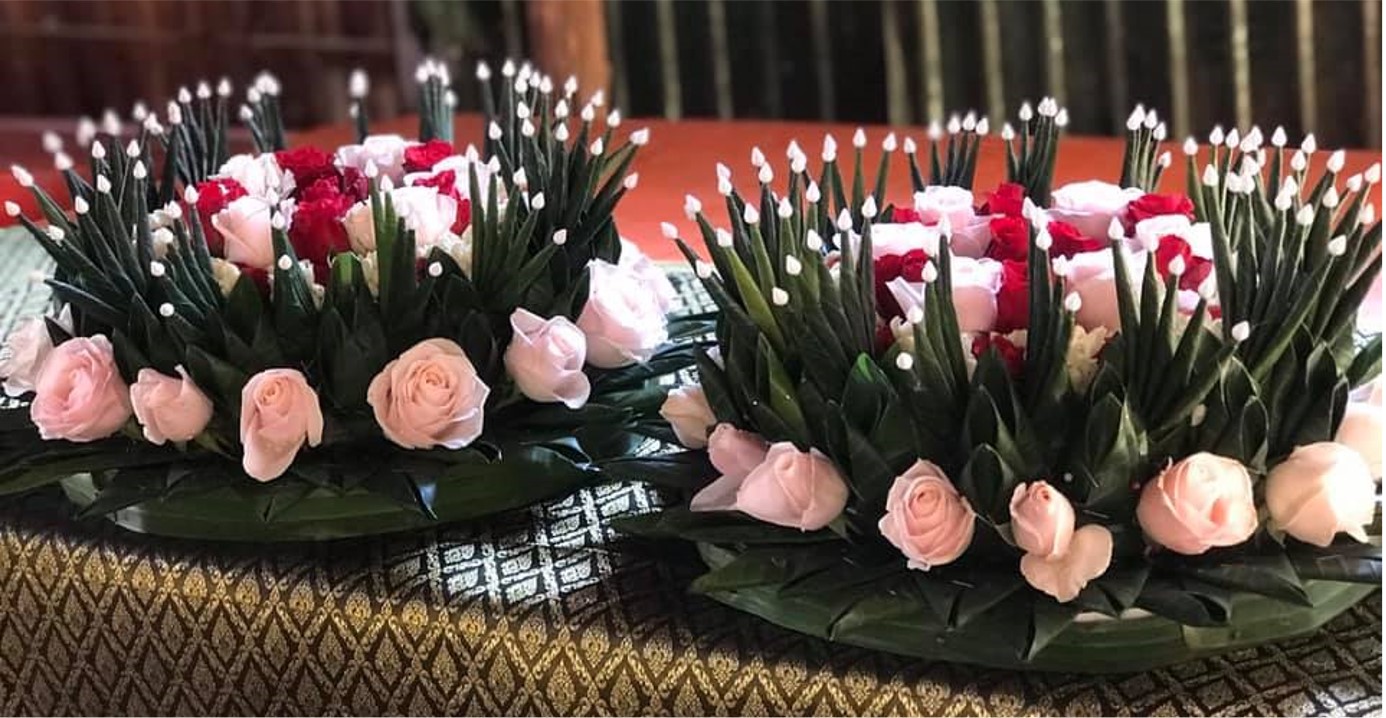
In Asian Theravadin Buddhist countries, related traditions, ceremonies, and festivals also occur. Like its Ullambana Sutra-origins in Mahayana Buddhist countries, the Theravada scripture, the Petavatthu gave rise to the idea of offering food to the hungry ghosts in the Theravada tradition as a form of merit-making. In stories published in the Petavatthu Maudgalyayana, who also plays the central role in the rise of the concept in the Mahayana tradition, along with Sariputta also play a role in the rise of the concept in the Theravada tradition. Similarly to the rise of the concept in Mahayana Buddhism, a version of Maudgalyayana Rescues His Mother, where Maudgalyayana is replaced by Sariputta is recorded in the Petavatthu and is in part the basis behind the practice of the concept in Theravadin societies. The concept of offering food to the hungry ghosts is also found in early Buddhist literature, in the Tirokudda Kanda.
Cambodia
Main article: Pchum Ben
In Cambodia, a fifteen-day-long annual festival known as Pchum Ben occurs generally in September or October. Cambodians pay their respects to deceased relatives up to seven generations. The gates of hell are believed to open during this period and many people make offerings to these hungry ghosts.
Laos
In Laos, a festival known as, Boun khao padap din usually occurs in September each year and goes on for two weeks. During this period, it is believed that hungry ghosts are freed from hell and enter the world of the living. A second festival known as Boun khao salak occurs directly after the conclusion of Boun khay padab din. During this period, food offerings are made to the hungry ghosts.
Sri Lanka
In Sri Lanka, food offerings are made to Buddhist monks as a way for indirectly offering them to their relatives who might have been born as a hungry ghost. This is typically offered on the seventh day, three months and one year after the death day of a deceased person. It is a ceremony conducted after death as part of traditional Sri Lankan Buddhist funeral rites and is known as mataka dānēs or matakadānaya. The offerings that are made acquire merit which are then transformed back into the equivalent goods in the world of the hungry ghosts. The offering that is offered on the seventh day, comes a day after personalized food offerings are given in the garden to the spirit of the deceased relative, which occurs on the sixth day. The deceased who do not reach the proper afterworld, the Hungry Ghost realm, are feared by the living as they are believed to cause various sicknesses and disasters to the living. Buddhist monks are called upon to perform pirit to ward off the floating spirits. The rite is also practiced in Thailand and Myanmar and is also practiced during the Ghost Festival that is observed in other Asian countries.
Thailand
Main article: Sat Thai
In Thailand, a fifteen-day-long annual festival known as Sat Thai is celebrated between September and October in Thailand especially in southern Thailand, particularly in the province of Nakhon Si Thammarat. Like related festivals and traditions in other parts of Asia, the deceased are believed to come back to earth for fifteen days and people make offerings to them. The festival is known as Sat Thai to differentiate it from the Chinese Ghost Festival which is known as Sat Chin in the Thai language.
Japan

''Chūgen'' =====
Chūgen (中元), also Ochūgen, is an annual event in Japan on the 15th day of the 7th month, when people give gifts, especially to their superiors. Originally it was an annual event for giving gifts to the ancestral spirits.
One of the three days that form the sangen of Daoism, it is sometimes considered a zassetsu, a type of seasonal day in the Japanese calendar.
''Bon''
Main article: Bon (festival)
Obon (sometimes transliterated O-bon), or simply Bon, is the Japanese version of the Ghost Festival. It has since been transformed over time into a family reunion holiday during which people from the big cities return to their home towns and visit and clean the resting places of their ancestors.
Traditionally including a dance called Bon Odori, Obon has existed in Japan for more than 500 years. In modern Japan, it is held on July 15 in the eastern part (Kantō) and on August 15 in the western part (Kansai).
Ryukyu Islands
In Okinawa and the Amami Islands, it is celebrated as in China, on the 15th day of the 7th lunisolar month. This festival is known as Bun/Usjooroo.
Hindu traditions

India
Main article: Pitru Paksha
The performance of Shraddha by a son during Pitru Paksha is regarded as compulsory by Hindus, to ensure that the soul of the ancestor goes to heaven. In this context, the scripture Garuda Purana says, "there is no salvation for a man without a son". The scriptures preach that a householder should propitiate ancestors (Pitris), along with the gods (devas), ghosts (bhutas), and guests. The scripture Markandeya Purana says that if the ancestors are content with the shraddhas, they will bestow health, wealth, knowledge and longevity, and ultimately heaven and salvation (moksha) upon the performer.
Indonesia
In Bali and some parts of Indonesia, particularly among the indigenous Hindus of Indonesia, ancestors who have died and cremated are said to return to visit their former homes. This day is known as Hari Raya Galungan and celebrations typically last over two weeks, often in the form of specific food and religious offerings along with festivities. The festival date is often calculated according to the Balinese pawukon calendar and typically occurs every 210 days.
Notes on references
References
General and cited bibliography
- .
- .
- .
- .
References
- "Zhongyuan festival". China Internet Information Center.
- Chow 2015
- (2017-08-22). "Ghost Festival".
- (8 August 2014). "Culture insider - China's ghost festival". China Daily.
- (30 October 2009). "Chinese Ghost Festival - "the Chinese Halloween"". Peoples Daily (English).
- Venerable Yin-shun. ''The Way to Buddhahood''. Massachusetts: Wisdom Publications: 1998.
- "目次:冥報記白話".
- Eberhard, Stephen F. ''The Ghost Festival in Medieval China''. New Jersey: Princeton University Press: 1988. Hungry ghosts, by contrast, are a much more exceptional case, and would only occur in very unfortunate circumstances, such as if a whole family were killed or when a family no longer venerated their ancestors.
- (2001). "中國節日的故事". 將門文物出版社.
- "中元节是中国的"鬼节"吗?听听民俗学家怎么说". 澎湃新闻.
- Karashima 2013a
- Karashima 2013b
- Karashima 2014
- {{harvp. Langer. 2007
- {{harvp. Teiser. 1988.
- (1952). "Chinese Festivals". H. Wolff.
- "Hungry Ghost Festival". Essortment, 2002. Retrieved 20 October 2008. [http://www.essortment.com/all/hungryghostfes_opi.htm Essortment Articles.] {{Webarchive. link. (February 23, 2009)
- (1991). "Mooncakes and Hungry Ghosts: Festivals of China". China Books & Periodicals.
- "Chinese Culture: Hungry Ghost Festival" [http://www.chinese-culture.net/html/hungry_ghost_festival.html Modern China] {{Webarchive. link. (February 3, 2009)
- "Ghost Festival" ChinaVoc 2001–2007, [http://www.chinavoc.com/festivals/ghost.htm Online Store.] {{webarchive. link. (8 June 2009)
- Lye, Hun Yeow, Department of Religious Studies, University of Virginia. "Feeding Ghosts: A Study of the Yuqie Yankou Rite".
- (2010). "Chinese Festivals: Traditions, Customs and Rituals".
- Soon, Lee Tong. (2000). "Professional Chinese Opera Troupes and Street Opera Performance in Singapore". Asian Music.
- "Hungry Ghost Festival".
- "Hungry Ghost Festival".
- (July 18, 2022). "Why August is called the "Ghost Month"".
- Dy-Zulueta, Dolly. (January 5, 2024). "Lifestyle: The Budgetarian: Money Do's and Don'ts during Ghost Month".
- Beltran, Cito. (October 27, 2023). "Opinion: Filipino Hungry Ghost Month".
- (August 16, 2023). "Lifestyle: Why Does Everything Seem To Stop During Ghost Month?".
- (August 12, 2018). "Starweek Magazine: Ghost Month".
- [http://www.chinatownconnection.com/taiwan-ghost-festival.htm Mid-Summer Ghost Festival] {{Webarchive. link. (January 18, 2011, [http://www.chinatownconnection.com/ China Town Connection] {{Webarchive). link. (September 19, 2010.)
- [http://www.gio.gov.tw/info/festival_c/ghost_e/html/ghost2.htm Ghost Month] {{webarchive. link. (3 December 2010 , [http://www.gio.gov.tw/info/festival_c/ghost_e/ghost.htm Ghost Festival] {{webarchive). link. (29 December 2010 , [http://www.gio.gov.tw/ Government Information Office] {{webarchive). link. (3 April 2005 , [[Taiwan]].)
- link. (October 29, 2010 , [http://www.go2taiwan.net/ Go2Taiwan.net] {{Webarchive). link. (August 31, 2010 .)
- (28 July 2022). "13 unlucky taboos to evade during Ghost Month in Taiwan". Taiwan News.
- "Hungry Ghost Festival 2022: 7 Things You Shouldn't Do". Tatler Asia.
- (8 September 2018). "Ghost Month effects cause Taiwan car sales to plunge in August". Taiwan News.
- (24 July 2006). "Taiwan Quick Take: Ghost Month fuels surgeries". Taipei Times.
- (2009). "Discovering Craft Villages in Vietnam: Ten Itineraries Around Hà Nội". IRD Editions.
- (10 January 2019). "Gods and Rollercoasters: Religion in Theme Parks Worldwide". Bloomsbury Publishing.
- (2013). "Buddhist funeral cultures of Southeast Asia and China". Mortality.
- (2002). "Sacred Biography in the Buddhist Traditions of South and Southeast Asia". Motilal Banarsidass Publ..
- Hecker, Hellmuth. "Maha-Moggallana".
- "StackPath".
- (2012-09-10). "Tibetan Rituals of Death: Buddhist Funerary Practices". Routledge.
- Holt, John Clifford. (April 2012). "Caring for the Dead Ritually in Cambodia". Southeast Asian Studies.
- Ladwig, Patrice. (2012). "Visitors from hell: transformative hospitality to ghosts in a Lao Buddhist festival". Journal of the Royal Anthropological Institute.
- {{harvp. Langer. 2007
- Buswell, Robert E. (2004). "Encyclopedia of Buddhism". Macmillan Reference USA.
- (2005). "Buddhism: Buddhism in South and Southeast Asia". Taylor & Francis.
- (2013-06-17). "Studying Buddhism in Practice". Routledge.
- "Archived copy".
- "Ancestors - Dictionary definition of Ancestors | Encyclopedia.com: FREE online dictionary".
- "Sat Thai Festival - Bangkok 101".
- "Thailand Events & Festivals of October".
- "Japanese Culture - Etiquette". Cultural Atlas.
- (14 June 2011). "Japanese Mind: Understanding Contemporary Japanese Culture". Tuttle Publishing.
- (15 September 2015). "Ghosts: A Haunted History". Reaktion Books.
- (14 March 2023). "Ritual: Magical Celebrations of Nature and Community from Around the World". Running Press.
- (15 January 2002). "The Illustrated Encyclopedia of Zen Buddhism". The Rosen Publishing Group, Inc.
- Sastri, S. M. Natesa. (1988). "Hindu feasts, fasts and ceremonies". Asian Educational Services.
- "Galungan and Kuningan in Bali - Bali Magazine".
- "Balinese ceremonies: Galungan and Kuningan".
- "The calendars of Bali".
This article was imported from Wikipedia and is available under the Creative Commons Attribution-ShareAlike 4.0 License. Content has been adapted to SurfDoc format. Original contributors can be found on the article history page.
Ask Mako anything about Ghost Festival — get instant answers, deeper analysis, and related topics.
Research with MakoFree with your Surf account
Create a free account to save articles, ask Mako questions, and organize your research.
Sign up freeThis content may have been generated or modified by AI. CloudSurf Software LLC is not responsible for the accuracy, completeness, or reliability of AI-generated content. Always verify important information from primary sources.
Report