From Surf Wiki (app.surf) — the open knowledge base
Ghanaians
People of Ghana
People of Ghana
| Field | Value | |
|---|---|---|
| group | Ghanaians | |
| flag | Ghana | |
| image | File:Map of the Ghanian Diaspora in the World.svg | |
| caption | Map of the Ghanaian diaspora in the world | |
| population | million | |
| pop | Ghana : 34 million (2024 estimate) | |
| -----> | region1 | Nigeria |
| pop1 | 500,000 (2021) | |
| ref1 | ||
| region2 | United States | |
| pop2 | 256,750 (2015) | |
| ref2 | ||
| region3 | United Kingdom | |
| pop3 | 250,000 (2021) | |
| ref3 | ||
| region4 | Ivory Coast | |
| pop4 | 111,024 | |
| region5 | Italy | |
| pop5 | 50,414 (2015) | |
| ref5 | ||
| region7 | Netherlands | |
| pop7 | 40,000 (2003) | |
| ref7 | ||
| region8 | Canada | |
| pop8 | 35,495 (2016) | |
| ref8 | ||
| region9 | Germany | |
| pop9 | 39,000 (2023) | |
| ref9 | ||
| region10 | Spain | |
| pop10 | 12,699 (2007) | |
| ref10 | ||
| region11 | Lebanon | |
| pop11 | 10,297 (2013) | |
| ref11 | ||
| region12 | France | |
| pop12 | 10,000 (2007) | |
| ref12 | ||
| region13 | South Africa | |
| pop13 | 10,000 (2010) | |
| ref13 | ||
| region14 | Belgium | |
| pop14 | 5,600 (2015) | |
| region15 | Sweden | |
| pop15 | 5,266 (2024) | |
| ref15 | ||
| region16 | Australia | |
| pop16 | 3,866 (2011) | |
| ref16 | ||
| region17 | Israel | |
| pop17 | 3,000 (2003) | |
| ref17 | ||
| region18 | Norway | |
| pop18 | 2,424 (2014) | |
| ref18 | ||
| region19 | Japan | |
| pop19 | 2,000 | |
| region20 | Finland | |
| pop20 | 2,135 (2017) | |
| ref20 | ||
| region21 | Senegal | |
| pop21 | 2,000 | |
| region22 | Denmark | |
| pop22 | 1,600 (2015) | |
| ref22 | ||
| region23 | Cuba | |
| pop23 | 533 (2011) | |
| ref23 | ||
| region24 | Turkey | |
| pop24 | 500 (2012) | |
| region25 | New Zealand | |
| pop25 | 277 (2007) | |
| ref25 | ||
| region26 | Russia | |
| pop26 | 200 (2011) | |
| ref26 | ||
| region27 | Brazil | |
| pop27 | 442,189 (2013) | |
| ref27 | ||
| region28 | United Arab Emirates | |
| pop28 | 300 | |
| region29 | Togo | |
| pop29 | 47,000 | |
| ref29 | ||
| region30 | Benin | |
| pop30 | 16,000 | |
| ref30 | ||
| region31 | Liberia | |
| pop31 | 8,000 | |
| ref31 | ||
| region32 | Mali | |
| pop32 | 6,000 | |
| ref32 | ||
| languages | ||
| religions | ||
| related | ||
| footnotes | Ghanaian citizens or Ghanaian card nationals. |
Note to editors: If you wish to change the numbers or add a country to this section, PLEASE CITE SOURCES (i.e. use the ref1, ref2, etc parameters) -----| region1 = Nigeria
Ghanaians are a nation originating in the Ghanaian Gold Coast. Ghanaians predominantly inhabit the Republic of Ghana and are the predominant cultural group and residents of Ghana, numbering 34 million people as of 2024, making up 85% of the population. The word "Ghana" means "warrior king". An estimated diaspora population of 4 million people worldwide are of Ghanaian descent. The term ethnic Ghanaian may also be used in some contexts to refer to a group of related ethnic groups native to the Gold Coast.
History
The ethnogenesis of Ghanaians is traced back to nomadic migration from Nubia along the Sahara desert then south to the Gold Coast, and the Ghanaian ethnogenesis taking place on the Ghanaian Gold Coast region from the 10th to 16th century AD. Early Ghanaians were involved in a lucrative trade with gold bars and other natural minerals to the Portuguese in 1471; these Ghanaian states were among the wealthiest on the African continent from the 17th century onwards, following successful further expansion of lucrative Ghanaian gold bars trading to the Dutch, Prussian and Scandinavians from the 16th century through to the 20th century.
Early Ghanaians established a number of powerful kingdoms and empires from the 10th to 17th century, some of which became great powers in the west African region. By 1902, the kingdoms had been annexed by the United Kingdom to the Gold Coast colony following a series of Anglo-Ghanaian conflicts in the 19th century. Ghanaians gained their independence from British colonial rule in 1957, and renamed their sovereign state "Ghana (Warrior King)" because the various Ghanaian kingdoms were a warrior-based society according to contemporary and historical historiography. The Republic of Ghana was the first African country to gain independence from European colonial rule.{{cite video |access-date = 27 April 2013
Demographics and genetics
Main article: Demographics of Ghana
More than 90% of the Ghanaian citizens in Ghana live in urban areas—a figure higher than the world average. The rate of Ghana's population growth is at the world average. Most Ghanaians move to urban areas seeking well-paid jobs. Ghanaians have high level of education in science, technology, mathematics and vocational studies. However, the rural areas have large productivity in agricultural produce. Ethnic groups in Ghana include the Akan (47.3%), the Mole-Dagbon (18.5%), the Ewe (13.9%), the Ga-Dangme (7.4%), the Gurma (5.7%) and the Guan (3.7%).
According to a 2005 Y-DNA study, indigenous Ghanaians in Ghana carry 61% E1b1a.Ghana Kwa: Indigenous Ghanaians of Kwa-speaking ethnicity in Ghana 68.8% of Ghana's population ― Akan (Ashanti, Fanti), Ga-Adangbe, and Ewe; see also Y-DNA haplogroups in populations of Sub-Saharan Africa. Indigenous Ghanaians also belong to paternal lineages at 2.2% E1a. Indigenous Ghanaians in Ghana are 1.1% E1b1b clade bearers, a haplogroup that is most common in North Africa and the Horn of Africa. West Eurasian haplogroup R1b is present in 1.1% of the population.
National identity and citizenship in Ghana
The inhabitants of Ghana possessing Ghanaian passports are 20 million persons, including an additional 3‒4 million persons abroad. Ghana has a diverse population that reflects its colorful history and the peoples who have populated the region from ancient times to the present, with the historic amalgam of the main groups forming the basis of Ghana's current demographics. Native West Africans make up 98% of the population. There is also a new population of Asians, Middle Easterners, Europeans and other recent immigrants.
To obtain Ghanaian nationality, one must be naturalized after seven years of Ghana Card permanent residency. The Asians, Middle Easterners and Europeans who have lived in Ghana for most of their lives have acquired Ghanaian citizenship, which is granted without any discrimination. Two thirds, or 67%, of Ghanaians speak English. There are more than 100 ethnic groups, each with its own distinct language. However, languages that belong to the same ethnic group are usually mutually intelligible. There are nine language family groups and 11 languages from these groups are officially sponsored by the government: Akuapem Twi, Asante Twi, Ewe, Fante, Ga, Dangme, Dagbani, Nzema, Ahanta language (Ahantas) Dagaare, Gonja and Kasena.
During the colonial era, a number of Europeans intermarried with Africans and had offspring, who include such notable Gold Coasters as Carel Hendrik Bartels and James Bannerman. Most European settlers left the Gold Coast after it won independence. Currently, the most significant immigrant populations in Ghana are Africans from other countries on the continent, Asians (Indians and Chinese), some of them Europeans (Britons, Portuguese, Dutch, French, Italians, Latin Americans, Poles, Scandinavians, and Germans), and Middle Easterners, particularly Lebanese and Syrians.
Nationalism, independence and transformation to republic
The Ghanaian nationalism was suspended by the Ghanaian government during the time of World War II, but was resumed in 1945. The Ghanaians allied with the Allies in World War II. The Fifth Pan-African Congress held in October 1945, served to form the support for the liberalization of Ghanaian colonial domination on 4 August 1947. On 12 June 1949, Kwame Nkrumah, formed the first governing party in the history of the Gold Coast, which refused to cooperate with the colonial authorities and which led to the achievement of Ghanaian independence and the opposition to the 1951 Constitution, in which Nkrumah was incarcerated together with his collaborators.
On 8 February 1951, the first elections in the history of the Gold Coast were held; Nkrumah's win was confirmed on 12 February 1951. Ghanaian nationalism was initiated in organisation with the Ghanaian nationlist movement, the Big Six and through the Gold Coast Aborigines' Rights Protection Society; then strikes and mass riots were formed on the streets of the Gold Coast by its natives for Gold Coast independence, the colonial governor at the time, the Earl of Listowel, proclaimed Gold Coast's independence on 6 March 1957. Nkrumah became the first prime minister. On 1 July 1960, Nkrumah drew up the first Constitution of Ghana; the British monarch ceased to be head of state, and Ghana became a republic.
Population
Approximately 5% of Ghanaian citizens live in rural areas and 95% in urban areas. The rate of urbanization estimated for the period 2010–2015 is 4% per annum, one of the highest among developing countries.
| Region (2010) | Region population | url=http://www.statsghana.gov.gh/docfiles/2010phc/Census2010_Summary_report_of_final_results.pdf | title=Ghana – 2010 Population and Housing Census | work=Ghana Statistics Service | year=2010 | publisher=Government of Ghana | access-date=25 April 2013 | archive-url=https://web.archive.org/web/20130925192147/http://www.statsghana.gov.gh/docfiles/2010phc/Census2010_Summary_report_of_final_results.pdf | archive-date=25 September 2013 | url-status=dead}} | url=http://bevoelkerungsstatistik.de/wg.php?x=1170623253&men=gcis&lng=de&dat=32&geo=-85&srt=npan&col=aohdq&pt=c&va=x | title=World Gazetteer online | publisher=World-gazetteer.com | access-date=25 April 2013 | url-status=dead | archive-url=https://web.archive.org/web/20120111172126/http://bevoelkerungsstatistik.de/wg.php?x=1170623253&men=gcis&lng=de&dat=32&geo=-85&srt=npan&col=aohdq&pt=c&va=x | archive-date=11 January 2012 }} | City population | Administrative divisions of Ghana |
|---|---|---|---|---|---|---|---|---|---|---|---|---|---|---|---|---|---|---|---|
| Ashanti Region | 4,780,380 | 24,389 | Kumasi | 1,989,062 | |||||||||||||||
| Brong-Ahafo Region | 2,310,983 | 39,557 | [[File:Sunyani Municipal Assembly (SMA) logo.JPG | 50px | center]] | Sunyani | 87,642 | ||||||||||||
| Central Region | 2,201,863 | 9,826 | [[File:Cape Coast Metropolitan Assembly(CCMA) logo.PNG | 40px | center]] | Cape Coast | 217,032 | ||||||||||||
| Eastern Region | 2,633,154 | 19,323 | [[File:New-Juaben Municipal District logo.jpg | 40px | center]] | Koforidua | 127,334 | ||||||||||||
| Greater Accra Region | 4,010,054 | 3,245 | Accra | 2,291,352 | |||||||||||||||
| Northern Region | 2,479,461 | 70,384 | [[File:Tamale Metropolitan Assembly (TaMA) logo.jpg | 60px | center]] | Tamale | 537,986 | ||||||||||||
| Upper East Region | 1,046,545 | 8,842 | [[File:Bolgatanga Municipal Assembly (BMA) logo.JPG | 40px | center]] | Bolgatanga | 66,68 | ||||||||||||
| Upper West Region | 702,110 | 18,476 | Wa | 102,446 | |||||||||||||||
| Volta Region | 2,118,252 | 20,570 | [[File:Ho Municipal Assembly District logo.jpg | 40px | center]] | Ho | 96,213 | ||||||||||||
| Western Region | 2,376,021 | 23,921 | [[File:Sekondi-Takoradi Metropolitan Assembly (STMA) logo.jpg | 40px | center]] | Sekondi-Takoradi | 445,205 | ||||||||||||
| Total Ghana Ghana | 24,658,823 | 238,533 | [[File:Coat of arms of Ghana.svg | 40px | center]] | Accra |
Subgroups
Ghanaian Arabs
Main article: Ghanaian Arabs
Ghanaian Arabs are Ghanaians and citizens of Arab origin or descent. Ghanaian Arabs are mainly from Lebanon, Syria and Arab Maghreb. Ghana has the largest Arab population in western Africa.
Ghanaian Indians
Main article: Ghanaian Indian
Ghanaian Indians are Ghanaians and citizens of Indian origin or descent. Many Ghanaian Indians are descendants of those who migrated from India following India's partition in 1947.
Ghanaian Chinese
Main article: Chinese people in Ghana
Ghanaian Jews
Main article: History of the Jews in Ghana
Diaspora
There are 3–4 million Ghanaians in the diaspora.
Ghanaian Australians
Main article: Ghanaian Australian
Ghanaian Australians are dual citizens with Australia and residents of Ghanaian origin and descent. More than 50% of all Ghanaian-born Australians live in Sydney, New South Wales.
Ghanaian Americans
Main article: Ghanaian Americans
Ghanaian Americans are dual citizens with America and residents of Ghanaian origin and descent.
Ghanaian Canadians
Main article: Ghanaian Canadians
Ghanaian Canadians are dual citizens with Canada and residents of Ghanaian origin and descent.
Ghanaian British
Main article: Ghanaian British
Ghanaian British are dual citizens with Britain and residents of Ghanaian origin and descent.
Ghanaian Germans
Main article: Ghanaians in Germany
Ghanaian New Zealanders
Main article: Ghanaian New Zealanders
Ghanaian New Zealanders are dual citizens with New Zealand and residents of Ghanaian origin and descent.
Ghanaian Nigerians
An estimated 45,000 people of Ghanaian descent reside in Nigeria.
Ghanaian South Africans
Main article: Ghanaian South Africans
Ghanaian South Africans are dual citizens with South Africa and residents of Ghanaian origin and descent.
Ghanaian Surinamese and Guyanese
Main article: Ndyuka people, Afro-Surinamese, Afro-Guyanese
Ndyuka (also spelled "Djuka") or Aukan or Okanisi sama, are a Ghanaian Akan subgroup who live in Eastern Suriname and west of French Guiana and speak the Ndyuka language, a sub-language of the Akan language. They were shipped as imported labourers slaves from the Gold Coast (modern-day Ghana) to Suriname about 300 years ago to work on Dutch-owned plantations. Ndyukas or Aukans are subdivided into the Opu, who live upstream of the Tapanahony River of southeastern Suriname, and the Bilo, who live downstream of that river. They further subdivide themselves into 14 matrilinear kinship groups called lo.
Ghanaian Japanese
Main article: Ghanaians in Japan
Culture
Ghana's cultural diversity is most evident in cuisine, arts, literature, heritage, music, dance, clothing, and sports.
Kente is a Ghanaian ceremonial cloth traditionally used as the national costume. Kente is hand-woven on a horizontal treadle loom in strips measuring about 4 inches wide, which are sewn together into larger pieces of cloth. Cloths come in various colours, sizes and designs, which have different meanings, and are worn on important social occasions. During the 13th century, Ghanaians developed their unique art of adinkra printing.
Notable Ghanaian authors include novelists Ayi Kwei Armah (The Beautyful Ones Are Not Yet Born), Ama Ata Aidoo (Our Sister Killjoy: or Reflections from a Black-eyed Squint) and J. E. Casely Hayford, author of Osiris Rising. In addition to novels, other literary genres such as theatre and poetry have been well developed at a national level.
Ghanaian music incorporates several distinct types of instruments, including talking drums, the atenteben and koloko lute, the atumpan, and log xylophones used in asonko music. The most well-known genre to come from Ghana is highlife. Highlife originated in the late 19th century and early 20th century. In the 1990s, a new genre of music, hiplife, was created through the combination of highlife, Afro-reggae, dancehall and hip hop. Hiplife is the most popular Ghanaian music, followed by the other genre of Ghanaian music, highlife. Ghanaian dance is globally well known and performed worldwide. The dances are varied and may involve complex and co-ordinated movement of the arms, torso, hips, feet and head, performed to different Ghanaian music forms for entertainment, celebrating at festivals, and other occasions. Some popular dances include Adowa and Azonto. Other traditional dances from Ghana are Kpanlogo, Klama and Bamaya.
Sports in Ghana is dominated by association football represented by the Ghana Premier League and the Ghana national football team. The rich culture in Ghana led to the annual festival held at the capital region, Greater Accra at the James Town township which is celebrated along with the Homowo festival. This new festival called Chale Wote has caught the eyes of many who seek to experience the true Ghanaian culture and festival for themselves.
Women

In Ghanaian society polygyny – marriages in which men are permitted to have more than one wife at the same time – has been traditionally practised, especially among well-to-do Ghanaian men. Among matrilineal groups, such as the Akan, married women continued to reside at their maternal homes. Meals prepared by the wife would be carried to the husband at his maternal house. In polygynous situations, visitation schedules would be arranged. The separate living patterns reinforced the idea that each spouse is subject to the authority of a different household head, and because spouses are always members of different lineages, each is ultimately subject to the authority of the senior men of his or her lineage. The wife, as an outsider in the husband's family, would not inherit any of his property, other than that granted to her by her husband as gifts in token appreciation of years of devotion. The children from this matrilineal marriage would be expected to inherit from their mother's family. Today, the percentage of women in polygynous marriages in Ghana's rural areas (23.9%) is almost double that of women in Ghana's urban areas (12.4%). The age group with the most women in polygynous marriages is 45–49, followed by the 15–19 age group and the 40–44 group. Rates of polygynous marriages decrease as education level and wealth level increase.
During 2008–2012, the national literacy rate for women aged 15–24 was 83.2%, only slightly lower than that for males of the same age group (88.3%). However, literacy rates fluctuate across Ghana country and socioeconomic statuses. Women living at the highest socioeconomic status exhibit the highest literacy rates at 85%, while only 31% of women living at the lowest socioeconomic status are literate. Net enrolment and attendance ratios for primary school were both about the same for males and females, net enrollment standing at about 84% and net attendance at about 73%. Enrolment in secondary school for females was slightly lower than for males (44.4% vs. 48.1%), but female attendance was higher by about the same difference (39.7% vs. 43.6%).
As of 2011, women made up 66.9% of economically active population in Ghana. Within the informal sector, women usually work in personal services. There are distinct differences in artisan apprenticeships offered to women and men, as well. Men are offered a much wider range of apprenticeships, such as carpenters, masons, blacksmiths, mechanics, painters, repairers of electrical and electronic appliances, upholsters, metal workers, car sprayers, etc. In contrast, most female artisans are involved in either hairdressing or dressmaking. Women generally experience a disparity in earnings, receiving a daily average of 6,280 cedis compared to 8,560 cedis received by men, according to the Ghana Living Standards Survey. Women are flourishing in teaching professions.

Early 1990s' data showed that about 19% of the instructional staff at the nation's three universities in 1990 was female.
Feminist organizing has increased in Ghana as women seek to obtain a stronger role in the nation's democratic government. In 2004, a coalition of women created the Women's Manifesto for Ghana, a document that demands economic and political equality as well as reproductive health care and other rights. The National Council for Women and Development (NCWD) is fervent in its stance that the social and economic well-being of women, who compose slightly more than half of the nation's population, cannot be taken for granted.
In 2007, the government of Ghana took legal proceedings to prosecute men who abuse their women.
Republic of Ghana (1957–present)
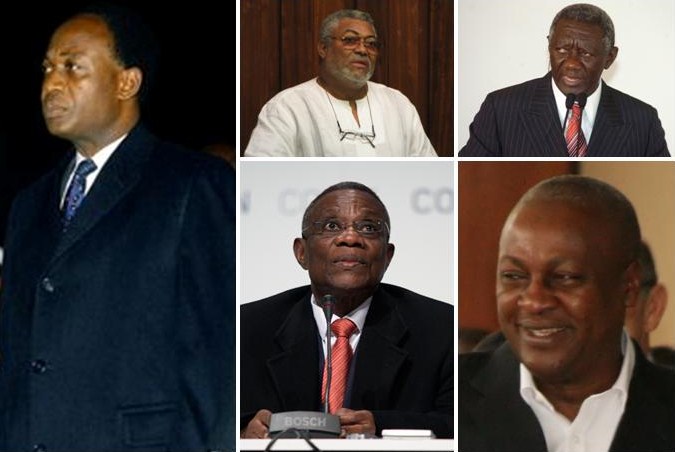
In 1966, Nkrumah was deposed, after which Ghana entered a period of military rule. On 31 December 1981, the regime led by Flight lieutenant Jerry John Rawlings installed the Provisional National Defence Council (PNDC), of which he became chairman. In 1992, Rawlings retired from the military and set up the National Democratic Congress (NDC), and was subsequently elected for two terms as president.
On January 7, 2001, John Agyekum Kufuor succeeded Rawlings as Ghanaian head of state until the year 2008. Kufuor was replaced as Ghanaian head of state by John Atta Mills until his death in July 2012. In July, 2012, John Dramani Mahama succeeded Mills as the Republic of Ghana President and Commander-in-Chief of the Ghana Armed Forces.
On 7 January 2017, Nana Akufo-Addo took office as President. On 7 January 2025, John Dramani Mahama took office once again as President of the Republic of Ghana.
References and notes
Notes
References
- (23 February 2024). "Digital 2024: Ghana".
- The Consul-General of Ghana in Lagos, Mr. Maxwell Awiaya, on Wednesday, disclosed that there are about 500,000 Ghanaians currently living in different Nigerian cities and communities.[https://www.vanguardngr.com/2018/02/500000-ghanaians-live-nigeria-envoy/amp/]
- United States Census Bureau. (April 2020}}{{cbignore). "People Reporting Ancestry, 2011 American Community Survey 1-Year Estimates, United States Census Bureau". United States Census Bureau.
- Office for National Statistics. (September 2009). "Estimated population resident in the United Kingdom, by foreign country of birth (Table 1.3)". census.gov.
- National Institute of Statistics (Italy). (2010). "National Institute of Statistics (ISTAT)". istat.it.
- (11 January 2012). "Comuni Italiani". Comuni.
- Statistics Netherlands. (2003). "Bevolking, publicaties en artikelen". cbs.nl.
- Bump, Micah. (2006). "Ghana: Searching for Opportunities at Home and Abroad". migrationinformation.org.
- Statistics Canada. (2006). "Ethnic origins, 2006 counts, for Canada, provinces and territories". statcan.ca.
- (12 April 2021). "Ausländische Bevölkerung Ergebnisse des Ausländerzentralregisters". Statistisches Bundesamt (Destatis) ([[Federal Statistical Office of Germany]]).
- (2007). "Datos – Instituto Nacional de Estadística. (National Statistics)". [[Instituto Nacional de Estadística (Spain)]].
- Lee, Hayeon. (3 October 2009). "African men in Lebanon". nowlebanon.com.
- "Raveil de l'ethnicit". [[Hyper Articles en Ligne]].
- (25 January 2010). "New money transfer facility for Ghanaians in SA". Bizcommunity.com.
- (December 2024). "Befolkning efter födelseland och ursprungsland, 31 december 2024, totalt". Statistiska centralbyrån.
- Australian Bureau of Statistics. (27 June 2007). "Community Information Summary – Ghana-born". immi.gov.au.
- Sinai, Ruth. (30 September 2003). "For these Ghanaians, Israel became a home they don't want to leave". [[Haaretz]].
- Statistics Norway (SSB). (1 January 2010). "Statistics Norway – Persons with immigrant background by immigration category and country background". ssb.no.
- "Väestö 31.12. Muuttujina Alue, Taustamaa, Sukupuoli, Vuosi ja Tiedot".
- "StatBank Denmark". statbank.dk.
- Ghana News Agency (GNA). (23 October 2011). "Ghana Signs MOU to train 250 medical personnel in Cuba-Veep". ghananewsagency.org.
- [http://www.arc.govt.nz/albany/fms/main/Documents/Auckland/Population%20and%20stats/Immigration%20and%20Ethnicity%20in%20the%20Auckland%20region%202006.pdf "Immigration and Ethnicity in the Auckland region"] {{Webarchive. link. (14 August 2012 . [[Statistics New Zealand]], 27 December 2007. Retrieved 21 June 2012.)
- [http://www.news.peacefmonline.com/education/201112/83000.php Govt Ghanaian in Russia]{{dead link. (January 2017)
- Hirsch, Afua. (31 January 2013). "Ghana opens its arms to diaspora in Brazil and beyond". [[The Guardian]].
- (10 February 2014). "Immigrant and Emigrant Populations by Country of Origin and Destination".
- "CIA WORLD FACTBOOK - Report".
- (2014). "Facts About Ghana". [[Ministry of Tourism (Ghana)]].
- "Ghana : History {{!}} The Commonwealth".
- (1 March 2013). "A Journey Through Islam: Muslims have come up well in Ghana". [[Arab News]].
- "Ghana | Etymology, origin and meaning of the name ghana".
- "The people of Ghana". niica.on.ca.
- Cohen, Robin. (1995). "The Cambridge Survey of World Migration". [[Cambridge University Press]].
- Chronology of world history: a calendar of principal events from 3000 BC to AD 1973, Part 1973.
- "Etymology of Ghana". Douglas Harper.
- (2024-10-18). "Ghana - Independence, Gold Coast, Kwame Nkrumah {{!}} Britannica".
- Wood, Elizabeth T., et al., 2005. [https://www.familytreedna.com/pdf/WoodEJHG2005.pdf Contrasting patterns of Y chromosome and mtDNA variation in Africa: evidence for sex-biased demographic processes] {{Webarchive. link. (27 December 2010; also [http://www.nature.com/ejhg/journal/v13/n7/extref/5201408x1.gif Appendix A])
- "Ghana Embassy – Population". Ghana Embassy.
- "Ghana Demographics Profile 2013". Indexmundi.
- "General Information – Key Figures". GhanaWeb.
- (2013). "Welcome". Government of Ghana.
- Abdulai, Alhaji Ibrahim. (1992). "Master Drummers of Dagbon, Volumes 1 and 2". Chicago: University of Chicago Press, 1979.
- "Regions in Ghana". ghanahighcommissionuk.com.
- "Nationalism and Independence". Ghana50.
- (November 2018). "Nationalism and Independence ''Parte 2''". Ghana50.
- "History of Ghana". Ghana50.
- "Post-Independence Ghana". Ghana50.
- "Government of Ghana partners with Cities Alliance to host Special Forum on rapid urbanization in Ghana".
- (2010). "Ghana – 2010 Population and Housing Census". Government of Ghana.
- "World Gazetteer online". World-gazetteer.com.
- (16 September 2011). "Jamaica National launches new Ghana money transfer brand". [[The Jamaica Observer]].
- "Community Information Summary: Ghana-born". Department of Immigration & Citizenship.
- "Man Ray, African art, and the modernist lens", Wendy Grossman, Martha Ann Bari, Letty Bonnell, ''International Arts & Artists'', 2009 – Photography, 183 pp.
- ''A Treasury of African Folklore: the oral literature, traditions, myths, legends, epics, tales, recollections, wisdom, sayings, and humor of Africa'', Crown Publishers, 1975, 617 pp.
- "Ghana". Amadeus.
- Harvard University. Gérard. 1990.p:81
- (12 February 2009). "Kofi Ghanaba - Influential Drummer Who Emphasised the African Origins of Jazz". AllAfrica.
- Ampene, Kwasi. (2005). "Female Song Tradition and the Akan of Ghana". Ashgate.
- HKW. "Ghana Hiplife".
- "Ghanaian Highlife Music". National Geographic.
- "Ghanaian Dance". [[Temple University]].
- Nsiah, Kofi. "50 years of the Ghanaian National Football Team".
- (6 July 2011). "Chale Wote Street festival brings street art to James Town". Ghanamusic.com.
- (2011). "Ghana". Multiple Indicator Cluster Survey with and Enhanced Malaria Module and Biomarker.
- "At a Glance: Ghana". UNICEF.
- Awumbila, Mariama. (2006). "Gender equality and poverty in Ghana: implications for poverty reduction strategies". GeoJournal.
- Campion, P.. (2004). "Gender and science in development: women scientists in Ghana, Kenya, and India.". Science, Technology, & Human Values.
- Interview with Manifesto organizers Dzodzi Tsikata, Rose Mensah-Kutin, and Hamida Harrison, conducted by [[Amina Mama]]: "[http://agi.ac.za/sites/agi.ac.za/files/fa_4_in_conversation.pdf In Conversation: The Ghanaian Women's Manifesto Movement] {{Webarchive. link. (13 March 2014 ", in ''[[Feminist Africa]]'' 4, 2005.)
- Hojlund Madsen, Diana. (2012). "Mainstreaming from Beijing to Ghana - the role of the women's movement in Ghana". Gender & Development.
- Adu-Gyamerah, Emmanuel. (22 February 2007). "Domestic Violence Bill Passed At Last". Modern Ghana.
- Benson, Ivy. (23 February 2011). "The law and gender-based violence". The Chronicle.
- (16 July 2007). "UN expert on violence against women concludes visit to Ghana". [[OHCHR]].
- (2010). "Domestic Violence and the Law in Colonial and Postcolonial Africa". Ohio University Press.
- Global Media Alliance. (5 September 2012). "Vodafone Ghana foundation launches first ever hotline for domestic abuse report".
- Amenyah, Awo Aidam. (11 March 2013). "Let's end violence against women in Ghana". todaygh.com.
- (14 August 2013). "Ending violence against women and girls". Business Ghana.
- Essel, Patricia Isabella. (30 July 2013). "The Role Of Religious Leaders In Preventing And Ending Domestic Violence". The Chronicle.
- "Notes: Country Republic of Ghana". Ministry of Foreign Affairs and cooperation.
- [http://edition.myjoyonline.com/pages/news/201207/90942.php "MPs called to Parliament as CJ prepares to swear in John Mahama as president"] {{webarchive. link. (29 October 2013 , ''Joy Online'', 24 August 2012.)
- (7 January 2017). "Akufo-Addo formally sworn in as Ghana's president, gets 21-gun salute". africanews.com.
This article was imported from Wikipedia and is available under the Creative Commons Attribution-ShareAlike 4.0 License. Content has been adapted to SurfDoc format. Original contributors can be found on the article history page.
Ask Mako anything about Ghanaians — get instant answers, deeper analysis, and related topics.
Research with MakoFree with your Surf account
Create a free account to save articles, ask Mako questions, and organize your research.
Sign up freeThis content may have been generated or modified by AI. CloudSurf Software LLC is not responsible for the accuracy, completeness, or reliability of AI-generated content. Always verify important information from primary sources.
Report